
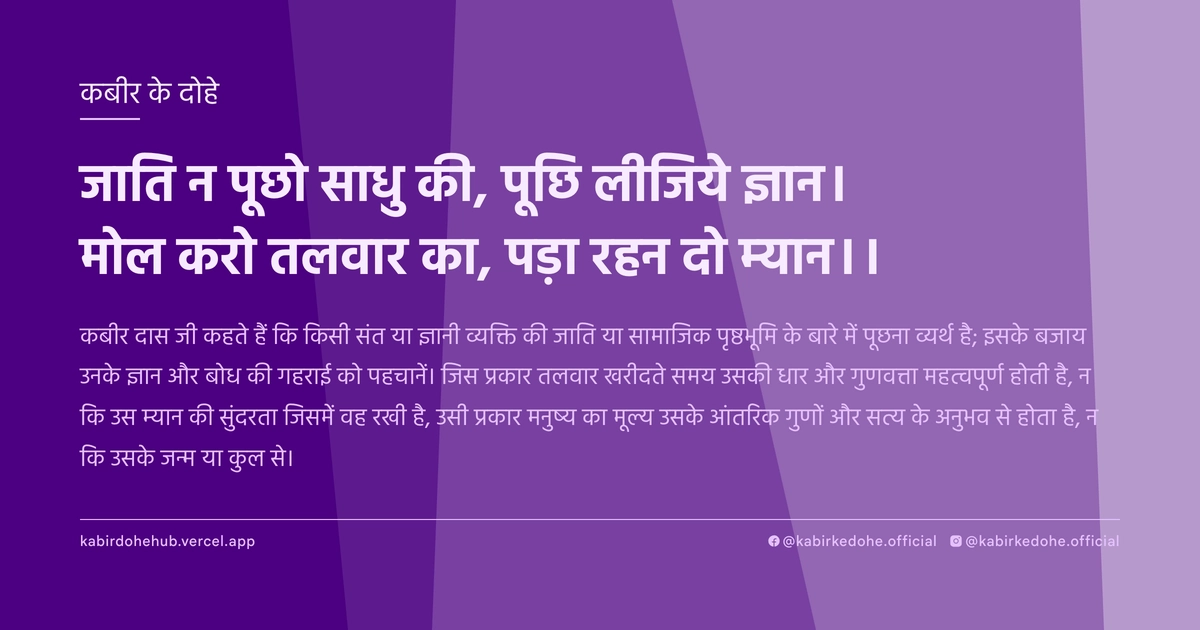
जाति न पूछो साधु की, पूछि लीजिये ज्ञान।
मोल करो तलवार का, पड़ा रहन दो म्यान।।
Jaati na poocho sadhu ki, poochi leejiye gyaan. Mol karo talwar ka, pada rahan do myaan.
इस पृष्ठ पर इस कबीर दोहे का अर्थ (meaning), हिंदी व्याख्या और अंग्रेज़ी अनुवाद, दार्शनिक विश्लेषण और व्यावहारिक जीवन सीख दी गई है। यह दोहा जाति विरोध (Anti-casteism) विषय से जुड़ा है — Kabir doha meaning and explanation in Hindi and English.
अर्थ (Meaning):
कबीर दास जी कहते हैं कि किसी संत या ज्ञानी व्यक्ति की जाति या सामाजिक पृष्ठभूमि के बारे में पूछना व्यर्थ है; इसके बजाय उनके ज्ञान और बोध की गहराई को पहचानें। जिस प्रकार तलवार खरीदते समय उसकी धार और गुणवत्ता महत्वपूर्ण होती है, न कि उस म्यान की सुंदरता जिसमें वह रखी है, उसी प्रकार मनुष्य का मूल्य उसके आंतरिक गुणों और सत्य के अनुभव से होता है, न कि उसके जन्म या कुल से।
Kabir asserts that inquiring about the caste or social lineage of a realized soul is a futile exercise; instead, one should seek the depth of their wisdom. Just as the value of a sword lies in its edge and strength rather than the ornate scabbard that holds it, the true worth of a human being is determined by their inner realization and spiritual insight, not by the circumstances of their birth or social standing.
व्याख्या (Interpretation):
यह दोहा बाहरी आवरण और आंतरिक सत्य के बीच के द्वंद्व को दर्शाता है। यहाँ 'म्यान' सामाजिक पहचान, जाति और अहंकार का प्रतीक है, जबकि 'तलवार' शुद्ध चेतना और आत्म-ज्ञान का प्रतिनिधित्व करती है। कबीर निरगुण भक्ति के माध्यम से यह समझाते हैं कि परमात्मा किसी विशेष कुल या जाति की बपौती नहीं है, बल्कि वह उस व्यक्ति में निवास करता है जिसने माया के बंधनों को तोड़ दिया है। यह अद्वैत वेदांत के उस सिद्धांत की पुष्टि करता है जहाँ आत्मा का कोई धर्म या जाति नहीं होती; वह केवल शुद्ध चैतन्य है। जब हम किसी को उसकी जाति से पहचानते हैं, तो हम वास्तव में म्यान को देख रहे होते हैं और उस दिव्य तलवार को अनदेखा कर देते हैं जो अज्ञानता के अंधकार को काटने की क्षमता रखती है। यह विरोधाभास है कि मनुष्य अक्सर बाहरी दिखावे को सत्य मान लेता है और वास्तविक सत्य को उसकी बाहरी अनुपस्थिति के कारण नकार देता है।
This couplet illustrates the conflict between the external veneer and the internal truth. Here, the 'scabbard' symbolizes social identity, caste, and the ego, while the 'sword' represents pure consciousness and self-realization. Through the lens of Nirgun Bhakti, Kabir explains that the Divine is not the monopoly of any specific clan or caste, but resides in whoever has shattered the bonds of Maya. This affirms the Advaita Vedanta principle that the Atman possesses no religion or caste; it is pure consciousness. When we identify someone by their caste, we are merely observing the scabbard and ignoring the divine blade capable of severing the darkness of ignorance. It is a profound paradox of the human condition that we often mistake the external shell for the essence, rejecting the truth simply because its container does not meet our societal expectations.
दार्शनिक विश्लेषण (Philosophical Analysis):
कबीर का यह संदेश उनके युग के कठोर जातिगत भेदभाव और धार्मिक कट्टरता के विरुद्ध एक क्रांतिकारी प्रहार था। उन्होंने देखा कि कैसे ब्राह्मणवादी व्यवस्था और सूफी मत के कुछ बाहरी स्वरूपों ने सत्य को कर्मकांडों और वंशानुगत श्रेष्ठता के पीछे छिपा दिया था। कबीर का दर्शन 'सहज' मार्ग का है, जहाँ ज्ञान किसी शास्त्र या कुल से नहीं, बल्कि अनुभव से आता है।
दार्शनिक स्तर पर, यह दोहा अद्वैत वेदांत के 'तत्वमसि' (वह तू ही है) के करीब है। यदि ब्रह्म सर्वव्यापी है, तो वह एक चर्मकार, जुलाहे या राजा में समान रूप से विद्यमान है। जाति पूछना वास्तव में द्वैत (duality) को बढ़ावा देना है, जो यह मानता है कि कुछ आत्माएं जन्म से ही श्रेष्ठ हैं। कबीर इस द्वैत को मिटाकर अद्वैत की स्थापना करते हैं।
सूफीवाद के प्रभाव में, कबीर 'इश्क' और 'इरफान' (ज्ञान) को सर्वोच्च मानते हैं। उनके लिए वह व्यक्ति 'साधु' है जिसने अपने 'नफ्स' (अहंकार) को मार दिया है। जब अहंकार मिट जाता है, तो सामाजिक पहचान अर्थहीन हो जाती है। यह मनोवैज्ञानिक रूपांतरण की प्रक्रिया है जहाँ व्यक्ति 'मैं' (सामाजिक पहचान) से ऊपर उठकर 'वह' (सार्वभौमिक सत्य) में विलीन हो जाता है।
कबीर ritualism (कर्मकांड) का खंडन करते हुए यह स्पष्ट करते हैं कि मोक्ष या ज्ञान किसी विशेष समूह का विशेषाधिकार नहीं है। वे तर्क देते हैं कि यदि कोई व्यक्ति निम्न जाति का होकर भी आत्म-साक्षात्कार कर चुका है, तो वह उस उच्च जाति के व्यक्ति से कहीं अधिक पूजनीय है जो केवल शास्त्रों का रटंत ज्ञान रखता है लेकिन भीतर से रिक्त है।
अंततः, यह विश्लेषण हमें सिखाता है कि सत्य का कोई पता या पता (address) नहीं होता। वह केवल अनुभव योग्य है। कबीर हमें चेतावनी देते हैं कि यदि हम बाहरी लक्षणों (म्यान) पर ध्यान केंद्रित करते रहेंगे, तो हम उस वास्तविक शक्ति (तलवार) को कभी प्राप्त नहीं कर पाएंगे जो हमें जन्म-मरण के चक्र से मुक्त कर सकती है।
Kabir's message was a revolutionary strike against the rigid caste discrimination and religious bigotry of his era. He observed how the Brahmanical structures and certain external forms of Sufism had hidden the truth behind rituals and hereditary superiority. Kabir's philosophy is that of the 'Sahaja' path, where knowledge comes not from scriptures or lineage, but from direct experience.
On a philosophical level, this doha aligns with the Advaita Vedanta concept of 'Tat Tvam Asi' (Thou Art That). If Brahman is omnipresent, then it exists equally in a cobbler, a weaver, or a king. Inquiring about caste is essentially promoting duality, the belief that some souls are inherently superior by birth. Kabir dismantles this duality to establish non-duality.
Influenced by Sufism, Kabir views 'Ishq' (divine love) and 'Irfan' (gnosis) as supreme. For him, a 'Sadhu' is one who has annihilated their 'Nafs' (ego). Once the ego is extinguished, social identity becomes meaningless. This is a process of psychological transformation where the individual transcends the 'I' (social identity) to merge into the 'That' (universal truth).
By rejecting ritualism, Kabir clarifies that liberation or knowledge is not the prerogative of a specific group. He argues that a person from a marginalized caste who has achieved self-realization is far more venerable than a high-caste individual who merely recites scriptures but remains internally void.
Ultimately, this analysis teaches us that Truth has no address or pedigree. It is only experiential. Kabir warns that if we remain preoccupied with external markers (the scabbard), we will never attain the actual power (the sword) capable of liberating us from the cycle of birth and death.
मूल संदेश (Core Message):
- बाहरी पहचान एक भ्रम है, आंतरिक बोध ही एकमात्र सत्य है।
- अहंकार वह पर्दा है जो हमें वास्तविक ज्ञान देखने से रोकता है।
- सत्य किसी विशेष कुल या धर्म की जागीर नहीं होता।
- गुणों की पूजा करें, जन्म की नहीं; यही वास्तविक मानवता है।
- जब 'मैं' मिटता है, तब सार्वभौमिक सत्य का उदय होता है।
- External identity is an illusion; internal realization is the only truth.
- Ego is the veil that prevents us from perceiving authentic wisdom.
- Truth is not the property of any specific lineage or religion.
- Venerate virtues, not birth; this is the essence of true humanity.
- When the 'I' dissolves, the universal truth emerges.
व्यावहारिक उदाहरण (Practical Example):
वाराणसी के एक पुराने मोहल्ले में रामदीन नाम का एक वृद्ध व्यक्ति रहता था, जो जीवन भर दूसरों के घरों में बर्तन मांजने और सफाई का काम करता रहा। समाज की नजरों में वह सबसे निचले पायदान पर था और लोग उसे छूने से भी कतराते थे।
उसी शहर में एक प्रसिद्ध विद्वान पंडित जी रहते थे, जिन्होंने दुनिया भर के ग्रंथों का अध्ययन किया था और जिनके पास शिष्यों की लंबी कतारें थीं। पंडित जी का अहंकार उनके ज्ञान से भी बड़ा था और वे केवल अपने कुल के लोगों को ही श्रेष्ठ मानते थे।
एक बार पंडित जी एक अत्यंत जटिल आध्यात्मिक दुविधा में फंस गए। उन्होंने कई ग्रंथों को खंगाला, लेकिन उन्हें वह शांति और उत्तर नहीं मिला जिसकी उन्हें तलाश थी। उनके अपने शिष्य केवल उनकी प्रशंसा करते थे, समाधान नहीं दे पाते थे।
संयोगवश, एक शाम पंडित जी की मुलाकात रामदीन से हुई, जो एक मंदिर की सीढ़ियों पर चुपचाप बैठा था। रामदीन की आंखों में एक ऐसी स्थिरता और चेहरे पर ऐसा तेज था जो पंडित जी ने बड़े-बड़े ऋषियों में भी नहीं देखा था।
पंडित जी ने अहंकारवश पहले रामदीन की जाति पूछी। रामदीन ने विनम्रता से अपनी तुच्छ सामाजिक स्थिति बताई। पंडित जी ने मन ही मन उसे तुच्छ समझा, लेकिन फिर भी अपनी जिज्ञासा के कारण उससे एक प्रश्न पूछा।
रामदीन ने केवल दो वाक्यों में ऐसा उत्तर दिया कि पंडित जी के मन के सारे भ्रम छिन्न-भिन्न हो गए। वह उत्तर किसी शास्त्र से नहीं, बल्कि रामदीन के जीवन भर के मौन और अनुभव से निकला था।
पंडित जी को अचानक कबीर का यह दोहा याद आया। उन्हें अहसास हुआ कि वे अब तक केवल 'म्यान' (जाति और पद) को देख रहे थे, जबकि उनके सामने साक्षात 'तलवार' (शुद्ध ज्ञान) मौजूद थी।
उस क्षण पंडित जी का अहंकार टूट गया। उन्होंने रामदीन के चरणों में सिर झुकाया और स्वीकार किया कि ज्ञान का कोई कुल नहीं होता।
इस घटना के बाद पंडित जी ने अपने जीवन का तरीका बदल दिया। उन्होंने जातिगत भेदभाव को पूरी तरह त्याग दिया और केवल सत्य की खोज को प्राथमिकता दी।
रामदीन की सादगी और ज्ञान ने एक अहंकारी विद्वान को एक सच्चे जिज्ञासु में बदल दिया, यह सिद्ध करते हुए कि सत्य किसी भी रूप में प्रकट हो सकता है।
In an old neighborhood of Varanasi lived an elderly man named Ramdin, who had spent his entire life scrubbing pots and cleaning others' homes. In the eyes of society, he was at the lowest rung, and people hesitated even to touch him.
In the same city lived a renowned scholar, Pandit Ji, who had studied texts from across the world and had long queues of disciples. Pandit Ji's ego was larger than his knowledge, and he believed only those of his own lineage were superior.
Once, Pandit Ji became trapped in a complex spiritual dilemma. He scoured numerous scriptures, but could not find the peace or the answer he sought. His disciples only praised him; they could not provide a solution.
By chance, one evening, Pandit Ji encountered Ramdin, who was sitting silently on the steps of a temple. There was a stillness in Ramdin's eyes and a radiance on his face that Pandit Ji had not seen even in great sages.
Driven by ego, Pandit Ji first asked about Ramdin's caste. Ramdin humbly described his lowly social standing. Pandit Ji internally dismissed him, yet, driven by curiosity, he asked him a question.
Ramdin answered in just two sentences, and all the illusions in Pandit Ji's mind were shattered. That answer did not come from any book, but from Ramdin's lifelong silence and direct experience.
Pandit Ji suddenly remembered this doha of Kabir. He realized that he had been looking only at the 'scabbard' (caste and status), while the 'sword' (pure knowledge) was standing right before him.
At that moment, Pandit Ji's ego collapsed. He bowed at Ramdin's feet and acknowledged that knowledge has no lineage.
Following this incident, Pandit Ji changed his entire way of living. He completely abandoned caste discrimination and prioritized only the search for Truth.
Ramdin's simplicity and wisdom transformed an arrogant scholar into a true seeker, proving that Truth can manifest in any form.
अभ्यास मार्गदर्शन (Practice Guidance):
- प्रतिदिन 15 मिनट मौन ध्यान करें, जहाँ आप अपनी सभी सामाजिक पहचानों (नाम, पद, जाति, धर्म) को मानसिक रूप से त्याग दें और केवल एक 'साक्षी' के रूप में स्वयं को देखें।
- स्व-पूछताछ जर्नल लिखें: 'यदि मेरी वर्तमान सामाजिक स्थिति और पहचान छीन ली जाए, तो मेरे भीतर ऐसा क्या बचेगा जो शाश्वत है?'
- सचेत व्यवहार परिवर्तन: दिन में कम से कम एक बार ऐसे व्यक्ति से बात करें जिसे समाज 'निम्न' मानता है, और उनके जीवन के अनुभवों से कुछ सीखने का प्रयास करें।
- निदान चेकलिस्ट: क्या मैं किसी व्यक्ति की बात को उसकी योग्यता के बजाय उसकी पृष्ठभूमि के आधार पर खारिज कर रहा हूँ? क्या मैं अपनी पहचान को अपनी श्रेष्ठता का आधार मानता हूँ? यदि हाँ, तो आप अभी भी 'म्यान' में उलझे हैं।
- Practice 15 minutes of silent meditation daily, mentally shedding all social identities (name, rank, caste, religion) and observing yourself solely as a 'witness'.
- Maintain a self-inquiry journal: 'If my current social status and identity were stripped away, what would remain within me that is eternal?'
- Conscious behavioral shift: At least once a day, engage with someone whom society deems 'inferior' and genuinely attempt to learn from their life experiences.
- Diagnostic Checklist: Am I dismissing someone's insight based on their background rather than their merit? Do I use my identity as a foundation for superiority? If yes, you are still entangled in the 'scabbard'.
चिंतन प्रश्न (Reflection Questions):
- मेरी वह कौन सी 'सामाजिक म्यान' है जिसे मैं अपनी असली पहचान समझ बैठा हूँ?
- क्या मैं उन लोगों का सम्मान कर पाता हूँ जिनके विचार मुझसे मिलते हैं, लेकिन जिनकी सामाजिक स्थिति मुझसे निम्न है?
- यदि मैं किसी महान संत को एक साधारण मजदूर के रूप में मिलूँ, तो क्या मेरी दृष्टि उन्हें पहचान पाएगी?
- मेरे भीतर का कौन सा पूर्वाग्रह मुझे सत्य को स्वीकार करने से रोकता है, भले ही वह सत्य मेरे अहंकार को चोट पहुँचाए?
- क्या मेरी आध्यात्मिक साधना मुझे दूसरों के प्रति अधिक विनम्र बना रही है या मुझे एक 'आध्यात्मिक श्रेष्ठता' का नया अहंकार दे रही है?
- What is the 'social scabbard' that I have mistaken for my true identity?
- Am I able to respect those whose insights align with mine, but whose social standing is lower than my own?
- If I encountered a great saint in the guise of a common laborer, would my vision be capable of recognizing them?
- Which internal prejudice prevents me from accepting the truth, even when that truth wounds my ego?
- Is my spiritual practice making me more humble toward others, or is it gifting me a new ego of 'spiritual superiority'?