
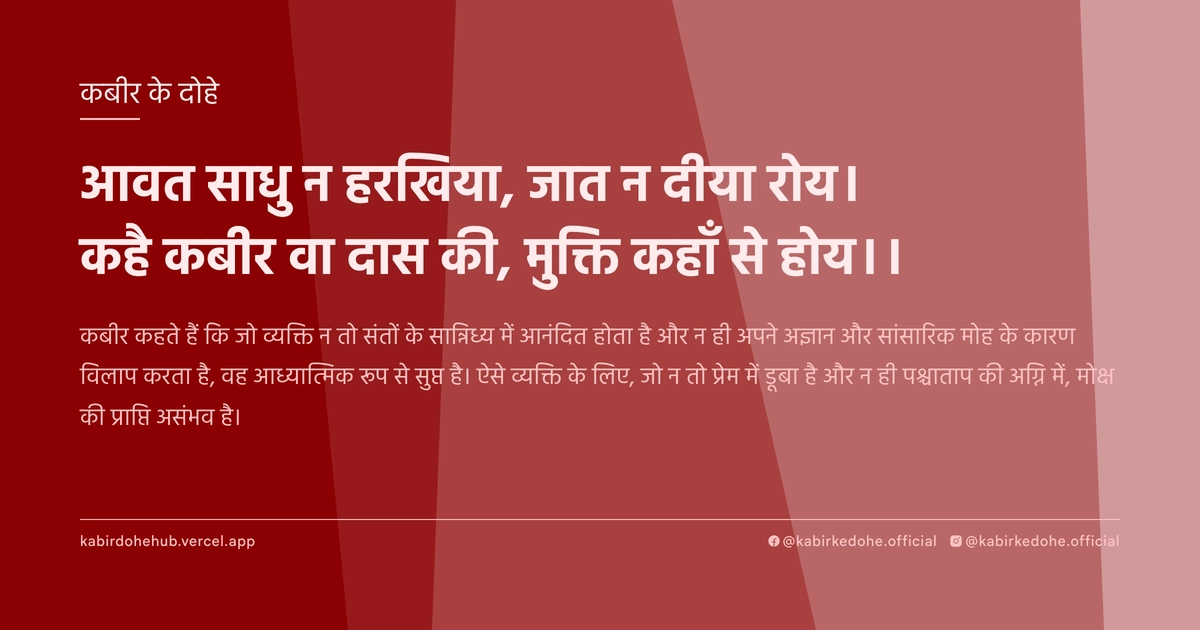
आवत साधु न हरखिया, जात न दीया रोय।
कहै कबीर वा दास की, मुक्ति कहाँ से होय।।
Aavat sadhu na harakhiya, jaat na diya roy. Kahe Kabir va daas ki, mukti kahan se hoye.
इस पृष्ठ पर इस कबीर दोहे का अर्थ (meaning), हिंदी व्याख्या और अंग्रेज़ी अनुवाद, दार्शनिक विश्लेषण और व्यावहारिक जीवन सीख दी गई है। यह दोहा जाति विरोध (Anti-casteism) विषय से जुड़ा है — Kabir doha meaning and explanation in Hindi and English.
अर्थ (Meaning):
कबीर कहते हैं कि जो व्यक्ति न तो संतों के सान्निध्य में आनंदित होता है और न ही अपने अज्ञान और सांसारिक मोह के कारण विलाप करता है, वह आध्यात्मिक रूप से सुप्त है। ऐसे व्यक्ति के लिए, जो न तो प्रेम में डूबा है और न ही पश्चाताप की अग्नि में, मोक्ष की प्राप्ति असंभव है।
Kabir asserts that a soul who neither finds joy in the company of the enlightened nor feels the poignant grief of separation from the Divine remains in a state of spiritual stagnation. For such an individual, devoid of both ecstatic love and the transformative pain of longing, liberation remains an unattainable dream.
व्याख्या (Interpretation):
इस दोहे का शाब्दिक अर्थ है कि जो साधु के प्रति हर्षित नहीं है और न ही रोता है, वह मुक्त नहीं हो सकता। रूपकात्मक रूप से, 'हरखिया' (हर्ष) उस दिव्य प्रेम का प्रतीक है जो आत्मा को परमात्मा से जोड़ता है, और 'रोय' (रोना) उस विरह और पश्चाताप का प्रतीक है जो अहंकार को नष्ट करता है। निर्गुण भक्ति में, ईश्वर बाहरी कर्मकांडों में नहीं, बल्कि आंतरिक भावों में बसता है। यदि हृदय में न तो मिलन की खुशी है और न ही विरह की तड़प, तो इसका अर्थ है कि माया ने चेतना को पूरी तरह ढंक लिया है। यह अद्वैत वेदांत की उस स्थिति को दर्शाता है जहाँ जीव स्वयं को ब्रह्म से अलग मानकर भी उस अलगाव के प्रति उदासीन है। जब तक व्यक्ति अपनी आध्यात्मिक रिक्तता को महसूस नहीं करता, वह उस रिक्तता को भरने का प्रयास नहीं करेगा।
Literally, the verse suggests that one who neither rejoices with the saint nor weeps in longing cannot be liberated. Metaphorically, 'harkhiya' (joy) symbolizes the divine ecstasy that binds the soul to the Infinite, while 'roy' (weeping) represents the transformative grief and repentance that incinerate the ego. In Nirgun Bhakti, the Divine is not found in rituals but in the intensity of internal emotion. If the heart lacks both the joy of union and the agony of separation, it indicates that Maya (illusion) has completely anesthetized the consciousness. This reflects the Advaita Vedanta paradox where the soul, forgetting its non-duality with Brahman, becomes indifferent to its own captivity. Until an individual feels the piercing void of spiritual absence, they will never seek the fullness of the Absolute.
दार्शनिक विश्लेषण (Philosophical Analysis):
कबीर का यह दोहा उनके युग के धार्मिक पाखंड और यांत्रिक आध्यात्मिकता पर एक तीखा प्रहार है। उस समय समाज में 'साधु' का अर्थ केवल गेरुआ वस्त्र पहनने वाले से था, लेकिन कबीर के लिए साधु वह है जिसने अपनी इंद्रियों को जीत लिया है। यहाँ वे ritualism (कर्मकांड) के बजाय emotional authenticity (भावनात्मक सत्यता) पर जोर देते हैं। वे बताते हैं कि मोक्ष केवल शास्त्रों को पढ़ने या माला जपने से नहीं मिलता, बल्कि हृदय के रूपांतरण से मिलता है।
यह विचार सूफी मत के 'इश्क-ए-हकीकी' (ईश्वरीय प्रेम) से गहराई से जुड़ा है, जहाँ प्रेमी की तड़प ही उसकी सबसे बड़ी उपलब्धि मानी जाती है। कबीर का तर्क है कि जो व्यक्ति तटस्थ है, वह वास्तव में मृत है। आध्यात्मिक प्रगति के लिए 'भाव' अनिवार्य है। यदि आप न तो प्रेम में नाच सकते हैं और न ही विरह में रो सकते हैं, तो आपकी आत्मा पत्थर हो चुकी है।
अद्वैत वेदांत के परिप्रेक्ष्य में, यह अज्ञान (Avidya) की चरम अवस्था है। जब मनुष्य यह भूल जाता है कि वह वास्तव में ब्रह्म है, और फिर भी उस सत्य की खोज के प्रति उदासीन रहता है, तो वह जन्म-मृत्यु के चक्र में फँसा रहता है। कबीर यहाँ अहंकार के उस सूक्ष्म रूप की बात कर रहे हैं जो 'उदासीनता' के रूप में प्रकट होता है।
कबीर जाति और वर्ग के भेदों को नकारते हुए कहते हैं कि मुक्ति का मार्ग केवल 'भाव' से खुलता है। एक उच्च कुल का व्यक्ति यदि भावशून्य है, तो वह निम्न कुल के उस व्यक्ति से पीछे है जो ईश्वर के विरह में रो रहा है। यह सामाजिक पदानुक्रम को आध्यात्मिक योग्यता द्वारा चुनौती देने का प्रयास है।
अंततः, यह विश्लेषण हमें यह सिखाता है कि मनोवैज्ञानिक रूपांतरण के बिना कोई भी धार्मिक अभ्यास व्यर्थ है। अहंकार का विसर्जन केवल तब होता है जब व्यक्ति या तो प्रेम की पराकाष्ठा में विलीन हो जाए या अपनी तुच्छता को महसूस कर विलाप करे। तटस्थता वास्तव में माया का सबसे घातक जाल है।
This couplet is a piercing critique of the mechanical spirituality and religious hypocrisy prevalent during Kabir's era. In his time, a 'Sadhu' was often reduced to someone wearing saffron robes, but for Kabir, a true saint is one who has conquered the senses. He emphasizes emotional authenticity over ritualism, arguing that liberation is not achieved through the rote recitation of scriptures or the mindless counting of beads, but through a profound transformation of the heart.
This philosophy aligns closely with the Sufi concept of 'Ishq-e-Haqiqi' (Divine Love), where the longing and agony of the lover are seen as the highest spiritual achievements. Kabir posits that the indifferent person is spiritually dead. For spiritual evolution to occur, 'Bhava' (emotional intensity) is indispensable. If one cannot dance in ecstasy or weep in longing, the soul has become calcified.
From the lens of Advaita Vedanta, this state represents the zenith of Avidya (ignorance). When a human forgets their identity as Brahman and remains indifferent to that truth, they remain shackled to the cycle of Samsara. Kabir addresses a subtle form of ego that manifests as indifference—a spiritual numbness that prevents the seeker from recognizing their own captivity.
By dismissing the importance of caste and lineage, Kabir asserts that the gateway to liberation opens only through the key of genuine emotion. A person of high birth who is emotionally void is inferior to a marginalized individual who weeps in the longing for the Divine. This is a direct challenge to social hierarchies, replacing them with a hierarchy of spiritual realization.
Ultimately, this analysis reveals that without psychological transformation, all religious practices are futile. The annihilation of the ego occurs only when one either dissolves into the peak of love or collapses under the weight of their own insignificance. Indifference is the most lethal trap of Maya, creating a false sense of peace that is actually spiritual stagnation.
मूल संदेश (Core Message):
- तटस्थता आध्यात्मिक मृत्यु है, भाव ही जीवन है।
- अहंकार को मिटाने के लिए प्रेम या विरह की अग्नि आवश्यक है।
- बिना हृदय के रूपांतरण के, सभी धार्मिक क्रियाएं व्यर्थ हैं।
- मोक्ष केवल ज्ञान से नहीं, बल्कि गहन संवेदना से आता है।
- अपनी आंतरिक रिक्तता को पहचानना ही जागृति की पहली सीढ़ी है।
- Indifference is spiritual death; emotion is the essence of life.
- The fire of love or longing is essential to incinerate the ego.
- All religious acts are futile without the transformation of the heart.
- Liberation comes not from intellect alone, but from profound sensibility.
- Recognizing your internal void is the first step toward awakening.
व्यावहारिक उदाहरण (Practical Example):
वाराणसी के एक पुराने घाट पर माधव नाम का एक वृद्ध नाविक रहता था। माधव का जीवन बहुत सीधा था—नाव चलाना, पैसे कमाना और शाम को मंदिर की आरती सुनना। वह खुद को एक 'धार्मिक' व्यक्ति मानता था क्योंकि वह कभी झूठ नहीं बोलता था और नियमित रूप से पूजा करता था। लेकिन उसके भीतर न तो किसी के लिए गहरा प्रेम था और न ही जीवन की नश्वरता को लेकर कोई दुख। वह एक ऐसी मशीन बन गया था जो बस जीवन जी रहा था, बिना किसी आंतरिक हलचल के।
एक दिन, उसकी नाव पर एक फकीर सवार हुआ। वह फकीर कभी अचानक जोर-जोर से हंसने लगता और कभी अचानक फूट-फूट कर रोने लगता। माधव को यह व्यवहार पागलपन लगा। उसने फकीर से पूछा, 'आप कभी इतने खुश होते हैं और कभी इतने दुखी, ऐसा क्यों?'
फकीर ने मुस्कुराकर कहा, 'नाविक, मैं उस सागर का प्रेमी हूँ जिसे तुमने कभी देखा ही नहीं। जब मैं उसकी याद में रोता हूँ, तो मेरा अहंकार धुल जाता है। और जब मैं उसकी झलक पाता हूँ, तो मेरा अस्तित्व मिट जाता है। तुम न तो रोते हो, न हंसते हो; तुम तो बस एक पत्थर की तरह तैर रहे हो।'
माधव को पहले तो यह बात समझ नहीं आई, लेकिन उस रात उसे नींद नहीं आई। उसने महसूस किया कि उसने दशकों से वास्तव में कुछ 'महसूस' ही नहीं किया था। वह केवल कर्तव्यों का पालन कर रहा था, लेकिन उसका हृदय शून्य था। उसने महसूस किया कि उसकी 'शांति' वास्तव में एक गहरी सुस्ती और उदासीनता थी।
अगले कुछ दिनों तक माधव ने फकीर के साथ समय बिताया। उसने सीखा कि कैसे अपने भीतर के दबे हुए दुखों को बाहर निकालना है। उसने अपने मृत बेटे की याद में, जिसे उसने वर्षों पहले खो दिया था और जिसे उसने 'समय की बात' कहकर दबा दिया था, पहली बार खुलकर रोया। उस विलाप ने उसके हृदय के कपाट खोल दिए।
जैसे ही दुख का वह बांध टूटा, उसके भीतर एक अजीब सी करुणा जाग उठी। अब जब वह नाव चलाता, तो वह केवल सवारी नहीं ढोता, बल्कि उनके दुखों को महसूस करने लगा। वह दूसरों की खुशी में वास्तव में खुश होने लगा।
एक दिन, उसने देखा कि एक गरीब महिला नाव का किराया नहीं दे सकती थी। पहले का माधव शायद उसे विनम्रता से मना कर देता, लेकिन अब उसके भीतर एक ऐसी तड़प थी कि उसने न केवल उसे मुफ्त में पार उतारा, बल्कि अपनी कमाई का एक हिस्सा उसे दे दिया।
माधव अब भी वही नाव चला रहा था, लेकिन वह अब 'पत्थर' नहीं था। वह अब 'साधु' के भाव में था—वह प्रेम में हंसना और विरह में रोना सीख चुका था। उसकी मुक्ति किसी मोक्ष-धाम जाने में नहीं, बल्कि उसके हृदय के जीवित होने में थी।
On an ancient ghat in Varanasi lived an elderly boatman named Madhav. Madhav's life was linear—rowing the boat, earning a living, and listening to the evening Aarti. He considered himself a 'religious' man because he never lied and performed his rituals diligently. However, within him, there was neither deep love for anyone nor any grief over the transience of life. He had become a machine, existing without any internal turbulence.
One day, a wandering dervish boarded his boat. This dervish would suddenly burst into loud laughter and then, moments later, weep uncontrollably. To Madhav, this behavior seemed like madness. He asked the dervish, 'Why are you sometimes so joyful and sometimes so heartbroken?'
The dervish smiled and replied, 'Boatman, I am a lover of the Ocean that you have never even seen. When I weep in His memory, my ego is washed away. And when I catch a glimpse of Him, my very existence dissolves. You neither weep nor laugh; you are merely floating like a stone.'
At first, Madhav didn't understand, but that night, sleep evaded him. He realized that he hadn't truly 'felt' anything in decades. He had been fulfilling duties, but his heart was a void. He recognized that his perceived 'peace' was actually a profound spiritual numbness and indifference.
Over the next few days, Madhav spent time with the dervish. He learned how to release the suppressed emotions within him. For the first time in years, he wept openly for his deceased son, a loss he had buried under the excuse of 'fate.' That lamentation broke the dams of his heart.
As the floodgates of grief opened, a strange compassion awakened within him. Now, when he rowed his boat, he didn't just transport passengers; he felt their sorrows. He began to genuinely rejoice in the happiness of others.
One day, he encountered a poor woman who could not afford the fare. The old Madhav might have politely refused her, but now, driven by a new internal urgency, he not only crossed her for free but gave her a portion of his earnings.
Madhav was still rowing the same boat, but he was no longer a 'stone.' He had entered the state of the 'Sadhu'—learning to laugh in love and weep in longing. His liberation was not found in traveling to a holy city, but in the awakening of his own heart.
अभ्यास मार्गदर्शन (Practice Guidance):
- दैनिक भावना-अवलोकन: दिन के अंत में 15 मिनट बैठें और विश्लेषण करें कि क्या आप केवल 'ऑटो-पायलट' पर थे या आपने वास्तव में किसी के प्रति करुणा या ईश्वर के प्रति विरह महसूस किया।
- भावनात्मक विरेचन (Catharsis): सप्ताह में एक बार एकांत में बैठें और अपने भीतर दबे हुए उन दुखों या पश्चाताप को बाहर आने दें जिन्हें आपने 'मजबूती' के नाम पर दबा रखा है।
- करुणा अभ्यास: किसी ऐसे व्यक्ति की मदद करें जिससे आपका कोई स्वार्थ न हो, और उस प्रक्रिया में उनके दुख को अपने भीतर महसूस करने का प्रयास करें।
- निदान चेकलिस्ट: यदि आप निम्नलिखित लक्षणों को महसूस करते हैं, तो आप 'आध्यात्मिक सुस्ती' में हैं: 1. दूसरों के दुख पर तटस्थता, 2. प्रार्थना में केवल शब्दों का दोहराव बिना किसी भाव के, 3. जीवन में किसी भी चीज़ के प्रति तीव्र प्रेम या तीव्र विरह का अभाव।
- Daily Emotional Observation: Spend 15 minutes at the end of the day analyzing whether you were merely on 'auto-pilot' or if you truly felt compassion for another or a longing for the Divine.
- Emotional Catharsis: Once a week, sit in solitude and allow the suppressed grief or repentance—which you have hidden in the name of 'strength'—to surface and flow.
- Compassion Practice: Help someone from whom you have nothing to gain, and in that process, consciously attempt to feel their suffering within your own heart.
- Diagnostic Checklist: You are in a state of 'spiritual numbness' if: 1. You feel indifference toward the suffering of others, 2. Your prayers are mere repetitions of words without emotion, 3. You lack both intense love and intense longing in your life.
चिंतन प्रश्न (Reflection Questions):
- क्या मेरी बाहरी शांति वास्तव में आंतरिक शांति है, या यह केवल भावनाओं के प्रति एक रक्षात्मक उदासीनता है?
- मैं किन भावनाओं को 'कमजोरी' मानकर दबाता हूँ, और क्या वही भावनाएं मेरे मोक्ष का द्वार हो सकती हैं?
- क्या मेरा धर्म केवल एक सामाजिक पहचान है, या यह मेरे भीतर एक जीवित, तड़पता हुआ अनुभव है?
- यदि आज मेरा सब कुछ छिन जाए, तो क्या मेरे भीतर वह विरह होगा जो मुझे ईश्वर की ओर ले जाए, या मैं केवल रिक्त महसूस करूँगा?
- मैं अपनी डिजिटल पहचान में कितना 'सजग' दिखता हूँ, और वास्तव में अपने एकांत में मैं कितना शून्य हूँ?
- Is my external calmness true inner peace, or is it merely a defensive indifference toward my emotions?
- Which emotions do I suppress by labeling them as 'weakness,' and could those very emotions be the gateway to my liberation?
- Is my religion merely a social identity, or is it a living, breathing, and aching experience within me?
- If everything were stripped away from me today, would I feel the longing that leads to the Divine, or would I only feel a hollow void?
- How 'aware' do I appear in my digital persona, and how empty am I in the reality of my solitude?