
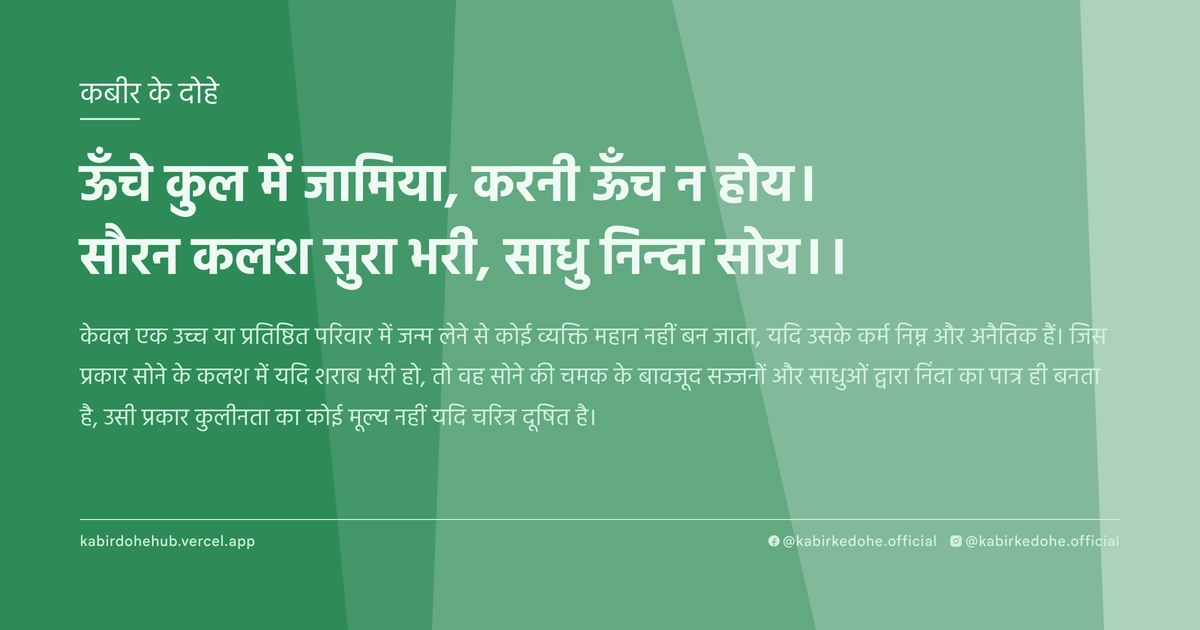
ऊँचे कुल में जामिया, करनी ऊँच न होय।
सौरन कलश सुरा भरी, साधु निन्दा सोय।।
Unche kul me jaamiya, karni unch na hoye. Sauran kalash sura bhari, sadhu ninda soy.
इस पृष्ठ पर इस कबीर दोहे का अर्थ (meaning), हिंदी व्याख्या और अंग्रेज़ी अनुवाद, दार्शनिक विश्लेषण और व्यावहारिक जीवन सीख दी गई है। यह दोहा जाति विरोध (Anti-casteism) विषय से जुड़ा है — Kabir doha meaning and explanation in Hindi and English.
अर्थ (Meaning):
केवल एक उच्च या प्रतिष्ठित परिवार में जन्म लेने से कोई व्यक्ति महान नहीं बन जाता, यदि उसके कर्म निम्न और अनैतिक हैं। जिस प्रकार सोने के कलश में यदि शराब भरी हो, तो वह सोने की चमक के बावजूद सज्जनों और साधुओं द्वारा निंदा का पात्र ही बनता है, उसी प्रकार कुलीनता का कोई मूल्य नहीं यदि चरित्र दूषित है।
Being born into a high or prestigious lineage does not make a person noble if their actions remain lowly and unethical. Just as a golden pot filled with liquor is despised by the wise and the holy despite its outward brilliance, a noble birth holds no value if the character is corrupted.
व्याख्या (Interpretation):
यह दोहा बाहरी दिखावे और आंतरिक वास्तविकता के बीच के गहरे विरोधाभास को उजागर करता है। 'ऊँचा कुल' यहाँ सामाजिक प्रतिष्ठा, जाति और वंशानुगत अहंकार का प्रतीक है, जबकि 'करनी' व्यक्ति के वास्तविक नैतिक आचरण को दर्शाती है। सोने का कलश 'माया' और सांसारिक चमक का प्रतिनिधित्व करता है, जो अक्सर सत्य को ढक लेता है। कबीर यहाँ यह समझा रहे हैं कि आत्मा की पवित्रता किसी बाहरी लेबल से नहीं, बल्कि निस्वार्थ कर्मों और सत्य के प्रति समर्पण से आती है। यह निर्गुण भक्ति का सार है, जहाँ ईश्वर किसी विशेष जाति या कुल में नहीं, बल्कि शुद्ध हृदय में निवास करता है। जब अहंकार कुल के अभिमान में डूबा होता है, तो वह व्यक्ति ब्रह्म के साथ अपने अद्वैत संबंध को भूल जाता है और केवल एक भौतिक खोल बनकर रह जाता है।
This couplet exposes the profound paradox between external appearance and internal reality. The 'high lineage' symbolizes social prestige, caste, and ancestral ego, while 'karni' (actions) represents the individual's actual ethical conduct. The golden pot serves as a metaphor for 'Maya' and worldly brilliance, which often masks the truth. Kabir asserts that the purity of the soul is not derived from an external label but from selfless actions and devotion to Truth. This is the essence of Nirgun Bhakti, where the Divine resides not in a specific caste or lineage, but in a pure heart. When the ego is drowned in the pride of ancestry, the individual forgets their non-dual relationship with Brahman and remains merely a physical shell.
दार्शनिक विश्लेषण (Philosophical Analysis):
कबीर का यह प्रहार उनके युग के गहरे सामाजिक स्तरीकरण और जातिगत भेदभाव के विरुद्ध एक क्रांतिकारी घोषणा है। उन्होंने देखा कि कैसे लोग अपनी योग्यता के बजाय अपने जन्म के आधार पर श्रेष्ठता का दावा करते थे। यह विचार सीधे तौर पर अद्वैत वेदांत के उस सिद्धांत से जुड़ता है जहाँ आत्मा (Atman) का कोई कुल, जाति या लिंग नहीं होता; वह शुद्ध चेतना है। कबीर यहाँ 'कुल' के अहंकार को 'अविद्या' (अज्ञान) के रूप में देखते हैं, जो मनुष्य को उसकी वास्तविक प्रकृति से दूर रखता है।
सूफीवाद के प्रभाव में, कबीर 'इश्क-ए-हकीकी' (ईश्वरीय प्रेम) पर जोर देते हैं, जो किसी भी सामाजिक बाधा को पार कर जाता है। उनके लिए, ईश्वर की प्राप्ति के लिए आवश्यक शर्त 'इन्सानियत' और 'सच्चाई' है, न कि किसी विशेष धार्मिक या सामाजिक पहचान का होना। वे कर्मकांडीय पवित्रता के बजाय नैतिक पवित्रता को प्राथमिकता देते हैं।
यह विश्लेषण यह भी स्पष्ट करता है कि कबीर केवल सामाजिक सुधारक नहीं थे, बल्कि एक मनोवैज्ञानिक चिकित्सक भी थे। वे जानते थे कि 'कुल का अभिमान' एक मानसिक बंधन है जो व्यक्ति को आत्म-निरीक्षण से रोकता है। जब तक व्यक्ति यह मानता है कि वह जन्म से ही श्रेष्ठ है, वह अपनी कमियों को सुधारने का प्रयास नहीं करता।
अद्वैत के परिप्रेक्ष्य में, यह दोहा 'अहंकार' के विसर्जन की बात करता है। जब व्यक्ति यह समझ जाता है कि वह केवल एक शरीर या नाम नहीं है, बल्कि संपूर्ण ब्रह्मांड का हिस्सा है, तब 'ऊँचे कुल' की अवधारणा अर्थहीन हो जाती है। यहाँ 'सोने का कलश' उस झूठी पहचान का प्रतीक है जिसे हम दुनिया के सामने पेश करते हैं।
अंततः, कबीर यह संदेश देते हैं कि वास्तविक कुलीनता 'करुणा' और 'सत्य' में निहित है। वे उस समय के ब्राह्मणवादी और मुल्लावादी वर्चस्व को चुनौती देते हुए यह स्थापित करते हैं कि भक्ति का मार्ग सबके लिए खुला है, बशर्ते उनका आचरण शुद्ध हो। यह एक ऐसी क्रांति थी जिसने धर्म को मंदिर-मस्जिद से निकालकर मनुष्य के व्यवहार में स्थापित किया।
Kabir's strike is a revolutionary declaration against the deep social stratification and caste discrimination of his era. He observed how individuals claimed superiority based on birth rather than merit. This thought aligns directly with the Advaita Vedanta principle that the Soul (Atman) has no lineage, caste, or gender; it is pure consciousness. Kabir views the pride of 'lineage' as 'Avidya' (ignorance), which keeps a human distant from their true nature.
Influenced by Sufism, Kabir emphasizes 'Ishq-e-Haqiqi' (Divine Love), which transcends all social barriers. For him, the essential prerequisite for realizing God is 'humanity' and 'truth,' not a specific religious or social identity. He prioritizes ethical purity over ritualistic purity.
This analysis further clarifies that Kabir was not merely a social reformer but a psychological healer. He understood that the 'pride of lineage' is a mental shackle that prevents self-introspection. As long as a person believes they are superior by birth, they make no effort to rectify their flaws.
From an Advaitic perspective, this doha speaks of the dissolution of the 'Ego.' When an individual realizes they are not just a body or a name, but a part of the universal consciousness, the concept of 'high lineage' becomes meaningless. Here, the 'golden pot' symbolizes the false identity we present to the world.
Ultimately, Kabir conveys that true nobility resides in 'compassion' and 'truth.' By challenging the Brahmanical and Mullah-led hegemony of his time, he established that the path of devotion is open to all, provided their conduct is pure. This was a revolution that moved religion from temples and mosques into human behavior.
मूल संदेश (Core Message):
- जन्म केवल एक संयोग है, चरित्र एक चुनाव है।
- बाहरी चमक आंतरिक गंदगी को नहीं छुपा सकती।
- अहंकार सत्य के मार्ग में सबसे बड़ी बाधा है।
- सेवा ही वास्तविक कुलीनता की एकमात्र कसौटी है।
- आत्मा का कोई कुल नहीं होता, वह केवल शुद्ध है।
- Birth is a mere coincidence; character is a conscious choice.
- External brilliance cannot mask internal corruption.
- Ego is the greatest obstacle on the path to Truth.
- Service is the only true litmus test of nobility.
- The soul has no lineage; it is purely universal.
व्यावहारिक उदाहरण (Practical Example):
एक समय की बात है, वाराणसी के एक पुराने मोहल्ले में रामदीन नाम का एक व्यक्ति रहता था। रामदीन का परिवार शहर के सबसे प्रतिष्ठित और धनी ब्राह्मण परिवारों में से एक था। वह हमेशा रेशमी वस्त्र पहनता और अपनी उच्च जाति का गुणगान करता था। वह अन्य लोगों को तुच्छ समझता और उन्हें नीची नजर से देखता था।
रामदीन का एक पड़ोसी था, माधव, जो एक साधारण मोची था। माधव गरीब था, लेकिन उसका हृदय करुणा से भरा था। वह चुपचाप बीमारों की सेवा करता और अपनी कमाई का एक हिस्सा भूखों को खिला देता था। रामदीन अक्सर माधव का मजाक उड़ाता और कहता, 'तुम एक नीची जाति के हो, तुम्हारी बातों का कोई मूल्य नहीं।'
एक बार शहर में भीषण अकाल पड़ा। लोग दाने-दाने को तरसने लगे। रामदीन के पास अनाज के भंडार थे, लेकिन उसने डर के मारे कि उसका धन कम हो जाएगा, किसी की मदद नहीं की। वह अपने ऊँचे कुल की मर्यादा का ढोंग करता रहा, लेकिन उसके भीतर केवल लालच और अहंकार था।
दूसरी ओर, माधव ने अपनी छोटी सी झोपड़ी के बाहर एक बर्तन में पानी और जो कुछ भी उसके पास था, वह सबके लिए रख दिया। उसने दिन-रात मेहनत की ताकि वह दूसरों के लिए भोजन जुटा सके। उसने अपनी फटी पुरानी धोती की परवाह नहीं की, बस दूसरों के दुख को अपना समझा।
एक दिन, शहर के एक महान संत वहाँ आए। रामदीन ने बड़े गर्व से उन्हें अपने घर आमंत्रित किया, यह सोचकर कि संत उसकी कुलीनता की प्रशंसा करेंगे। उसने सोने की थालियों में भोजन परोसा और अपनी वंशावली का लंबा विवरण सुनाया।
संत ने रामदीन की बातों को सुना, लेकिन उनकी आँखों में कोई चमक नहीं थी। उन्होंने देखा कि रामदीन के शब्दों में अहंकार था और उसके कार्यों में स्वार्थ। संत ने भोजन नहीं किया और चुपचाप वहाँ से उठकर बाहर चले गए।
बाहर जाते समय, संत माधव की झोपड़ी के पास रुके, जहाँ माधव एक बीमार वृद्ध की सेवा कर रहा था। संत ने माधव के कंधे पर हाथ रखा और कहा, 'यही वह असली कुलीनता है जिसकी खोज में दुनिया भटक रही है।'
रामदीन ने यह देखा और उसे गहरा धक्का लगा। उसने सोचा कि वह सोने के कलश जैसा है—बाहर से चमकता हुआ, लेकिन अंदर से शराब की तरह कड़वा और दूषित। उसे समझ आया कि उसकी जाति उसे महान नहीं बनाती, बल्कि उसके कर्म बनाते हैं।
उस दिन रामदीन का अहंकार टूट गया। उसने अपनी तिजोरी खोली और शहर के गरीबों के लिए अन्न वितरित करना शुरू किया। उसने माधव से क्षमा मांगी और पहली बार महसूस किया कि वास्तविक शांति दूसरों की सेवा में है, न कि कुल के अभिमान में।
रामदीन अब केवल एक 'ऊँचे कुल' का व्यक्ति नहीं रहा, बल्कि एक 'ऊँचे चरित्र' का इंसान बन गया। उसकी पहचान अब उसके पूर्वजों से नहीं, बल्कि उसके द्वारा किए गए निस्वार्थ कार्यों से होने लगी।
Once, in an old neighborhood of Varanasi, lived a man named Ramdeen. Ramdeen's family was one of the most prestigious and wealthy Brahmin families in the city. He always wore silk clothes and boasted about his high caste, looking down upon others as inferior.
Ramdeen had a neighbor, Madhav, who was a simple cobbler. Madhav was poor, but his heart was full of compassion. He quietly served the sick and spent a portion of his meager earnings feeding the hungry. Ramdeen often mocked Madhav, saying, 'You are of a low caste; your words have no value.'
One year, a severe famine struck the city. People longed for a single grain of food. Ramdeen had stores of grain, but fearing his wealth would diminish, he helped no one. He continued to pretend to maintain the dignity of his high lineage, but inside, there was only greed and ego.
On the other hand, Madhav placed a pot of water and whatever little he had outside his small hut for everyone. He worked day and night to gather food for others, ignoring his torn old dhoti, seeing the pain of others as his own.
One day, a great saint visited the city. Ramdeen proudly invited him to his home, thinking the saint would praise his nobility. He served food on golden plates and recited a long history of his ancestry.
The saint listened to Ramdeen, but there was no spark of admiration in his eyes. He saw that Ramdeen's words were filled with ego and his actions with selfishness. The saint refused the food and quietly left the house.
Upon leaving, the saint stopped by Madhav's hut, where Madhav was tending to a sick elderly man. The saint placed a hand on Madhav's shoulder and said, 'This is the true nobility that the world is searching for.'
Ramdeen witnessed this and was deeply shaken. He realized he was like the golden pot—shining on the outside, but bitter and corrupted like liquor on the inside. He understood that his caste did not make him great, but his actions did.
That day, Ramdeen's ego shattered. He opened his coffers and began distributing grain to the poor. He asked Madhav for forgiveness and felt for the first time that true peace lies in serving others, not in ancestral pride.
Ramdeen was no longer just a man of 'high lineage,' but a man of 'high character.' His identity was no longer defined by his ancestors, but by the selfless acts he performed.
अभ्यास मार्गदर्शन (Practice Guidance):
- प्रतिदिन 15 मिनट मौन बैठें और विचार करें कि आपकी कौन सी पहचान (नाम, पद, जाति) आपके अहंकार को बढ़ा रही है।
- एक 'अहंकार डायरी' लिखें: उन क्षणों को दर्ज करें जब आपने किसी को खुद से छोटा महसूस कराया और विश्लेषण करें कि उस समय आपके मन में क्या चल रहा था।
- सप्ताह में एक बार किसी ऐसे व्यक्ति की निस्वार्थ सेवा करें जिसे समाज 'निम्न' मानता है, बिना यह जताए कि आप उनकी मदद कर रहे हैं।
- निदान चेकलिस्ट: क्या मैं किसी की प्रशंसा उसकी योग्यता के बजाय उसके परिचय के आधार पर करता हूँ? क्या मुझे अपनी उपलब्धियों का श्रेय केवल अपने परिवार या भाग्य को मिलता है? यदि हाँ, तो आप अभी भी 'सोने के कलश' के भ्रम में हैं।
- Sit in silence for 15 minutes daily and contemplate which identity (name, position, caste) is inflating your ego.
- Maintain an 'Ego Diary': Record moments when you made someone feel inferior and analyze the mental state that triggered that behavior.
- Once a week, perform a selfless act of service for someone whom society deems 'low,' without letting them know you are helping them.
- Diagnostic Checklist: Do I praise someone based on their introduction rather than their merit? Do I attribute my achievements solely to my family or luck? If yes, you are still under the illusion of the 'golden pot.'
चिंतन प्रश्न (Reflection Questions):
- यदि आपसे आपकी सारी सामाजिक पहचान (डिग्री, पद, कुल) छीन ली जाए, तो आपके पास क्या बचेगा?
- क्या आप उन लोगों का सम्मान करते हैं जिनके पास देने के लिए कोई सामाजिक प्रतिष्ठा नहीं है?
- आपके जीवन का वह कौन सा 'सोने का कलश' है जो दुनिया को तो आकर्षित करता है, लेकिन अंदर से खाली या दूषित है?
- क्या आपकी नैतिकता केवल तब काम करती है जब कोई देख रहा होता है, या वह आपके एकांत का स्वभाव है?
- आप अपनी श्रेष्ठता को सिद्ध करने के लिए किन अदृश्य दीवारों का सहारा लेते हैं?
- If all your social identities (degrees, titles, lineage) were stripped away, what would remain of you?
- Do you genuinely respect those who have no social prestige to offer?
- What is the 'golden pot' in your life that attracts the world but is empty or corrupted inside?
- Does your morality function only when observed, or is it the nature of your solitude?
- Which invisible walls do you lean on to prove your superiority?