
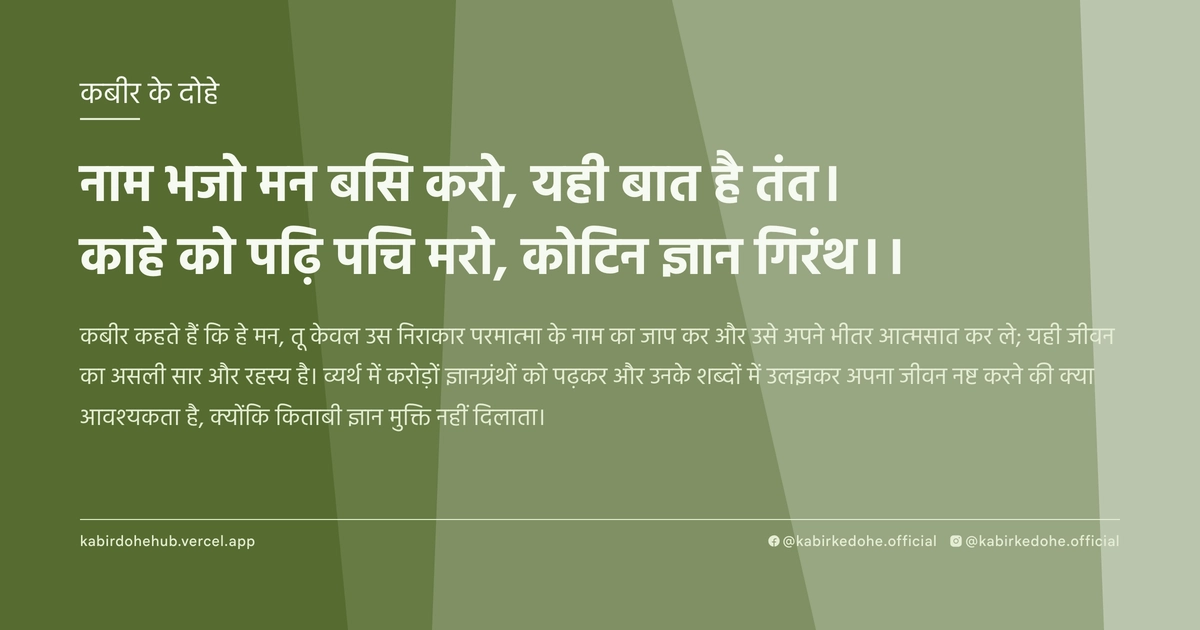
नाम भजो मन बसि करो, यही बात है तंत।
काहे को पढ़ि पचि मरो, कोटिन ज्ञान गिरंथ।।
Naam bhajo man basi karo, yahi baat hai tant. Kahe ko padhi pachi maro, kotin gyan giranth.
इस पृष्ठ पर इस कबीर दोहे का अर्थ (meaning), हिंदी व्याख्या और अंग्रेज़ी अनुवाद, दार्शनिक विश्लेषण और व्यावहारिक जीवन सीख दी गई है। यह दोहा भक्ति (Bhakti) विषय से जुड़ा है — Kabir doha meaning and explanation in Hindi and English.
अर्थ (Meaning):
कबीर कहते हैं कि हे मन, तू केवल उस निराकार परमात्मा के नाम का जाप कर और उसे अपने भीतर आत्मसात कर ले; यही जीवन का असली सार और रहस्य है। व्यर्थ में करोड़ों ज्ञानग्रंथों को पढ़कर और उनके शब्दों में उलझकर अपना जीवन नष्ट करने की क्या आवश्यकता है, क्योंकि किताबी ज्ञान मुक्ति नहीं दिलाता।
Kabir urges the mind to dwell deeply upon the Divine Name and internalize its essence, asserting that this singular devotion is the ultimate secret of existence. He questions the futility of exhausting one's life in the study of millions of scholarly texts, for intellectual accumulation of knowledge does not lead to spiritual liberation.
व्याख्या (Interpretation):
इस दोहे का शाब्दिक अर्थ है कि ग्रंथों के अध्ययन से अधिक महत्वपूर्ण नाम-स्मरण है। रूपकात्मक रूप से, 'नाम' यहाँ किसी शब्द का जाप नहीं, बल्कि उस 'अनाहत नाद' या सार्वभौमिक चेतना का अनुभव है जो हर जीव में व्याप्त है। कबीर 'तंत' (तंतु/धागा) शब्द का प्रयोग कर यह समझाते हैं कि भक्ति वह सूक्ष्म सूत्र है जो आत्मा को परमात्मा से जोड़ता है। यहाँ 'पढ़ि पचि मरो' का अर्थ बौद्धिक अहंकार से है, जहाँ व्यक्ति ज्ञान को सूचना समझ लेता है। यह निर्गुण भक्ति का सार है: जब तक मन शांत होकर अंतर्मुखी नहीं होता, तब तक बाहरी शास्त्र केवल माया के पर्दे की तरह कार्य करते हैं। यह अद्वैत वेदांत की उस स्थिति की ओर संकेत है जहाँ ज्ञाता, ज्ञान और ज्ञेय का भेद मिट जाता है और केवल शुद्ध अस्तित्व शेष रहता है।
Literally, the verse prioritizes the remembrance of the Divine over the study of scriptures. Metaphorically, 'Naam' does not refer to a linguistic label but to the 'Anahata Nada' or the primordial vibration of universal consciousness pervading all existence. By using the word 'tant' (thread), Kabir suggests that devotion is the subtle filament connecting the Atman to Brahman. The phrase 'padh pachi maro' critiques intellectual vanity, where knowledge is mistaken for mere information. This embodies the essence of Nirgun Bhakti: unless the mind becomes still and introverted, external scriptures act only as veils of Maya. It points toward the Advaita Vedanta state where the distinction between the knower, the known, and the knowledge dissolves, leaving only pure existence.
दार्शनिक विश्लेषण (Philosophical Analysis):
कबीर का यह दोहा उस युग की प्रतिक्रिया है जहाँ धर्म केवल पंडितों और मौलवियों के नियंत्रण में था और शास्त्र केवल एक विशिष्ट वर्ग की जागीर थे। कबीर ने ritualism (कर्मकांड) और शास्त्र-प्रदर्शन का कड़ा विरोध किया क्योंकि उनका मानना था कि सत्य अनुभव का विषय है, न कि तर्क का। वे कहते हैं कि ज्ञान जब तक हृदय में नहीं उतरता, वह केवल एक बोझ है।
दार्शनिक स्तर पर, यह सूफी मत के 'इश्क' और अद्वैत वेदांत के 'आत्म-साक्षात्कार' का संगम है। सूफीवाद में 'जिक्र' (स्मरण) के माध्यम से अहंकार को मिटाया जाता है, ठीक उसी तरह जैसे कबीर 'नाम' के माध्यम से मन को वश में करने की बात करते हैं। यहाँ 'नाम' का अर्थ है उस निराकार तत्व की उपस्थिति को महसूस करना जो धर्म, जाति और भाषा से परे है।
कबीर का प्रहार उन लोगों पर है जो ज्ञान को अपनी पहचान (Identity) बना लेते हैं। जब कोई कहता है 'मैं विद्वान हूँ', तो वह वास्तव में अपनी सूक्ष्म अहंकार (Sookshma Ahankar) को पुष्ट कर रहा होता है। यह अहंकार ही वह सबसे बड़ी बाधा है जो साधक को सत्य से दूर रखती है। उनके लिए मुक्ति का मार्ग 'विवेक' से नहीं, बल्कि 'विराग' और 'समर्पण' से होकर जाता है।
यह विश्लेषण हमें बताता है कि कबीर केवल ग्रंथों के विरोधी नहीं थे, बल्कि वे उस 'बौद्धिक पाखंड' के विरोधी थे जो मनुष्य को उसके वास्तविक स्वरूप से दूर ले जाता है। वे चाहते थे कि मनुष्य बाहरी दुनिया की खोज छोड़कर अपने भीतर के 'अंतर्यामी' को खोजे। यह मनोवैज्ञानिक रूपांतरण की प्रक्रिया है जहाँ बाहरी शोर (शास्त्रों का विवाद) शांत होता है और आंतरिक मौन (परमात्मा का नाम) गूँजता है।
अंततः, यह दोहा यह स्थापित करता है कि सत्य सरल है। जटिलता केवल मनुष्य के अहंकार द्वारा निर्मित की गई है। जब मन 'नाम' में लीन होता है, तो वह द्वैत (Duality) से ऊपर उठकर अद्वैत (Non-duality) में प्रवेश करता है, जहाँ न कोई पढ़ने वाला रहता है और न ही कोई ग्रंथ, केवल एक अनंत प्रकाश शेष रहता है।
This couplet is a reaction to an era where religion was monopolized by priests and clerics, and scriptures were the exclusive domain of a privileged few. Kabir vehemently opposed ritualism and the performative display of scholarship, believing that Truth is a matter of direct experience, not logical deduction. He posits that knowledge, until it descends into the heart, remains a mere intellectual burden.
On a philosophical level, this is a confluence of the Sufi concept of 'Ishq' (divine love) and the Advaita Vedanta principle of 'Atman-Sākshātkāra' (self-realization). In Sufism, the ego is annihilated through 'Zikr' (remembrance), mirroring Kabir's insistence on harnessing the mind through the 'Naam'. Here, 'Naam' signifies the awareness of the Formless Element that transcends religion, caste, and language.
Kabir targets those who transform knowledge into a social identity. When one claims, 'I am a scholar,' they are merely reinforcing their 'Sookshma Ahankar' (subtle ego). This ego is the primary obstacle preventing the seeker from realizing the Truth. For Kabir, the path to liberation leads not through 'Viveka' (intellectual discrimination) alone, but through 'Viraga' (detachment) and total surrender.
This analysis reveals that Kabir was not against books per se, but against the 'intellectual hypocrisy' that alienates a human from their true nature. He urged humanity to cease the external search and discover the 'Antaryami' (the Inner Witness). This is a process of psychological transformation where external noise—the disputes over scriptures—is silenced, allowing the internal silence of the Divine to resonate.
Ultimately, the doha establishes that Truth is simple. Complexity is a construct of human ego. When the mind is absorbed in the 'Naam', it transcends duality and enters the state of Advaita, where neither the reader nor the text remains—only an infinite, singular Light persists.
मूल संदेश (Core Message):
- बौद्धिक संचय आध्यात्मिक प्रगति की गारंटी नहीं है।
- सत्य शब्दों में नहीं, बल्कि अनुभव के मौन में बसता है।
- अहंकार का त्याग ही वास्तविक ज्ञान की पहली सीढ़ी है।
- बाहरी शोर को शांत कर आंतरिक नाद को सुनना ही साधना है।
- प्रेम और करुणा ही शास्त्रों का अंतिम और वास्तविक निष्कर्ष हैं।
- Intellectual accumulation is not a guarantee of spiritual progress.
- Truth resides not in words, but in the silence of experience.
- The surrender of ego is the first step toward genuine knowledge.
- Sadhana is the act of silencing external noise to hear the inner vibration.
- Love and compassion are the ultimate and real conclusions of all scriptures.
व्यावहारिक उदाहरण (Practical Example):
वाराणसी के एक पुराने घाट पर रहने वाले एक वृद्ध विधवा, जानकी, का जीवन केवल धार्मिक अनुष्ठानों और कठिन नियमों के इर्द-गिर्द घूमता था। वह प्रतिदिन घंटों शास्त्रों का पाठ करती और इस बात पर गर्व करती कि उसने वेदों के कई अंश याद कर लिए हैं। उसका व्यवहार दूसरों के प्रति कठोर था क्योंकि वह स्वयं को आध्यात्मिक रूप से श्रेष्ठ मानती थी।
एक दिन उसकी मुलाकात एक साधारण से बुनकर से हुई, जो चुपचाप अपनी धुन में बैठा था। जानकी ने उससे पूछा, 'क्या तुम जानते हो कि मुक्ति के लिए किन ग्रंथों का अध्ययन अनिवार्य है?' बुनकर ने मुस्कुराकर कहा, 'माता, मैं पढ़ना नहीं जानता, लेकिन मैं अपने हर धागे के साथ उस एक नाम को बुनता हूँ जो मेरे भीतर धड़कता है।'
जानकी को यह बात बहुत तुच्छ लगी। उसने उसे उपदेश देना शुरू किया कि बिना शास्त्र ज्ञान के भक्ति अधूरी है। लेकिन उसने देखा कि उस बुनकर के चेहरे पर एक ऐसी शांति और करुणा थी, जो जानकी ने अपने जीवन के तमाम अध्ययन के बाद भी प्राप्त नहीं की थी।
कुछ दिनों बाद, जानकी के जीवन में एक बड़ा संकट आया। उसके परिवार के साथ एक गहरा विवाद हुआ और वह मानसिक रूप से टूट गई। उसके सारे शास्त्र और मंत्र उसे शांति देने में विफल रहे क्योंकि उसका मन अभी भी 'मैं' और 'मेरे' के अहंकार में उलझा था।
वह उसी बुनकर के पास गई और रोने लगी। बुनकर ने उसे कोई मंत्र नहीं दिया, बस कहा, 'अपनी आँखें बंद करो और उस शोर को सुनो जो तुम्हारे भीतर है, फिर उस शोर के पीछे छिपे मौन को पकड़ो। वही असली नाम है।'
जानकी ने पहली बार अपनी किताबों को किनारे रखा और केवल अपने भीतर के उस मौन को महसूस करने की कोशिश की। उसने महसूस किया कि वह अब तक केवल शब्दों को पढ़ रही थी, सत्य को नहीं।
धीरे-धीरे, उसका अहंकार पिघलने लगा। उसने महसूस किया कि उसकी श्रेष्ठता का बोध वास्तव में उसकी सबसे बड़ी बेड़ी थी। उसने शास्त्रों का अध्ययन पूरी तरह नहीं छोड़ा, लेकिन अब वे उसके लिए अहंकार का साधन नहीं, बल्कि केवल संकेत मात्र थे।
उसने अपने व्यवहार में बदलाव लाया। वह अब घाट पर आने वाले हर व्यक्ति को, चाहे वह किसी भी जाति का हो, प्रेम और सम्मान देने लगी। उसने पाया कि जब उसने 'नाम' (आंतरिक शांति) को अपना लिया, तो बाहरी दुनिया के प्रति उसकी नफरत अपने आप खत्म हो गई।
जानकी का रूपांतरण यह दर्शाता है कि ज्ञान जब तक हृदय को कोमल नहीं बनाता, वह व्यर्थ है। वह अब एक 'विद्वान' नहीं, बल्कि एक 'साधक' बन चुकी थी।
अंत में, उसने समझा कि करोड़ों ग्रंथों का सार केवल एक ही है: स्वयं को मिटाकर उस अनंत में मिल जाना, जिसे कबीर ने 'नाम' कहा है।
Janaki, an elderly widow living on an ancient ghat in Varanasi, spent her life revolving around rigid religious rituals and strict rules. She spent hours daily reciting scriptures and took great pride in having memorized portions of the Vedas. Her demeanor toward others was harsh, as she viewed herself as spiritually superior.
One day, she encountered a simple weaver who sat quietly, absorbed in his work. Janaki asked him, 'Do you know which scriptures are mandatory to study for liberation?' The weaver smiled and replied, 'Mother, I cannot read, but with every thread I weave, I weave that one Name that beats within me.'
Janaki found this answer trivial. She began lecturing him, claiming that devotion without scriptural knowledge is incomplete. However, she noticed a profound peace and compassion on the weaver's face—a serenity she had never achieved despite a lifetime of study.
Shortly after, a crisis struck Janaki's life. A deep conflict arose within her family, leaving her emotionally shattered. All her scriptures and mantras failed to bring her peace because her mind was still entangled in the ego of 'I' and 'Mine'.
She returned to the weaver, weeping. The weaver gave her no mantra; he simply said, 'Close your eyes and listen to the noise within you, then catch the silence hidden behind that noise. That is the true Name.'
For the first time, Janaki set aside her books and attempted to feel that inner silence. She realized she had been reading words, not the Truth.
Gradually, her ego began to melt. She recognized that her sense of superiority was, in fact, her heaviest shackle. She did not abandon her studies entirely, but they were no longer tools for pride; they became mere signposts.
Her behavior transformed. She began treating everyone who came to the ghat, regardless of caste, with love and respect. She discovered that once she embraced the 'Naam' (inner peace), her hatred toward the external world vanished spontaneously.
Janaki's transformation illustrates that knowledge is futile unless it softens the heart. She was no longer a 'scholar' but a 'seeker'.
Ultimately, she understood that the essence of millions of texts is singular: to annihilate the self and merge into the Infinite, which Kabir called the 'Naam'.
अभ्यास मार्गदर्शन (Practice Guidance):
- दैनिक अभ्यास: प्रतिदिन 20 मिनट मौन बैठें। किसी शब्द का जाप करने के बजाय, अपने भीतर उठने वाले विचारों को केवल देखें और अंत में उस शून्य (Silence) को महसूस करें जहाँ से विचार जन्म लेते हैं।
- आत्म-पूछताछ जर्नल: प्रतिदिन लिखें—'आज मैंने कितनी बार अपने ज्ञान या पद का उपयोग दूसरों को छोटा महसूस कराने के लिए किया?' इस सूक्ष्म अहंकार को पहचानें और उसे विसर्जित करें।
- व्यवहार परिवर्तन: किसी ऐसे व्यक्ति की सेवा करें जिससे आप वैचारिक रूप से असहमत हों। यह अभ्यास आपके बौद्धिक अहंकार को तोड़कर आपको करुणा से जोड़ेगा।
- डायग्नोस्टिक चेकलिस्ट: यदि आप किसी चर्चा में अपनी बात सही साबित करने के लिए व्याकुल हैं, तो आप 'ग्रंथों' (अहंकार) में फंसे हैं। यदि आप दूसरे की बात सुनकर भी शांत और प्रेमपूर्ण हैं, तो आप 'नाम' (सत्य) में हैं।
- Daily Practice: Sit in silence for 20 minutes daily. Instead of chanting a word, simply observe the thoughts arising within you and eventually feel the void (Silence) from which thoughts are born.
- Self-Inquiry Journal: Write daily—'How many times today did I use my knowledge or position to make others feel inferior?' Identify this subtle ego and consciously dissolve it.
- Behavioral Change: Serve someone with whom you are ideologically opposed. This practice breaks intellectual vanity and connects you to universal compassion.
- Diagnostic Checklist: If you feel an urgent need to prove yourself right in a debate, you are trapped in 'texts' (ego). If you remain calm and loving even while listening to opposing views, you are residing in the 'Naam' (Truth).
चिंतन प्रश्न (Reflection Questions):
- क्या मेरा ज्ञान मुझे विनम्र बना रहा है, या यह मेरे भीतर एक अदृश्य दीवार खड़ी कर रहा है?
- यदि मुझसे मेरी सारी डिग्रियां और किताबी ज्ञान छीन लिया जाए, तो मेरी आत्मा की वास्तविक पहचान क्या होगी?
- मैं अक्सर दूसरों को सुधारने की कोशिश करता हूँ, लेकिन क्या मैं अपने भीतर के अंधेरे को देखने का साहस रखता हूँ?
- क्या मेरी भक्ति केवल एक सामाजिक प्रदर्शन है या यह वास्तव में मेरे अहंकार को मिटा रही है?
- मैं किन 'मानसिक ग्रंथों' (पूर्वाग्रहों) के बोझ तले दबा हूँ जो मुझे वर्तमान क्षण को जीने से रोक रहे हैं?
- Is my knowledge making me humble, or is it building an invisible wall between me and others?
- If all my degrees and bookish knowledge were stripped away, what would be the true identity of my soul?
- I often try to correct others, but do I have the courage to look at the darkness within myself?
- Is my devotion merely a social performance, or is it actually annihilating my ego?
- Which 'mental scriptures' (prejudices) am I burdened with that prevent me from living in the present moment?