
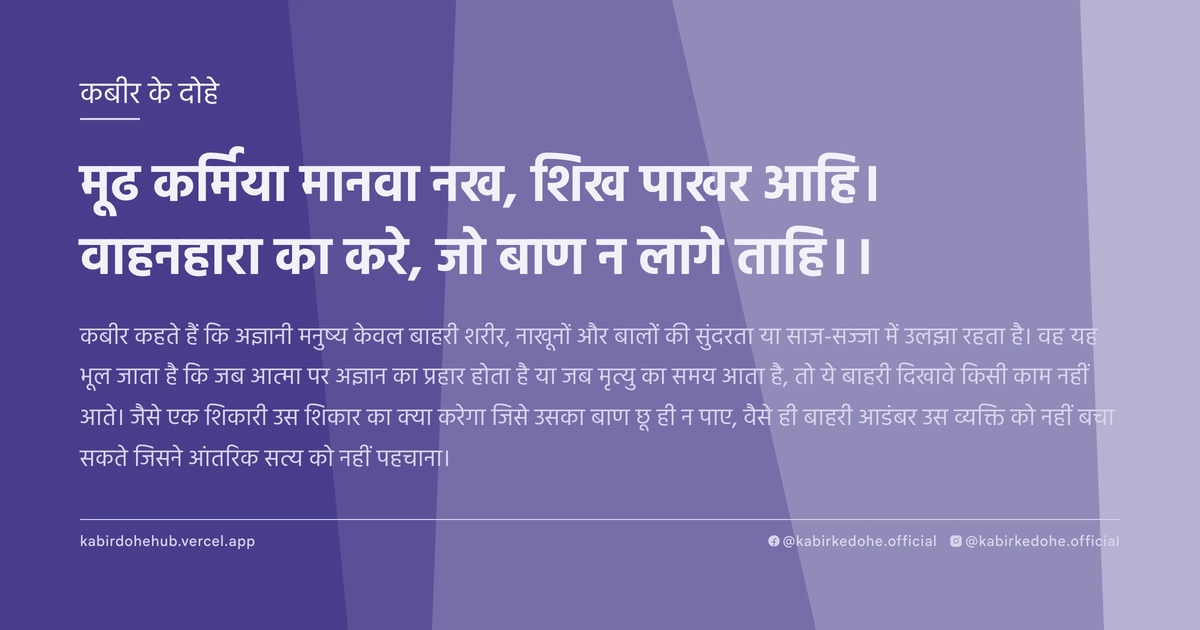
मूढ कर्मिया मानवा नख, शिख पाखर आहि।
वाहनहारा का करे, जो बाण न लागे ताहि।।
Moodh karmiya manava nakh, shikh pakhar aahi. Vahanhara ka kare, jo baan na lage tahi.
इस पृष्ठ पर इस कबीर दोहे का अर्थ (meaning), हिंदी व्याख्या और अंग्रेज़ी अनुवाद, दार्शनिक विश्लेषण और व्यावहारिक जीवन सीख दी गई है। यह दोहा कर्म (Karma) विषय से जुड़ा है — Kabir doha meaning and explanation in Hindi and English.
अर्थ (Meaning):
कबीर कहते हैं कि अज्ञानी मनुष्य केवल बाहरी शरीर, नाखूनों और बालों की सुंदरता या साज-सज्जा में उलझा रहता है। वह यह भूल जाता है कि जब आत्मा पर अज्ञान का प्रहार होता है या जब मृत्यु का समय आता है, तो ये बाहरी दिखावे किसी काम नहीं आते। जैसे एक शिकारी उस शिकार का क्या करेगा जिसे उसका बाण छू ही न पाए, वैसे ही बाहरी आडंबर उस व्यक्ति को नहीं बचा सकते जिसने आंतरिक सत्य को नहीं पहचाना।
Kabir asserts that the ignorant human spends their entire existence obsessing over the superficial—the nails, the hair, and the outward adornments of the physical shell. He warns that these external trappings are useless when the soul is confronted by the ultimate truth or the inevitability of death. Just as a hunter is powerless against a target that cannot be pierced by his arrow, external rituals and physical beauty cannot protect or save one who has failed to realize the internal spiritual essence.
व्याख्या (Interpretation):
यहाँ 'नख' और 'शिख' शरीर की बाहरी सीमाओं के प्रतीक हैं, जो माया के मोह को दर्शाते हैं। कबीर का संकेत है कि मनुष्य अपनी पहचान को त्वचा और बालों तक सीमित कर लेता है, जो कि अद्वैत वेदांत के अनुसार एक महान भ्रम है। 'वाहनहारा' या शिकारी यहाँ काल (समय) या कर्मों के फल का प्रतीक है। यदि मनुष्य ने अपनी चेतना को 'निर्गुण' ब्रह्म में विलीन कर लिया है, तो वह उस 'बाण' (दुःख और मोह) से मुक्त हो जाता है जो साधारण मनुष्यों को विदीर्ण करता है। यह दोहा शरीर की नश्वरता और आत्मा की अमरता के बीच के विरोधाभास को उजागर करता है। अंततः, यह संदेश देता है कि वास्तविक सुरक्षा बाहरी साज-सज्जा में नहीं, बल्कि आत्म-ज्ञान के कवच में है।
In this verse, 'nakh' (nails) and 'shikh' (hair/crest) symbolize the outermost boundaries of the physical body, representing the grip of Maya (illusion). Kabir suggests that humans mistakenly identify themselves with the biological shell, a fundamental error according to Advaita Vedanta. The 'hunter' serves as a metaphor for Kaal (Time) or the inevitable consequences of Karma. If a seeker has realized the non-duality of Atman and Brahman, they become like a target that the arrow of worldly suffering cannot pierce. The central paradox lies in the human tendency to decorate the prison (the body) while neglecting the prisoner (the soul). The 'arrow' represents the piercing pain of separation from the Divine, which only the awakened soul can transcend through Nirgun Bhakti.
दार्शनिक विश्लेषण (Philosophical Analysis):
कबीर का यह दोहा उनके युग के उस सामाजिक परिवेश पर प्रहार है जहाँ धर्म केवल बाहरी प्रतीकों, जैसे कि तिलक, जटाएँ या विशेष वस्त्रों तक सीमित हो गया था। वे स्पष्ट रूप से कर्मकांडवाद का विरोध करते हैं और यह तर्क देते हैं कि ईश्वर किसी विशेष शारीरिक बनावट या बाहरी दिखावे में नहीं बसता। यह दृष्टिकोण सूफी मत के 'इन्सान-ए-कामिल' (पूर्ण मनुष्य) की अवधारणा से मिलता-जुलता है, जहाँ आंतरिक शुद्धि बाहरी दिखावे से कहीं अधिक महत्वपूर्ण है।
दार्शनिक स्तर पर, यह अद्वैत वेदांत के उस सिद्धांत को पुष्ट करता है जहाँ 'अहं ब्रह्मास्मि' की अनुभूति ही एकमात्र सत्य है। जब तक व्यक्ति स्वयं को शरीर मानता है, वह भय और मृत्यु के अधीन रहता है। जैसे ही वह इस देह-बोध से ऊपर उठता है, वह उस शिकारी (मृत्यु/माया) के लिए अदृश्य हो जाता है। कबीर यहाँ 'अहंकार' के विसर्जन की बात कर रहे हैं, क्योंकि अहंकार ही वह बिंदु है जहाँ माया का बाण सबसे गहरा प्रहार करता है।
कबीर की दृष्टि में, शरीर एक वस्त्र मात्र है। वे इस बात पर जोर देते हैं कि जो लोग केवल शरीर की देखभाल करते हैं, वे वास्तव में एक ऐसे घर को सजा रहे हैं जिसे उन्हें जल्द ही छोड़ना है। यह मनोवैज्ञानिक रूपांतरण की मांग करता है—बाहरी सौंदर्य से आंतरिक सत्य की ओर संक्रमण।
यहाँ 'बाण न लगना' एक उच्च आध्यात्मिक अवस्था को दर्शाता है। यह वह स्थिति है जहाँ साधक 'साक्षी भाव' (Witness Consciousness) में स्थित हो जाता है। जब व्यक्ति स्वयं को कर्ता के बजाय दृष्टा मान लेता है, तो संसार के सुख-दुःख उसे वैसे ही प्रभावित नहीं करते जैसे पानी की बूंद कमल के पत्ते को नहीं करती।
अंततः, यह दोहा हमें याद दिलाता है कि आध्यात्मिक यात्रा 'होने' (Being) की यात्रा है, न कि 'दिखने' (Appearing) की। यह ritualism के खोखलेपन को उजागर कर उस सहज मार्ग की ओर ले जाता है जहाँ केवल प्रेम और ज्ञान ही एकमात्र currency हैं।
This doha is a scathing critique of the socio-religious climate of Kabir's era, where spirituality had devolved into the maintenance of external symbols—be it the sacred thread, the matted hair of ascetics, or specific ritualistic attire. Kabir rejects this ritualism, arguing that the Divine does not reside in the geometry of the body or the aesthetics of clothing, but in the purity of the consciousness.
Philosophically, this aligns with the Advaita Vedanta principle of 'Neti Neti' (not this, not that). By dismissing the importance of 'nakh' and 'shikh', Kabir is guiding the seeker to peel away the layers of false identity. He suggests that as long as one identifies with the physical form, one remains a target for the arrows of duality, fear, and eventual decay. The annihilation of the ego is the only way to become 'invulnerable' to the hunter of time.
There is a strong resonance here with Sufi mysticism, specifically the concept of 'Fana' (the annihilation of the self). The 'hunter' represents the worldly attachments and the egoic drive that keeps the soul imprisoned. To be 'unpierceable' by the arrow is to reach a state of spiritual equilibrium where the distinction between the seeker and the Sought vanishes.
Psychologically, Kabir addresses the human tendency toward vanity. We spend our lives polishing the mirror (the body) without ever looking at the reflection (the soul). He argues that this is a fundamental misallocation of energy. The transformation he proposes is a shift from 'Appearance' to 'Essence', urging the practitioner to move from the periphery of existence to its center.
Ultimately, the 'arrow' is the pain of separation. For the one who has realized the non-dual nature of reality, there is no 'other' to be separated from. Thus, the arrow finds no target. This is the pinnacle of Nirgun Bhakti—finding the formless within the form, thereby rendering the form irrelevant to the soul's liberation.
मूल संदेश (Core Message):
- बाहरी सौंदर्य एक क्षणभंगुर भ्रम है जो आत्मा को सत्य से दूर ले जाता है।
- अहंकार का विसर्जन ही एकमात्र ऐसा कवच है जिसे काल का बाण नहीं भेद सकता।
- शरीर एक साधन है, साध्य नहीं; इसे सजाने के बजाय इसे शुद्ध करें।
- निर्गुण भक्ति का अर्थ है रूप और रंग से परे उस निराकार तत्व से जुड़ना।
- सच्ची सुरक्षा आत्म-ज्ञान में है, न कि सामाजिक प्रतिष्ठा या शारीरिक आकर्षण में।
- External beauty is a fleeting illusion that distracts the soul from its ultimate truth.
- The dissolution of the ego is the only shield that the arrow of Time cannot pierce.
- The body is a vehicle, not the destination; purify it rather than decorating it.
- Nirgun Bhakti means connecting with the formless essence beyond shape and color.
- True security lies in self-realization, not in social prestige or physical allure.
व्यावहारिक उदाहरण (Practical Example):
एक समय की बात है, वाराणसी के घाटों पर रहने वाला एक वृद्ध बुनकर था, जिसका नाम माधव था। माधव अपनी कला में निपुण था, लेकिन वह हमेशा इस बात से परेशान रहता था कि उसके पास महंगे रेशमी वस्त्र नहीं हैं और उसका शरीर अब ढलने लगा है। वह घंटों दर्पण के सामने बिताता, अपनी झुर्रियों को देखता और सोचता कि काश वह फिर से युवा और प्रभावशाली दिखता, ताकि समाज उसे सम्मान दे।
माधव का पूरा जीवन इस बात की चिंता में बीता कि लोग उसे कैसे देखते हैं। उसने अपनी सारी जमा पूँजी अच्छे वस्त्रों और बाहरी साज-सज्जा पर खर्च कर दी, यह सोचकर कि बाहरी चमक उसके आंतरिक खालीपन को भर देगी। वह अक्सर अन्य बुनकरों से ईर्ष्या करता था जिनके पास अधिक सुंदर वस्त्र थे।
एक दिन, माधव की मुलाकात एक फकीर से हुई जो फटे हुए कपड़ों में था, लेकिन उसकी आँखों में एक ऐसी शांति थी जिसे माधव ने कभी महसूस नहीं किया था। फकीर ने माधव की बेचैनी को देखा और मुस्कुराते हुए कहा, "माधव, तुम उस घर की दीवारों को रंगने में इतने व्यस्त हो कि तुमने यह देखना ही छोड़ दिया कि घर के अंदर कोई रहता ही नहीं है।"
माधव को यह बात समझ नहीं आई। फकीर ने आगे कहा, "तुम अपने नाखूनों और बालों की चिंता करते हो, लेकिन जब काल का बाण आएगा, तो क्या ये रेशमी कपड़े तुम्हें बचा पाएंगे? शिकारी उस शिकार को नहीं मार सकता जो खुद को मिटा चुका है।"
यह शब्द माधव के हृदय में गहरे उतरे। उसे अहसास हुआ कि उसने अपना पूरा जीवन एक भ्रम (माया) को सजाने में बिता दिया। उसने महसूस किया कि उसकी असली पहचान वह बुनकर नहीं थी जो सुंदर कपड़े बनाता है, बल्कि वह चेतना थी जो इन सबके पीछे छिपी है।
अगले कुछ महीनों में, माधव ने बाहरी दिखावे की अपनी आदत को पूरी तरह त्याग दिया। उसने अब केवल अपनी आत्मा की शुद्धि पर ध्यान देना शुरू किया। उसने अपनी कला को ईश्वर की सेवा माना और बिना किसी अहंकार के दूसरों की मदद करने लगा।
जब उसके शरीर की बीमारियाँ बढ़ीं और उसकी त्वचा और अधिक झुर्रीदार हो गई, तो वह डरा नहीं। बल्कि, वह और अधिक शांत हो गया। उसने पाया कि अब उसे किसी की प्रशंसा की आवश्यकता नहीं थी क्योंकि वह अपने भीतर ही पूर्ण था।
अंत में, जब मृत्यु का समय आया, तो माधव के चेहरे पर एक अलौकिक मुस्कान थी। वह अब उस शिकारी से नहीं डर रहा था, क्योंकि उसने अपने अहंकार का त्याग कर दिया था। वह अब वह लक्ष्य नहीं था जिसे बाण भेद सके; वह स्वयं वह बाण बन गया था जो अनंत में विलीन हो गया।
Once, in the bustling ghats of Varanasi, lived an elderly weaver named Madhav. Madhav was a master of his craft, yet he was plagued by a deep insecurity regarding his aging body. He spent hours staring into a mirror, lamenting his wrinkles and wishing for the lost vigor of youth, believing that physical attractiveness was the only key to social respect.
Madhav's entire existence was consumed by the gaze of others. He spent his meager savings on fine silks and external adornments, hoping that a polished exterior would mask the void within his soul. He lived in a constant state of comparison, envying other weavers who possessed more opulent wardrobes.
One afternoon, Madhav encountered a wandering dervish. The man wore rags that were barely holding together, yet his eyes radiated a profound serenity that Madhav had never experienced. Observing Madhav's restlessness, the dervish smiled and said, "Madhav, you are so busy painting the walls of your house that you have forgotten to check if anyone actually lives inside."
Confused, Madhav asked for clarification. The dervish replied, "You fret over your nails and your hair, but when the arrow of Time strikes, will these silks shield you? The hunter cannot strike the prey that has already vanished into the Divine."
These words pierced Madhav's heart more deeply than any arrow. He realized he had spent his life decorating a prison. He understood that his true identity was not the weaver of cloth, but the consciousness that observed the weaving—the eternal witness.
Over the following months, Madhav underwent a radical transformation. He ceased his obsession with appearance and shifted his focus toward internal alchemy. He began to view his weaving not as a means of prestige, but as a meditative act of service to the formless Divine.
As his health declined and his skin became more weathered, he felt no fear. In fact, he felt a growing lightness. He no longer craved validation from the world because he had discovered an inexhaustible source of approval within himself.
When the moment of death finally arrived, a celestial smile graced Madhav's lips. He did not tremble before the hunter of Time. Having dissolved his ego, he was no longer a target to be hit; he had become the arrow itself, merging seamlessly into the infinite void.
अभ्यास मार्गदर्शन (Practice Guidance):
- दैनिक चिंतन: प्रतिदिन 15 मिनट मौन बैठें और विचार करें कि आपकी कौन सी आदतें केवल दूसरों को प्रभावित करने के लिए हैं।
- आत्म-पूछताछ जर्नल: लिखें कि यदि आपका वर्तमान सामाजिक स्तर और शारीरिक रूप छीन लिया जाए, तो आपके पास 'स्वयं' के रूप में क्या बचेगा?
- व्यवहार परिवर्तन: सप्ताह में एक दिन ऐसा चुनें जब आप अपनी बाहरी दिखावट (कपड़े, मेकअप, गहने) के प्रति पूरी तरह उदासीन रहें और केवल अपने आंतरिक भावों पर ध्यान दें।
- नैदानिक चेकलिस्ट: क्या मैं अपनी खुशी को दूसरों की प्रशंसा से जोड़ रहा हूँ? क्या मैं शरीर की नश्वरता को भूलकर केवल उसकी सुंदरता में निवेश कर रहा हूँ? यदि हाँ, तो आप अभी भी 'मूढ कर्मिया' की अवस्था में हैं।
- Daily Contemplation: Spend 15 minutes in silence daily, questioning which of your habits are designed solely for external validation and social performance.
- Self-Inquiry Journaling: Write a detailed reflection on what remains of 'You' if your social status, physical beauty, and material possessions are stripped away.
- Behavioral Shift: Designate one day a week to be completely indifferent to your physical appearance (clothing, grooming, accessories) and focus exclusively on internal states of being.
- Diagnostic Checklist: Am I linking my happiness to the praise of others? Am I investing more in the preservation of the body than the evolution of the soul? If yes, you are still operating within the 'Moodh Karmiya' state.
चिंतन प्रश्न (Reflection Questions):
- यदि आज आपका दर्पण आपसे बात करे, तो वह आपके व्यक्तित्व के किस हिस्से को 'झूठ' कहेगा?
- आपकी डिजिटल पहचान (सोशल मीडिया) आपके वास्तविक आंतरिक स्वरूप से कितनी अलग है, और यह अंतर आपको कितना मानसिक तनाव देता है?
- क्या आप अपनी नैतिकता को अपने पहनावे या जाति/धर्म के प्रतीकों से जोड़ते हैं? यदि हाँ, तो क्या यह आपकी वास्तविक नैतिकता है या केवल एक सामाजिक मुखौटा?
- मृत्यु के क्षण में, आपकी कौन सी उपलब्धि ऐसी होगी जिसे आप 'अपने साथ' ले जा पाएंगे, जो भौतिक नहीं है?
- क्या आप वास्तव में स्वतंत्र हैं, या आप अभी भी दूसरों की नजरों में 'सुंदर' दिखने के गुलाम हैं?
- If your mirror could speak today, which part of your personality would it label as a 'lie'?
- How stark is the divide between your digital persona and your internal reality, and how much psychic energy do you spend maintaining that gap?
- Do you subconsciously link your moral worth to your attire or religious symbols? If so, is this true morality or merely a social mask?
- In the final moment of transition, what non-material achievement will you carry with you that is not tied to the physical shell?
- Are you truly free, or are you still a slave to the desire of being perceived as 'beautiful' or 'successful' by others?