
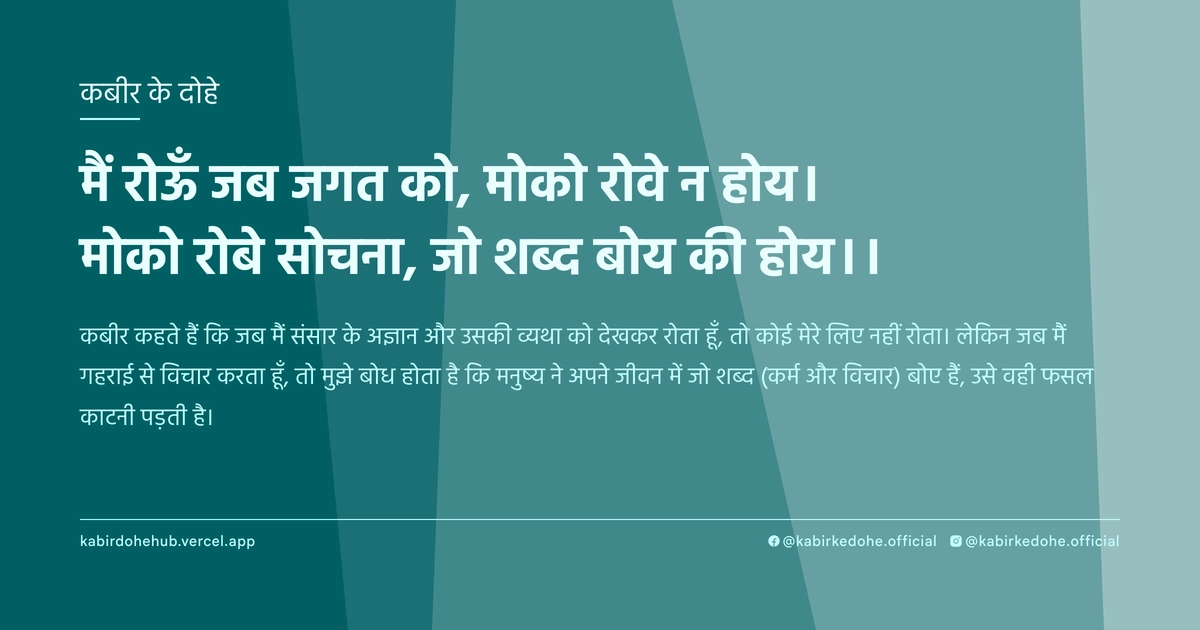
मैं रोऊँ जब जगत को, मोको रोवे न होय।
मोको रोबे सोचना, जो शब्द बोय की होय।।
Main roon jab jagat ko, moko rove na hoye. Moko robe sochna, jo shabd boy ki hoye.
इस पृष्ठ पर इस कबीर दोहे का अर्थ (meaning), हिंदी व्याख्या और अंग्रेज़ी अनुवाद, दार्शनिक विश्लेषण और व्यावहारिक जीवन सीख दी गई है। यह दोहा कर्म (Karma) विषय से जुड़ा है — Kabir doha meaning and explanation in Hindi and English.
अर्थ (Meaning):
कबीर कहते हैं कि जब मैं संसार के अज्ञान और उसकी व्यथा को देखकर रोता हूँ, तो कोई मेरे लिए नहीं रोता। लेकिन जब मैं गहराई से विचार करता हूँ, तो मुझे बोध होता है कि मनुष्य ने अपने जीवन में जो शब्द (कर्म और विचार) बोए हैं, उसे वही फसल काटनी पड़ती है।
Kabir laments that while he weeps for the ignorance and suffering of the world, no one weeps for him. However, upon deep reflection, he realizes the cosmic law of causality: a person must inevitably reap exactly what they have sown through their words, thoughts, and actions.
व्याख्या (Interpretation):
यह दोहा करुणा और कर्म के सिद्धांत के बीच के द्वंद्व को दर्शाता है। प्रारंभ में, यह एक संत की गहरी विरक्ति और अकेलेपन को व्यक्त करता है जो मानवता के पतन पर दुखी है। फिर यह 'शब्द' के बीज पर केंद्रित होता है, जहाँ शब्द केवल भाषा नहीं, बल्कि संकल्प और कर्म हैं। यह निर्गुण भक्ति के उस पहलू को उजागर करता है जहाँ ईश्वर बाहरी अनुष्ठानों में नहीं, बल्कि आत्मा की शुद्धता और उसके द्वारा बोए गए बीजों में है। माया यहाँ वह भ्रम है जो मनुष्य को यह सोचने पर मजबूर करता है कि वह अपने कर्मों के फल से बच सकता है। अंततः, यह आत्मा और ब्रह्म की एकता की ओर ले जाता है, जहाँ व्यक्तिगत दुख सार्वभौमिक सत्य में विलीन हो जाता है।
This couplet illustrates the tension between divine compassion and the immutable law of Karma. It begins with the profound isolation of a mystic who weeps for a world blinded by illusion, finding no reciprocal empathy. The transition to the metaphor of 'sowing words' shifts the focus from emotional grief to metaphysical causality. In the context of Nirgun Bhakti, 'Shabd' (the Word) is not merely speech but the vibrational seed of intention and action. Maya is the veil that blinds humanity to this causal link, leading them to seek external salvation while ignoring internal cultivation. The paradox lies in the saint's grief for others, which eventually dissolves into the realization of non-duality (Advaita), where the observer and the observed are one in the cycle of cosmic justice.
दार्शनिक विश्लेषण (Philosophical Analysis):
कबीर का यह दोहा उस युग की उपज है जहाँ धर्म केवल कर्मकांडों और बाहरी दिखावे तक सीमित था। वे इस बात पर प्रहार करते हैं कि लोग मंदिरों और मस्जिदों में रोते हैं, लेकिन अपने भीतर के अहंकार को नहीं देखते। यहाँ 'शब्द' का अर्थ सूफी मत के 'कलमा' और वेदांत के 'ॐ' के समान है—एक ऐसा बीज जो पूरे अस्तित्व को निर्धारित करता है।
दार्शनिक रूप से, यह अद्वैत वेदांत के इस सिद्धांत से जुड़ता है कि हम जो भी बाहरी दुनिया में देखते हैं, वह हमारे आंतरिक संस्कारों का प्रतिबिंब है। यदि हम घृणा बोते हैं, तो हम दुख की फसल काटते हैं। कबीर यहाँ यह स्पष्ट करते हैं कि मोक्ष किसी बाहरी कृपा से नहीं, बल्कि स्वयं के द्वारा बोए गए सत्य के बीजों से प्राप्त होता है।
सूफीवाद के प्रभाव में, यहाँ 'इश्क-ए-हकीकी' (ईश्वरीय प्रेम) की झलक मिलती है, जहाँ संत दुनिया के लिए रोता है। यह करुणा अहंकार के विसर्जन की पहली सीढ़ी है। जब 'मैं' मिट जाता है, तब केवल वह 'शब्द' बचता है जो शाश्वत है।
कबीर जाति और वर्ग के भेदों को नकारते हुए यह संदेश देते हैं कि कर्म का नियम सबके लिए समान है। चाहे वह ब्राह्मण हो या चर्मकार, जो जैसा बोएगा, वैसा ही पाएगा। यह सामाजिक समानता का एक आध्यात्मिक आधार प्रस्तुत करता है।
मनोवैज्ञानिक स्तर पर, यह दोहा आत्म-जिम्मेदारी (Self-responsibility) की बात करता है। यह हमें पीड़ित (victim) की मानसिकता से निकालकर कर्ता (creator) की स्थिति में लाता है, जहाँ हम समझते हैं कि हमारा वर्तमान हमारे ही अतीत का परिणाम है।
Kabir’s verse emerges from an era dominated by rigid ritualism and caste hierarchies, where spirituality was often reduced to performative piety. He critiques the tendency to seek solace in external shrines while remaining oblivious to the internal seeds of desire and hatred. The term 'Shabd' here transcends linguistic meaning, aligning with the Sufi concept of the primordial word and the Vedantic 'Om'—the vibrational seed of all existence.
Philosophically, this aligns with Advaita Vedanta’s premise that the external world is a projection of internal impressions (Samskaras). The universe acts as a mirror; the grief the poet feels for the world is a reflection of the collective ignorance. By emphasizing that one reaps what one sows, Kabir strips away the illusion of divine whim, replacing it with a rational, spiritual law of causality.
Influence from Sufism is evident in the 'divine longing' and the empathetic sorrow for humanity. This compassion is not a weakness but a catalyst for the annihilation of the ego (Fana). When the individual 'I' dissolves, the duality between the weeper and the wept-for vanishes, revealing the singular truth of the Absolute.
Kabir’s rejection of caste is embedded in this law of Karma. He asserts that spiritual evolution is not a birthright but a result of conscious cultivation. The law of the seed is democratic; it applies equally to the priest and the peasant, thereby dismantling the spiritual monopoly of the elite.
Psychologically, the poem shifts the human consciousness from a 'victim mindset' to one of 'radical accountability.' It suggests that the only way to change the harvest of one's life is to change the seeds of one's thoughts and intentions in the present moment.
मूल संदेश (Core Message):
- बाहरी दुनिया हमारे आंतरिक बीजों का प्रतिबिंब है।
- करुणा तब जन्म लेती है जब हम दूसरों के दुख को अपना मानते हैं।
- शब्द केवल ध्वनि नहीं, बल्कि भविष्य के निर्माता हैं।
- अहंकार का विसर्जन ही वास्तविक आध्यात्मिक जागृति है।
- कर्म का नियम अटल है; बोए बिना काटना असंभव है।
- शांति की खोज बाहर नहीं, बल्कि अपने बीजों की शुद्धि में है।
- The external world is a mirror reflecting our internal seeds.
- True compassion arises when we perceive the world's grief as our own.
- Words are not mere sounds, but the architects of our future.
- The dissolution of the ego is the only gateway to awakening.
- The law of causality is absolute; one cannot reap without sowing.
- Peace is found not in the world, but in the purification of one's seeds.
व्यावहारिक उदाहरण (Practical Example):
वाराणसी के एक पुराने घाट पर रामदीन नाम का एक वृद्ध नाविक रहता था। वह स्वभाव से अत्यंत क्रोधी था और अक्सर अपने साथी नाविकों और यात्रियों पर चिल्लाता था। वह मानता था कि उसकी बदकिस्मती का कारण उसकी गरीबी और समाज की अनदेखी है। वह अक्सर ईश्वर को कोसता कि उसने उसे ऐसा जीवन क्यों दिया।
एक दिन उसकी नाव एक बड़े तूफान में फंस गई। उसने अपनी पूरी ताकत लगा दी, लेकिन नाव डूबने लगी। तभी उसे कबीर का यह दोहा याद आया जो उसने बचपन में सुना था। उसने महसूस किया कि उसने जीवन भर केवल क्रोध, कड़वाहट और शिकायत के 'शब्द' बोए थे।
उसने सोचा, 'मैं आज जिस तूफान में हूँ, क्या यह मेरे ही भीतर के क्रोध का प्रतिबिंब नहीं है?' उसने पहली बार अपनी परिस्थितियों के लिए दूसरों को दोष देना बंद किया। उसने स्वीकार किया कि उसकी कड़वाहट ने ही उसके चारों ओर एक ऐसा वातावरण बना दिया था जहाँ कोई उसकी मदद नहीं करना चाहता था।
उस दिन के बाद, रामदीन ने एक प्रयोग शुरू किया। उसने तय किया कि वह अब केवल प्रेम और कृतज्ञता के शब्द बोएगा। जब कोई यात्री उससे बदतमीजी करता, तो वह मुस्कुराकर जवाब देता। उसने अपने साथी नाविकों की चुपचाप मदद करना शुरू किया।
शुरुआत में लोग उसे पागल समझने लगे। उन्हें लगा कि वह डर गया है। लेकिन धीरे-धीरे, घाट का माहौल बदलने लगा। जो लोग उससे नफरत करते थे, वे अब उसकी नाव पर सबसे पहले आने लगे।
उसकी आय बढ़ी, लेकिन उससे अधिक उसकी मानसिक शांति बढ़ी। उसे समझ आया कि जब उसने अपने शब्दों का बीज बदला, तो उसके जीवन की फसल अपने आप बदल गई।
एक शाम, जब वह शांत गंगा को देख रहा था, उसने महसूस किया कि अब उसे दुनिया के लिए रोने की जरूरत नहीं है, क्योंकि वह स्वयं उस शांति का हिस्सा बन चुका था।
उसका रूपांतरण केवल व्यवहारिक नहीं था, बल्कि आध्यात्मिक था। उसने जान लिया कि बाहरी दुनिया केवल एक प्रतिध्वनि है; असली ध्वनि हमारे भीतर के शब्दों से पैदा होती है।
On the ancient ghats of Varanasi lived an elderly boatman named Ramdeen. He was known for his volatile temper, frequently shouting at fellow boatmen and passengers. He lived in a state of perpetual grievance, believing his misery was a result of poverty and societal neglect, often cursing the heavens for his misfortune.
One afternoon, a sudden storm caught his boat in the middle of the river. As he struggled desperately against the current, the boat began to take on water. In that moment of sheer terror, a forgotten couplet of Kabir echoed in his mind: 'As one sows the word, so shall they reap.'
For the first time, Ramdeen looked inward. He realized that for decades, he had sown only seeds of anger, bitterness, and complaint. He questioned, 'Is this external storm not a reflection of the turbulence I have cultivated within myself?' He stopped playing the victim and accepted that his own hostility had alienated everyone around him.
Following this epiphany, Ramdeen embarked on a conscious experiment. He decided to sow only seeds of kindness and gratitude. When a passenger was rude, he responded with a gentle smile. He began helping other boatmen with their nets without being asked.
Initially, the community mocked him, thinking he had lost his mind or was suddenly frightened by age. However, as the months passed, the atmosphere around his boat shifted. The very people who once avoided him now sought his company for the peace he radiated.
His earnings increased, but more importantly, his internal chaos vanished. He understood that by changing the 'seeds' of his speech and intention, the 'harvest' of his life had fundamentally transformed.
One evening, watching the sunset over the Ganges, he realized he no longer felt the need to weep for the world's cruelty, for he had become a sanctuary of peace himself.
His transformation was not merely behavioral but ontological. He discovered that the external world is but an echo; the original sound originates from the words we sow within our own consciousness.
अभ्यास मार्गदर्शन (Practice Guidance):
- दैनिक आत्म-निरीक्षण: प्रतिदिन सोने से पहले उन 'शब्दों' (विचारों और प्रतिक्रियाओं) की सूची बनाएं जो आपने दिन भर बोए। क्या वे प्रेम के थे या क्रोध के?
- मौन साधना: दिन में 30 मिनट पूर्ण मौन रहें। यह देखें कि जब बाहरी शब्द रुकते हैं, तो भीतर कौन से अनचाहे विचार बीज की तरह उभरते हैं।
- सचेत प्रतिक्रिया: जब भी आपको क्रोध आए, प्रतिक्रिया देने से पहले 5 सेकंड रुकें और स्वयं से पूछें, 'क्या मैं इस शब्द के फल को भविष्य में काटने के लिए तैयार हूँ?'
- डायग्नोस्टिक चेकलिस्ट: यदि आप बार-बार एक ही तरह की समस्याओं (जैसे रिश्तों में तनाव या अकेलापन) का सामना कर रहे हैं, तो यह संकेत है कि आप अनजाने में पुराने और नकारात्मक बीज बो रहे हैं।
- Daily Self-Audit: Before sleep, list the 'seeds' (thoughts and reactions) you sowed throughout the day. Were they seeds of compassion or seeds of conflict?
- Practice of Silence: Spend 30 minutes in absolute silence daily. Observe which unconscious thoughts emerge as seeds when the external noise ceases.
- Conscious Response: Whenever anger arises, pause for 5 seconds before reacting. Ask yourself, 'Am I prepared to reap the fruit of this specific word in the future?'
- Diagnostic Checklist: If you find yourself encountering the same recurring patterns of conflict or loneliness, recognize this as a sign that you are unconsciously sowing the same negative seeds.
चिंतन प्रश्न (Reflection Questions):
- आप अपनी सार्वजनिक छवि (Public Image) को बनाए रखने के लिए भीतर किन नकारात्मक बीजों को दबा रहे हैं?
- क्या आपका 'दुख' वास्तव में दूसरों की चिंता है, या यह आपके अपने अहंकार की एक सूक्ष्म अभिव्यक्ति है?
- यदि आज आपके जीवन की पूरी फसल आपके द्वारा बोले गए शब्दों से तय हो, तो आपका जीवन कैसा दिखेगा?
- आप किन ऐसे पूर्वाग्रहों को 'सत्य' मानकर बो रहे हैं जो वास्तव में केवल सामाजिक कंडीशनिंग हैं?
- क्या आप वास्तव में दूसरों के लिए रोते हैं, या आप केवल इस बात से दुखी हैं कि दुनिया आपकी उम्मीदों के अनुसार नहीं है?
- What negative seeds are you suppressing internally to maintain your curated public identity?
- Is your 'grief' for the world genuine compassion, or is it a subtle manifestation of your own ego?
- If your entire life's harvest were determined solely by the words you have spoken, what would your landscape look like?
- Which biases are you sowing as 'truth' that are actually just remnants of social conditioning?
- Do you truly weep for others, or are you merely distressed that the world does not align with your expectations?