
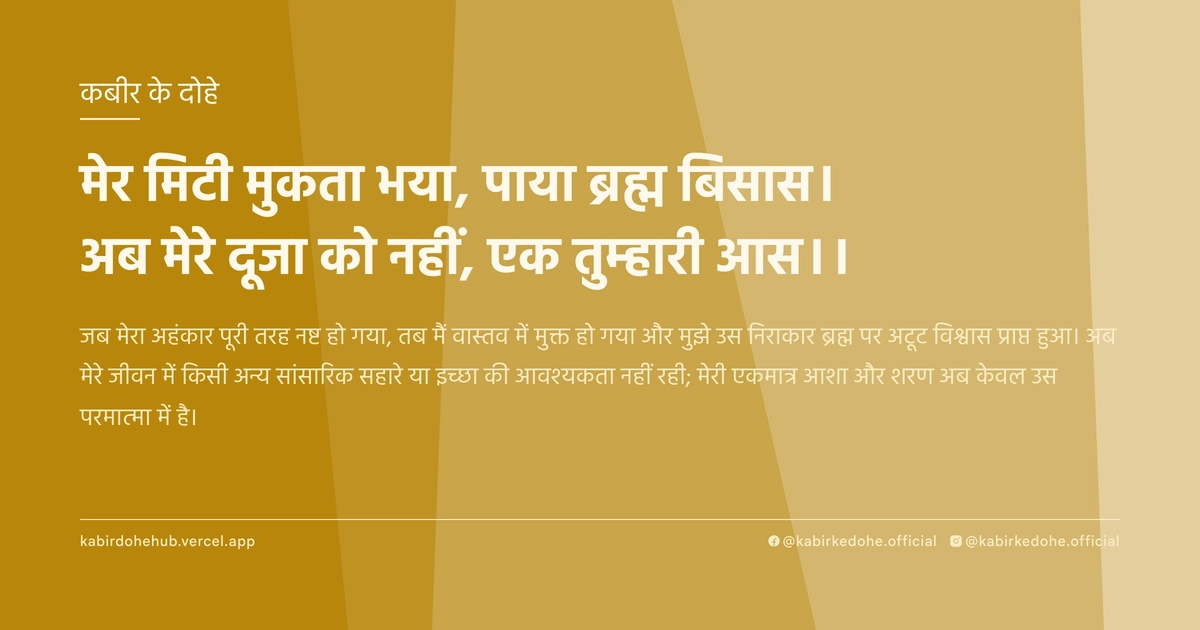
मेर मिटी मुकता भया, पाया ब्रह्म बिसास।
अब मेरे दूजा को नहीं, एक तुम्हारी आस।।
Mer miti mukta bhaya, paaya braham bisaas. Ab mere dooja ko nahi, ek tumhari aas.
इस पृष्ठ पर इस कबीर दोहे का अर्थ (meaning), हिंदी व्याख्या और अंग्रेज़ी अनुवाद, दार्शनिक विश्लेषण और व्यावहारिक जीवन सीख दी गई है। यह दोहा मुक्ति (Liberation) विषय से जुड़ा है — Kabir doha meaning and explanation in Hindi and English.
अर्थ (Meaning):
जब मेरा अहंकार पूरी तरह नष्ट हो गया, तब मैं वास्तव में मुक्त हो गया और मुझे उस निराकार ब्रह्म पर अटूट विश्वास प्राप्त हुआ। अब मेरे जीवन में किसी अन्य सांसारिक सहारे या इच्छा की आवश्यकता नहीं रही; मेरी एकमात्र आशा और शरण अब केवल उस परमात्मा में है।
When my ego was completely annihilated, I attained true liberation and gained an unwavering faith in the Formless Brahman. Now, there remains no need for any other worldly support or desire in my life; my sole hope and refuge lie exclusively in the Divine.
व्याख्या (Interpretation):
इस दोहे का शाब्दिक अर्थ है कि अहंकार के मिटते ही मोक्ष की प्राप्ति होती है। यहाँ 'मेर' (मैं) का अर्थ केवल व्यक्ति नहीं, बल्कि वह सूक्ष्म अहंकार है जो आत्मा को परमात्मा से अलग महसूस कराता है। जब यह द्वैत समाप्त होता है, तो साधक 'ब्रह्म बिसास' यानी उस परम सत्य के साथ एकरूपता का अनुभव करता है। यह निर्गुण भक्ति का शिखर है जहाँ भक्त और भगवान के बीच का अंतर मिट जाता है। माया का पर्दा हटते ही यह स्पष्ट हो जाता है कि आत्मा और ब्रह्म एक ही हैं। यह विरोधाभास है कि स्वयं को पूरी तरह खोकर ही मनुष्य वास्तव में स्वयं को पाता है। अंततः, बाहरी दुनिया की सभी आशाएं व्यर्थ हो जाती हैं और केवल एक अनंत चेतना शेष रहती है।
The literal meaning suggests that liberation is achieved only when the ego is erased. Here, 'Mer' (I) does not refer to the physical person, but to the subtle ego that creates a perceived separation between the soul and the Divine. When this duality vanishes, the seeker experiences 'Brahma Bisas'—an unwavering trust and oneness with the Supreme Truth. This represents the pinnacle of Nirgun Bhakti, where the distinction between the devotee and the Deity dissolves. As the veil of Maya lifts, it becomes evident that Atman and Brahman are non-dual. It is the central paradox of the human condition: only by completely losing the 'self' does one truly find the 'Self'. Ultimately, all external hopes prove futile, leaving only the infinite consciousness as the sole refuge.
दार्शनिक विश्लेषण (Philosophical Analysis):
कबीर का यह कथन उनके समय के कर्मकांडीय और बाहरी आडंबरों के विरुद्ध एक सशक्त प्रहार है। उनके युग में धर्म को बाहरी पहचान, जाति और कठोर अनुष्ठानों से जोड़ा गया था, लेकिन कबीर ने आंतरिक रूपांतरण पर बल दिया। वे कहते हैं कि मुक्ति किसी तीर्थ या मंदिर में नहीं, बल्कि अहंकार के विसर्जन में है।
यह दर्शन अद्वैत वेदांत के 'अहं ब्रह्मास्मि' (मैं ही ब्रह्म हूँ) के सिद्धांत से गहराई से जुड़ा है। जब 'मैं' मिटता है, तो जो बचता है वह शुद्ध चेतना है। कबीर यहाँ सूफी मत के 'फना' (अहंकार का विनाश) की अवधारणा को भी समाहित करते हैं, जहाँ प्रेमी अपने अस्तित्व को प्रियतम (ईश्वर) में विलीन कर देता है।
मनोवैज्ञानिक स्तर पर, यह 'अहं' का विलोपन मानसिक क्लेशों का अंत है। जब तक व्यक्ति स्वयं को एक अलग इकाई मानता है, वह भय, ईर्ष्या और असुरक्षा से घिरा रहता है। जैसे ही यह भ्रम टूटता है, वह सार्वभौमिक प्रेम और शांति का अनुभव करता है।
कबीर इस बात पर जोर देते हैं कि 'ब्रह्म बिसास' या विश्वास कोई बौद्धिक सहमति नहीं है, बल्कि एक जीवित अनुभव है। यह विश्वास तब आता है जब तर्क समाप्त हो जाता है और केवल समर्पण बचता है। यह समर्पण किसी बाहरी देवता के प्रति नहीं, बल्कि उस सत्य के प्रति है जो हर कण में व्याप्त है।
अतः, यह दोहा हमें सिखाता है कि आध्यात्मिक यात्रा बाहर की ओर नहीं, बल्कि भीतर की ओर है। यह बाहरी दुनिया के सहारे को छोड़कर आंतरिक शक्ति को खोजने की प्रक्रिया है। जब हम 'दूसरे' की तलाश छोड़ देते हैं, तभी हम उस 'एक' को पाते हैं जो वास्तव में हम स्वयं हैं।
Kabir's statement is a powerful critique of the ritualistic and external pomposity of his era. In his time, religion was tied to external identity, caste, and rigid rituals, but Kabir emphasized internal transformation. He asserts that liberation is found not in pilgrimages or temples, but in the dissolution of the ego.
This philosophy is deeply aligned with the Advaita Vedanta principle of 'Aham Brahmasmi' (I am Brahman). When the 'I' is erased, what remains is pure consciousness. Kabir also incorporates the Sufi concept of 'Fana' (annihilation), where the lover merges their existence into the Beloved (the Divine).
On a psychological level, the annihilation of the ego is the end of mental suffering. As long as an individual perceives themselves as a separate entity, they are plagued by fear, jealousy, and insecurity. Once this illusion shatters, they experience universal love and peace.
Kabir emphasizes that 'Brahma Bisas' or faith is not an intellectual agreement but a lived experience. This faith emerges when logic ends and only surrender remains. This surrender is not to an external deity, but to the Truth that permeates every atom of existence.
Thus, this couplet teaches that the spiritual journey is not outward, but inward. It is the process of abandoning external crutches to discover internal strength. When we stop searching for the 'other', we find the 'One' who is, in reality, our true Self.
मूल संदेश (Core Message):
- अहंकार ही आत्मा और परमात्मा के बीच की सबसे बड़ी दीवार है।
- जब तक 'मैं' जीवित है, तब तक सत्य का अनुभव असंभव है।
- पूर्ण समर्पण ही वास्तविक स्वतंत्रता और मानसिक शांति का एकमात्र मार्ग है।
- बाहरी सहारे भ्रम हैं; केवल आंतरिक चेतना ही शाश्वत सत्य है।
- शून्यता में ही पूर्णता का वास होता है; स्वयं को खोकर ही स्वयं को पाना है।
- The ego is the greatest wall between the soul and the Divine.
- As long as the 'I' survives, the experience of Truth remains impossible.
- Total surrender is the only path to real freedom and mental peace.
- External supports are illusions; only internal consciousness is the eternal truth.
- Completeness resides in emptiness; one must lose the self to find the Self.
व्यावहारिक उदाहरण (Practical Example):
एक समय की बात है, वाराणसी के घाटों पर रहने वाला एक वृद्ध बुनकर था, जिसका नाम माधव था। माधव अपनी कला में निपुण था और उसे अपनी श्रेष्ठता पर बहुत गर्व था। वह मानता था कि उसके द्वारा बुने गए वस्त्र सबसे उत्तम हैं और वह अन्य बुनकरों को तुच्छ समझता था।
उसका अहंकार इतना प्रबल था कि वह अपनी सफलता का श्रेय केवल अपनी मेहनत को देता था, ईश्वर या प्रकृति को नहीं। वह अक्सर कहता, "देखो, मेरी उंगलियों का जादू है जिसने इस कपड़े को अनमोल बनाया है।"
एक दिन, एक साधारण सा साधु उसके पास आया और उसने माधव से एक ऐसा वस्त्र बुनने को कहा जो "अदृश्य धागों" से बना हो। माधव ने उपहास किया और कहा कि यह असंभव है। साधु ने मुस्कुराते हुए कहा, "जब तक तुम्हारे भीतर 'मैं' का धागा मौजूद है, तुम कभी भी उस सत्य को नहीं बुन पाओगे जो वास्तव में अनंत है।"
साधु ने माधव को एक चुनौती दी: एक महीने तक वह जो भी कमाए, उसे गरीबों में बाँट दे और हर सुबह यह स्वीकार करे कि वह केवल एक माध्यम है, कर्ता नहीं। माधव ने पहले तो इसे मजबूरी में किया, लेकिन धीरे-धीरे उसे महसूस हुआ कि जब वह अपनी श्रेष्ठता का मोह छोड़ रहा है, तो उसके मन का बोझ हल्का हो रहा है।
एक रात, जब वह गहरे ध्यान में था, उसे अनुभव हुआ कि उसकी कला उसकी अपनी नहीं, बल्कि उस ब्रह्मांडीय ऊर्जा का एक छोटा सा हिस्सा है। अचानक उसके भीतर का 'मैं' टूट गया। वह फूट-फूट कर रोने लगा, क्योंकि उसे एहसास हुआ कि उसने वर्षों तक एक झूठी पहचान को ढोया था।
उस क्षण, माधव को वह 'मुक्ति' मिली जिसकी बात कबीर करते हैं। अब उसे अपनी कला पर गर्व नहीं था, बल्कि एक गहरी कृतज्ञता थी। उसने महसूस किया कि वह अब अकेला नहीं है; वह उस अनंत चेतना का हिस्सा है।
उसकी बुनाई में अब एक अलग ही चमक थी, क्योंकि अब वह अहंकार से नहीं, बल्कि प्रेम से बुन रहा था। वह अब किसी की प्रशंसा का भूखा नहीं था, क्योंकि उसकी एकमात्र आशा अब उस परमात्मा में थी।
माधव का जीवन बदल गया। वह अब केवल वस्त्र नहीं बुनता था, बल्कि लोगों के दिलों में प्रेम और विनम्रता के बीज बोता था। उसकी पहचान अब एक "महान बुनकर" की नहीं, बल्कि एक "समर्पित सेवक" की थी।
Once, there lived an elderly weaver named Madhav on the ghats of Varanasi. Madhav was a master of his craft and took immense pride in his superiority. He believed the fabrics he wove were the finest and looked down upon other weavers.
His ego was so strong that he attributed all his success solely to his own hard work, ignoring the role of the Divine or nature. He would often boast, "Look, it is the magic of my fingers that has made this cloth priceless."
One day, a simple monk approached him and asked Madhav to weave a garment made of "invisible threads." Madhav mocked him, saying it was impossible. The monk smiled and replied, "As long as the thread of 'I' exists within you, you will never be able to weave the truth that is truly infinite."
The monk gave Madhav a challenge: for one month, he must distribute everything he earned to the poor and acknowledge every morning that he was merely a medium, not the creator.
Madhav initially did this reluctantly, but gradually he realized that as he let go of his attachment to superiority, the burden on his mind was lifting.
One night, while in deep contemplation, he felt that his art was not his own, but a small fragment of a cosmic energy. Suddenly, the 'I' within him shattered. He wept uncontrollably, realizing he had carried a false identity for years.
In that moment, Madhav found the 'liberation' Kabir speaks of. He no longer felt pride in his art, but a profound sense of gratitude. He realized he was not alone; he was part of an infinite consciousness.
There was now a different radiance in his weaving, for he was weaving not from ego, but from love. He no longer craved praise, as his sole hope now lay in the Divine.
Madhav's life was transformed. He no longer just wove cloth; he sowed seeds of love and humility in the hearts of people. His identity was no longer that of a "great weaver," but of a "devoted servant."
अभ्यास मार्गदर्शन (Practice Guidance):
- प्रतिदिन 20 मिनट मौन ध्यान करें, जहाँ आप अपने विचारों को केवल साक्षी भाव से देखें और 'मैं' की भावना को धीरे-धीरे विलीन होने दें।
- एक 'अहंकार डायरी' बनाएँ। दिन भर में जब भी आपको अपनी श्रेष्ठता का अनुभव हो या किसी पर अहंकार महसूस हो, उसे लिखें और फिर विश्लेषण करें कि वह भावना कहाँ से आई।
- सेवा का अभ्यास करें: सप्ताह में एक बार ऐसा कार्य करें जिसमें आपको कोई श्रेय न मिले और आपकी पहचान पूरी तरह गुप्त रहे।
- निदान चेकलिस्ट: क्या आप दूसरों की आलोचना करते समय स्वयं को श्रेष्ठ महसूस करते हैं? क्या आप अपनी उपलब्धियों का श्रेय केवल स्वयं को देते हैं? यदि हाँ, तो आप अभी भी 'मैं' के बंधन में हैं।
- Practice 20 minutes of silent meditation daily, observing your thoughts as a witness and gradually letting the sense of 'I' dissolve.
- Maintain an 'Ego Diary'. Whenever you feel a sense of superiority or pride during the day, record it and analyze the root of that emotion.
- Practice selfless service: Once a week, perform an act of kindness where you receive no credit and your identity remains completely anonymous.
- Diagnostic Checklist: Do you feel superior while criticizing others? Do you attribute all your achievements solely to yourself? If yes, you are still bound by the 'I'.
चिंतन प्रश्न (Reflection Questions):
- यदि आपकी सभी उपलब्धियाँ, पद और सामाजिक पहचान छीन ली जाएँ, तो आपके भीतर क्या बचेगा?
- आपकी वह कौन सी 'छिपी हुई श्रेष्ठता' है जिसे आप दुनिया के सामने नहीं लाते, लेकिन वह आपके व्यवहार को नियंत्रित करती है?
- क्या आपका आध्यात्मिक अभ्यास वास्तव में अहंकार को मिटा रहा है, या यह आपके भीतर एक 'आध्यात्मिक अहंकार' (Spiritual Ego) पैदा कर रहा है?
- आप किन लोगों या परिस्थितियों के प्रति सबसे अधिक आसक्त हैं, और वह आसक्ति आपको सत्य से कैसे दूर कर रही है?
- क्या आप वास्तव में अकेले रहने में सक्षम हैं, या आपकी शांति दूसरों की स्वीकृति पर निर्भर है?
- If all your achievements, titles, and social identities were stripped away, what would remain within you?
- What is that 'hidden superiority' you don't show the world, but which silently controls your behavior?
- Is your spiritual practice actually erasing the ego, or is it creating a 'spiritual ego' within you?
- To which people or circumstances are you most attached, and how is that attachment distancing you from the Truth?
- Are you truly capable of being alone, or does your peace depend on the validation of others?