
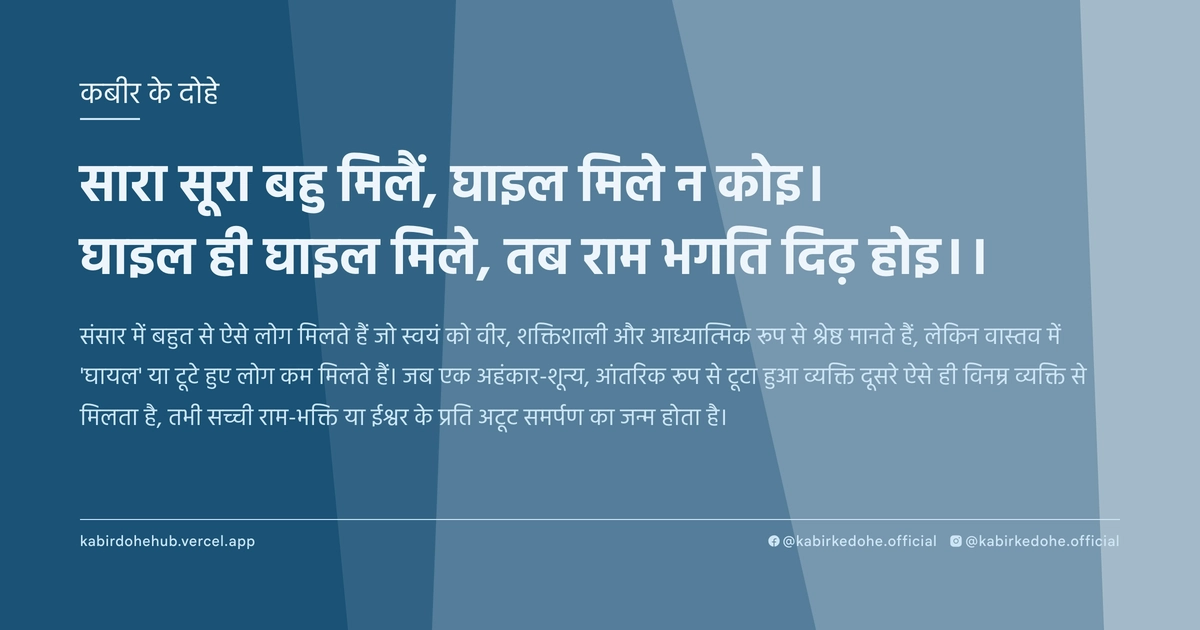
सारा सूरा बहु मिलैं, घाइल मिले न कोइ।
घाइल ही घाइल मिले, तब राम भगति दिढ़ होइ।।
Sara sura bahu milain, ghail mile na koi. Ghail hi ghail mile, tab Ram bhagati didh hoye.
इस पृष्ठ पर इस कबीर दोहे का अर्थ (meaning), हिंदी व्याख्या और अंग्रेज़ी अनुवाद, दार्शनिक विश्लेषण और व्यावहारिक जीवन सीख दी गई है। यह दोहा भक्ति (Bhakti) विषय से जुड़ा है — Kabir doha meaning and explanation in Hindi and English.
अर्थ (Meaning):
संसार में बहुत से ऐसे लोग मिलते हैं जो स्वयं को वीर, शक्तिशाली और आध्यात्मिक रूप से श्रेष्ठ मानते हैं, लेकिन वास्तव में 'घायल' या टूटे हुए लोग कम मिलते हैं। जब एक अहंकार-शून्य, आंतरिक रूप से टूटा हुआ व्यक्ति दूसरे ऐसे ही विनम्र व्यक्ति से मिलता है, तभी सच्ची राम-भक्ति या ईश्वर के प्रति अटूट समर्पण का जन्म होता है।
In this world, one encounters countless individuals who proclaim themselves as warriors, the strong, or the spiritually advanced, yet those who are truly 'wounded' are rare. It is only when one broken soul meets another who is equally shattered by the realization of their own insignificance that a firm, unwavering devotion to the Divine (Ram) is established.
व्याख्या (Interpretation):
यहाँ 'सूरा' का अर्थ केवल शारीरिक योद्धा नहीं, बल्कि वह अहंकारी व्यक्ति है जो अपनी बौद्धिक या धार्मिक उपलब्धियों पर गर्व करता है। 'घायल' होने का अर्थ है अहंकार का पूर्ण विनाश, जहाँ व्यक्ति अपनी सीमाओं और त्रुटियों को स्वीकार कर लेता है। यह दोहा निरगुण भक्ति के उस मर्म को छूता है जहाँ ईश्वर तक पहुँचने का मार्ग शक्ति से नहीं, बल्कि पूर्ण समर्पण और विनम्रता से होकर जाता है। जब 'मैं' का विसर्जन होता है, तब आत्मा और परमात्मा का अद्वैत संबंध स्थापित होता है। यह एक विरोधाभास है कि पूर्णता केवल पूर्णतः टूटने के बाद ही प्राप्त होती है। माया का पर्दा तभी हटता है जब व्यक्ति अपनी कृत्रिम श्रेष्ठता के भ्रम को त्याग देता है।
Here, 'Sura' (warrior) does not merely denote a physical combatant, but represents the ego-driven individual who prides themselves on intellectual or religious achievements. To be 'Ghail' (wounded) signifies the total annihilation of the ego, where the seeker acknowledges their inherent limitations and flaws. This verse touches upon the core of Nirgun Bhakti, suggesting that the path to the Formless Divine is paved not with strength, but with absolute surrender and humility. When the 'I' is dissolved, the non-duality of Atman and Brahman is realized. It presents a spiritual paradox: wholeness is achieved only after one has been completely broken. The veil of Maya is lifted only when the illusion of artificial superiority is discarded.
दार्शनिक विश्लेषण (Philosophical Analysis):
कबीर का यह दोहा मध्यकालीन भारत के उस सामाजिक और धार्मिक परिवेश की प्रतिक्रिया है जहाँ कर्मकांड और बाहरी आडंबरों के माध्यम से आध्यात्मिक श्रेष्ठता का दावा किया जाता था। कबीर ने स्पष्ट किया कि मोक्ष किसी पद, जाति या शास्त्र ज्ञान से नहीं, बल्कि हृदय की दीनता से मिलता है। यह विचार सूफीवाद के 'फना' (अहंकार का विनाश) के सिद्धांत से गहराई से मेल खाता है, जहाँ प्रेमी अपने अस्तित्व को मिटाकर ही प्रियतम (ईश्वर) में विलीन होता है।
अद्वैत वेदांत के परिप्रेक्ष्य में, यह 'घायल' होना वास्तव में अविद्या (ignorance) का विनाश है। जब तक मनुष्य स्वयं को कर्ता मानता है, वह 'सूरा' बना रहता है, जो कि एक भ्रम है। जैसे ही यह भ्रम टूटता है, वह 'घायल' हो जाता है, और यही वह बिंदु है जहाँ वह अपनी वास्तविक प्रकृति को पहचानता है।
कबीर ritualism (कर्मकांड) का विरोध करते हैं क्योंकि कर्मकांड अक्सर अहंकार को पुष्ट करते हैं। एक व्यक्ति जो यह सोचता है कि वह कठिन व्रत या तीर्थयात्रा करके ईश्वर को पा लेगा, वह वास्तव में अपनी आध्यात्मिक शक्ति का प्रदर्शन कर रहा है। कबीर के अनुसार, ऐसी 'वीरता' ईश्वर और भक्त के बीच एक दीवार बन जाती है।
मनोवैज्ञानिक स्तर पर, यह दोहा 'अहंकार के विखंडन' की प्रक्रिया है। जब तक हम अपनी छवि को सुरक्षित रखते हैं, हम सत्य के प्रति बंद रहते हैं। केवल वही व्यक्ति सत्य को ग्रहण कर सकता है जो अपनी त्रुटियों के प्रति ईमानदार है और जिसने अपनी श्रेष्ठता के मुखौटे को उतार फेंका है।
अंततः, 'राम भक्ति' यहाँ किसी विशेष देवता की पूजा नहीं, बल्कि उस सार्वभौमिक चेतना के साथ एकाकार होना है जो केवल विनम्रता के द्वार से प्रवेश योग्य है। यह एक ऐसी अवस्था है जहाँ दो 'शून्य' मिलते हैं और एक अनंत सत्य का निर्माण करते हैं।
This couplet by Kabir is a reaction to the socio-religious climate of medieval India, where spiritual superiority was often claimed through rituals and external displays of piety. Kabir clarifies that liberation is not attained through rank, caste, or scriptural knowledge, but through the humility of the heart. This aligns profoundly with the Sufi concept of 'Fana' (annihilation of the self), where the lover must erase their existence to merge with the Beloved.
From the perspective of Advaita Vedanta, being 'wounded' is actually the destruction of Avidya (ignorance). As long as a human perceives themselves as the 'doer' or the agent, they remain a 'Sura' (warrior), which is a delusion. The moment this delusion shatters, they become 'wounded,' and it is precisely at this point that they recognize their true nature as Brahman.
Kabir rejects ritualism because rituals often reinforce the ego. A person who believes they can 'earn' God through rigorous fasting or pilgrimages is merely showcasing their spiritual prowess. According to Kabir, such 'valor' becomes a wall between the seeker and the Divine.
On a psychological level, this verse describes the process of 'ego-fragmentation.' As long as we protect our curated image, we remain closed to the Truth. Only those who are honest about their flaws and have stripped away the mask of superiority can truly receive spiritual insight.
Ultimately, 'Ram Bhakti' here does not refer to the worship of a specific deity, but to unification with the universal consciousness, which is accessible only through the gateway of humility. It is a state where two 'voids' meet to create an infinite truth.
मूल संदेश (Core Message):
- अहंकार की शक्ति आध्यात्मिक प्रगति में सबसे बड़ी बाधा है।
- सच्ची भक्ति केवल पूर्ण आत्म-समर्पण और विनम्रता से संभव है।
- अपनी त्रुटियों को स्वीकार करना ही ईश्वर की ओर पहला कदम है।
- जब 'मैं' मिटता है, तभी 'वह' (परमात्मा) प्रकट होता है।
- आध्यात्मिक पूर्णता केवल अहंकार के विखंडन के बाद आती है।
- बाहरी ज्ञान की तुलना में आंतरिक दीनता अधिक मूल्यवान है।
- The power of ego is the greatest obstacle to spiritual progress.
- True devotion is possible only through absolute surrender and humility.
- Accepting one's flaws is the first step toward the Divine.
- When the 'I' vanishes, the 'He' (Universal Truth) manifests.
- Spiritual wholeness comes only after the fragmentation of the ego.
- Inner humility is far more valuable than external erudition.
व्यावहारिक उदाहरण (Practical Example):
वाराणसी के घाटों पर रहने वाला एक वृद्ध विधवा, जिसे समाज ने हाशिए पर धकेल दिया था, अपना समय केवल गंगा की लहरों को देखते हुए बिताती थी। वह स्वयं को पूरी तरह से तुच्छ और ईश्वर की दया पर निर्भर मानती थी।
उसी घाट पर एक प्रसिद्ध विद्वान पंडित आते थे, जिन्होंने वेदों का गहन अध्ययन किया था और जिनके पास अनुयायियों की भीड़ रहती थी। पंडित जी अपनी ज्ञान-शक्ति और शुद्धता के अहंकार में चूर थे।
पंडित जी अक्सर उस विधवा को देखते और सोचते कि यह स्त्री कितनी अज्ञानी है, इसे शास्त्रों का ज्ञान नहीं है, यह कभी मोक्ष नहीं पा सकेगी।
एक दिन, पंडित जी एक कठिन आध्यात्मिक संकट में घिर गए। उनके ज्ञान के सारे तर्क विफल हो गए और वे गहरे अवसाद और मानसिक द्वंद्व में डूब गए।
वे उसी विधवा के पास बैठे और अपनी पीड़ा व्यक्त की। उन्होंने पाया कि उनकी सारी विद्वत्ता उन्हें शांति नहीं दे पा रही थी, जबकि वह विधवा एक असीम आंतरिक शांति में डूबी हुई थी।
विधवा ने बस इतना कहा, "बाबा, जब मैंने यह मान लिया कि मैं कुछ भी नहीं हूँ, तब मुझे वह मिल गया जो सब कुछ है।"
पंडित जी को पहली बार अहसास हुआ कि उनकी 'वीरता' (विद्वत्ता) वास्तव में उनकी सबसे बड़ी बाधा थी। वे उस क्षण 'घायल' हुए, यानी उनका अहंकार टूट गया।
जब एक टूटे हुए विद्वान और एक विनम्र आत्मा का मिलन हुआ, तब पंडित जी के जीवन में पहली बार सच्ची भक्ति का उदय हुआ।
उन्होंने अपनी पोथियों को किनारे रखा और उस विधवा के साथ मौन रहकर ईश्वर को महसूस करना शुरू किया।
यह 'कबीर ट्विस्ट' था—जहाँ ज्ञान की हार ने भक्ति की जीत का मार्ग प्रशस्त किया और अहंकार के विनाश ने उन्हें वास्तव में ईश्वर से जोड़ा।
An elderly widow living on the ghats of Varanasi, pushed to the margins of society, spent her days simply watching the waves of the Ganges. She viewed herself as utterly insignificant and entirely dependent on Divine grace.
On the same ghat, a renowned scholar-priest would visit, a man who had mastered the Vedas and was surrounded by a crowd of admirers. The priest was consumed by the ego of his knowledge and ritual purity.
The priest often looked at the widow and thought, "How ignorant this woman is; she knows nothing of the scriptures and will never attain liberation."
One day, the priest fell into a profound spiritual crisis. All his logical arguments failed, and he sank into deep depression and mental turmoil.
He sat beside the widow and expressed his agony. He realized that all his erudition could not grant him peace, while the widow remained immersed in an infinite inner stillness.
The widow simply said, "Baba, when I accepted that I am nothing, I found Him who is everything."
The priest realized for the first time that his 'valor' (intellectual pride) was actually his greatest obstacle. In that moment, he became 'wounded'—his ego shattered.
When the broken scholar met the humble soul, true devotion was born in the priest's life for the first time.
He set aside his manuscripts and began to experience the Divine in silence alongside the widow.
This was the 'Kabir Twist'—where the defeat of intellectual pride paved the way for the victory of devotion, and the annihilation of ego finally connected him to the Truth.
अभ्यास मार्गदर्शन (Practice Guidance):
- दैनिक आत्म-निरीक्षण: प्रतिदिन 15 मिनट मौन बैठें और उन क्षणों को याद करें जब आपने अपनी श्रेष्ठता सिद्ध करने की कोशिश की। उस अहंकार को पहचानें और उसे विसर्जित करें।
- विनम्रता का अभ्यास: दिन में कम से कम एक बार किसी ऐसे व्यक्ति से सहायता लें या उनकी प्रशंसा करें जिसे समाज 'निम्न' मानता है, ताकि आपका आंतरिक 'सूरा' शांत हो सके।
- जर्नलिंग प्रॉम्प्ट: "मेरे जीवन का वह कौन सा हिस्सा है जहाँ मैं अभी भी 'अजेय' दिखने की कोशिश कर रहा हूँ? यदि मैं इस मुखौटे को गिरा दूँ, तो मुझे क्या डर लगता है?"
- डायग्नोस्टिक चेकलिस्ट: क्या आप दूसरों की आलोचना करते समय श्रेष्ठता महसूस करते हैं? क्या आप अपनी गलतियों को स्वीकार करने में कठिनाई महसूस करते हैं? यदि हाँ, तो आप अभी भी 'सूरा' हैं, 'घायल' नहीं।
- Daily Self-Inquiry: Sit in silence for 15 minutes daily and recall moments where you tried to prove your superiority. Identify that ego and consciously release it.
- Practice of Humility: At least once a day, seek help from or genuinely appreciate someone whom society deems 'inferior,' to quiet the internal 'warrior' within you.
- Journaling Prompt: "Which part of my life am I still trying to appear 'invincible' in? What fear arises if I drop this mask?"
- Diagnostic Checklist: Do you feel a sense of superiority while criticizing others? Do you struggle to admit your mistakes? If yes, you are still a 'Sura' (warrior), not yet 'Ghail' (wounded).
चिंतन प्रश्न (Reflection Questions):
- क्या आपकी आध्यात्मिक साधना आपको और अधिक विनम्र बना रही है, या यह आपके भीतर एक 'धार्मिक अहंकार' पैदा कर रही है?
- आपकी सार्वजनिक छवि (Digital/Social Ego) और आपके आंतरिक अंधेरे के बीच कितना अंतर है?
- क्या आप वास्तव में अपनी कमजोरियों को स्वीकार करते हैं, या आप उन्हें 'विशेषता' कहकर छिपाते हैं?
- यदि आपसे आपकी सारी उपलब्धियाँ और पद छीन लिए जाएँ, तो क्या आपके पास ईश्वर के सामने पेश करने के लिए कुछ बचेगा?
- आप किन लोगों को 'घायल' या 'अयोग्य' मानते हैं, और क्या संभव है कि वही लोग आपको सत्य का मार्ग दिखा सकें?
- क्या आप अपनी श्रेष्ठता के भ्रम में इतने डूबे हैं कि आप दूसरों की वास्तविक पीड़ा को महसूस करना भूल गए हैं?
- Is your spiritual practice making you more humble, or is it creating a 'religious ego' within you?
- How wide is the gap between your public persona (Digital/Social Ego) and your internal shadows?
- Do you truly accept your weaknesses, or do you hide them by rebranding them as 'unique traits'?
- If all your achievements and titles were stripped away, would you have anything left to offer before the Divine?
- Whom do you perceive as 'wounded' or 'unworthy,' and is it possible that they are the ones who could show you the Truth?
- Are you so immersed in the illusion of your superiority that you have forgotten how to feel the actual pain of others?