
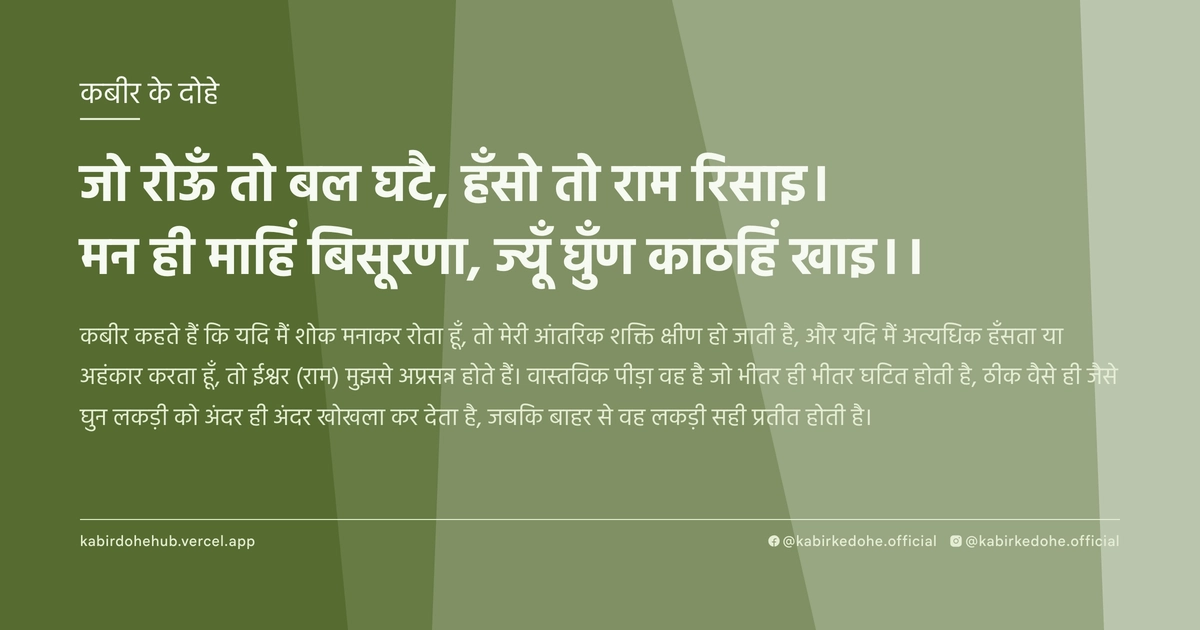
जो रोऊँ तो बल घटै, हँसो तो राम रिसाइ।
मन ही माहिं बिसूरणा, ज्यूँ घुँण काठहिं खाइ।।
Jo roon to bal ghatai, hanso to Ram risai. Man hi mahin bisoorna, jyun ghun kaathin khai.
इस पृष्ठ पर इस कबीर दोहे का अर्थ (meaning), हिंदी व्याख्या और अंग्रेज़ी अनुवाद, दार्शनिक विश्लेषण और व्यावहारिक जीवन सीख दी गई है। यह दोहा मन नियंत्रण (Mind Control) विषय से जुड़ा है — Kabir doha meaning and explanation in Hindi and English.
अर्थ (Meaning):
कबीर कहते हैं कि यदि मैं शोक मनाकर रोता हूँ, तो मेरी आंतरिक शक्ति क्षीण हो जाती है, और यदि मैं अत्यधिक हँसता या अहंकार करता हूँ, तो ईश्वर (राम) मुझसे अप्रसन्न होते हैं। वास्तविक पीड़ा वह है जो भीतर ही भीतर घटित होती है, ठीक वैसे ही जैसे घुन लकड़ी को अंदर ही अंदर खोखला कर देता है, जबकि बाहर से वह लकड़ी सही प्रतीत होती है।
Kabir observes that weeping in grief diminishes one's spiritual strength, while excessive laughter or egoistic mirth displeases the Divine. The true, silent agony is that which resides within the mind—a hidden erosion of the soul, similar to how a woodworm consumes a piece of timber from the inside, leaving the exterior seemingly intact while the core is hollowed out.
व्याख्या (Interpretation):
यह दोहा बाहरी प्रतिक्रियाओं और आंतरिक वास्तविकता के बीच के विरोधाभास को दर्शाता है। 'रोना' यहाँ केवल दुख नहीं, बल्कि मोह और विलाप है जो जीव को कमजोर करता है। 'हँसना' यहाँ सांसारिक अहंकार और अज्ञानता का प्रतीक है। कबीर 'निर्गुण भक्ति' के माध्यम से समझाते हैं कि आत्मा का वास्तविक संघर्ष बाहरी दुनिया से नहीं, बल्कि उसके अपने भीतर के द्वंद्वों से है। जिस प्रकार घुन लकड़ी को अदृश्य रूप से नष्ट करता है, उसी प्रकार अनसुलझे मानसिक विकार, वासनाएँ और अज्ञानता मनुष्य के आध्यात्मिक आधार को धीरे-धीरे समाप्त कर देते हैं। यह अद्वैत वेदांत के उस सत्य की ओर संकेत है जहाँ माया हमें बाहरी रूपों में उलझाए रखती है, जबकि वास्तविक विनाश आंतरिक स्तर पर घटित हो रहा होता है।
This couplet illustrates the paradox between external reactions and internal reality. 'Weeping' here represents not just sorrow, but attachment and lamentation that drain the seeker's spiritual vitality. 'Laughter' symbolizes worldly arrogance and the ignorance of the ego. Through the lens of Nirgun Bhakti, Kabir explains that the soul's true struggle is not with the external world, but with its own internal contradictions. Just as a woodworm invisibly destroys timber, unresolved mental disturbances, desires, and ignorance gradually erode the human spiritual foundation. This points toward the truth of Advaita Vedanta, where Maya keeps us entangled in external forms while the actual decay occurs at the core of our being, hidden from the world's view.
दार्शनिक विश्लेषण (Philosophical Analysis):
कबीर का यह दर्शन उस समय के सामाजिक और धार्मिक पाखंड के विरुद्ध एक प्रहार था, जहाँ बाहरी दिखावे (जैसे लंबी मालाएँ या जोर-जोर से विलाप करना) को भक्ति माना जाता था। वे स्पष्ट करते हैं कि ईश्वर न तो आपके आंसुओं से प्रभावित होते हैं और न ही आपकी बाहरी प्रसन्नता से। यह दृष्टिकोण सूफीवाद के 'फना' (अहंकार का विनाश) के करीब है, जहाँ साधक को अपने आंतरिक विकारों को पहचानकर उन्हें मिटाना होता है।
यहाँ 'राम' शब्द किसी व्यक्ति विशेष के लिए नहीं, बल्कि उस सर्वव्यापी चेतना (Brahman) के लिए है जो तटस्थ है। जब मनुष्य बाहरी भावनाओं के अतिरेक में बहता है, तो वह अपनी केंद्रता खो देता है। यह मनोवैज्ञानिक विश्लेषण है कि कैसे हम अपनी पीड़ा को बाहरी दुनिया में प्रक्षेपित करते हैं, जबकि मूल समस्या हमारे भीतर के 'अहं' और 'माया' का टकराव है।
अद्वैत वेदांत के अनुसार, आत्मा शुद्ध है, लेकिन मन की परतों ने उसे ढक लिया है। घुन का उदाहरण यह बताता है कि अज्ञानता (Avidya) सूक्ष्म रूप से कार्य करती है। यह अचानक नहीं आता, बल्कि धीरे-धीरे विश्वासों और आदतों के माध्यम से आत्मा की जीवंतता को सोख लेता है।
कबीर ritualism (कर्मकांड) का खंडन करते हुए कहते हैं कि वास्तविक शुद्धि बाहरी स्नान या प्रार्थना से नहीं, बल्कि आंतरिक विश्लेषण से आती है। वे चेतावनी देते हैं कि यदि हम केवल बाहरी व्यक्तित्व को संवारते रहे, तो हम अंदर से खोखले हो जाएंगे।
अंततः, यह दोहा साधक को 'साक्षी भाव' (Witness Consciousness) में आने का आह्वान करता है। न अत्यधिक दुख, न अत्यधिक मोह—केवल एक संतुलित, जागरूक स्थिति जहाँ व्यक्ति अपने भीतर के 'घुन' यानी वासनाओं को पहचानकर उन्हें ज्ञान की अग्नि में भस्म कर सके।
Kabir's philosophy serves as a critique of the social and religious hypocrisy of his era, where external displays—such as long prayer beads or loud lamentations—were mistaken for true devotion. He clarifies that the Divine is moved neither by your tears nor by your outward cheer. This perspective aligns closely with the Sufi concept of 'Fana' (the annihilation of the ego), where the seeker must identify and dissolve internal impurities.
In this context, 'Ram' does not refer to a mythological figure but to the omnipresent consciousness (Brahman) that remains detached. When a human is swept away by the extremes of emotion, they lose their spiritual center. This is a psychological analysis of how we project our suffering onto the external world, while the root problem is the clash between the 'Ego' and 'Maya' within.
According to Advaita Vedanta, the Atman is pure, but it is obscured by layers of the mind. The metaphor of the woodworm illustrates how ignorance (Avidya) operates subtly. It does not strike suddenly but slowly consumes the vitality of the soul through ingrained beliefs and habitual patterns.
Rejecting ritualism, Kabir asserts that true purification does not come from external bathing or rote prayers, but from rigorous internal scrutiny. He warns that if we focus solely on polishing our external persona, we risk becoming hollowed out from within.
Ultimately, this doha calls the seeker to enter the state of 'Sakshi Bhava' (Witness Consciousness). Neither excessive grief nor excessive attachment—only a balanced, aware state where one can identify the 'woodworms' of desire and incinerate them in the fire of self-knowledge.
मूल संदेश (Core Message):
- बाहरी प्रदर्शन आध्यात्मिक प्रगति का प्रमाण नहीं है।
- दबाई गई भावनाएं आंतरिक विनाश का कारण बनती हैं।
- सच्ची भक्ति स्वयं के प्रति पूर्ण ईमानदारी में निहित है।
- अहंकार और मोह ही आत्मा के अदृश्य घुन हैं।
- शांति बाहरी संतुलन में नहीं, आंतरिक सत्य की स्वीकृति में है।
- External performance is not evidence of spiritual progress.
- Suppressed emotions act as internal agents of destruction.
- True devotion resides in absolute honesty with oneself.
- Ego and attachment are the invisible woodworms of the soul.
- Peace is found not in external balance, but in accepting internal truth.
व्यावहारिक उदाहरण (Practical Example):
वाराणसी के एक पुराने घाट पर रहने वाले एक वृद्ध बुनकर थे, जिनका नाम माधव था। माधव अपने काम में निपुण थे और शहर भर में अपनी ईमानदारी के लिए जाने जाते थे। बाहरी तौर पर उनका जीवन शांत था, वे मंदिर जाते थे और सबके साथ विनम्रता से पेश आते थे।
लेकिन माधव के भीतर एक गहरा द्वंद्व था। वर्षों पहले उनके बेटे ने उन्हें छोड़कर शहर छोड़ दिया था। माधव ने कभी किसी के सामने अपनी पीड़ा व्यक्त नहीं की। जब लोग उनसे पूछते, तो वे एक फीकी मुस्कान के साथ कह देते, 'सब ईश्वर की इच्छा है।'
वे न तो रोते थे, क्योंकि उन्हें लगता था कि दुख दिखाना कमजोरी है, और न ही वे वास्तव में खुश थे, क्योंकि उनकी मुस्कान केवल एक मुखौटा थी। वे समाज की नजरों में एक 'आदर्श' व्यक्ति थे, लेकिन अंदर ही अंदर वे अकेलेपन और कड़वाहट के घुन से खाए जा रहे थे।
एक दिन उनकी मुलाकात एक घुमक्कड़ संत से हुई। संत ने माधव की आँखों में देखा और कहा, 'माधव, तुम्हारी मुस्कान पत्थर की है और तुम्हारा मौन चीख रहा है। तुम बाहर से तो मजबूत दिखते हो, लेकिन अंदर से तुम खोखले हो चुके हो।'
माधव पहले तो चौंक गए, फिर वे फूट-फूट कर रो पड़े। उन्होंने महसूस किया कि उन्होंने अपने दुख को स्वीकार करने के बजाय उसे भीतर दबाकर रखा था। उन्होंने समझा कि 'राम' को प्रसन्न करने का अर्थ यह नहीं है कि हम अपनी भावनाओं को नकार दें, बल्कि यह है कि हम उन्हें ईमानदारी से स्वीकार करें।
उन्होंने महसूस किया कि उनका 'आदर्श' बनने का अहंकार ही वह घुन था जिसने उनके जीवन की वास्तविक खुशी को नष्ट कर दिया था। वे अब केवल दिखावे के लिए नहीं मुस्कुराते थे, बल्कि अपने दुख को स्वीकार कर उससे ऊपर उठने का प्रयास करने लगे।
उन्होंने अपने पुराने संचित क्रोध और विरह को धीरे-धीरे क्षमा में बदलना शुरू किया। उन्होंने पाया कि जब उन्होंने अपनी आंतरिक रिक्तता को स्वीकार किया, तभी उसमें नई शांति भर पाई।
माधव का जीवन अब केवल एक सामाजिक मुखौटा नहीं था। वे अब वास्तव में हल्के महसूस कर रहे थे क्योंकि उन्होंने उस आंतरिक घुन को पहचान लिया था जो उन्हें अंदर से नष्ट कर रहा था।
On an ancient ghat in Varanasi lived an elderly weaver named Madhav. Madhav was a master of his craft and known throughout the city for his unwavering honesty. Externally, his life appeared serene; he visited the temple daily and treated everyone with profound humility.
However, within Madhav raged a deep conflict. Years ago, his only son had abandoned him to seek a fortune in a distant city. Madhav never expressed his grief to anyone. Whenever people inquired about his well-being, he would offer a faint, practiced smile and say, 'Everything is the will of the Divine.'
He did not weep, for he believed that showing sorrow was a sign of weakness, nor was he truly happy, as his smile was merely a mask. In the eyes of society, he was a 'model' man, but internally, he was being eaten away by the woodworms of loneliness and bitterness.
One day, he encountered a wandering sanyasi. The saint looked into Madhav's eyes and said, 'Madhav, your smile is made of stone and your silence is screaming. You appear strong to the world, but inside, you have become hollow.'
Madhav was startled, and then, for the first time in decades, he broke down and wept uncontrollably. He realized that instead of processing his grief, he had suppressed it, allowing it to fester.
He understood that pleasing 'Ram' did not mean denying one's emotions, but acknowledging them with honesty. He realized that his ego—the desire to be seen as 'ideal'—was the very woodworm that had destroyed the genuine joy of his life.
He began the slow process of transforming his accumulated anger and longing into forgiveness. He discovered that only by acknowledging the internal void could he begin to fill it with true peace.
Madhav's life was no longer a social performance. He felt a lightness he hadn't known in years because he had finally identified and confronted the internal decay that was consuming him.
अभ्यास मार्गदर्शन (Practice Guidance):
- दैनिक आत्म-निरीक्षण: प्रतिदिन 20 मिनट मौन बैठें और यह देखें कि क्या आप अपनी भावनाओं को दबा रहे हैं या उनका प्रदर्शन कर रहे हैं।
- भावनात्मक ईमानदारी का अभ्यास: एक डायरी लिखें जहाँ आप उन कड़वी भावनाओं को दर्ज करें जिन्हें आप दुनिया के सामने 'मुस्कुराहट' के पीछे छिपाते हैं।
- साक्षी भाव का ध्यान: जब क्रोध या दुख आए, तो उसे 'मैं दुखी हूँ' के बजाय 'दुख का अनुभव हो रहा है' के रूप में देखें।
- डायग्नोस्टिक चेकलिस्ट: क्या मैं दूसरों की प्रशंसा के लिए अपनी पीड़ा छिपा रहा हूँ? क्या मेरी खुशी केवल बाहरी है? क्या मैं अंदर से थकान और रिक्तता महसूस करता हूँ जबकि बाहर सब ठीक है?
- Daily Self-Scrutiny: Sit in silence for 20 minutes daily and observe whether you are suppressing your emotions or merely performing them for others.
- Emotional Honesty Practice: Maintain a journal to record the bitter emotions that you hide behind a 'social smile' in your public life.
- Witness Meditation: When anger or sorrow arises, observe it as 'Sorrow is being experienced' rather than 'I am sad,' distancing the Atman from the emotion.
- Diagnostic Checklist: Am I hiding my pain to maintain a public image? Is my happiness merely superficial? Do I feel an internal exhaustion and emptiness despite an outward appearance of stability?
चिंतन प्रश्न (Reflection Questions):
- वह कौन सा दुख है जिसे मैं 'सब ठीक है' कहकर दुनिया से छिपा रहा हूँ?
- क्या मेरी आध्यात्मिक साधना वास्तव में आंतरिक परिवर्तन के लिए है, या केवल एक सामाजिक पहचान बनाने के लिए?
- मेरे व्यक्तित्व का वह कौन सा हिस्सा है जो बाहर से चमक रहा है लेकिन अंदर से खोखला हो चुका है?
- मैं अपनी भावनाओं को नियंत्रित करने की कोशिश करता हूँ या उन्हें समझने की?
- यदि मेरा सामाजिक मुखौटा हट जाए, तो क्या मैं अपनी वास्तविक छवि को स्वीकार करने का साहस रखता हूँ?
- What is the specific sorrow that I hide from the world by claiming 'everything is fine'?
- Is my spiritual practice truly for internal transformation, or is it merely to build a social identity?
- Which part of my personality shines brightly on the outside while being completely hollowed out within?
- Do I attempt to control my emotions, or do I strive to understand their root cause?
- If my social mask were stripped away, would I have the courage to accept my authentic self?