
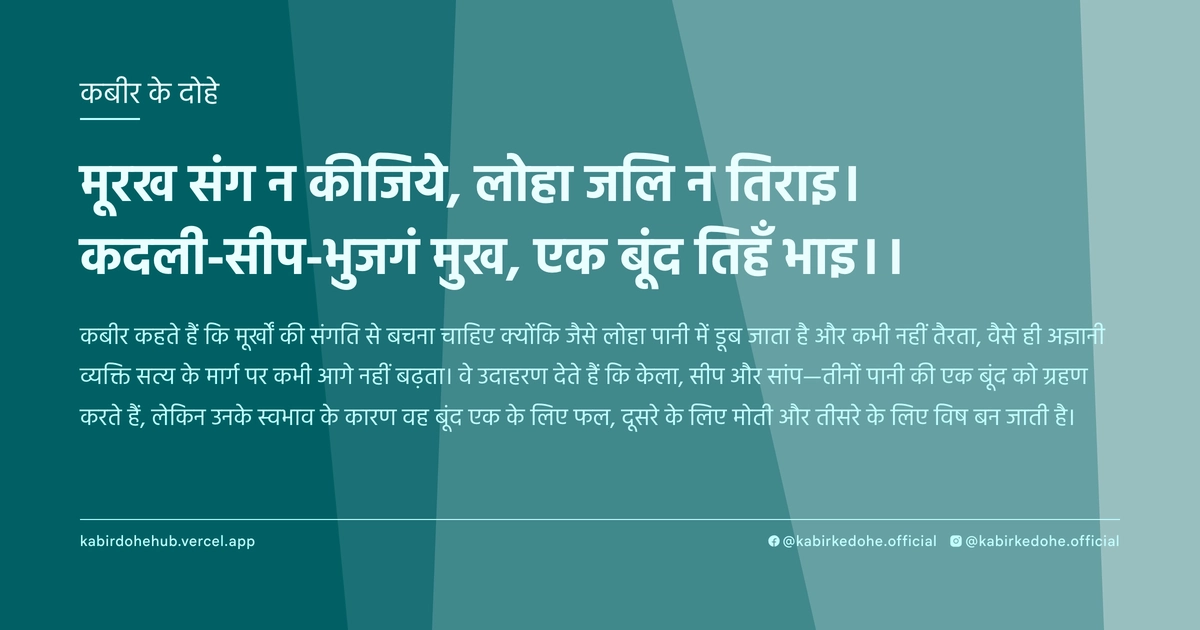
मूरख संग न कीजिये, लोहा जलि न तिराइ।
कदली-सीप-भुजगं मुख, एक बूंद तिहँ भाइ।।
Moorkh sang na keeje, loha jali na tirai. Kadli-seep-bhujagan mukh, ek boond tihan bhai.
इस पृष्ठ पर इस कबीर दोहे का अर्थ (meaning), हिंदी व्याख्या और अंग्रेज़ी अनुवाद, दार्शनिक विश्लेषण और व्यावहारिक जीवन सीख दी गई है। यह दोहा सत्संग (Satsang) विषय से जुड़ा है — Kabir doha meaning and explanation in Hindi and English.
अर्थ (Meaning):
कबीर कहते हैं कि मूर्खों की संगति से बचना चाहिए क्योंकि जैसे लोहा पानी में डूब जाता है और कभी नहीं तैरता, वैसे ही अज्ञानी व्यक्ति सत्य के मार्ग पर कभी आगे नहीं बढ़ता। वे उदाहरण देते हैं कि केला, सीप और सांप—तीनों पानी की एक बूंद को ग्रहण करते हैं, लेकिन उनके स्वभाव के कारण वह बूंद एक के लिए फल, दूसरे के लिए मोती और तीसरे के लिए विष बन जाती है।
Kabir warns against the company of the ignorant, noting that just as iron sinks in water and never floats, a fool remains submerged in ignorance regardless of the truth presented. He illustrates that a single drop of water, when received by a banana tree, a seashell, and a cobra, transforms into a fruit, a pearl, and poison respectively, depending entirely on the inherent nature of the receiver.
व्याख्या (Interpretation):
यह दोहा बाहरी प्रभाव बनाम आंतरिक स्वभाव के द्वंद्व को दर्शाता है। 'मूरख' यहाँ केवल कम शिक्षा वाले व्यक्ति को नहीं, बल्कि उस अहंकारग्रस्त मन को कहते हैं जो सत्य के प्रति बंद है। जिस प्रकार लोहा जल के स्वभाव के विपरीत है, वैसे ही अज्ञानी का अहंकार सत्य के प्रवाह को स्वीकार नहीं करता। कदली (केला), सीप और भुजंग (सांप) का रूपक यह समझाता है कि ज्ञान (एक बूंद) सबके लिए समान है, लेकिन व्यक्ति का 'संस्कार' या 'चित्त' यह निर्धारित करता है कि वह ज्ञान उसे विकसित करेगा, मूल्यवान बनाएगा या विनाशकारी बना देगा। यह निर्गुण भक्ति का सार है कि ईश्वर या सत्य सर्वव्यापी है, परंतु उसे ग्रहण करने की क्षमता साधक की पात्रता पर निर्भर करती है। यह अद्वैत वेदांत के उस सिद्धांत को पुष्ट करता है जहाँ माया व्यक्ति की दृष्टि को धुंधला करती है, जिससे वह एक ही सत्य को अलग-अलग विकृत रूपों में देखता है।
This couplet explores the conflict between external influence and internal disposition. The 'fool' here refers not to a lack of formal education, but to the ego-driven mind that remains closed to truth. Just as iron is fundamentally opposed to the buoyancy of water, the ignorant mind resists the flow of spiritual awakening. The metaphor of the banana, the shell, and the serpent demonstrates that while the 'drop' of divine knowledge is universal and identical for all, the 'Samskara' or latent impressions of the individual determine the outcome: growth, value, or toxicity. This aligns with Nirgun Bhakti, suggesting that the Formless Truth is accessible to all, yet the capacity to realize it depends on the seeker's readiness. It echoes Advaita Vedanta, where Maya obscures the singular reality, causing the individual to perceive the one Truth through the distorted lens of their own conditioned nature.
दार्शनिक विश्लेषण (Philosophical Analysis):
कबीर का यह दृष्टिकोण उनके युग के कट्टरपंथ और केवल बाहरी कर्मकांडों पर आधारित धर्म के विरुद्ध एक सशक्त प्रहार है। वे तर्क देते हैं कि केवल किसी पवित्र व्यक्ति के साथ बैठने या किसी ग्रंथ को पढ़ने से परिवर्तन नहीं आता, यदि आंतरिक पात्रता (Receptivity) शून्य हो। यह सूफी मत के 'इन्सान-ए-कामिल' की अवधारणा से मिलता-जुलता है, जहाँ आध्यात्मिक यात्रा के लिए एक योग्य मार्गदर्शक (मुर्शिद) और एक तैयार हृदय की आवश्यकता होती है।
ऐतिहासिक रूप से, कबीर ने जाति और धर्म के कृत्रिम विभाजनों को नकारते हुए यह स्थापित किया कि मनुष्य की पहचान उसके जन्म से नहीं, बल्कि उसकी चेतना के स्तर से होती है। लोहा और जल का उदाहरण यह दर्शाता है कि जब तक अहंकार का 'भारीपन' नहीं जाता, आत्मा सत्य की सतह पर तैर नहीं सकती। यह मनोवैज्ञानिक रूपांतरण की बात है, जहाँ साधक को पहले अपने भीतर के 'मूर्ख' (अहंकार) को पहचानना और मिटाना होता है।
अद्वैत वेदांत के परिप्रेक्ष्य में, यह दोहा 'अविद्या' (अज्ञान) के प्रभाव को स्पष्ट करता है। एक ही ब्रह्म (एक बूंद) अलग-अलग प्रकृतियों में अलग-अलग अनुभव होता है। यदि मन तामसिक है, तो वह ज्ञान को विष की तरह लेगा; यदि राजसिक है, तो वह उसे केवल भौतिक लाभ (मोती) के लिए उपयोग करेगा; और यदि सात्विक है, तो वह उसे पोषण (फल) बनाएगा।
कबीर यहाँ यह चेतावनी दे रहे हैं कि गलत संगति केवल समय की बर्बादी नहीं है, बल्कि यह आपकी अपनी चेतना को विषाक्त कर सकती है। जब आप ऐसे व्यक्ति के साथ होते हैं जो सत्य को नकारता है, तो आपका अपना विवेक भी कुंद होने लगता है। यह सामाजिक दबाव और मानसिक प्रोग्रामिंग के विरुद्ध एक चेतावनी है।
अंततः, यह विश्लेषण हमें इस निष्कर्ष पर ले जाता है कि आध्यात्मिक प्रगति के लिए 'संगति' से अधिक 'संस्कार' महत्वपूर्ण हैं। बाहरी वातावरण चाहे कितना भी अनुकूल हो, यदि आंतरिक बीज विषाक्त है, तो परिणाम विनाशकारी ही होगा। कबीर हमें स्वयं के आंतरिक स्वभाव का निरीक्षण करने और उसे परिष्कृत करने का आह्वान करते हैं।
Kabir's perspective is a powerful critique of the dogmatism and ritual-centric religion of his era. He argues that mere proximity to a holy person or the reading of a scripture does not trigger transformation if internal receptivity is absent. This mirrors the Sufi concept of 'Insan-e-Kamil' (the Perfect Human), where the spiritual journey requires both a qualified guide (Murshid) and a heart prepared for transcendence.
Historically, by rejecting the artificial divisions of caste and creed, Kabir established that a human's identity is defined not by birth, but by the level of their consciousness. The analogy of iron and water suggests that until the 'heaviness' of the ego is shed, the soul cannot float upon the surface of Truth. This is a call for psychological transformation, where the seeker must first identify and annihilate the 'fool' (the ego) within.
From the lens of Advaita Vedanta, this doha elucidates the impact of 'Avidya' (ignorance). The single Brahman (the drop) is experienced differently based on the nature of the observer. If the mind is Tamasic, it perceives knowledge as poison; if Rajasic, it seeks only material gain (the pearl); and if Sattvic, it transforms knowledge into spiritual nourishment (the fruit).
Kabir warns that wrong company is not merely a waste of time but can actively intoxicate one's own consciousness. When immersed in the company of those who deny the Truth, one's own discernment begins to dull. This serves as a warning against social pressure and the subconscious mental programming that reinforces ignorance.
Ultimately, this analysis leads to the conclusion that for spiritual progress, 'Samskara' (internal conditioning) is more critical than 'Sangat' (external company). No matter how favorable the environment, if the internal seed is toxic, the result will be destructive. Kabir calls us to inspect and refine our own inner nature to become a vessel capable of turning the divine drop into a fruit.
मूल संदेश (Core Message):
- अहंकार सत्य के मार्ग में सबसे बड़ी बाधा है।
- ज्ञान की उपयोगिता ग्रहण करने वाले के स्वभाव पर निर्भर है।
- बाहरी संगति से अधिक आंतरिक पात्रता आवश्यक है।
- बिना विनम्रता के ज्ञान केवल विष बन जाता है।
- स्वयं को जानना ही वास्तविक बुद्धिमत्ता है।
- Ego is the primary obstacle on the path to Truth.
- The utility of knowledge depends on the nature of the receiver.
- Internal receptivity is more vital than external association.
- Without humility, knowledge transforms into poison.
- Knowing oneself is the only true intelligence.
व्यावहारिक उदाहरण (Practical Example):
वाराणसी के एक पुराने मोहल्ले में माधव नाम का एक बुनकर रहता था, जो अपनी कला में निपुण था लेकिन स्वभाव से अत्यंत क्रोधी और अहंकारी था। वह मानता था कि उसकी श्रेष्ठता उसके कौशल में है और वह अक्सर अपने पड़ोसियों को नीचा दिखाता था।
उसी मोहल्ले में एक शांत वृद्ध संत रहते थे, जिनके पास लोग शांति की तलाश में आते थे। माधव ने देखा कि संत के पास बैठने वाले लोग बदल रहे हैं, उनकी वाणी में मिठास आ रही है। माधव ने सोचा कि वह भी उनके पास जाकर कुछ 'सीखेगा', लेकिन उसका उद्देश्य ज्ञान प्राप्त करना नहीं, बल्कि यह सिद्ध करना था कि संत की बातें बेकार हैं।
कई दिनों तक माधव संत के पास बैठा रहा। संत ने उसे प्रेम, क्षमा और विनम्रता के उपदेश दिए। लेकिन माधव का मन उन बातों को ग्रहण करने के बजाय, उनमें कमियाँ ढूँढने में लगा रहता था। वह मन ही मन सोचता, 'यह सब कहने में आसान है, असल दुनिया में यह काम नहीं आता।'
एक दिन संत ने माधव को एक कटोरा पानी दिया और कहा, 'इसे देखो, यह पानी सबके लिए एक है, लेकिन तुम इसे कैसे देखते हो?' माधव ने चिढ़कर कहा, 'यह तो बस पानी है, इसमें क्या देखना?'
संत मुस्कुराए और बोले, 'माधव, तुम उस लोहे की तरह हो जो पानी में गिरकर डूब गया है। तुम सत्य के पास तो बैठे हो, लेकिन तुम्हारा अहंकार तुम्हें डूबो रहा है। तुम ज्ञान की बूंद को विष बना रहे हो क्योंकि तुम्हारा हृदय क्रोध से भरा है।'
माधव को पहली बार महसूस हुआ कि वह सत्य के इतने करीब होकर भी उससे कोसों दूर है। उसने महसूस किया कि उसकी बौद्धिक श्रेष्ठता का अहंकार ही वह पर्दा था जिसने उसे अंधा कर दिया था।
उस रात माधव सो नहीं सका। उसने विचार किया कि कैसे वह अपनी कला का उपयोग दूसरों को नीचा दिखाने के लिए करता था। उसने तय किया कि वह पहले अपने भीतर के 'मूर्ख' को मारेगा।
अगले कुछ महीनों में, माधव ने अपनी वाणी पर नियंत्रण पाया। उसने अपने अहंकार को त्यागकर दूसरों की मदद करना शुरू किया। अब जब वह संत की बातें सुनता, तो वे उसे बोझ नहीं, बल्कि औषधि लगने लगीं।
उसका व्यवहार बदलने पर उसके पड़ोसियों का नजरिया भी बदल गया। जो लोग उससे नफरत करते थे, वे अब उसका सम्मान करने लगे।
माधव ने अनुभव किया कि ज्ञान की वह एक बूंद, जो पहले उसे कड़वी लगती थी, अब उसके जीवन में प्रेम का फल बन चुकी थी।
In an old neighborhood of Varanasi lived a weaver named Madhav, who was masterly in his craft but extremely arrogant and quick-tempered. He believed his superiority lay in his skill and frequently belittled his neighbors.
In the same lane lived a serene elderly saint, whom people visited in search of peace. Madhav noticed that those who spent time with the saint were changing; their speech became sweet and their demeanor calm. Madhav decided to visit the saint, not to seek truth, but to prove that the saint's teachings were useless.
For many days, Madhav sat with the saint. The saint spoke of love, forgiveness, and humility. However, instead of absorbing these truths, Madhav's mind searched for flaws. He thought, 'This is easy to say, but it doesn't work in the real world.'
One day, the saint handed Madhav a bowl of water and said, 'Look at this water; it is the same for everyone, but how do you perceive it?' Madhav replied irritably, 'It is just water, what is there to see?'
The saint smiled and said, 'Madhav, you are like the iron that sinks in water. You sit beside the Truth, yet your ego drowns you. You are turning the drop of knowledge into poison because your heart is filled with rage.'
For the first time, Madhav realized that despite being physically close to the truth, he was spiritually miles away. He understood that his intellectual pride was the veil blinding him.
Madhav could not sleep that night. He reflected on how he used his art to demean others. He decided that he must first slay the 'fool' within himself.
Over the next few months, Madhav practiced restraint in his speech. He abandoned his ego and began helping others. Now, when he listened to the saint, the words felt like medicine rather than a burden.
As his behavior shifted, the attitude of his neighbors changed. Those who once hated him began to respect him.
Madhav experienced that the single drop of knowledge, which had previously tasted like poison, had now become the fruit of love in his life.
अभ्यास मार्गदर्शन (Practice Guidance):
- प्रतिदिन 20 मिनट मौन अभ्यास करें, जहाँ आप केवल अपने विचारों के 'भारीपन' (अहंकार) को देखें बिना किसी निर्णय के।
- एक 'अहंकार डायरी' बनाएँ: दिन भर में जब भी आप किसी को खुद से कमतर महसूस कराएं, उसे लिखें और विश्लेषण करें कि उस समय आपके भीतर कौन सा 'मूर्ख' जाग रहा था।
- सजग संगति का चयन: ऐसे लोगों के साथ समय बिताएं जो आपको चुनौती दें और आपके अहंकार को आईना दिखाएं, न कि वे जो केवल आपकी प्रशंसा करें।
- निदान चेकलिस्ट: क्या आप दूसरों की सलाह को तुरंत नकार देते हैं? क्या आप सत्य को अपनी शर्तों पर चाहते हैं? यदि हाँ, तो आप 'लोहे' की तरह डूब रहे हैं।
- Practice 20 minutes of daily silence, observing the 'heaviness' (ego) of your thoughts without judgment.
- Maintain an 'Ego Diary': Record moments when you made someone feel inferior and analyze which 'fool' within you was active at that time.
- Conscious Association: Spend time with people who challenge you and mirror your ego, rather than those who only offer flattery.
- Diagnostic Checklist: Do you instinctively dismiss advice? Do you demand that Truth conform to your terms? If yes, you are sinking like the 'iron'.
चिंतन प्रश्न (Reflection Questions):
- मेरे जीवन में वह कौन सा 'लोहा' है जो मुझे सत्य के प्रवाह में तैरने से रोक रहा है?
- मैं अपनी डिजिटल पहचान (Social Media Ego) के माध्यम से किस प्रकार के 'मोती' या 'विष' का निर्माण कर रहा हूँ?
- क्या मैं वास्तव में सत्य की खोज में हूँ, या केवल अपनी मान्यताओं की पुष्टि चाहता हूँ?
- मेरे भीतर का वह कौन सा हिस्सा है जो ज्ञान मिलने पर भी उसे अहंकार में बदल देता है?
- यदि आज मेरा पूरा सामाजिक दर्जा छिन जाए, तो मेरे भीतर क्या बचेगा?
- What is the 'iron' in my life that prevents me from floating in the flow of Truth?
- What kind of 'pearls' or 'poison' am I creating through my digital identity (Social Media Ego)?
- Am I truly seeking the Truth, or am I merely seeking confirmation of my own beliefs?
- Which part of me transforms knowledge into ego the moment it is received?
- If all my social status were stripped away today, what would remain within me?