
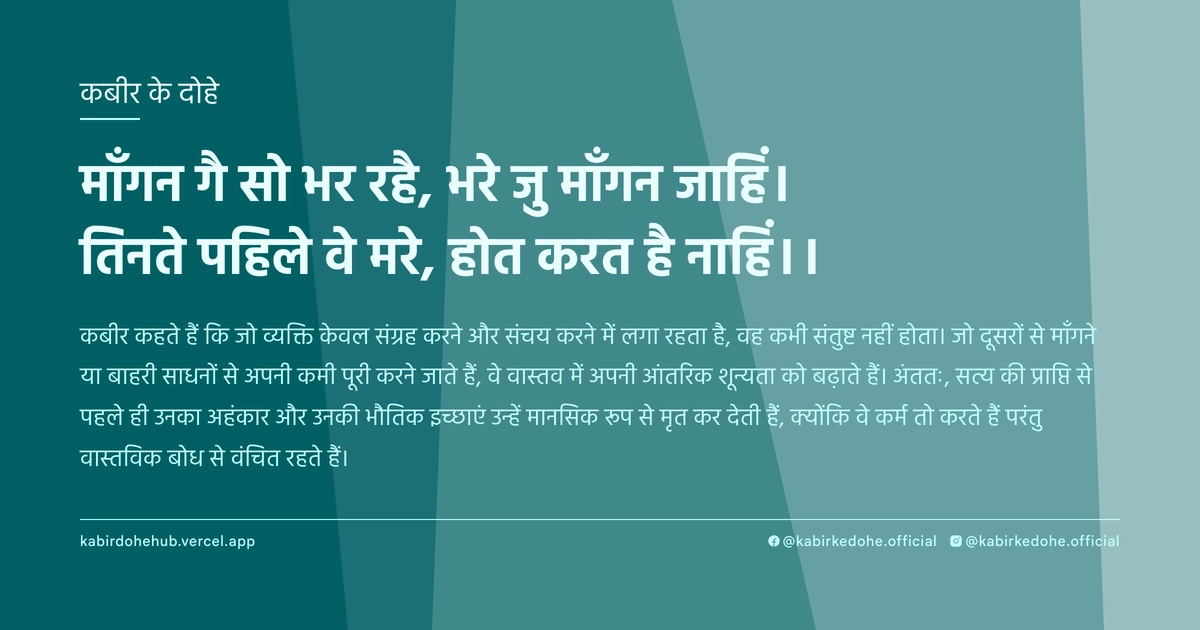
माँगन गै सो भर रहै, भरे जु माँगन जाहिं।
तिनते पहिले वे मरे, होत करत है नाहिं।।
Maangan gai so bhar rahai, bhare ju maangan jahin. Tinte pahile ve mare, hot karat hai nahin.
इस पृष्ठ पर इस कबीर दोहे का अर्थ (meaning), हिंदी व्याख्या और अंग्रेज़ी अनुवाद, दार्शनिक विश्लेषण और व्यावहारिक जीवन सीख दी गई है। यह दोहा संतोष (Contentment) विषय से जुड़ा है — Kabir doha meaning and explanation in Hindi and English.
अर्थ (Meaning):
कबीर कहते हैं कि जो व्यक्ति केवल संग्रह करने और संचय करने में लगा रहता है, वह कभी संतुष्ट नहीं होता। जो दूसरों से माँगने या बाहरी साधनों से अपनी कमी पूरी करने जाते हैं, वे वास्तव में अपनी आंतरिक शून्यता को बढ़ाते हैं। अंततः, सत्य की प्राप्ति से पहले ही उनका अहंकार और उनकी भौतिक इच्छाएं उन्हें मानसिक रूप से मृत कर देती हैं, क्योंकि वे कर्म तो करते हैं परंतु वास्तविक बोध से वंचित रहते हैं।
Kabir asserts that the one preoccupied with accumulation and hoarding never finds fulfillment. Those who seek to fill their void by begging or relying on external sources only deepen their inner emptiness. Ultimately, before achieving spiritual truth, they are rendered spiritually dead by their own greed and ego; though they remain active in the world, their actions are devoid of true consciousness or purpose.
व्याख्या (Interpretation):
इस दोहे का शाब्दिक अर्थ संचय की व्यर्थता है, लेकिन इसका गहरा आध्यात्मिक संकेत 'माया' और 'अहंकार' की ओर है। 'भरना' यहाँ केवल भौतिक धन नहीं, बल्कि मानसिक तृष्णाओं का प्रतीक है। कबीर निरगुण भक्ति के माध्यम से समझाते हैं कि जब तक मनुष्य स्वयं को एक अलग इकाई (अहंकार) मानकर बाहरी दुनिया से पूर्णता खोजता है, वह अद्वैत के सत्य से दूर रहता है। यह एक विरोधाभास है: जो जितना अधिक भरने की कोशिश करता है, वह उतना ही रिक्त होता जाता है। आत्मा (Atman) स्वभाव से पूर्ण है, लेकिन जब वह शरीर और सामाजिक पहचान के भ्रम में फंसकर 'माँगने' लगता है, तो वह अपनी मूल दिव्यता को खो देता है। यहाँ 'मृत्यु' शारीरिक नहीं, बल्कि चेतना की मृत्यु है, जहाँ व्यक्ति जीवित होते हुए भी आत्म-बोध से शून्य रहता है।
Literally, this couplet addresses the futility of accumulation, but metaphorically, it targets 'Maya' (illusion) and the 'Ahamkara' (ego). 'Filling' here symbolizes not just material wealth, but the insatiable psychological thirst for validation and possession. Through the lens of Nirgun Bhakti, Kabir explains that as long as a human perceives themselves as a separate entity seeking completeness from the external world, they remain distanced from the truth of Advaita (non-duality). It is a spiritual paradox: the more one attempts to 'fill' their life, the emptier they become. The Atman is inherently complete, yet when it identifies with the limited body and social persona and begins to 'beg' for fulfillment, it loses sight of its own divinity. The 'death' mentioned here is not biological, but the death of consciousness, where a person exists physically but remains spiritually void.
दार्शनिक विश्लेषण (Philosophical Analysis):
कबीर का यह दृष्टिकोण उनके समय के धार्मिक पाखंड और कर्मकांडीय संचय के विरुद्ध एक कड़ा प्रहार है। मध्यकालीन भारत में, धर्म का उपयोग अक्सर सामाजिक प्रतिष्ठा और आध्यात्मिक 'पुण्य' के संचय के लिए किया जाता था। कबीर ने इस 'पुण्य संचय' की अवधारणा को नकारते हुए कहा कि मोक्ष किसी बाहरी वस्तु या अनुष्ठान को इकट्ठा करने से नहीं, बल्कि अहंकार के विसर्जन से मिलता है।
अद्वैत वेदांत के परिप्रेक्ष्य में, यह दोहा 'अविद्या' (अज्ञान) की व्याख्या करता है। जब जीव यह मानता है कि वह अधूरा है और उसे कुछ 'प्राप्त' करना है, तो वह द्वैत (duality) के जाल में फंस जाता है। यह विचार कि 'मैं' और 'ईश्वर' अलग हैं और मुझे ईश्वर की कृपा या बाहरी साधनों की आवश्यकता है, वास्तव में अहंकार का ही एक सूक्ष्म रूप है।
सूफी मत के 'फना' (annihilation) के सिद्धांत से जोड़कर देखें तो, जब तक 'मैं' जीवित है, तब तक 'सत्य' प्रकट नहीं हो सकता। जो व्यक्ति बाहरी दुनिया में अपनी पहचान और संपत्ति को 'भरने' में लगा है, वह वास्तव में अपनी आत्मा की आवाज़ को दबा रहा है। यह मानसिक संचय एक पर्दे की तरह है जो मनुष्य को उसके वास्तविक स्वरूप से अलग करता है।
मनोवैज्ञानिक स्तर पर, कबीर यहाँ 'तृष्णा' (craving) के चक्र की बात कर रहे हैं। आधुनिक मनोविज्ञान भी मानता है कि बाहरी उपलब्धियों से मिलने वाली संतुष्टि क्षणिक होती है। कबीर इसे 'मृत्यु' कहते हैं क्योंकि यह प्रक्रिया मनुष्य की रचनात्मकता और उसकी सहज करुणा को समाप्त कर देती है, जिससे वह केवल एक मशीन बनकर रह जाता है।
अंततः, कबीर का संदेश यह है कि वास्तविक 'पूर्णता' संचय में नहीं, बल्कि त्याग और शून्य होने में है। जब मनुष्य यह जान लेता है कि वह स्वयं ही वह पूर्ण ब्रह्म है, तब माँगने की आवश्यकता समाप्त हो जाती है। यही वह बिंदु है जहाँ 'होत करत' (क्रियाएँ) सार्थक होती हैं, अन्यथा वे केवल समय की बर्बादी हैं।
Kabir’s perspective is a sharp critique of the religious hypocrisy and ritualistic accumulation prevalent during his era. In medieval India, religion was often weaponized to accumulate social prestige and spiritual 'merit' (punya). Kabir rejects this notion of 'merit-hoarding,' arguing that liberation is not achieved by collecting external objects or performing rites, but through the dissolution of the ego.
From the lens of Advaita Vedanta, this doha explains 'Avidya' (ignorance). When a being believes they are incomplete and must 'acquire' something to be whole, they fall into the trap of duality. The belief that 'I' and 'the Divine' are separate, and that I need external grace or tools to bridge that gap, is actually a subtle manifestation of the ego.
Connecting this to the Sufi concept of 'Fana' (annihilation), as long as the 'I' persists, the Truth cannot manifest. The person preoccupied with filling their identity and possessions in the external world is effectively silencing the voice of their own soul. This mental accumulation acts as a veil, separating the human from their primordial nature.
Psychologically, Kabir is addressing the cycle of 'Trishna' (craving). Modern psychology confirms that satisfaction derived from external achievements is ephemeral. Kabir calls this a form of 'death' because this process erodes a person's innate creativity and compassion, reducing them to a mere biological machine driven by desire.
Ultimately, Kabir’s message is that true 'fullness' lies not in accumulation, but in renunciation and becoming 'zero.' When a person realizes they are themselves the complete Brahman, the need to beg or seek vanishes. This is the point where 'action' becomes meaningful; otherwise, it is merely a futile expenditure of life force.
मूल संदेश (Core Message):
- बाहरी संचय आंतरिक शून्यता का पर्दा है।
- माँगने की प्रवृत्ति अहंकार की अधीनता है।
- पूर्णता प्राप्त नहीं की जाती, वह अनुभव की जाती है।
- संग्रह की भूख आध्यात्मिक चेतना को मार देती है।
- शून्यता में ही वास्तविक पूर्णता का वास है।
- अहंकार का विसर्जन ही एकमात्र वास्तविक उपलब्धि है।
- External accumulation is a veil over inner emptiness.
- The urge to beg is a submission to the ego.
- Fullness is not acquired; it is realized.
- The hunger for hoarding kills spiritual consciousness.
- True completeness resides within absolute emptiness.
- The dissolution of ego is the only real achievement.
व्यावहारिक उदाहरण (Practical Example):
वाराणसी के एक पुराने घाट पर रहने वाले रामदीन नाम के एक वृद्ध बुनकर थे। रामदीन का पूरा जीवन केवल एक ही लक्ष्य में बीता—अधिक से अधिक रेशमी वस्त्र बुनना और उन्हें बेचकर धन संचित करना। उनका मानना था कि जिस दिन उनके पास पर्याप्त स्वर्ण मुद्राएँ होंगी, उस दिन वे शांति से पूजा-पाठ करेंगे और मोक्ष प्राप्त करेंगे। वे दिन-रात काम करते, नींद त्याग देते और अपने परिवार की खुशियों को भी धन की भूख के नीचे दबा देते।
रामदीन ने अपने जीवन के साठ साल इसी 'भरने' की प्रक्रिया में लगा दिए। उन्होंने अपने घर को बड़ा किया, अनाज के गोदाम भरे और शहर के सबसे अमीर बुनकरों में गिने जाने लगे। लेकिन जैसे-जैसे उनका धन बढ़ा, उनकी बेचैनी भी बढ़ती गई। उन्हें डर लगने लगा कि कोई उनका धन चुरा न ले, या व्यापार में घाटा न हो जाए। वे अब सोने के बिस्तर पर सोते थे, लेकिन नींद उनके पास से कोसों दूर थी।
एक दिन, उनके घर के पास एक फकीर आया जो केवल एक फटे हुए कंबल में लिपटा था, लेकिन उसके चेहरे पर एक ऐसी शांति थी जिसे रामदीन ने अपने करोड़ों रुपयों में कभी नहीं पाया। रामदीन ने अहंकारवश उस फकीर से पूछा, 'तुम्हारे पास तो कुछ नहीं है, फिर भी तुम इतने प्रसन्न कैसे हो? मैं सब कुछ पाकर भी अशांत हूँ।'
फकीर ने मुस्कुराकर रामदीन के भरे हुए गोदामों की ओर इशारा किया और कहा, 'तुमने अपनी तिजोरियाँ तो भर लीं, लेकिन अपनी आत्मा को खाली कर दिया। तुम जिस पूर्णता को बाहर खोज रहे हो, वह तुम्हारे भीतर ही थी, जिसे तुमने लालच की धूल से ढक दिया। तुम जीवित तो हो, लेकिन तुम्हारी शांति मर चुकी है।'
यह शब्द रामदीन के हृदय पर बिजली की तरह गिरे। उन्होंने महसूस किया कि वे अब तक केवल एक 'संग्रहकर्ता' थे, 'साधक' नहीं। उन्होंने देखा कि उनकी पूरी जिंदगी केवल 'माँगने' और 'इकट्ठा करने' की एक अंतहीन दौड़ थी, जिसमें वे कभी नहीं जीते।
उस रात रामदीन को पहली बार अपनी आंतरिक शून्यता का अहसास हुआ। उन्होंने महसूस किया कि जिस 'पूर्णता' के लिए वे भाग रहे थे, वह वास्तव में एक भ्रम था। उन्होंने तय किया कि वे अब धन का संचय नहीं, बल्कि प्रेम और सेवा का विस्तार करेंगे।
अगले कुछ महीनों में, रामदीन ने अपने गोदामों का एक बड़ा हिस्सा गरीब बुनकरों के बच्चों की शिक्षा के लिए दान कर दिया। उन्होंने अपनी कार्यशैली बदली; अब वे केवल लाभ के लिए नहीं, बल्कि कला की संतुष्टि के लिए बुनने लगे।
जैसे-जैसे उन्होंने अपनी पकड़ ढीली की, उनका मानसिक बोझ कम होने लगा। जिस शांति को वे स्वर्ण मुद्राओं में खोज रहे थे, वह उन्हें दूसरों की मदद करने और स्वयं को शून्य करने में मिली। रामदीन अब वास्तव में 'जीवित' महसूस कर रहे थे, क्योंकि उन्होंने संचय की मृत्यु को त्यागकर विसर्जन के जीवन को अपनाया था।
In the ancient ghats of Varanasi lived an elderly weaver named Ramdeen. Ramdeen's entire life was driven by a single goal—to weave as many silk garments as possible and accumulate wealth. He believed that the day he possessed enough gold coins, he would finally be able to worship in peace and attain salvation. He worked day and night, sacrificing sleep and suppressing his family's happiness beneath his hunger for gold.
Ramdeen spent sixty years of his life in this process of 'filling.' He expanded his house, filled granaries, and became one of the wealthiest weavers in the city. However, as his wealth grew, so did his anxiety. He became paranoid that someone would steal his riches or that his business would fail. He slept on a bed of gold, yet sleep remained miles away from him.
One day, a fakir arrived near his home, wrapped in nothing but a tattered blanket, yet possessing a serenity that Ramdeen had never found in his millions. Out of ego, Ramdeen asked the fakir, 'You have nothing, yet you are so content. I have everything, yet I am restless.'
The fakir smiled, pointed toward Ramdeen's overflowing warehouses, and said, 'You have filled your coffers, but you have emptied your soul. The completeness you seek outside was always within you, but you covered it with the dust of greed. You are alive, but your peace is dead.'
These words struck Ramdeen like a bolt of lightning. He realized he had been merely a 'collector,' not a 'seeker.' He saw that his entire life had been an endless race of 'begging' and 'hoarding,' a race in which he had never actually won.
That night, Ramdeen felt his inner void for the first time. He understood that the 'fullness' he was chasing was a mirage. He decided that henceforth, he would not accumulate wealth, but expand love and service.
Over the next few months, Ramdeen donated a large portion of his warehouses to fund the education of poor weavers' children. He changed his way of working; he no longer wove for profit, but for the sheer satisfaction of the art.
As he loosened his grip on possession, his mental burden lightened. The peace he had sought in gold coins was found in helping others and emptying himself. Ramdeen finally felt 'alive' because he had abandoned the death of accumulation and embraced the life of surrender.
अभ्यास मार्गदर्शन (Practice Guidance):
- दैनिक चिंतन: प्रतिदिन 15 मिनट मौन बैठें और विचार करें कि आपकी कौन सी इच्छाएं आपको 'अधूरा' महसूस कराती हैं। यह पहचानें कि क्या आप बाहरी वस्तुओं से अपनी आंतरिक शून्यता भरने की कोशिश कर रहे हैं।
- आत्म-पूछताछ जर्नल: एक डायरी लिखें जिसमें उन क्षणों को दर्ज करें जब आपने किसी वस्तु या प्रशंसा की 'माँग' की। पूछें: 'यदि यह वस्तु मुझे नहीं मिलती, तो क्या मेरी आत्मा की शांति वास्तव में कम हो जाएगी?'
- व्यवहारिक परिवर्तन: सप्ताह में एक बार ऐसी वस्तु का त्याग करें या दान करें जिसे आप 'जरूरी' मानकर पकड़ कर बैठे हैं। यह अभ्यास करें कि 'छोड़ने' से रिक्तता नहीं, बल्कि हल्कापन आता है।
- नैदानिक चेकलिस्ट (Diagnostic Checklist): यदि आप निम्नलिखित अनुभव कर रहे हैं, तो आप 'संग्रह की मृत्यु' की ओर हैं: 1. अधिक पाने के बाद भी असंतोष। 2. खोने का निरंतर डर। 3. दूसरों की सफलता से जलन। 4. वर्तमान क्षण के बजाय भविष्य की सुरक्षा की चिंता।
- Daily Contemplation: Sit in silence for 15 minutes daily and reflect on which desires make you feel 'incomplete.' Identify whether you are attempting to fill an inner void with external objects.
- Self-Inquiry Journal: Maintain a diary recording moments when you 'begged' for a thing or validation. Ask yourself: 'If I do not receive this, will the peace of my soul truly diminish?'
- Behavioral Shift: Once a week, renounce or donate an item you consider 'essential' to hold onto. Practice the realization that 'letting go' brings lightness, not emptiness.
- Diagnostic Checklist: You are experiencing the 'death of accumulation' if: 1. Dissatisfaction persists despite gaining more. 2. A constant fear of loss. 3. Envy of others' success. 4. Anxiety about future security rather than presence in the now.
चिंतन प्रश्न (Reflection Questions):
- आपकी वह कौन सी 'डिजिटल पहचान' है जिसे आप दुनिया की नजरों में 'भरने' की कोशिश कर रहे हैं?
- क्या आपकी उदारता वास्तव में त्याग है, या यह 'पुण्य' संचित करने का एक सूक्ष्म तरीका है?
- यदि आपकी सारी सामाजिक उपलब्धियां छीन ली जाएं, तो क्या आपके भीतर कुछ बचेगा?
- आप किन गुप्त पूर्वाग्रहों के कारण दूसरों को स्वयं से 'कम' या 'अधिक' मानते हैं?
- क्या आप वास्तव में जीवित हैं, या केवल अपनी आदतों और इच्छाओं का एक पुतला मात्र हैं?
- वह कौन सा डर है जो आपको पूरी तरह से 'शून्य' होने से रोकता है?
- What 'digital identity' are you trying to 'fill' in the eyes of the world?
- Is your generosity a true renunciation, or a subtle way of hoarding 'spiritual merit'?
- If all your social achievements were stripped away, would anything remain within you?
- Which hidden biases lead you to perceive others as 'less' or 'more' than yourself?
- Are you truly alive, or merely a puppet of your habits and desires?
- What is the specific fear that prevents you from becoming completely 'zero'?