
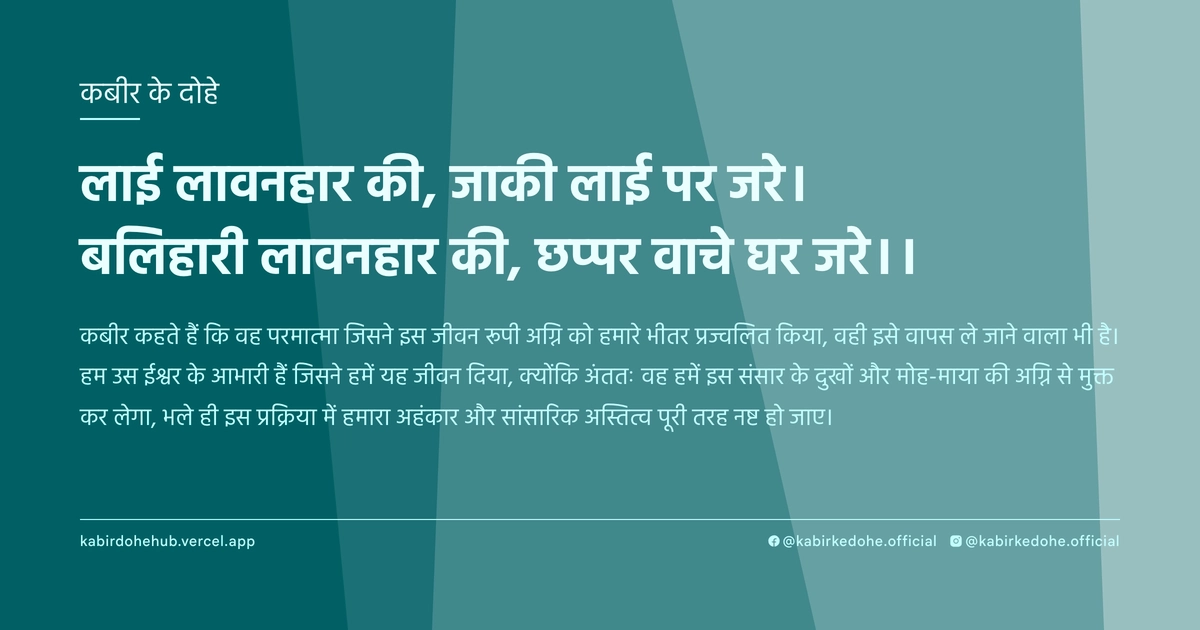
लाई लावनहार की, जाकी लाई पर जरे।
बलिहारी लावनहार की, छप्पर वाचे घर जरे।।
Laai lavanhaar ki, jaaki laai par jare. Balihari lavanhaar ki, chhappar vaache ghar jare.
इस पृष्ठ पर इस कबीर दोहे का अर्थ (meaning), हिंदी व्याख्या और अंग्रेज़ी अनुवाद, दार्शनिक विश्लेषण और व्यावहारिक जीवन सीख दी गई है। यह दोहा प्रपत्ति (Surrender) विषय से जुड़ा है — Kabir doha meaning and explanation in Hindi and English.
अर्थ (Meaning):
कबीर कहते हैं कि वह परमात्मा जिसने इस जीवन रूपी अग्नि को हमारे भीतर प्रज्वलित किया, वही इसे वापस ले जाने वाला भी है। हम उस ईश्वर के आभारी हैं जिसने हमें यह जीवन दिया, क्योंकि अंततः वह हमें इस संसार के दुखों और मोह-माया की अग्नि से मुक्त कर लेगा, भले ही इस प्रक्रिया में हमारा अहंकार और सांसारिक अस्तित्व पूरी तरह नष्ट हो जाए।
Kabir asserts that the Divine Creator who brought this spark of life into existence is the same one who will eventually reclaim it. We owe our gratitude to the Eternal Source because, while the fire of worldly existence consumes our temporary identity, the Divine ensures that the core essence is liberated from the burning house of material illusions.
व्याख्या (Interpretation):
इस दोहे का शाब्दिक अर्थ एक ऐसे घर से है जहाँ छत बच गई लेकिन पूरा घर जल गया। यहाँ 'घर' मानव शरीर और अहंकार का प्रतीक है, और 'छप्पर' उस शुद्ध आत्मा या परमात्मा का प्रतीक है जो अविनाशी है। कबीर निर्गुण भक्ति के माध्यम से समझाते हैं कि माया रूपी अग्नि सब कुछ जला देती है, लेकिन जो वास्तव में 'लावनहार' (परमात्मा) है, वह हमें इस बंधन से मुक्त करता है। यह अद्वैत वेदांत के उस सत्य को दर्शाता है जहाँ जीव और ब्रह्म एक ही हैं। जब अहंकार (घर) जलकर नष्ट होता है, तभी आत्मा (छप्पर) की वास्तविकता प्रकट होती है। यह विरोधाभास है कि विनाश ही वास्तव में मुक्ति का मार्ग है।
Literally, the verse describes a house where the roof remains while the structure burns. Here, the 'house' symbolizes the human body and the ego, while the 'roof' represents the eternal Atman or the Divine essence that remains untouched. Through the lens of Nirgun Bhakti, Kabir explains that the fire of Maya consumes all transient attachments. This aligns with Advaita Vedanta, where the illusion of separation is incinerated to reveal the non-duality of the self and the Absolute. The central paradox is that the destruction of the worldly identity is the only way to preserve the spiritual essence. The 'Lavanhaar' is the cosmic force that initiates and concludes the cycle of existence, ensuring that only the Truth survives the blaze.
दार्शनिक विश्लेषण (Philosophical Analysis):
कबीर का यह दोहा उस युग की उपज है जब समाज कर्मकांडों और बाहरी आडंबरों में फंसा था। वे स्पष्ट करते हैं कि मोक्ष किसी मंदिर या मस्जिद में नहीं, बल्कि स्वयं के भीतर के अहंकार के विसर्जन में है। यहाँ 'जलाने' की प्रक्रिया वास्तव में आध्यात्मिक शुद्धिकरण है। सूफी मत के 'फना' (अहंकार का विनाश) की अवधारणा यहाँ स्पष्ट दिखती है, जहाँ साधक स्वयं को ईश्वर में विलीन कर देता है।
वेदांत के अनुसार, हम जिसे अपना 'मैं' समझते हैं, वह केवल एक मानसिक रचना है। जब यह रचना जल जाती है, तो केवल शुद्ध चेतना बचती है। कबीर का विद्रोह उन लोगों के प्रति है जो बाहरी सुरक्षा (धर्म, जाति, पद) को अपना 'छप्पर' समझते हैं। वे सिखाते हैं कि वास्तविक सुरक्षा केवल उस परमात्मा में है जो जन्म और मृत्यु दोनों का स्वामी है।
मनोवैज्ञानिक स्तर पर, यह दोहा स्वीकार्यता (Acceptance) की बात करता है। मृत्यु का भय तब समाप्त होता है जब हम यह समझ लेते हैं कि हम शरीर नहीं, बल्कि वह तत्व हैं जिसे नष्ट नहीं किया जा सकता। यह भय से मुक्ति की यात्रा है।
कबीर यहाँ यह भी संकेत देते हैं कि जीवन एक ऋण है जिसे अंततः चुकाना होगा। जो व्यक्ति इस सत्य को स्वीकार कर लेता है, वह जीवन के उतार-चढ़ाव में विचलित नहीं होता। वह जानता है कि जो आया है, वह जाएगा, और यही चक्र शाश्वत है।
अंततः, यह विश्लेषण हमें इस निष्कर्ष पर ले जाता है कि भक्ति केवल प्रार्थना नहीं, बल्कि पूर्ण समर्पण है। जब हम कहते हैं 'बलिहारी', तो हम अपनी पूरी सत्ता को उस अनंत में सौंप देते हैं, जिससे द्वैत समाप्त हो जाता है और केवल अद्वैत शेष रहता है।
This Doha emerges from an era dominated by rigid ritualism and caste hierarchies. Kabir rejects these external shells, arguing that liberation is found not in shrines, but in the dissolution of the ego. The 'burning' described is not a physical tragedy but a spiritual alchemy—the process of purifying the soul by incinerating the false self. This closely mirrors the Sufi concept of 'Fana', the annihilation of the individual ego in the Divine Presence.
From the perspective of Advaita Vedanta, the 'house' is the Maya-constructed identity. We mistake the walls of our social status, beliefs, and physical form for our true self. Kabir suggests that the fire of spiritual awakening must consume these illusions to reveal the 'roof'—the unchanging Brahman. He challenges the notion of worldly security, asserting that only the Divine is a reliable refuge.
Psychologically, the verse addresses the fundamental human fear of death and loss. By framing the Divine as the 'Lavanhaar' (the one who brings and takes away), Kabir transforms the terror of annihilation into a sense of gratitude. The realization that the essence is indestructible allows the seeker to face the transience of life with equanimity.
Kabir also emphasizes the concept of cosmic debt. Life is a loan from the Infinite, and death is the repayment. Those who cling to the 'house' suffer; those who surrender to the 'Lavanhaar' find peace. This shift from grasping to letting go is the core of his mystical teaching.
Ultimately, the philosophical weight of this verse lies in the transition from duality to non-duality. The act of 'Balihari' (sacrificial gratitude) is the final step where the seeker stops fighting the fire and instead welcomes the transformation, realizing that the burner and the burnt are one and the same.
मूल संदेश (Core Message):
- अहंकार का विनाश ही वास्तविक आध्यात्मिक उदय है।
- संसार एक अस्थायी बसेरा है, इसे घर न समझें।
- परमात्मा ही जीवन का दाता और हरणकर्ता है।
- मोह की अग्नि में जलकर ही आत्मा शुद्ध होती है।
- शाश्वत सत्य केवल वही है जो समय से परे है।
- The incineration of the ego is the only true spiritual awakening.
- The world is a transient shelter; do not mistake it for a permanent home.
- The Divine is both the giver of life and the one who reclaims it.
- Only by burning in the fire of detachment does the soul become pure.
- The only eternal truth is that which exists beyond the reach of time.
व्यावहारिक उदाहरण (Practical Example):
वाराणसी के एक पुराने घाट पर रहने वाले एक वृद्ध बुनकर, माधव, का जीवन सादगी और संतोष का उदाहरण था। माधव ने अपना पूरा जीवन बेहतरीन रेशमी साड़ियाँ बुनने में बिताया, लेकिन उसका असली धन उसकी आध्यात्मिक समझ थी।
एक समय आया जब शहर में भीषण आग लगी और माधव की छोटी सी झोपड़ी, जिसमें उसके जीवन भर की जमा पूँजी और करघे थे, पूरी तरह जलकर राख हो गए। उसके पड़ोसी उसे सांत्वना देने आए और उसके नुकसान पर शोक व्यक्त किया।
माधव के चेहरे पर कोई शिकन नहीं थी। उसने शांत भाव से मुस्कुराते हुए कहा, "जिसने यह सब दिया था, उसने आज इसे वापस ले लिया। मेरा घर तो जल गया, लेकिन मेरी आत्मा का छप्पर अभी भी सुरक्षित है।"
लोग हैरान थे कि वह इस विनाश में भी इतना शांत कैसे था। माधव ने उन्हें समझाया कि वह अब तक उन कपड़ों और पैसों को अपनी पहचान समझता था, लेकिन आग ने उसे उस बोझ से मुक्त कर दिया।
उसने महसूस किया कि वह अब तक अपनी संपत्ति की सुरक्षा करने में इतना व्यस्त था कि उसने कभी उस 'लावनहार' को याद ही नहीं किया जिसने उसे यह जीवन दिया था।
इस घटना के बाद, माधव का व्यवहार और भी अधिक उदार हो गया। उसने जो कुछ भी बचा था, वह गरीबों में बाँट दिया और अपना समय दूसरों को शांति का मार्ग दिखाने में बिताने लगा।
उसने पाया कि जब खोने के लिए कुछ नहीं बचता, तब इंसान वास्तव में स्वतंत्र होता है। उसका डर पूरी तरह समाप्त हो गया था।
गाँव के लोग, जो पहले उसे केवल एक साधारण बुनकर समझते थे, अब उसे एक संत की दृष्टि से देखने लगे।
माधव की कहानी यह सिखाती है कि भौतिक हानि वास्तव में एक अवसर है अपनी आंतरिक संपदा को खोजने का।
उसने 'कबीर ट्विस्ट' को जीया: उसने विनाश को विनाश नहीं, बल्कि एक दिव्य विदाई माना, जिससे उसका अहंकार जल गया और केवल प्रेम शेष रहा।
In the ancient alleys of Varanasi, there lived an elderly weaver named Madhav. His life was a tapestry of simplicity and profound contentment, spending his days crafting exquisite silk sarees.
One devastating night, a massive fire swept through the neighborhood, reducing Madhav's small hut—containing his looms and all his life's savings—to a heap of grey ash.
His neighbors rushed to him, their faces clouded with pity, mourning the total loss of his worldly possessions. They expected him to be broken by the tragedy.
However, Madhav stood amidst the ruins with a serene smile. He looked at the embers and whispered, "The One who brought these things into my life has simply reclaimed them today."
When asked how he could remain so calm, Madhav explained that he had spent decades identifying himself with his wealth and his craft, treating them as his true home.
He realized that the fire had done him a favor by incinerating the walls of his attachment, leaving only the 'roof' of his eternal spirit untouched.
For the first time in years, he felt a lightness in his chest, as if a heavy cloak of anxiety had been lifted from his shoulders.
Following this event, Madhav became even more generous, distributing the few remnants of his belongings to the needy and spending his days teaching others the art of detachment.
He discovered that when there is nothing left to lose, a human being becomes truly invincible and free from the shackles of fear.
The villagers, who once saw him as a mere artisan, began to revere him as a sage who had mastered the art of living without clinging.
Madhav's life became a living testament to the 'Kabir Twist': he transformed a material catastrophe into a spiritual liberation, allowing his ego to burn so that only divine love could remain.
अभ्यास मार्गदर्शन (Practice Guidance):
- दैनिक चिंतन: प्रतिदिन 15 मिनट मौन बैठें और विचार करें कि आपके जीवन की कौन सी वस्तुएं या रिश्ते 'घर' (अस्थायी) हैं और आपकी आत्मा का कौन सा हिस्सा 'छप्पर' (शाश्वत) है।
- आत्म-पूछताछ जर्नल: एक डायरी लिखें जिसमें उन चीजों की सूची बनाएं जिन्हें आप खोने से डरते हैं। फिर लिखें कि यदि वे कल चले जाएं, तो आपके भीतर क्या शेष रहेगा।
- व्यवहारिक परिवर्तन: सप्ताह में एक बार ऐसी वस्तु का दान करें जो आपको बहुत प्रिय हो, ताकि आप सचेत रूप से आसक्ति (Attachment) को कम करना सीख सकें।
- डायग्नोस्टिक चेकलिस्ट: यदि आप किसी छोटी सी हानि पर अत्यधिक क्रोधित या दुखी होते हैं, तो समझें कि आप अभी भी 'घर' (अहंकार) से चिपके हुए हैं। यदि आप हानि में भी शांति पाते हैं, तो आप 'छप्पर' की ओर बढ़ रहे हैं।
- Daily Contemplation: Spend 15 minutes in silence daily, reflecting on which aspects of your life are the 'house' (transient) and which part of your essence is the 'roof' (eternal).
- Self-Inquiry Journaling: Maintain a journal listing the things you fear losing most. Then, write about what would remain of your identity if those things vanished tomorrow.
- Behavioral Shift: Once a week, consciously donate an object you are deeply attached to, practicing the art of letting go to weaken the grip of the ego.
- Diagnostic Checklist: If a minor loss triggers intense anger or despair, recognize that you are still clinging to the 'house'. If you can find equanimity in loss, you are aligning with the 'roof'.
चिंतन प्रश्न (Reflection Questions):
- यदि आज आपकी सामाजिक प्रतिष्ठा और डिजिटल पहचान पूरी तरह मिट जाए, तो आप स्वयं को कैसे परिभाषित करेंगे?
- क्या आप वास्तव में ईश्वर की इच्छा को स्वीकार करते हैं, या आप केवल तब स्वीकार करते हैं जब परिणाम आपके पक्ष में होते हैं?
- आपके जीवन का वह कौन सा 'छप्पर' है जिसे कोई भी सांसारिक आपदा नहीं जला सकती?
- क्या आपकी करुणा दूसरों के प्रति है, या वह केवल आपके अपने अहंकार को 'अच्छा' महसूस कराने का एक साधन है?
- मृत्यु का विचार आपको भयभीत करता है या यह आपको जीवन की क्षणभंगुरता के प्रति जागरूक करता है?
- If your social status and digital identity were completely erased today, how would you define yourself?
- Do you truly accept the Divine will, or do you only 'accept' it when the outcomes favor your desires?
- What is the 'roof' in your life—that singular essence which no worldly catastrophe can incinerate?
- Is your compassion truly for others, or is it merely a tool to make your ego feel 'virtuous'?
- Does the thought of death terrify you, or does it awaken you to the profound fragility and beauty of existence?