
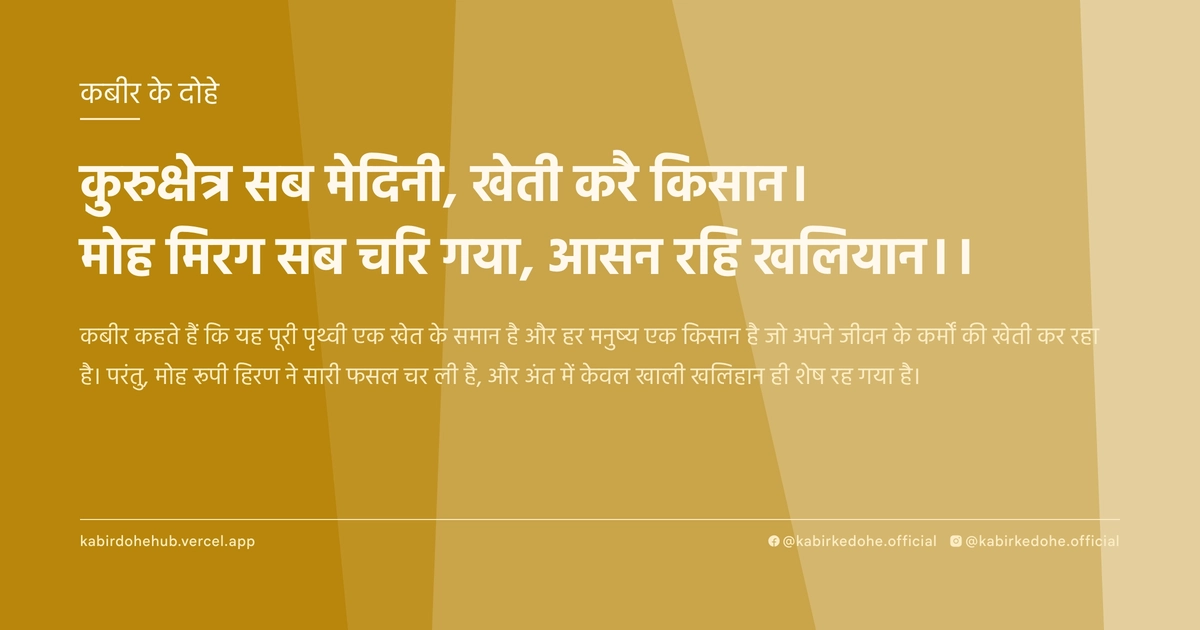
कुरुक्षेत्र सब मेदिनी, खेती करै किसान।
मोह मिरग सब चरि गया, आसन रहि खलियान।।
Kurukshetra sab medini, kheti karai kisan. Moh mirag sab chari gaya, aasan rahi khaliyan.
इस पृष्ठ पर इस कबीर दोहे का अर्थ (meaning), हिंदी व्याख्या और अंग्रेज़ी अनुवाद, दार्शनिक विश्लेषण और व्यावहारिक जीवन सीख दी गई है। यह दोहा मोह (Attachment) विषय से जुड़ा है — Kabir doha meaning and explanation in Hindi and English.
अर्थ (Meaning):
कबीर कहते हैं कि यह पूरी पृथ्वी एक खेत के समान है और हर मनुष्य एक किसान है जो अपने जीवन के कर्मों की खेती कर रहा है। परंतु, मोह रूपी हिरण ने सारी फसल चर ली है, और अंत में केवल खाली खलिहान ही शेष रह गया है।
Kabir posits that the entire earth is a vast field where every human being acts as a farmer, sowing the seeds of their actions. However, the deer of attachment (Moh) has grazed away the entire harvest, leaving the threshing floor empty and the soul devoid of spiritual fruit.
व्याख्या (Interpretation):
यहाँ 'मेदिनी' संसार का प्रतीक है और 'खेती' मानवीय प्रयासों और संचित कर्मों की। कबीर एक गहरे रूपक का उपयोग करते हैं जहाँ 'मोह' को एक चंचल हिरण बताया गया है जो अदृश्य रूप से हमारी आध्यात्मिक कमाई को नष्ट कर देता है। यह निरगुण भक्ति का सार है कि बाहरी कर्मकांड और सांसारिक आसक्तियाँ वास्तव में आत्मा को परमात्मा से दूर ले जाती हैं। जब मनुष्य माया के भ्रम में फँसा रहता है, तो वह समझता है कि वह संचय कर रहा है, जबकि वास्तव में वह अपनी मुक्ति की फसल खो रहा होता है। यह द्वैतवाद की त्रासदी है जहाँ व्यक्ति स्वयं को कर्ता मानता है, परंतु अंततः शून्य हाथ लेकर खड़ा रहता है।
In this verse, 'Medini' symbolizes the material world and 'farming' represents the accumulation of human deeds and desires. Kabir employs a profound metaphor where 'Moh' (attachment) is depicted as a restless deer that invisibly consumes the spiritual harvest. This aligns with Nirgun Bhakti, suggesting that external rituals and worldly attachments act as parasites on the soul's progress. While the individual believes they are prospering in the realm of Maya (illusion), they are actually depleting their spiritual capital. The central paradox lies in the human condition: the harder one clings to the ego's harvest, the emptier the spiritual threshing floor becomes, illustrating the non-duality of loss and liberation.
दार्शनिक विश्लेषण (Philosophical Analysis):
कबीर का यह दोहा उनके युग के सामाजिक और धार्मिक पाखंड पर एक तीखा प्रहार है। उन्होंने देखा कि लोग तीर्थयात्राओं और कर्मकांडों में समय व्यतीत कर रहे थे, जिसे वे 'पुण्य की खेती' समझते थे, जबकि उनका आंतरिक अहंकार और मोह बढ़ता जा रहा था। यह दृष्टिकोण अद्वैत वेदांत के करीब है, जहाँ संसार को एक मिथ्या या भ्रम माना गया है। कबीर तर्क देते हैं कि जब तक 'मैं' और 'मेरा' का भाव है, तब तक सत्य की प्राप्ति असंभव है।
सूफी मत के 'फना' (अहंकार का विनाश) के सिद्धांत की तरह, कबीर यहाँ यह समझा रहे हैं कि मोह का हिरण वास्तव में वह सूक्ष्म अहंकार है जो हमें यह विश्वास दिलाता है कि हम कुछ 'प्राप्त' कर रहे हैं। वास्तव में, आध्यात्मिक उपलब्धि 'प्राप्त करने' में नहीं, बल्कि 'छोड़ने' में है। वे कर्मकांडीय धर्म के बजाय सहज मार्ग और आंतरिक शुद्धि पर बल देते हैं।
मनोवैज्ञानिक स्तर पर, यह दोहा संज्ञानात्मक विसंगति (cognitive dissonance) को दर्शाता है। मनुष्य जीवन भर भौतिक सुखों को संचित करता है, लेकिन मृत्यु के समय उसे अहसास होता है कि वह सब व्यर्थ था। यह 'खाली खलिहान' उस मानसिक रिक्तता का प्रतीक है जो तब उत्पन्न होती है जब भौतिक इच्छाएँ पूरी हो जाती हैं लेकिन आत्मा अतृप्त रहती है।
कबीर यहाँ जाति और धर्म के भेदों को निरर्थक बताते हैं क्योंकि 'मोह' का हिरण सबको समान रूप से प्रभावित करता है। चाहे वह एक पंडित हो या एक जुलाहा, यदि हृदय में आसक्ति है, तो आध्यात्मिक फसल नष्ट हो जाएगी। यह सार्वभौमिक सत्य उन्हें एक क्रांतिकारी समाज सुधारक बनाता है।
अंततः, यह विश्लेषण हमें यह समझने पर मजबूर करता है कि वास्तविक 'खेती' वह है जो निस्वार्थ भाव से, बिना किसी फल की इच्छा के की जाए। जब किसान (साधक) मोह का त्याग कर देता है, तभी वह उस अनंत फसल का स्वामी बनता है जो कभी नष्ट नहीं होती। यह भौतिकता से आध्यात्मिकता की ओर संक्रमण की यात्रा है।
Kabir's couplet is a sharp critique of the social and religious hypocrisy of his era. He observed people spending lifetimes in pilgrimages and rituals, perceiving them as 'spiritual farming,' while their internal ego and attachments grew unchecked. This perspective closely aligns with Advaita Vedanta, where the material world is viewed as Maya—a cosmic illusion that veils the ultimate reality of the Atman-Brahman non-duality.
Drawing parallels with the Sufi concept of 'Fana' (the annihilation of the self), Kabir illustrates that the 'deer of attachment' is actually the subtle ego. This ego tricks the seeker into believing they are 'acquiring' salvation, whereas true spiritual liberation is found not in acquisition, but in the systematic shedding of the false self. He champions the 'Sahaj Marg' (the natural path) over rigid ritualism.
Psychologically, the verse addresses the tragedy of human desire. We spend our lives accumulating material wealth and social status, only to realize at the threshold of death that these are ephemeral. The 'empty threshing floor' symbolizes the existential void that remains when the distractions of the world fade, leaving the soul bankrupt of genuine peace.
Kabir transcends the caste and religious divides of his time by pointing out that the deer of Moh is an equalizer; it consumes the spiritual merits of the priest and the weaver alike. By stripping away these identities, he forces the listener to confront their raw, spiritual nakedness, suggesting that the only valid identity is that of the seeker.
Ultimately, this analysis reveals that the only 'harvest' worth pursuing is that of selfless action (Karma Yoga) performed without attachment to the fruits. When the farmer ceases to identify with the crop and instead identifies with the Source, the threshing floor is no longer empty, but overflows with the timeless presence of the Divine.
मूल संदेश (Core Message):
- सांसारिक संचय अक्सर आध्यात्मिक रिक्तता का कारण बनता है।
- मोह वह अदृश्य शत्रु है जो हमारी वास्तविक कमाई को नष्ट करता है।
- सच्ची फसल वह है जो अहंकार के बिना बोई और काटी जाए।
- बाहरी समृद्धि आंतरिक दरिद्रता को छिपाने का एक मुखौटा मात्र है।
- मुक्ति का मार्ग 'पाने' में नहीं, बल्कि 'छोड़ने' की कला में है।
- Worldly accumulation often leads to profound spiritual bankruptcy.
- Attachment is the invisible parasite that consumes our true spiritual merit.
- The only harvest that lasts is that which is sown without ego.
- External prosperity is often a mask hiding internal poverty.
- Liberation lies not in the art of acquiring, but in the art of letting go.
व्यावहारिक उदाहरण (Practical Example):
वाराणसी के एक पुराने घाट पर माधव नाम का एक वृद्ध नाविक रहता था। माधव का पूरा जीवन नाव चलाने और यात्रियों को पार उतारने में बीता। उसने अपनी पूरी मेहनत से बहुत धन संचित किया और एक बड़ा पक्का मकान बनाया। वह शहर के सबसे समृद्ध नाविकों में गिना जाता था।
माधव का मानना था कि उसकी यह संपत्ति उसके बच्चों के लिए एक सुरक्षित भविष्य है। वह दिन-रात इसी चिंता में रहता कि उसकी संपत्ति कम न हो जाए। उसने अपने परिवार और रिश्तों को किनारे कर दिया ताकि वह और अधिक धन कमा सके। उसके लिए उसकी नाव और उसका घर ही उसकी पूरी दुनिया थे।
एक दिन, माधव की मुलाकात एक घुमक्कड़ साधु से हुई, जो कबीर के पदों का गान कर रहा था। साधु ने माधव की संपत्ति देखी और मुस्कुराते हुए कहा, 'माधव, तुम्हारी फसल तो बहुत बड़ी है, लेकिन क्या तुमने देखा कि मोह का हिरण उसे धीरे-धीरे चर रहा है?'
माधव को पहले यह बात समझ नहीं आई। उसने सोचा कि उसके पास तो सब कुछ है, फिर कमी क्या है? लेकिन उस रात उसे एक सपना आया। उसने देखा कि उसका आलीशान घर रेत का बना है और एक छोटा सा हिरण उसकी दीवारों को कुतर रहा है। जैसे-जैसे हिरण खाता, घर ढहता जाता और माधव असहाय खड़ा देखता रहा।
जागने के बाद माधव गहरे संकट में पड़ गया। उसने महसूस किया कि जिस संपत्ति पर उसे गर्व था, उसने वास्तव में उसे अपनों से दूर कर दिया था। उसके बच्चे उससे बात नहीं करते थे और उसकी पत्नी केवल उसकी संपत्ति की देखभाल करने वाली एक नौकरानी बनकर रह गई थी।
उसने महसूस किया कि उसने 'धन की खेती' तो की, लेकिन 'प्रेम और शांति की फसल' को मोह के हिरण ने चर लिया था। उसका खलिहान भौतिक रूप से भरा था, लेकिन आध्यात्मिक रूप से वह पूरी तरह खाली था।
इस अहसास ने माधव को बदल दिया। उसने अपनी संपत्ति का एक बड़ा हिस्सा अनाथालय और गरीबों के लिए दान कर दिया। उसने अपने परिवार के साथ समय बिताना शुरू किया और नाव चलाने को केवल व्यवसाय नहीं, बल्कि सेवा का माध्यम बनाया।
अब माधव जब नाव चलाता, तो वह केवल पैसे के लिए नहीं, बल्कि यात्रियों के चेहरों पर मुस्कान देखने के लिए चलाता। उसने पाया कि जब उसने 'पकड़ने' की इच्छा छोड़ी, तो उसका जीवन वास्तव में समृद्ध हो गया।
उसका खलिहान अब खाली नहीं था; वह संतोष, करुणा और आंतरिक शांति की फसल से भरा हुआ था। माधव ने जान लिया था कि असली समृद्धि वह है जो मोह से परे हो।
On the ancient ghats of Varanasi lived an elderly boatman named Madhav. Madhav had spent his entire life ferrying passengers across the Ganges. Through relentless toil, he had accumulated significant wealth and built a large, sturdy house, becoming one of the most prosperous boatmen in the city.
Madhav believed his wealth was a guarantee of a secure future for his children. He spent his days and nights in constant anxiety, fearing any loss of his assets. In his pursuit of more, he pushed aside his family and emotional bonds, viewing his boat and house as the sole measures of his success.
One day, Madhav encountered a wandering monk chanting the verses of Kabir. The monk looked at Madhav's grand house and smiled, saying, 'Madhav, your harvest is indeed vast, but have you noticed that the deer of attachment is slowly grazing it all away?'
Initially, Madhav was perplexed. He wondered how he could be lacking anything when he possessed so much. However, that night, he had a vivid dream. He saw his magnificent house made of sand, and a small deer was nibbling away at the walls. As the deer ate, the house crumbled, and Madhav stood by, helpless and terrified.
Upon waking, Madhav was struck by a profound crisis. He realized that the wealth he prided himself on had actually alienated him from those he loved. His children were strangers to him, and his wife had become a mere caretaker of his estate, devoid of affection.
He understood that while he had 'farmed' for money, the deer of Moh had consumed the harvest of love, peace, and genuine connection. His threshing floor was physically full, but spiritually, it was utterly vacant.
This realization transformed Madhav. He donated a large portion of his wealth to orphanages and the poor. He began spending quality time with his family and shifted his perspective on his profession, treating boatmanship not as a business, but as a service to humanity.
Now, when Madhav rowed his boat, he didn't do it for the coins, but for the joy of seeing a passenger's smile. He discovered that the moment he stopped trying to 'grasp,' his life became truly rich.
His threshing floor was no longer empty; it was overflowing with the harvest of contentment, compassion, and inner stillness. Madhav had finally learned that true prosperity is that which exists beyond the reach of attachment.
अभ्यास मार्गदर्शन (Practice Guidance):
- दैनिक चिंतन: प्रतिदिन 15 मिनट मौन बैठें और विचार करें कि आपकी कौन सी इच्छाएं 'मोह के हिरण' की तरह आपकी मानसिक शांति को चर रही हैं।
- स्व-पूछताछ जर्नल: एक डायरी लिखें जिसमें उन चीजों की सूची हो जिन्हें आप 'अपना' मानते हैं, और फिर ईमानदारी से लिखें कि यदि वे कल छिन जाएं, तो आपकी आत्मा पर क्या प्रभाव पड़ेगा।
- व्यवहारिक परिवर्तन: सप्ताह में एक बार ऐसी वस्तु या सेवा का दान करें जिससे आप भावनात्मक रूप से जुड़े हों, ताकि आसक्ति कम हो सके।
- निदान चेकलिस्ट: क्या मैं छोटी-छोटी बातों पर अत्यधिक क्रोधित होता हूँ? क्या मेरी खुशी दूसरों की प्रगति पर निर्भर है? क्या मैं भविष्य की चिंता में वर्तमान को खो रहा हूँ? यदि हाँ, तो मोह का हिरण सक्रिय है।
- Daily Contemplation: Spend 15 minutes in silence daily, identifying which specific desires are acting as the 'deer of attachment,' grazing away your mental peace.
- Self-Inquiry Journal: Maintain a log of things you identify as 'mine,' and honestly record how your soul would react if these were stripped away tomorrow.
- Behavioral Shift: Once a week, donate an object or a service to which you feel a strong emotional attachment, consciously practicing the art of letting go.
- Diagnostic Checklist: Do I experience disproportionate anger over trivial losses? Is my happiness contingent on others' failures? Am I sacrificing the present for a hypothetical future? If yes, the deer of Moh is active.
चिंतन प्रश्न (Reflection Questions):
- मेरी डिजिटल पहचान (सोशल मीडिया प्रोफाइल) मेरे वास्तविक अस्तित्व को कितना ढक रही है?
- मैं किन 'सफलताओं' को संचित कर रहा हूँ, और क्या वे वास्तव में मेरी आत्मा को पोषण दे रही हैं?
- मेरे जीवन का वह कौन सा 'खलिहान' है जो दिखने में भरा है, लेकिन अंदर से खाली है?
- क्या मेरा धर्म और नैतिकता केवल दूसरों को दिखाने के लिए है, या यह मेरे एकांत का सत्य है?
- यदि आज मेरा सारा सामाजिक दर्जा छीन लिया जाए, तो मेरे पास क्या बचेगा?
- To what extent does my digital identity mask the void of my actual existence?
- Which 'successes' am I accumulating, and do they truly nourish my soul or just my ego?
- Which area of my life looks like a full granary to the world but is spiritually empty?
- Is my adherence to morality a performance for others, or is it my truth in solitude?
- If all my social status were stripped away today, what essence of 'me' would remain?