
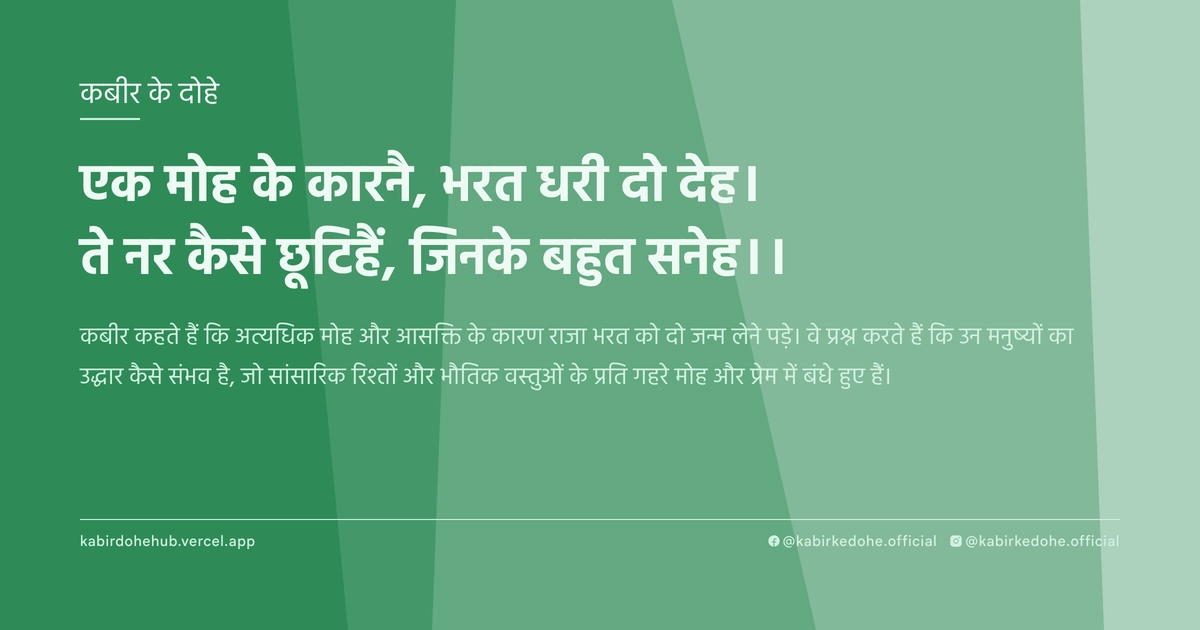
एक मोह के कारनै, भरत धरी दो देह।
ते नर कैसे छूटिहैं, जिनके बहुत सनेह।।
Ek moh ke kaaranai, Bharat dhari do deh. Te nar kaise chhutihain, jinke bahut saneh.
इस पृष्ठ पर इस कबीर दोहे का अर्थ (meaning), हिंदी व्याख्या और अंग्रेज़ी अनुवाद, दार्शनिक विश्लेषण और व्यावहारिक जीवन सीख दी गई है। यह दोहा मोह (Attachment) विषय से जुड़ा है — Kabir doha meaning and explanation in Hindi and English.
अर्थ (Meaning):
कबीर कहते हैं कि अत्यधिक मोह और आसक्ति के कारण राजा भरत को दो जन्म लेने पड़े। वे प्रश्न करते हैं कि उन मनुष्यों का उद्धार कैसे संभव है, जो सांसारिक रिश्तों और भौतिक वस्तुओं के प्रति गहरे मोह और प्रेम में बंधे हुए हैं।
Kabir explains that due to intense attachment and delusion, King Bharat was forced to embody two physical forms across two lives. He questions how those humans can ever achieve liberation when they are tightly bound by excessive worldly affection and emotional clinging.
व्याख्या (Interpretation):
इस दोहे का शाब्दिक अर्थ राजा भरत की पौराणिक कथा से जुड़ा है, जहाँ हिरण के प्रति मोह ने उन्हें पुनर्जन्म के चक्र में बांध दिया। रूपकात्मक रूप से, 'दो देह' केवल शारीरिक जन्म नहीं, बल्कि द्वैत (duality) की स्थिति है—जहाँ आत्मा स्वयं को शरीर और अहंकार से अलग मान लेती है। यह निर्गुण भक्ति का संकेत है कि जब तक 'मैं' और 'मेरा' का भाव रहता है, तब तक मोक्ष असंभव है। माया यहाँ एक पर्दे की तरह है जो आत्मा को उसके वास्तविक स्वरूप (ब्रह्म) से दूर रखती है। यह विरोधाभास है कि जिसे हम प्रेम समझते हैं, वह वास्तव में एक सूक्ष्म बंधन है जो हमें अनंतता से रोकता है।
Literally, this verse references the legend of King Bharat, whose attachment to a deer led to a fragmented rebirth. Metaphorically, 'two bodies' signifies the state of duality—where the soul perceives itself as separate from the Universal Consciousness. This aligns with Nirgun Bhakti, suggesting that as long as the notions of 'I' and 'Mine' persist, liberation remains elusive. Maya acts as a veil, obscuring the non-dual reality of Atman and Brahman. The central paradox presented is that what we perceive as love is often actually a subtle form of clinging, a golden chain that prevents the soul from merging with the Infinite.
दार्शनिक विश्लेषण (Philosophical Analysis):
कबीर का यह प्रहार उस समय के सामाजिक और धार्मिक पाखंड पर था, जहाँ लोग बाहरी कर्मकांडों से मुक्ति खोज रहे थे। वे स्पष्ट करते हैं कि मुक्ति किसी तीर्थ या मंत्र से नहीं, बल्कि 'मोह' के विसर्जन से आती है। यह अद्वैत वेदांत के उस सिद्धांत का समर्थन करता है जहाँ अज्ञान (Avidya) ही बंधन का कारण है।
सूफी मत के 'फना' (अहंकार का विनाश) के समान, कबीर यहाँ मानसिक आसक्ति के विनाश की बात कर रहे हैं। उनके अनुसार, प्रेम और मोह के बीच एक सूक्ष्म रेखा है; प्रेम मुक्त करता है, जबकि मोह बांधता है। जब व्यक्ति किसी वस्तु या व्यक्ति को अपनी पहचान का हिस्सा मान लेता है, तो वह अपनी वास्तविक पूर्णता को खो देता है।
ऐतिहासिक रूप से, कबीर ने जाति और वर्ग के भेदों को नकारते हुए यह बताया कि आध्यात्मिक पतन किसी विशेष वर्ग का नहीं, बल्कि हर उस व्यक्ति का है जो आसक्ति में है। वे तर्क देते हैं कि भावनात्मक निर्भरता वास्तव में एक मनोवैज्ञानिक कारागार है।
यहाँ 'सनेह' शब्द का प्रयोग व्यंग्यात्मक है। यह वह प्रेम नहीं है जो ईश्वर के प्रति है, बल्कि वह संकीर्ण प्रेम है जो केवल 'स्व' के विस्तार के लिए है। यह अहंकार का एक परिष्कृत रूप है जहाँ हम दूसरों को प्रेम नहीं करते, बल्कि उस भावना को प्रेम करते हैं जो हमें उनसे मिलती है।
अंततः, कबीर यह समझाते हैं कि जब तक हम संसार को सत्य मानते रहेंगे, हम पुनर्जन्म के चक्र में फंसे रहेंगे। केवल वही मुक्त है जिसने यह जान लिया कि संसार एक क्षणभंगुर स्वप्न है और केवल वह निराकार तत्व ही शाश्वत है।
Kabir's critique targets the social and religious hypocrisy of his era, where people sought liberation through external rituals. He asserts that salvation comes not from pilgrimages or mantras, but from the dissolution of 'Moh' (delusional attachment). This supports the Advaita Vedanta principle that ignorance (Avidya) is the primary cause of bondage.
Parallel to the Sufi concept of 'Fana' (annihilation of the ego), Kabir advocates for the destruction of mental clinging. He distinguishes between true love and attachment; while love liberates, attachment binds. When an individual incorporates an external object or person into their identity, they lose sight of their inherent spiritual wholeness.
Historically, by rejecting caste and class distinctions, Kabir demonstrates that spiritual downfall is not reserved for a specific group but affects anyone trapped in attachment. He argues that emotional dependency is, in essence, a psychological prison.
The use of 'Saneh' (affection) here is nuanced. He is not referring to divine love, but to a narrow, possessive affection that serves as an extension of the ego. This is a refined form of narcissism where one does not love the other, but rather the feeling of possession or the reflection of self in the other.
Ultimately, Kabir explains that as long as we mistake the transient world for the ultimate truth, we remain trapped in the cycle of Samsara. Only those who recognize the world as a fleeting dream and the Formless Absolute as the only reality can attain liberation.
मूल संदेश (Core Message):
- मोह वह अदृश्य जंजीर है जो आत्मा को मुक्त नहीं होने देती।
- सच्चा प्रेम मुक्त करता है, जबकि आसक्ति केवल बंधन पैदा करती है।
- अहंकार का विसर्जन ही पुनर्जन्म के चक्र से मुक्ति का एकमात्र मार्ग है।
- बाहरी दुनिया की वस्तुओं में अपनी पहचान खोजना एक भ्रम है।
- जब 'मेरा' समाप्त होता है, तब 'ब्रह्म' का अनुभव शुरू होता है।
- Attachment is the invisible chain that prevents the soul from liberating.
- True love sets one free, while clinging only creates bondage.
- The annihilation of ego is the only path out of the cycle of rebirth.
- Seeking identity in external worldly objects is a fundamental illusion.
- When the 'mine' ends, the experience of the Absolute begins.
व्यावहारिक उदाहरण (Practical Example):
वाराणसी के एक पुराने घाट पर रहने वाली एक वृद्ध विधवा, जानकी, का जीवन केवल उनकी एक पुरानी रेशमी साड़ी और उनके दिवंगत पति की यादों के इर्द-गिर्द सिमटा हुआ था। वे उस साड़ी को अपनी अंतिम पहचान मानती थीं और उसे छूने तक किसी को नहीं देती थीं।
वर्षों तक, जानकी ने उस साड़ी के साथ अपनी पूरी भावनात्मक दुनिया बसा ली। उनके लिए वह कपड़ा केवल वस्त्र नहीं, बल्कि उनके अतीत का एक जीवित हिस्सा था। वे अक्सर उस साड़ी को देखते हुए रोतीं और अपनी पुरानी दुनिया को याद करतीं।
एक दिन, घाट पर एक भीषण बाढ़ आई। पानी तेजी से बढ़ा और जानकी के छोटे से कमरे में घुस गया। जानकी ने अपनी जान बचाने के बजाय, सबसे पहले उस रेशमी साड़ी को बचाने की कोशिश की।
जैसे ही वे साड़ी को बचाने के लिए झुकीं, उनका पैर फिसला और वे पानी के तेज बहाव में घिर गईं। साड़ी का भारी कपड़ा पानी सोखकर और भी भारी हो गया, जिससे जानकी को तैरने में मुश्किल होने लगी।
वह साड़ी, जिसे वे अपना सबसे कीमती सहारा मानती थीं, अब उनके लिए एक बोझ बन गई थी। वे जितना उस कपड़े को पकड़कर रखने की कोशिश करतीं, पानी उन्हें उतना ही नीचे खींचता।
तभी उन्हें कबीर का वह विचार याद आया कि मोह ही बंधन है। उन्होंने महसूस किया कि यह साड़ी उनके पति की याद नहीं, बल्कि एक मृत वस्तु है जिसने उन्हें वर्तमान से काट दिया है।
एक गहरे मानसिक संघर्ष के बाद, जानकी ने अपनी पूरी शक्ति लगाकर उस साड़ी की पकड़ छोड़ दी। जैसे ही उन्होंने कपड़े को त्याग दिया, उनका शरीर हल्का हुआ और वे पानी की सतह पर तैरने लगीं।
जब वे सुरक्षित बाहर निकलीं, तो उन्होंने देखा कि वह साड़ी पानी में बह गई थी। लेकिन पहली बार वर्षों बाद, जानकी ने महसूस किया कि वे वास्तव में स्वतंत्र हैं।
उन्होंने महसूस किया कि जिस 'प्रेम' को वे सहेज रही थीं, वह वास्तव में एक मानसिक बेड़ी थी। अब वे घाट पर आने वाले अजनबियों से मुस्कुराकर बात करती हैं और अपनी यादों को बोझ नहीं, बल्कि एक कहानी की तरह देखती हैं।
यह 'कबीर ट्विस्ट' था—जहाँ एक भौतिक वस्तु का खोना वास्तव में एक आध्यात्मिक प्राप्ति बन गया।
Janaki, an elderly widow living on an ancient ghat in Varanasi, had her entire existence revolve around a single old silk saree and the memories of her late husband. She viewed that saree as her final identity and allowed no one to touch it.
For years, Janaki built her entire emotional world around that fabric. To her, it wasn't just clothing, but a living piece of her past. She would often weep while clutching the saree, longing for the world she once knew.
One day, a severe flood hit the ghats. The water rose rapidly and surged into Janaki's tiny room. Instead of prioritizing her own safety, Janaki first attempted to rescue the silk saree.
As she leaned over to grab it, her foot slipped, and she was swept away by the powerful current. The heavy silk fabric absorbed the water, becoming an anchor that dragged her down.
The saree, which she considered her most precious support, had now become a lethal burden. The tighter she clung to the fabric, the faster the current pulled her under.
In that moment of desperation, Kabir's teaching about attachment being a bond flashed through her mind. She realized that the saree was not her husband's memory, but a dead object that had severed her from the present.
After a fierce internal struggle, Janaki exerted all her strength and let go of the saree. The moment she relinquished the fabric, her body lightened, and she began to float on the surface.
When she was finally rescued and brought to safety, she saw the saree floating away into the distance. For the first time in years, Janaki felt truly free.
She understood that the 'love' she had been preserving was actually a mental shackle. Now, she greets strangers on the ghat with a smile and views her memories as stories rather than burdens.
This was the 'Kabir Twist'—where the loss of a physical object became a profound spiritual gain.
अभ्यास मार्गदर्शन (Practice Guidance):
- साक्षी भाव का अभ्यास: प्रतिदिन 20 मिनट मौन बैठें और अपने मन में उठने वाले 'मेरे' और 'मेरा' के विचारों को केवल एक दर्शक की तरह देखें, बिना उनसे जुड़े।
- आसक्ति विश्लेषण जर्नल: एक सूची बनाएं कि आप किन वस्तुओं या व्यक्तियों के बिना खुद को अधूरा महसूस करते हैं। लिखें कि यदि वे कल गायब हो जाएं, तो आपकी आत्मा का कौन सा हिस्सा प्रभावित होगा।
- त्याग का सूक्ष्म प्रयोग: सप्ताह में एक बार किसी ऐसी वस्तु का दान करें जिससे आप भावनात्मक रूप से जुड़े हों, ताकि आप 'छोड़ने' की मानसिक मांसपेशी को मजबूत कर सकें।
- डायग्नोस्टिक चेकलिस्ट: क्या मैं किसी की आलोचना इसलिए कर रहा हूँ क्योंकि उसने मेरी अपेक्षाओं (मोह) को पूरा नहीं किया? क्या मेरी खुशी बाहरी परिस्थितियों पर निर्भर है? यदि हाँ, तो आप अभी भी 'दो देह' की स्थिति में हैं।
- Practice of Witness Consciousness: Sit in silence for 20 minutes daily and observe the thoughts of 'mine' and 'my' as a detached witness, without identifying with them.
- Attachment Analysis Journal: List the objects or people without whom you feel incomplete. Write down which part of your soul feels threatened if they were to disappear tomorrow.
- Micro-Renunciation Exercise: Once a week, donate an item you are emotionally attached to, strengthening the mental muscle of 'letting go'.
- Diagnostic Checklist: Am I criticizing someone because they failed to meet my expectations (attachment)? Is my happiness dependent on external circumstances? If yes, you are still in the state of 'two bodies'.
चिंतन प्रश्न (Reflection Questions):
- मेरे जीवन में वह कौन सी 'रेशमी साड़ी' है जिसे मैं डूबते हुए भी नहीं छोड़ना चाहता?
- क्या मेरा प्रेम वास्तव में दूसरे के लिए है, या यह केवल मेरी अपनी जरूरतों का एक विस्तार है?
- मैं अपनी डिजिटल पहचान (सोशल मीडिया प्रोफाइल) को कितना सच मानता हूँ, और यह मेरी वास्तविक शांति को कैसे बाधित करता है?
- यदि आज मेरी सभी सामाजिक उपलब्धियां छीन ली जाएं, तो मेरे पास 'मैं' के रूप में क्या बचेगा?
- क्या मैं वास्तव में लोगों से प्यार करता हूँ, या मैं उस नियंत्रण से प्यार करता हूँ जो मैं उन पर रखता हूँ?
- What is the 'silk saree' in my life that I refuse to let go of, even while drowning?
- Is my love truly for the other, or is it merely an extension of my own needs?
- How much do I believe in my digital identity, and how does this distort my inner peace?
- If all my social achievements were stripped away today, what would remain of 'I'?
- Do I actually love people, or do I love the control I exert over them?