
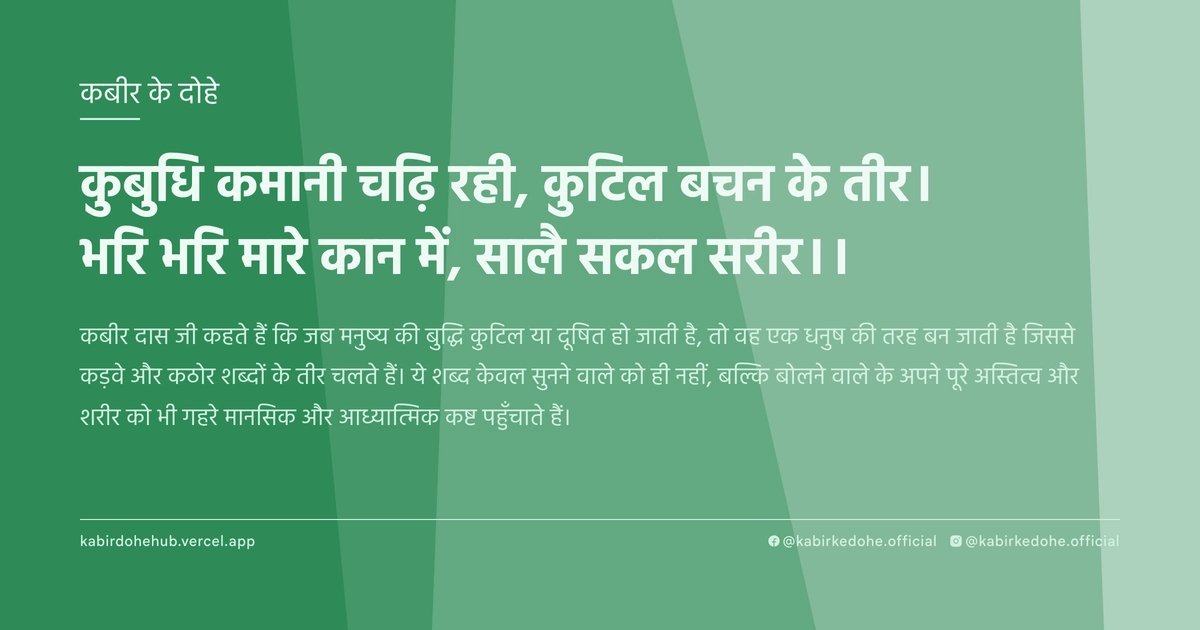
कुबुधि कमानी चढ़ि रही, कुटिल बचन के तीर।
भरि भरि मारे कान में, सालै सकल सरीर।।
Kubudhi kamani chadhi rahi, kutil bachan ke teer. Bhari bhari maare kaan mein, saalai sakal sareer.
इस पृष्ठ पर इस कबीर दोहे का अर्थ (meaning), हिंदी व्याख्या और अंग्रेज़ी अनुवाद, दार्शनिक विश्लेषण और व्यावहारिक जीवन सीख दी गई है। यह दोहा क्रोध (Anger) विषय से जुड़ा है — Kabir doha meaning and explanation in Hindi and English.
अर्थ (Meaning):
कबीर दास जी कहते हैं कि जब मनुष्य की बुद्धि कुटिल या दूषित हो जाती है, तो वह एक धनुष की तरह बन जाती है जिससे कड़वे और कठोर शब्दों के तीर चलते हैं। ये शब्द केवल सुनने वाले को ही नहीं, बल्कि बोलने वाले के अपने पूरे अस्तित्व और शरीर को भी गहरे मानसिक और आध्यात्मिक कष्ट पहुँचाते हैं।
Kabir explains that when a person's intellect becomes corrupted by malice, it transforms into a bow that launches arrows of harsh and crooked speech. These verbal arrows, when fired into the ears of others, do not merely wound the listener but inflict profound spiritual and psychological agony upon the speaker's own entire being.
व्याख्या (Interpretation):
यहाँ 'कुबुधि' (दुष्ट बुद्धि) को एक धनुष के रूप में चित्रित किया गया है, जो अहंकार और क्रोध से संचालित होता है। कबीर यह समझाते हैं कि शब्द केवल ध्वनि नहीं हैं, बल्कि वे ऊर्जा के वाहक हैं। जब हम कड़वे वचन बोलते हैं, तो हम वास्तव में अपने ही भीतर के द्वैत और अज्ञान को पुष्ट कर रहे होते हैं। यह निरगुण भक्ति का मार्ग है जहाँ बाहरी शोर को शांत कर आंतरिक मौन को खोजना होता है। माया हमें यह विश्वास दिलाती है कि दूसरों को नीचा दिखाकर हम श्रेष्ठ बन रहे हैं, जबकि वास्तव में हम अपनी ही आत्मा (Atman) को खंडित कर रहे होते हैं। यह विरोधाभास है कि जो तीर हम दूसरों पर चलाते हैं, उनका विष अंततः हमारे अपने शरीर और मन को विषाक्त करता है, क्योंकि आत्मा और परमात्मा एक ही चैतन्य हैं।
Here, 'Kubudhi' (malicious intellect) is metaphorically depicted as a bow, powered by ego and anger. Kabir illustrates that words are not mere sounds but carriers of energy. By uttering harsh words, one reinforces the internal duality and ignorance of the self. This aligns with Nirgun Bhakti, where the seeker must silence external noise to find internal stillness. Maya creates the illusion that belittling others elevates the self, whereas it actually fragments the Atman. The central paradox is that the arrows launched at others carry a poison that inevitably intoxicates the speaker's own body and spirit, reflecting the non-duality of Brahman where any harm caused to another is harm caused to oneself.
दार्शनिक विश्लेषण (Philosophical Analysis):
कबीर का यह दोहा उनके युग के सामाजिक और धार्मिक पाखंडों पर एक गहरा प्रहार है। उस समय धर्म के नाम पर श्रेष्ठता का दावा करने वाले लोग अक्सर अपनी वाणी का उपयोग दूसरों को नीचा दिखाने के लिए करते थे। कबीर ने इस 'बौद्धिक अहंकार' को पहचाना और उसे आध्यात्मिक पतन का मुख्य कारण बताया। वे ritualism (कर्मकांड) के बजाय 'शब्द' की शुद्धता पर जोर देते हैं, क्योंकि उनके अनुसार वाणी ही मन का दर्पण है।
अद्वैत वेदांत के दृष्टिकोण से, यदि हम सभी एक ही ब्रह्म का हिस्सा हैं, तो दूसरे को अपशब्द कहना स्वयं को गाली देने के समान है। यह 'अहं' का भ्रम है जो हमें अलग महसूस कराता है। जब तक यह भ्रम बना रहता है, मनुष्य हिंसा और द्वेष के चक्र में फंसा रहता है।
सूफी मत के 'नफ्स' (अहंकार) के सिद्धांत से जोड़कर देखें तो, कुबुधि वह नफ्स है जिसे वश में करना अनिवार्य है। जब तक साधक अपनी वाणी को संयमित नहीं करता, वह ईश्वर के प्रेम (Ishq) को प्राप्त नहीं कर सकता। वाणी की कठोरता वास्तव में हृदय की कठोरता का लक्षण है।
मनोवैज्ञानिक स्तर पर, कबीर यहाँ 'प्रोजेक्शन' की बात कर रहे हैं। हम अपनी आंतरिक कुंठाओं और असुरक्षाओं को क्रोधित शब्दों के रूप में दूसरों पर प्रक्षेपित करते हैं। यह प्रक्रिया क्षणिक संतुष्टि तो दे सकती है, लेकिन दीर्घकालिक मानसिक अशांति और आत्म-घृणा पैदा करती है।
अंततः, कबीर यह संदेश देते हैं कि आध्यात्मिक जागृति केवल ध्यान या माला जपने से नहीं आती, बल्कि इस बात से आती है कि हम दूसरों के साथ कैसा व्यवहार करते हैं। वाणी का संयम ही वास्तविक तपस्या है। जो व्यक्ति अपनी जीभ पर नियंत्रण पा लेता है, वह वास्तव में अपनी इंद्रियों और मन पर विजय प्राप्त कर लेता है, जिससे वह मोक्ष की ओर अग्रसर होता है।
This couplet is a profound critique of the social and religious hypocrisies of Kabir's era. During his time, those claiming spiritual superiority often used their speech to demean others. Kabir identified this 'intellectual arrogance' as the primary cause of spiritual decline. He emphasizes the purity of 'Shabd' (the Word) over ritualism, asserting that speech is the mirror of the mind.
From the perspective of Advaita Vedanta, if we are all manifestations of the same Brahman, then insulting another is equivalent to insulting oneself. It is the illusion of 'Aham' (ego) that creates a sense of separation. As long as this illusion persists, the human remains trapped in a cycle of violence and hatred.
Linking this to the Sufi concept of 'Nafs' (the lower self/ego), Kubudhi is the Nafs that must be subdued. Until a seeker disciplines their speech, they cannot attain the divine love of Ishq. Harshness of speech is a symptom of a hardened heart, which blocks the flow of spiritual grace.
Psychologically, Kabir is addressing the concept of 'projection.' We project our internal frustrations and insecurities onto others through angry words. While this may provide momentary catharsis, it leads to long-term mental turmoil and self-loathing.
Ultimately, Kabir suggests that spiritual awakening does not come solely from meditation or chanting, but from how we treat others. The discipline of speech is the true austerity. One who masters the tongue masters the senses and the mind, paving the way toward liberation (Mukti).
मूल संदेश (Core Message):
- कठोर वाणी अहंकार का हथियार है, जो स्वयं को ही घायल करती है।
- शब्द केवल ध्वनि नहीं, बल्कि आत्मा के स्तर पर ऊर्जा का विनिमय हैं।
- दूसरों को नीचा दिखाना वास्तव में अपनी आंतरिक रिक्तता को प्रदर्शित करना है।
- वाणी की शुद्धता ही मन की शुद्धता का पहला और सबसे बड़ा प्रमाण है।
- मौन और प्रेम ही वह औषधि हैं जो कुबुद्धि के घावों को भर सकती हैं।
- सच्ची आध्यात्मिक प्रगति बाहरी दिखावे में नहीं, बल्कि व्यवहार की सौम्यता में है।
- Harsh speech is a weapon of ego that ultimately wounds the wielder.
- Words are not just sounds, but an exchange of energy at the soul level.
- Belittling others is merely a display of one's own inner emptiness.
- Purity of speech is the first and greatest evidence of a pure mind.
- Silence and love are the only medicines that can heal the wounds of malice.
- True spiritual progress lies not in outward show, but in the gentleness of conduct.
व्यावहारिक उदाहरण (Practical Example):
वाराणसी के एक पुराने घाट पर रहने वाले रामदीन एक कुशल बुनकर थे, लेकिन उनका स्वभाव अत्यंत क्रोधी था। वे अपनी कला में निपुण थे, परंतु अपनी वाणी से सबको आहत करते थे। उनके घर के सदस्य और पड़ोसी उनसे बात करने से कतराते थे क्योंकि उनकी 'कुबुधि' हमेशा दूसरों में कमियां ढूंढती थी।
एक दिन, रामदीन ने अपने सबसे पुराने शिष्य, जो एक सीधा-सादा युवक था, को एक छोटी सी गलती के लिए सबके सामने बहुत कठोर शब्दों में अपमानित किया। उन्होंने उसे 'मूर्ख' और 'अयोग्य' जैसे शब्दों के तीरों से छलनी कर दिया। शिष्य चुपचाप वहां से चला गया, लेकिन रामदीन के मन में एक अजीब सी बेचैनी शुरू हो गई।
उस रात रामदीन को नींद नहीं आई। उन्हें महसूस हुआ कि जो कड़वाहट उन्होंने शिष्य के कानों में डाली थी, वह अब उनके अपने सीने में एक भारी पत्थर की तरह जमी हुई है। उन्हें ऐसा लगा जैसे उनके शब्द वापस लौटकर उनके अपने ही शरीर को काट रहे हैं।
अगले दिन, उन्होंने देखा कि उनके द्वारा बुना गया सबसे सुंदर वस्त्र, जिसे वे गर्व से बाजार ले जाने वाले थे, उसमें एक बड़ा छेद था। यह छेद उनकी एकाग्रता की कमी और मानसिक अशांति का परिणाम था। उन्हें समझ आया कि जब मन में द्वेष और वाणी में विष होता है, तो कर्म की गुणवत्ता गिर जाती है।
रामदीन ने महसूस किया कि उनका क्रोध वास्तव में उनकी अपनी आंतरिक असुरक्षा थी। वे चाहते थे कि सब उन्हें श्रेष्ठ मानें, इसलिए वे दूसरों को छोटा दिखाते थे। यह उनकी 'कुबुधि' का धनुष था।
उन्होंने उस शिष्य को बुलाया और पहली बार अपनी गलती स्वीकार की। उन्होंने महसूस किया कि माफी मांगने के बाद उनके सीने का वह भारीपन गायब हो गया। यह उनके लिए एक आध्यात्मिक मोड़ था।
अब रामदीन ने एक नियम बनाया: बोलने से पहले वे तीन बार सोचते कि क्या उनके शब्द किसी को चोट पहुँचाएंगे। उन्होंने अपनी वाणी को 'तीर' के बजाय 'मरहम' बनाने का प्रयास किया।
धीरे-धीरे, उनके घर का वातावरण बदल गया। लोग अब उनसे सलाह लेने आने लगे। उनकी बुनाई में एक नई चमक आ गई क्योंकि अब उनका मन शांत था।
रामदीन ने सीखा कि जब हम दूसरों के लिए गड्ढा खोदते हैं या उन्हें शब्दों से घायल करते हैं, तो हम वास्तव में अपनी ही शांति का विनाश कर रहे होते हैं।
अंत में, रामदीन एक ऐसे व्यक्ति बन गए जिन्हें पूरा मोहल्ला केवल उनकी कला के लिए नहीं, बल्कि उनकी सौम्यता और प्रेमपूर्ण वाणी के लिए जानने लगा।
Ramdeen was a skilled weaver living on an old ghat in Varanasi, but he possessed an extremely volatile temperament. Though masterful in his craft, he wounded everyone with his speech. Family and neighbors avoided him because his 'Kubudhi' (malicious intellect) was always searching for flaws in others.
One day, Ramdeen harshly insulted his oldest disciple, a simple young man, in front of everyone for a minor mistake. He riddled the youth with verbal arrows, calling him 'foolish' and 'worthless.' The disciple left silently, but a strange restlessness began to brew within Ramdeen.
That night, Ramdeen could not sleep. He felt that the bitterness he had poured into the disciple's ears had now settled in his own chest like a heavy stone. It felt as if his own words had rebounded to lacerate his own body.
The next morning, he discovered a large hole in the most beautiful garment he had woven, which he intended to take to the market. This flaw was a direct result of his lack of concentration and mental turmoil. He realized that when the mind is filled with malice and the tongue with poison, the quality of one's karma declines.
Ramdeen realized that his anger was actually a manifestation of his own inner insecurity. He wanted everyone to perceive him as superior, so he sought to belittle others. This was the bow of his 'Kubudhi.'
He summoned the disciple and, for the first time, admitted his mistake. He felt the heavy burden in his chest vanish the moment he asked for forgiveness. This was a spiritual turning point for him.
Ramdeen then established a rule: before speaking, he would think three times about whether his words would hurt anyone. He strove to turn his speech from an 'arrow' into a 'healing balm.'
Gradually, the atmosphere of his home transformed. People began seeking his guidance again. His weaving acquired a new radiance because his mind was finally at peace.
Ramdeen learned that when we dig pits for others or wound them with words, we are essentially destroying our own tranquility.
Ultimately, Ramdeen became a man known throughout the neighborhood not just for his art, but for his gentleness and loving speech.
अभ्यास मार्गदर्शन (Practice Guidance):
- दैनिक मौन अभ्यास: प्रतिदिन कम से कम 30 मिनट पूर्ण मौन रहें। इस दौरान यह देखें कि मन में कितने 'कड़वे शब्द' उठ रहे हैं और उन्हें बिना प्रतिक्रिया दिए केवल देखें।
- वाणी का आत्म-निरीक्षण: सोने से पहले एक डायरी में लिखें कि आज आपने कितने बार क्रोध या अहंकार में बात की। उन शब्दों के प्रभाव को महसूस करें जो आपने दूसरों पर छोड़े।
- सचेत प्रतिक्रिया (Mindful Response): जब भी किसी पर क्रोध आए, प्रतिक्रिया देने से पहले 5 गहरी सांसें लें। स्वयं से पूछें, 'क्या यह शब्द मेरी आत्मा की शांति बढ़ा रहा है या घटा रहा है?'
- निदान चेकलिस्ट (Diagnostic Checklist): क्या आप दूसरों की गलती पर तुरंत प्रतिक्रिया देते हैं? क्या बातचीत के बाद आपको ग्लानि महसूस होती है? क्या आपके रिश्तों में तनाव आपकी वाणी के कारण है? यदि हाँ, तो आपकी 'कुबुधि' सक्रिय है।
- Daily Silence Practice: Maintain complete silence for at least 30 minutes daily. During this time, observe how many 'bitter words' arise in the mind and witness them without reacting.
- Speech Self-Audit: Before sleeping, journal about the instances where you spoke out of anger or ego. Feel the energetic residue of the words you launched at others.
- Mindful Response: Whenever anger arises, take five deep breaths before responding. Ask yourself, 'Is this word increasing or decreasing the peace of my soul?'
- Diagnostic Checklist: Do you react instantly to others' mistakes? Do you feel guilt after a conversation? Is the tension in your relationships caused by your speech? If yes, your 'Kubudhi' is active.
चिंतन प्रश्न (Reflection Questions):
- मेरे वे कौन से 'कड़वे तीर' हैं जिन्हें मैं अक्सर अपने प्रियजनों पर चलाता हूँ, और उनके पीछे का असली डर क्या है?
- जब मैं किसी की आलोचना करता हूँ, तो क्या मैं वास्तव में उस व्यक्ति की गलती सुधार रहा हूँ या अपने अहंकार को संतुष्ट कर रहा हूँ?
- मेरी डिजिटल पहचान (सोशल मीडिया) पर मेरी वाणी कितनी विनम्र है और मेरे वास्तविक जीवन के एकांत में वह कैसी है?
- क्या मैं उन शब्दों को सहने की क्षमता रखता हूँ जो मैंने दूसरों को दिए हैं?
- मेरे भीतर का वह कौन सा हिस्सा है जो दूसरों को छोटा देखकर खुद को बड़ा महसूस करने की कोशिश करता है?
- यदि मेरी वाणी ही मेरा दर्पण है, तो आज मेरा दर्पण मुझे मेरे बारे में क्या बता रहा है?
- What are the 'bitter arrows' I frequently launch at my loved ones, and what is the actual fear hidden behind them?
- When I criticize someone, am I truly correcting their mistake or merely satisfying my own ego?
- How polite is my speech in my digital identity (social media) compared to how it is in the solitude of my real life?
- Do I possess the strength to endure the very words I have given to others?
- Which part of me tries to feel superior by making others feel inferior?
- If my speech is my mirror, what is that mirror telling me about myself today?