
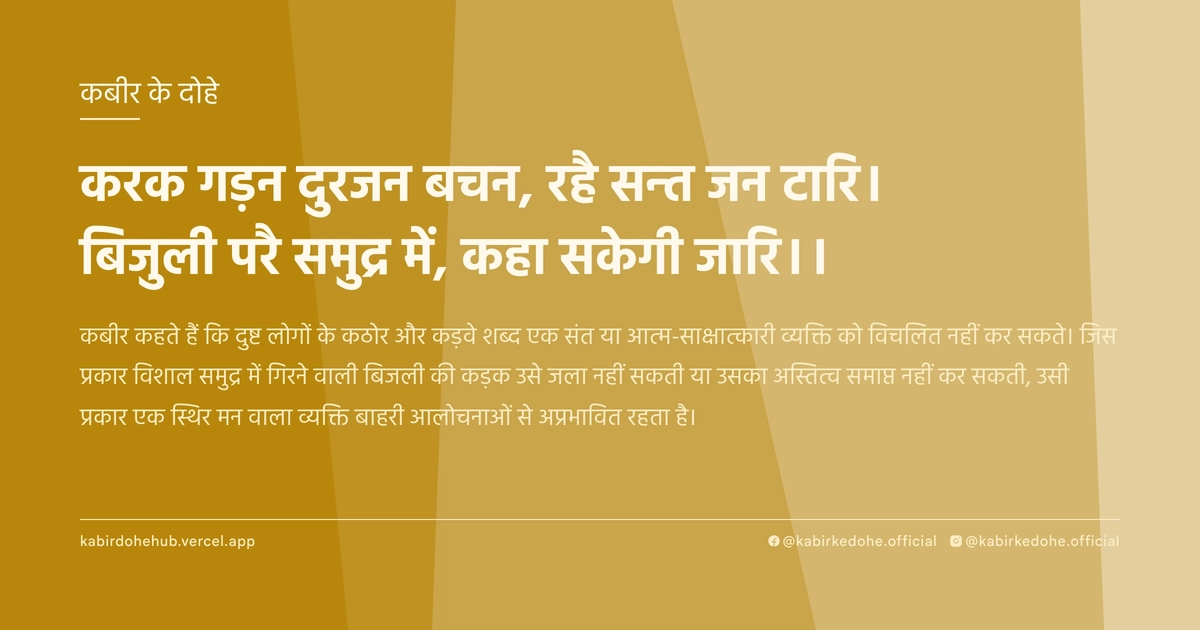
करक गड़न दुरजन बचन, रहै सन्त जन टारि।
बिजुली परै समुद्र में, कहा सकेगी जारि।।
Karak gadan durjan bachan, rahai sant jan taari. Bijuli parai samudra mein, kaha sakegi jaari.
इस पृष्ठ पर इस कबीर दोहे का अर्थ (meaning), हिंदी व्याख्या और अंग्रेज़ी अनुवाद, दार्शनिक विश्लेषण और व्यावहारिक जीवन सीख दी गई है। यह दोहा धैर्य (Patience) विषय से जुड़ा है — Kabir doha meaning and explanation in Hindi and English.
अर्थ (Meaning):
कबीर कहते हैं कि दुष्ट लोगों के कठोर और कड़वे शब्द एक संत या आत्म-साक्षात्कारी व्यक्ति को विचलित नहीं कर सकते। जिस प्रकार विशाल समुद्र में गिरने वाली बिजली की कड़क उसे जला नहीं सकती या उसका अस्तित्व समाप्त नहीं कर सकती, उसी प्रकार एक स्थिर मन वाला व्यक्ति बाहरी आलोचनाओं से अप्रभावित रहता है।
Kabir asserts that the harsh and piercing words of malicious people cannot unsettle a saint or a self-realized soul. Just as a bolt of lightning striking the vast ocean cannot burn it or diminish its essence, a person with a steady, centered mind remains untouched by external criticisms and verbal assaults.
व्याख्या (Interpretation):
यहाँ 'करक गड़न' का अर्थ है शब्दों का प्रहार जो तीर की तरह चुभता है। कबीर एक गहरे विरोधाभास का उपयोग करते हैं: बिजली, जो विनाशकारी है, और समुद्र, जो अनंत है। यह रूपक आत्मा (Atman) और माया (Maya) के बीच के संबंध को दर्शाता है। जब एक साधक निर्गुण भक्ति के माध्यम से अपनी पहचान को 'अहंकार' से हटाकर 'ब्रह्म' के साथ जोड़ लेता है, तो वह व्यक्तिगत पहचान (ego) को खो देता है। चूंकि अब वहां कोई 'मैं' नहीं है जिसे चोट पहुंचे, इसलिए दुष्टों के वचन शून्य हो जाते हैं। यह अद्वैत वेदांत की उस स्थिति को दर्शाता है जहाँ व्यक्ति स्वयं को ब्रह्मांडीय चेतना के रूप में देखता है, जिससे सांसारिक द्वंद्व अर्थहीन हो जाते हैं।
The phrase 'karak gadan' refers to words that pierce like thorns or arrows. Kabir employs a profound metaphor: lightning, a symbol of destructive energy, and the ocean, a symbol of infinite depth. This represents the relationship between the Atman (Soul) and Maya (Illusion). When a seeker, through Nirgun Bhakti, shifts their identity from the limited 'ego' to the limitless 'Brahman,' the target for pain disappears. Since there is no longer a fragile 'I' to be offended, the words of the malicious become void. This reflects the state of Advaita Vedanta where the individual perceives themselves as universal consciousness, rendering worldly dualities and personal conflicts meaningless.
दार्शनिक विश्लेषण (Philosophical Analysis):
कबीर का यह दोहा उस सामाजिक और धार्मिक परिवेश में लिखा गया था जहाँ बाहरी कर्मकांड और सामाजिक प्रतिष्ठा को सर्वोपरि माना जाता था। कबीर ने जानबूझकर उन लोगों को चुनौती दी जो केवल बाहरी दिखावे से पवित्रता का दावा करते थे। उनका दर्शन 'सहज मार्ग' पर आधारित है, जो बाहरी शोर के बजाय आंतरिक मौन पर जोर देता है।
यहाँ वे ritualism (कर्मकांड) का विरोध करते हुए यह समझाते हैं कि वास्तविक पवित्रता मंदिर या मस्जिद में नहीं, बल्कि मन की स्थिरता में है। यदि कोई व्यक्ति केवल धार्मिक ग्रंथों को रटता है लेकिन आलोचना सुनकर क्रोधित होता है, तो वह अभी भी माया के बंधन में है।
सूफीवाद के 'फना' (अहंकार का विनाश) के सिद्धांत से इसे जोड़ा जा सकता है। जब साधक अपनी इच्छाओं और अहंकार को ईश्वर की इच्छा में विलीन कर देता है, तो वह 'अजेय' हो जाता है। बाहरी दुनिया की प्रतिक्रियाएं उसके लिए केवल लहरें हैं, जबकि वह स्वयं गहरा सागर है।
अद्वैत वेदांत के दृष्टिकोण से, यह दोहा 'साक्षी भाव' (Witness Consciousness) की शिक्षा देता है। जब हम अपने विचारों और भावनाओं को तटस्थ होकर देखते हैं, तो हम पाते हैं कि क्रोध या अपमान केवल मानसिक तरंगें हैं, जो हमारी मूल चेतना को स्पर्श नहीं कर सकतीं।
मनोवैज्ञानिक स्तर पर, कबीर यहाँ 'इमोशनल डिटैचमेंट' की बात कर रहे हैं। वे यह नहीं कह रहे कि हम संवेदनहीन हो जाएं, बल्कि यह कि हम अपनी शांति की चाबी दूसरों के हाथों में न सौंपें। यह अहंकार के विसर्जन की प्रक्रिया है, जहाँ व्यक्ति यह समझ जाता है कि दूसरे की बुराई वास्तव में उसकी अपनी आंतरिक पीड़ा का प्रतिबिंब है, न कि आपकी वास्तविकता।
This couplet was composed in a socio-religious climate where external rituals and social prestige were paramount. Kabir deliberately challenged those who claimed purity based solely on outward appearances. His philosophy is rooted in the 'Sahaj Marg' (the Natural Path), emphasizing internal silence over external noise.
By rejecting ritualism, he explains that true sanctity resides not in temples or mosques, but in the stability of the mind. If a person recites scriptures but reacts with rage to criticism, they remain bound by Maya (illusion).
This connects deeply with the Sufi concept of 'Fana' (the annihilation of the ego). When a seeker dissolves their personal desires and ego into the Divine Will, they become 'invincible.' The reactions of the external world become mere ripples on the surface, while the seeker remains the deep, undisturbed ocean.
From the perspective of Advaita Vedanta, this Doha teaches 'Sakshi Bhava' (Witness Consciousness). By observing thoughts and emotions neutrally, one realizes that anger or insult are merely mental fluctuations that cannot touch the core consciousness.
Psychologically, Kabir is advocating for emotional detachment. He is not suggesting insensitivity, but rather that we should not hand over the key to our peace to others. It is a process of ego-dissolution, where one understands that another's malice is a reflection of their own internal suffering, not a definition of one's own reality.
मूल संदेश (Core Message):
- बाहरी शोर केवल तभी सुनाई देता है जब आंतरिक शांति गायब हो।
- अहंकार वह छोटा बर्तन है जिसमें अपमान का जहर समा जाता है।
- अपनी पहचान को शरीर और नाम से ऊपर उठाकर चेतना में स्थापित करें।
- क्षमा कमजोरी नहीं, बल्कि असीम आंतरिक विस्तार की शक्ति है।
- सत्य वह है जो विपरीत परिस्थितियों में भी अपरिवर्तित रहता है।
- External noise is only audible when internal peace is absent.
- The ego is a small vessel that traps the poison of insult.
- Elevate your identity beyond body and name into pure consciousness.
- Forgiveness is not weakness, but the power of infinite internal expansion.
- Truth is that which remains unchanged despite adverse circumstances.
व्यावहारिक उदाहरण (Practical Example):
वाराणसी के घाटों पर रहने वाली एक वृद्ध विधवा, जानकी, का जीवन अत्यंत कठिन था। वह दूसरों के घरों में छोटे-मोटे काम करके अपना गुजारा करती थी। मोहल्ले के कुछ लोग, जो स्वयं को बहुत धार्मिक और उच्च कुल का मानते थे, उसे अक्सर 'अपशकुन' कहकर पुकारते और उसके कपड़ों या उसकी गरीबी का उपहास उड़ाते थे।
जानकी इन बातों को सुनती, लेकिन कभी पलटकर जवाब नहीं देती थी। लोग समझते थे कि वह डरपोक है या उसमें बोलने की हिम्मत नहीं है। वे उसके सामने उसे नीचा दिखाने के लिए कड़वे शब्द बोलते, लेकिन जानकी के चेहरे पर एक अजीब सी शांति बनी रहती थी।
एक दिन, मोहल्ले के सबसे प्रभावशाली व्यक्ति का बेटा एक गंभीर संकट में फंस गया और पूरा परिवार मानसिक तनाव में था। वे लोग जानकी के पास आए, क्योंकि उन्होंने देखा था कि चाहे कितनी भी आंधी आए, जानकी कभी विचलित नहीं होती।
उन्होंने उससे पूछा, 'जब हम तुम्हें इतना बुरा बोलते थे, तब तुम क्रोध क्यों नहीं करती थीं? क्या तुम्हें दुख नहीं होता था?'
जानकी ने मुस्कुराते हुए कहा, 'बेटा, जब कोई समुद्र में पत्थर फेंकता है, तो क्या समुद्र छोटा हो जाता है? या पत्थर डूब जाता है? आपके शब्द पत्थर की तरह थे, और मैंने अपने मन को समुद्र बना लिया था। पत्थर तो डूबा, पर समुद्र वैसा ही रहा।'
यह सुनकर उन लोगों को अपनी छोटी सोच का एहसास हुआ। उन्होंने महसूस किया कि उनकी 'श्रेष्ठता' वास्तव में उनके अहंकार का बोझ था, जबकि जानकी की 'गरीबी' उसकी सबसे बड़ी आध्यात्मिक संपत्ति थी।
उस दिन के बाद, मोहल्ले का वातावरण बदल गया। लोगों ने बाहरी शुद्धता के बजाय आंतरिक शांति की खोज शुरू की।
जानकी ने बिना किसी उपदेश के, केवल अपने व्यवहार से उन्हें यह सिखा दिया कि असली ताकत चिल्लाने में नहीं, बल्कि चुप रहकर सब कुछ आत्मसात कर लेने में है।
उसका जीवन एक जीवित उदाहरण बन गया कि जब आप स्वयं को 'अहंकार' से मुक्त कर लेते हैं, तो दुनिया की कोई भी बुराई आपको चोट नहीं पहुँचा सकती।
Janaki, an elderly widow living on the ghats of Varanasi, led a life of extreme hardship. She survived by doing odd jobs in other people's homes. Some locals, who considered themselves highly religious and of noble birth, often called her an 'omen of ill luck' and mocked her tattered clothes and poverty.
Janaki heard these insults, but she never retaliated. People assumed she was timid or lacked the courage to speak. They would use bitter words to demean her in public, yet a strange, unshakable peace always lingered on her face.
One day, the son of the most influential man in the neighborhood fell into a severe crisis, leaving the entire family in mental turmoil. They approached Janaki because they had noticed that no matter how fierce the storm, she never wavered.
They asked her, 'When we spoke so cruelly to you, why didn't you get angry? Did it not hurt you?'
Janaki smiled and replied, 'My child, when someone throws a stone into the ocean, does the ocean shrink? Or does the stone simply sink? Your words were like stones, and I had made my mind an ocean. The stone sank, but the ocean remained as it was.'
Hearing this, the people realized the narrowness of their own perspective. They understood that their 'superiority' was actually a burden of ego, while Janaki's 'poverty' was her greatest spiritual asset.
After that day, the atmosphere of the neighborhood changed. People began seeking internal peace rather than external purity.
Without a single sermon, Janaki taught them through her existence that true strength lies not in shouting, but in the capacity to absorb everything in silence.
Her life became a living testament that once you liberate yourself from the 'ego,' no amount of worldly malice can cause you harm.
अभ्यास मार्गदर्शन (Practice Guidance):
- प्रतिदिन 20 मिनट 'साक्षी ध्यान' करें: अपने मन में आने वाले विचारों को ऐसे देखें जैसे आप सड़क पर चलती गाड़ियों को देख रहे हों, बिना किसी निर्णय के।
- स्व-पूछताछ जर्नल: जब कोई आपकी आलोचना करे, तो लिखें—'मेरे भीतर वह कौन सा हिस्सा है जिसे यह बात चुभ रही है? क्या यह मेरा अहंकार है या मेरी वास्तविकता?'
- मौन का अभ्यास: दिन में एक घंटा पूर्ण मौन रहें, विशेषकर तब जब आप क्रोधित महसूस करें, ताकि आप प्रतिक्रिया और प्रतिक्रिया के बीच के अंतराल को पहचान सकें।
- डायग्नोस्टिक चेकलिस्ट: यदि आप किसी की बात पर घंटों सोचते रहते हैं या बदला लेने की इच्छा रखते हैं, तो समझें कि आप अभी भी 'लहर' हैं, 'समुद्र' नहीं।
- Practice 'Witness Meditation' for 20 minutes daily: Observe the thoughts arising in your mind as if you are watching cars pass on a street, without judgment.
- Self-Inquiry Journaling: When criticized, write—'Which part of me is feeling hurt? Is it my ego or my actual reality?'
- Practice of Silence: Maintain complete silence for one hour a day, especially when feeling angry, to recognize the gap between stimulus and response.
- Diagnostic Checklist: If you ruminate on a comment for hours or harbor a desire for revenge, recognize that you are still acting as a 'ripple' and not as the 'ocean'.
चिंतन प्रश्न (Reflection Questions):
- आपकी सार्वजनिक छवि (Public Image) को बनाए रखने की इच्छा आपके मानसिक स्वास्थ्य को कितना नियंत्रित करती है?
- क्या आप वास्तव में दूसरों को क्षमा करते हैं, या आप केवल अपनी श्रेष्ठता सिद्ध करने के लिए क्षमा का ढोंग करते हैं?
- आपके भीतर का वह कौन सा 'अदृश्य घाव' है जो दूसरों की छोटी सी टिप्पणी से बार-बार हरा हो जाता है?
- यदि आज आपकी सारी सामाजिक प्रतिष्ठा छीन ली जाए, तो आपके पास 'स्वयं' के रूप में क्या बचेगा?
- क्या आपकी शांति बाहरी परिस्थितियों पर निर्भर है, या वह आपके भीतर का एक स्वतंत्र स्रोत है?
- To what extent does the desire to maintain your public image control your mental well-being?
- Do you truly forgive others, or do you merely pretend to forgive to prove your own moral superiority?
- What is that 'invisible wound' within you that is reopened by a trivial comment from others?
- If all your social prestige were stripped away today, what would remain of 'you' as a self?
- Is your peace dependent on external circumstances, or is it an independent source within you?