
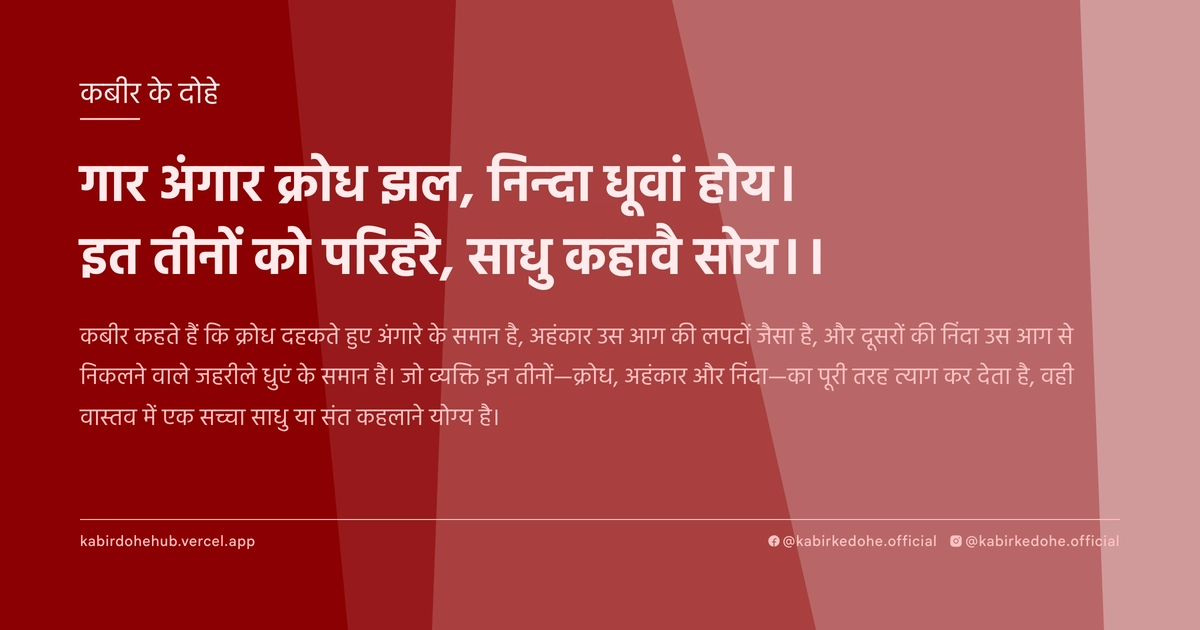
गार अंगार क्रोध झल, निन्दा धूवां होय।
इत तीनों को परिहरै, साधु कहावै सोय।।
Gaar angaar krodh jhal, ninda dhuwan hoye. It teeno ko pariharai, sadhu kahavai soy.
इस पृष्ठ पर इस कबीर दोहे का अर्थ (meaning), हिंदी व्याख्या और अंग्रेज़ी अनुवाद, दार्शनिक विश्लेषण और व्यावहारिक जीवन सीख दी गई है। यह दोहा क्रोध (Anger) विषय से जुड़ा है — Kabir doha meaning and explanation in Hindi and English.
अर्थ (Meaning):
कबीर कहते हैं कि क्रोध दहकते हुए अंगारे के समान है, अहंकार उस आग की लपटों जैसा है, और दूसरों की निंदा उस आग से निकलने वाले जहरीले धुएं के समान है। जो व्यक्ति इन तीनों—क्रोध, अहंकार और निंदा—का पूरी तरह त्याग कर देता है, वही वास्तव में एक सच्चा साधु या संत कहलाने योग्य है।
Kabir asserts that anger is like a glowing ember, ego is the leaping flame, and the act of criticizing others is the choking smoke emanating from that fire. He declares that only the individual who successfully renounces all three of these destructive forces—anger, pride, and condemnation—can truly be recognized as a 'Sadhu' or an enlightened soul.
व्याख्या (Interpretation):
यहाँ कबीर ने क्रोध और अहंकार की तुलना अग्नि के विभिन्न रूपों से की है। 'गार' और 'अंगार' उस आंतरिक जलन को दर्शाते हैं जो आत्मा को भीतर से भस्म कर देती है। निंदा को धुएं के समान बताया गया है क्योंकि धुआं न केवल आंखों को धुंधला करता है, बल्कि सत्य के दर्शन को भी बाधित करता है। यह निरगुण भक्ति का मार्ग है जहाँ साधक बाहरी कर्मकांडों के बजाय आंतरिक शुद्धि पर बल देता है। माया यहाँ क्रोध और अहंकार के रूप में कार्य करती है, जो जीव को ब्रह्म के वास्तविक स्वरूप से अलग करती है। जब ये तीनों समाप्त होते हैं, तब अद्वैत की स्थिति प्राप्त होती है जहाँ 'मैं' और 'तू' का भेद मिट जाता है। यह विरोधाभास है कि शांति पाने के लिए पहले अपने भीतर की अग्नि को पहचानना और उसे बुझाना आवश्यक है। अंततः, साधु वह नहीं जो गेरुआ वस्त्र पहने, बल्कि वह है जिसका चित्त इन विकारों से मुक्त है।
Kabir employs a potent elemental metaphor, equating anger and ego to the various stages of fire. 'Gaar' and 'Angaar' represent the latent and active heat of passion that incinerates the spiritual merit of the seeker. Slander or criticism is likened to smoke, which does not just irritate the senses but obscures the vision of Truth (Satya), creating a veil of Maya between the self and the Divine. In the context of Nirgun Bhakti, the focus shifts from external rituals to the alchemy of internal purification. The ego is the fuel, anger is the flame, and condemnation is the resulting smog that blinds the soul to its non-dual nature (Advaita). The paradox presented is that one must first acknowledge the destructive fire within to eventually extinguish it. True sainthood, therefore, is not defined by outward asceticism or religious titles, but by the psychological liberation from these three poisons. Only when the smoke clears can the Atman recognize its identity as Brahman.
दार्शनिक विश्लेषण (Philosophical Analysis):
कबीर का यह दोहा उनके युग के सामाजिक और धार्मिक पाखंड के विरुद्ध एक सशक्त प्रहार है। 15वीं शताब्दी में, धर्म अक्सर बाहरी प्रतीकों, जातिगत श्रेष्ठता और कठोर अनुष्ठानों तक सीमित था। कबीर ने इस व्यवस्था को चुनौती देते हुए यह प्रतिपादित किया कि वास्तविक आध्यात्मिकता हृदय की पवित्रता में है, न कि किसी विशेष कुल या वस्त्र में। वे क्रोध और निंदा को केवल व्यक्तिगत दोष नहीं, बल्कि आध्यात्मिक अवरोध मानते हैं जो मनुष्य को उसकी मूल प्रकृति से दूर ले जाते हैं।
अद्वैत वेदांत के परिप्रेक्ष्य में, क्रोध और अहंकार 'अविद्या' (अज्ञान) के परिणाम हैं। जब व्यक्ति स्वयं को शरीर और मन के साथ जोड़ लेता है, तो वह द्वैत का अनुभव करता है, जिससे ईर्ष्या और क्रोध का जन्म होता है। कबीर का संदेश है कि जब 'अहं' का विसर्जन होता है, तब क्रोध स्वतः समाप्त हो जाता क्योंकि क्रोध करने के लिए एक 'स्व' का होना आवश्यक है।
सूफी मत के साथ कबीर का यह विचार मेल खाता है, जहाँ 'नफ्स' (अहंकार/इच्छा) को मारने की बात कही गई है। सूफीवाद में भी आंतरिक संघर्ष और आत्म-शुद्धि को ईश्वर तक पहुँचने का एकमात्र मार्ग माना गया है। कबीर यहाँ 'फना' (अहंकार का विनाश) की बात कर रहे हैं, ताकि केवल परमात्मा शेष रहे।
मनोवैज्ञानिक स्तर पर, कबीर यह समझा रहे हैं कि निंदा करना वास्तव में अपनी ही आंतरिक असुरक्षाओं का प्रक्षेपण (projection) है। जब हम दूसरों की बुराई करते हैं, तो हम अनजाने में अपने भीतर के उस धुएं को फैला रहे होते हैं जो हमें स्वयं के सत्य को देखने से रोकता है। यह एक चक्र है: अहंकार क्रोध को जन्म देता है, और क्रोध निंदा के रूप में बाहर निकलता है।
इस विश्लेषण का निष्कर्ष यह है कि कबीर के लिए 'साधु' होना एक उपलब्धि नहीं, बल्कि एक 'नकारात्मक प्रक्रिया' (via negativa) है—अर्थात, वह सब कुछ हटा देना जो आप नहीं हैं। जब क्रोध, अहंकार और निंदा हट जाते हैं, तो जो शेष बचता है, वही शुद्ध चेतना या परमात्मा है।
This couplet serves as a profound critique of the socio-religious hypocrisy prevalent during Kabir's era in the 15th century. At a time when spirituality was often reduced to external symbols, caste hierarchies, and rigid ritualism, Kabir redirected the gaze inward. He argued that true sanctity is not found in the beads of a rosary or the ash on one's forehead, but in the eradication of the internal poisons of anger and pride.
From the lens of Advaita Vedanta, anger and ego are manifestations of 'Avidya' (primordial ignorance). The illusion of separation—the belief that the 'I' is distinct from the 'Other'—creates the friction that ignites anger. Kabir suggests that by dissolving the ego, the very foundation of anger vanishes. If there is no separate 'self' to be offended, there can be no anger; if there is no 'superior self' to compare, there can be no pride.
This philosophy resonates deeply with the Sufi concept of 'Nafs' (the lower self/ego). The Sufi path of annihilation (Fana) mirrors Kabir's insistence on the removal of the 'three fires.' Both traditions emphasize that the heart must be scrubbed clean of worldly attachments and self-importance before it can become a mirror reflecting the Divine Light.
Psychologically, Kabir identifies the cycle of toxicity: Ego fuels anger, and anger manifests as the 'smoke' of condemnation. Slandering others is a psychological defense mechanism—a projection of one's own internal chaos onto another. By labeling this as 'smoke,' Kabir warns that such behavior does not harm the victim as much as it blinds the perpetrator to their own spiritual decay.
Ultimately, Kabir redefines the 'Sadhu.' He strips the term of its institutional baggage. A saint is not one who has acquired a title, but one who has successfully undergone a process of subtraction. By removing the layers of anger, ego, and judgment, the individual returns to their primordial state of purity. The path to God is not an addition of knowledge, but a subtraction of the false self.
मूल संदेश (Core Message):
- क्रोध आत्मा को जलाने वाला अंगारा है।
- अहंकार सत्य के मार्ग में सबसे बड़ी बाधा है।
- निंदा मन को धुंधला करने वाला जहरीला धुआं है।
- इन तीनों का त्याग ही वास्तविक शुद्धि है।
- बाहरी आडंबर नहीं, आंतरिक शांति ही साधुता है।
- स्वयं को जीतना ही सबसे बड़ी विजय है।
- Anger is the ember that consumes the soul.
- Ego is the primary obstacle on the path to Truth.
- Condemnation is the toxic smoke that blinds the mind.
- Renunciation of these three is the only true purification.
- Sainthood is internal peace, not external ritual.
- Conquering the self is the ultimate victory.
व्यावहारिक उदाहरण (Practical Example):
वाराणसी के एक पुराने घाट पर रामदीन नाम का एक वृद्ध बुनकर रहता था। वह अपनी कला में निपुण था, लेकिन उसका स्वभाव अत्यंत उग्र था। वह छोटी-छोटी बातों पर अपने शिष्यों और पड़ोसियों पर चिल्लाता था। उसका अहंकार इतना बड़ा था कि वह मानता था कि पूरे शहर में उसके जैसा कपड़ा कोई नहीं बुन सकता। जब कोई उसकी गलती बताता, तो वह उसकी इतनी निंदा करता कि सामने वाला लज्जित हो जाता।
एक दिन रामदीन की मुलाकात एक मौन साधु से हुई। साधु ने रामदीन के क्रोध को देखा और केवल एक छोटा सा इशारा किया। उन्होंने रामदीन को एक जलते हुए कोयले को हाथ में पकड़ने के लिए कहा। जैसे ही रामदीन ने उसे छुआ, वह दर्द से चीख उठा। साधु ने धीरे से कहा, 'तुम्हारा क्रोध भी इसी कोयले की तरह है; तुम दूसरों को जलाने की कोशिश करते हो, लेकिन सबसे पहले तुम्हारा अपना हाथ जलता है।'
रामदीन को पहली बार अपनी स्थिति का अहसास हुआ। उसने महसूस किया कि उसकी निंदा उस धुएं की तरह थी जिसने उसकी आँखों में इतनी जलन पैदा कर दी थी कि वह अपने बच्चों के प्यार को देख ही नहीं पा रहा था। वह घर लौटा, लेकिन उसका क्रोध अभी पूरी तरह गया नहीं था।
अगले कुछ हफ्तों तक, जब भी उसे गुस्सा आता, वह अपनी हथेलियों को देखता और उस जलते कोयले की याद करता। उसने अभ्यास किया कि जब भी वह किसी की बुराई करने के लिए मुँह खोले, तो वह पहले तीन गहरी साँसें ले और सोचे कि क्या यह धुआं उसके अपने घर को गंदा कर रहा है।
धीरे-धीरे, उसका अहंकार टूटने लगा। उसने स्वीकार किया कि उसके कपड़े अच्छे हैं, लेकिन उससे बेहतर बुनकर दुनिया में और भी हो सकते हैं। उसने अपनी गलतियों को स्वीकार करना शुरू किया।
उसके व्यवहार में बदलाव देखकर उसके शिष्य वापस आने लगे। जो लोग उससे डरते थे, अब वे उससे प्रेम करने लगे। रामदीन ने पाया कि जब उसने दूसरों की निंदा करना छोड़ा, तो उसके मन की बेचैनी समाप्त हो गई।
उसने महसूस किया कि उसकी असली कला कपड़ों में नहीं, बल्कि अपने स्वभाव को बदलने में थी। वह अब केवल एक बुनकर नहीं था, बल्कि एक शांत मनुष्य बन गया था।
अंत में, रामदीन ने अपने जीवन के अंतिम वर्ष दूसरों की सेवा और क्षमा में बिताए। उसने सीखा कि शांति बाहरी दुनिया को जीतने में नहीं, बल्कि अपने भीतर की अग्नि को शांत करने में है।
In the ancient alleys of Varanasi lived an elderly weaver named Ramdin. He was a master of his craft, but his temperament was volatile. He would scream at his apprentices and neighbors over the slightest mistakes. His ego was immense; he believed no one in the city could match his skill. Whenever someone pointed out a flaw in his work, he would unleash a torrent of criticism, shaming the other person publicly.
One afternoon, Ramdin encountered a silent monk by the Ganges. The monk observed Ramdin's outburst and offered a simple challenge. He asked Ramdin to hold a glowing piece of charcoal in his palm for just a few seconds. The moment Ramdin touched it, he recoiled in agony, screaming in pain.
The monk spoke softly: 'Your anger is exactly like this coal. You attempt to burn others with your words, but you are the first one whose hand is scorched.'
For the first time, Ramdin felt the weight of his own toxicity. He realized that his habit of slandering others was like the smoke from that coal—it had clouded his vision so much that he could no longer see the genuine love and respect his children had for him.
He returned home, but the fire of anger did not vanish overnight. For several weeks, whenever he felt a surge of rage, he would look at his palms and remember the searing pain of the charcoal. He began a practice: whenever he felt the urge to criticize someone, he would take three deep breaths and ask himself if he was merely spreading smoke in his own home.
Slowly, his ego began to crumble. He accepted that while his work was excellent, there were others in the world who might be even more skilled. He started acknowledging his own mistakes without feeling diminished.
As his behavior shifted, his apprentices returned. Those who once feared him began to love him. Ramdin discovered that by ceasing the act of condemnation, the chronic restlessness in his mind finally subsided.
He realized that his true masterpiece was not the intricate fabric he wove, but the transformation of his own character. He was no longer just a weaver of cloth, but a weaver of peace.
Ramdin spent his final years in service and forgiveness. He learned that true victory is not in dominating others, but in extinguishing the internal fires of the self.
अभ्यास मार्गदर्शन (Practice Guidance):
- प्रतिदिन 20 मिनट 'साक्षी भाव' का अभ्यास करें: अपने क्रोध को एक बाहरी वस्तु की तरह देखें, जैसे आप किसी और के गुस्से को देख रहे हों।
- निंदा-उपवास (Slander Fast): दिन में एक बार संकल्प लें कि आप किसी भी व्यक्ति के बारे में, चाहे वह सामने हो या न हो, कोई नकारात्मक बात नहीं कहेंगे।
- आत्म-पूछताछ जर्नल: जब भी आप क्रोधित हों, लिखें—'यह क्रोध वास्तव में किस डर या असुरक्षा से पैदा हुआ है?'
- निदान चेकलिस्ट: क्या मैं दूसरों की गलतियों पर तुरंत प्रतिक्रिया देता हूँ? क्या मैं अपनी प्रशंसा सुनने के लिए व्याकुल रहता हूँ? क्या मैं दूसरों को नीचा दिखाकर श्रेष्ठ महसूस करता हूँ? (यदि हाँ, तो अग्नि अभी सक्रिय है)।
- Practice 'Witness Consciousness' for 20 minutes daily: Observe your anger as an external object, as if you are watching someone else's emotional reaction.
- Slander Fast: Commit to a period each day where you refrain from speaking negatively about anyone, whether they are present or absent.
- Self-Inquiry Journaling: Whenever anger arises, write down: 'What specific fear or insecurity is this anger attempting to protect?'
- Diagnostic Checklist: Do I react instantly to others' mistakes? Do I crave validation and praise? Do I feel a sense of superiority by belittling others? (If yes, the internal fire is still active).
चिंतन प्रश्न (Reflection Questions):
- मेरे जीवन में वह कौन सा 'अंगारा' है जो मुझे बार-बार जलाता है?
- जब मैं दूसरों की निंदा करता हूँ, तो मैं वास्तव में अपने भीतर की किस कमी को छिपाने की कोशिश कर रहा होता हूँ?
- क्या मेरी 'धार्मिक' या 'नैतिक' पहचान मेरे अहंकार को और अधिक पोषण दे रही है?
- यदि मेरा पद, प्रतिष्ठा और ज्ञान छीन लिया जाए, तो क्या मेरे भीतर कोई शांति शेष रहेगी?
- मैं अपनी डिजिटल पहचान (Social Media) के माध्यम से दूसरों को नीचा दिखाकर किस प्रकार के सूक्ष्म अहंकार को संतुष्ट कर रहा हूँ?
- What is the specific 'ember' in my life that continues to burn me from within?
- When I criticize others, what internal deficiency am I subconsciously trying to hide?
- Is my 'religious' or 'moral' identity actually feeding my ego rather than dissolving it?
- If my status, reputation, and knowledge were stripped away, would any peace remain within me?
- How am I feeding a subtle ego by projecting a curated image or judging others through my digital identity?