
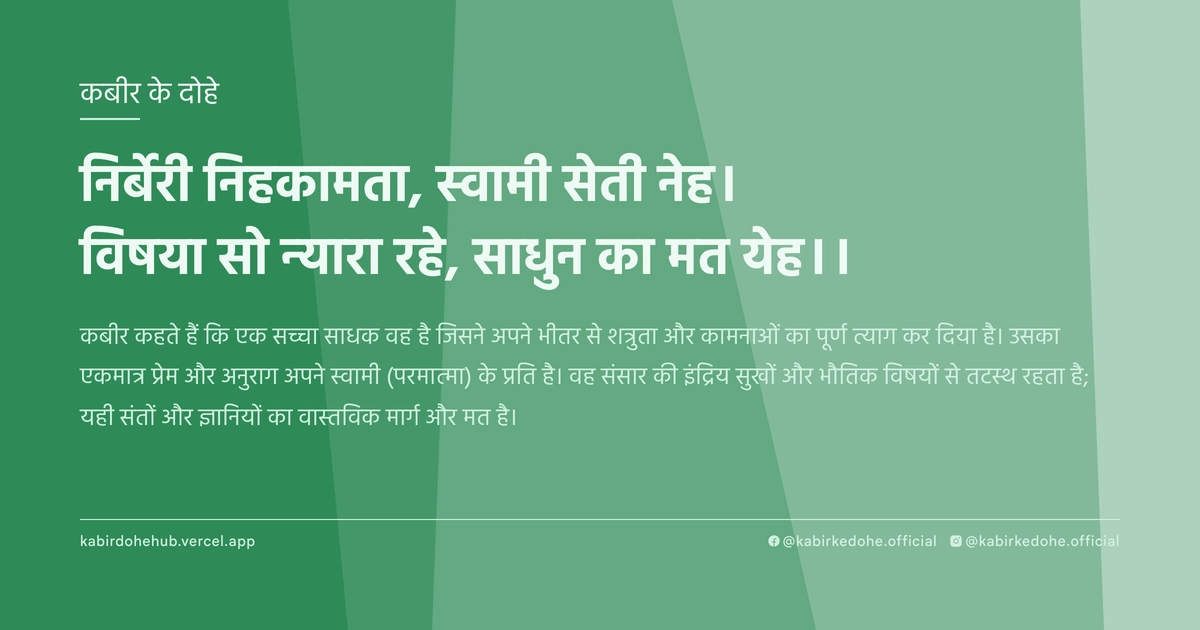
निर्बेरी निहकामता, स्वामी सेती नेह।
विषया सो न्यारा रहे, साधुन का मत येह।।
Nirberi nihkamta, swami seti neh. Vishaya so nyara rahe, sadhun ka mat yeh.
इस पृष्ठ पर इस कबीर दोहे का अर्थ (meaning), हिंदी व्याख्या और अंग्रेज़ी अनुवाद, दार्शनिक विश्लेषण और व्यावहारिक जीवन सीख दी गई है। यह दोहा संयम (Self-discipline) विषय से जुड़ा है — Kabir doha meaning and explanation in Hindi and English.
अर्थ (Meaning):
कबीर कहते हैं कि एक सच्चा साधक वह है जिसने अपने भीतर से शत्रुता और कामनाओं का पूर्ण त्याग कर दिया है। उसका एकमात्र प्रेम और अनुराग अपने स्वामी (परमात्मा) के प्रति है। वह संसार की इंद्रिय सुखों और भौतिक विषयों से तटस्थ रहता है; यही संतों और ज्ञानियों का वास्तविक मार्ग और मत है।
Kabir asserts that a true seeker is one who has completely eradicated enmity and desire from within. Their sole affection and longing are reserved for the Divine Master. Such a person remains detached from sensory pleasures and worldly objects; this, according to Kabir, is the authentic path and perspective of the enlightened saints.
व्याख्या (Interpretation):
इस दोहे का शाब्दिक अर्थ है कि क्रोध और इच्छा का त्याग कर ईश्वर में लीन होना। गहरे स्तर पर, 'निर्बेरी' केवल बाहरी दुश्मनों की अनुपस्थिति नहीं, बल्कि अहंकार के उस सूक्ष्म रूप का अंत है जो हमें दूसरों से अलग मानता है। 'निहकामता' का अर्थ है वासनाओं का विसर्जन, जहाँ व्यक्ति बाहरी दुनिया में सुख खोजना बंद कर देता है। यह निर्गुण भक्ति का सार है, जहाँ ईश्वर किसी मूर्ति में नहीं, बल्कि शून्य और पूर्णता के मिलन में है। माया यहाँ वह पर्दा है जो हमें यह विश्वास दिलाता है कि हम शरीर हैं, जबकि हम वास्तव में आत्मा हैं। जब साधक 'विषयों' से न्यारा होता है, तो वह द्वैत (दो होने का भाव) को समाप्त कर अद्वैत (एकता) की स्थिति में पहुँचता है। यह विरोधाभास है कि संसार में रहते हुए भी संसार से अलग रहना ही वास्तविक मुक्ति है।
Literally, the verse speaks of abandoning anger and desire to merge with the Divine. On a deeper level, 'Nirberi' signifies not just the absence of external enemies, but the annihilation of the subtle ego that perceives separation. 'Nihkaamta' refers to the dissolution of cravings, where the seeker ceases to hunt for happiness in the external world. This is the essence of Nirgun Bhakti, where the Divine is found not in idols, but in the union of emptiness and fullness. Maya is the veil that convinces us we are the physical body, whereas we are the eternal Atman. When the seeker remains 'detached from objects,' they dissolve duality and enter the state of Advaita (non-duality). The central paradox is that true liberation is achieved not by fleeing the world, but by remaining untouched by it while living within it.
दार्शनिक विश्लेषण (Philosophical Analysis):
कबीर का यह दृष्टिकोण उनके समय के कट्टरपंथी धार्मिक वातावरण के विरुद्ध एक सशक्त प्रतिक्रिया था। उन्होंने देखा कि लोग बाहरी कर्मकांडों और जातिगत श्रेष्ठता में उलझे हुए थे, जबकि आंतरिक शुद्धि की उपेक्षा कर रहे थे। यह दोहा स्पष्ट करता है कि मोक्ष किसी विशेष मंदिर या मस्जिद में नहीं, बल्कि मन की अवस्था में है।
दार्शनिक रूप से, यह अद्वैत वेदांत के करीब है, जहाँ 'अहं ब्रह्मास्मि' (मैं ही ब्रह्म हूँ) का बोध होता है। जब 'बेरी' (शत्रु) और 'काम' (इच्छा) समाप्त होते हैं, तो केवल शुद्ध चेतना बचती है। यह सूफी मत के 'फना' (अहंकार का विनाश) के समान है, जहाँ प्रेमी अपने अस्तित्व को ईश्वर में विलीन कर देता है।
कबीर यहाँ 'विषय' (sensory objects) के त्याग की बात कर रहे हैं, लेकिन यह वैराग्य पलायनवादी नहीं है। यह एक मनोवैज्ञानिक रूपांतरण है। जब हम वस्तुओं से अपनी खुशी जोड़ना बंद कर देते हैं, तो हम मानसिक गुलामी से मुक्त हो जाते हैं।
ritualism (कर्मकांड) का विरोध करते हुए कबीर यह समझाते हैं कि माला जपना या व्रत रखना व्यर्थ है यदि हृदय में ईर्ष्या और कामना जीवित है। वास्तविक 'साधु' वह नहीं जो गेरुआ वस्त्र पहने, बल्कि वह है जिसका चित्त स्थिर है।
अंततः, यह विश्लेषण हमें बताता है कि आध्यात्मिक प्रगति का पैमाना ज्ञान की मात्रा नहीं, बल्कि इच्छाओं की कमी है। अहंकार का विसर्जन ही वह एकमात्र द्वार है जिससे होकर मनुष्य अपनी मूल प्रकृति, जो कि अनंत आनंद है, को पुनः प्राप्त कर सकता है।
Kabir's perspective was a powerful reaction against the rigid religious atmosphere of his era. He observed people entangled in external rituals and caste superiority while neglecting internal purification. This verse clarifies that salvation is not found in a specific temple or mosque, but in a state of consciousness.
Philosophically, this aligns with Advaita Vedanta, emphasizing the realization of 'Aham Brahmasmi' (I am Brahman). When 'Beris' (enemies) and 'Kaam' (desires) are eradicated, only pure consciousness remains. This mirrors the Sufi concept of 'Fana' (annihilation of the self), where the lover dissolves their existence into the Beloved.
Kabir speaks of detachment from 'Vishaya' (sensory objects), but this is not an escapist renunciation. It is a psychological transformation. When we stop tethering our happiness to external objects, we are liberated from mental servitude.
Opposing ritualism, Kabir explains that chanting beads or fasting is futile if jealousy and craving remain alive in the heart. A true 'Sadhu' is not one who wears saffron robes, but one whose mind is steady and undisturbed.
Ultimately, this analysis reveals that the metric of spiritual progress is not the accumulation of knowledge, but the reduction of desire. The annihilation of the ego is the only gateway through which a human can reclaim their original nature, which is infinite bliss.
मूल संदेश (Core Message):
- शत्रुता का अंत ही वास्तविक शांति की शुरुआत है।
- इच्छाओं का त्याग ही आत्मा की स्वतंत्रता का मार्ग है।
- ईश्वर के प्रति प्रेम बाहरी आडंबरों से नहीं, आंतरिक शुद्धि से आता है।
- संसार में रहें, पर संसार को अपने भीतर न बसने दें।
- अहंकार का विसर्जन ही अद्वैत की प्राप्ति है।
- The end of enmity is the true beginning of peace.
- Renunciation of craving is the path to the soul's freedom.
- Divine love stems from internal purity, not external rituals.
- Live in the world, but do not let the world dwell within you.
- The dissolution of ego is the attainment of non-duality.
व्यावहारिक उदाहरण (Practical Example):
वाराणसी के एक पुराने घाट पर रहने वाली एक वृद्ध विधवा, जानकी, का जीवन अत्यंत कठिन था। वह दूसरों के घरों में छोटे-मोटे काम करती और जो मिलता, उसी में संतोष करती। लेकिन उसके मन में एक गहरी टीस थी—अपने बेटे के प्रति क्रोध, जिसने उसे सालों पहले छोड़ दिया था। वह हर रात उस क्रोध की अग्नि में जलती और ईश्वर से उसकी बर्बादी की प्रार्थना करती।
एक दिन वह कबीर के एक अनुयायी के संपर्क में आई, जिसने उसे यह दोहा सुनाया। उस संत ने उसे समझाया कि जब तक वह अपने बेटे को 'शत्रु' मानकर घृणा करेगी, वह ईश्वर के 'नेह' (प्रेम) को कभी महसूस नहीं कर पाएगी, क्योंकि क्रोध और ईश्वरीय प्रेम एक साथ नहीं रह सकते।
जानकी ने पहले तो इसे नकार दिया। उसने सोचा, 'जिसने मुझे धोखा दिया, उसे कैसे क्षमा करूँ?' लेकिन धीरे-धीरे उसने महसूस किया कि उसका क्रोध उसके बेटे को नहीं, बल्कि उसकी अपनी शांति को नष्ट कर रहा था। उसने अपनी 'बेरी' (शत्रुता) को त्यागने का निर्णय लिया।
उसने मानसिक रूप से अपने बेटे को क्षमा किया और अपनी सारी ऊर्जा को सेवा और ध्यान में लगा दी। उसने देखा कि जैसे ही उसने नफरत छोड़ी, उसका मन हल्का हो गया और उसे अपने भीतर एक ऐसी शांति मिली जो उसने पहले कभी अनुभव नहीं की थी।
अब वह घाट पर आने वाले हर अजनबी में अपने बेटे की छवि देखती और उन्हें निस्वार्थ प्रेम देती। उसकी कामनाएं—कि उसका बेटा वापस आए और माफी मांगे—पूरी तरह समाप्त हो गईं।
वह अब वस्तुओं या रिश्तों से अपनी खुशी नहीं मांगती थी। वह बस उस 'स्वामी' के प्रेम में मग्न रहती थी जो हर कण में व्याप्त है।
उसकी इस आंतरिक क्रांति ने आसपास के लोगों को भी प्रभावित किया। जो लोग उसे एक दुखी विधवा समझते थे, अब उसे एक शांत और प्रकाशमय व्यक्तित्व के रूप में देखने लगे।
जानकी का जीवन अब एक उदाहरण था कि कैसे 'निर्बेरी' और 'निहकामता' का मार्ग एक टूटे हुए हृदय को भी पूर्णता की ओर ले जा सकता है।
Janaki, an elderly widow living on an old ghat in Varanasi, led a precarious life. She did odd jobs in various households and lived with minimal means. However, a deep ache resided within her—a burning rage toward her son, who had abandoned her years ago. Every night, she burned in the fire of that anger, praying for his downfall.
One day, she encountered a follower of Kabir who recited this doha to her. The saint explained that as long as she viewed her son as an 'enemy' and harbored hatred, she could never experience the 'Neh' (love) of the Divine, for anger and divine love cannot coexist in the same heart.
Initially, Janaki resisted. She thought, 'How can I forgive the one who betrayed me?' But gradually, she realized that her hatred was not hurting her son; it was destroying her own peace. She decided to surrender her 'Beri' (enmity).
She mentally forgave her son and redirected all her energy toward selfless service and meditation. She discovered that the moment she let go of the hate, her heart felt light, and she experienced a tranquility she had never known before.
She began to see reflections of her son in every stranger who visited the ghat, offering them unconditional kindness. Her craving—the desire for her son to return and beg for forgiveness—completely vanished.
She no longer sought happiness from external relationships or material possessions. She remained immersed in the love of the 'Swami' who permeates every atom of existence.
This internal revolution influenced everyone around her. People who once saw her as a broken, grieving widow now saw her as a luminous and serene presence.
Janaki's life became a living testament to how the path of 'Nirberi' and 'Nihkaamta' can lead even a shattered heart toward absolute wholeness.
अभ्यास मार्गदर्शन (Practice Guidance):
- दैनिक अभ्यास: प्रतिदिन 20 मिनट मौन बैठें और मन में उठने वाले हर क्रोध या ईर्ष्या के विचार को एक 'शत्रु' के रूप में देखें, फिर उसे प्रेमपूर्वक विसर्जित करें।
- आत्म-पूछताछ जर्नल: प्रतिदिन लिखें—'आज मैंने किस व्यक्ति या परिस्थिति के प्रति द्वेष महसूस किया? क्या यह द्वेष मेरी अपनी पहचान (अहंकार) को बचाने की कोशिश थी?'
- व्यवहार परिवर्तन: किसी ऐसे व्यक्ति की मदद करें जिसे आप पसंद नहीं करते, बिना यह उम्मीद किए कि वे आपकी सराहना करेंगे।
- नैदानिक चेकलिस्ट: यदि आप अभी भी दूसरों की सफलता से जलते हैं या अतीत की कड़वाहट को याद कर बेचैन होते हैं, तो आप 'निर्बेरी' अवस्था से दूर हैं। यदि आप बिना किसी शर्त के शांति महसूस करते हैं, तो आप सही मार्ग पर हैं।
- Daily Practice: Sit in silence for 20 minutes daily. Observe every thought of anger or jealousy as an 'enemy' and consciously dissolve it with compassion.
- Self-Inquiry Journal: Write daily—'Toward whom or what did I feel resentment today? Was this resentment an attempt to protect my own ego/identity?'
- Behavioral Shift: Perform a selfless act of kindness for someone you dislike, without expecting any acknowledgment or gratitude in return.
- Diagnostic Checklist: If you still feel envy at others' success or restlessness when recalling past bitterness, you are distant from the 'Nirberi' state. If you feel peace without conditions, you are aligning with the wisdom.
चिंतन प्रश्न (Reflection Questions):
- मेरे जीवन में वह कौन सा 'शत्रु' है जिसे मैं वास्तव में क्षमा नहीं कर पा रहा हूँ, और वह शत्रु मेरी किस कमजोरी को दर्शाता है?
- क्या मेरी धार्मिकता वास्तव में ईश्वर के प्रति प्रेम है, या यह केवल मेरी सामाजिक छवि को बेहतर बनाने का एक साधन है?
- यदि मेरी सभी भौतिक इच्छाएं आज पूरी हो जाएं, तो क्या मैं वास्तव में शांत हो जाऊंगा, या मेरी नई इच्छाएं जन्म ले लेंगी?
- मैं अपनी डिजिटल पहचान (सोशल मीडिया) पर जो 'आदर्श' व्यक्तित्व दिखाता हूँ, वह मेरे आंतरिक संघर्षों से कितना अलग है?
- क्या मैं वास्तव में 'न्यारा' (detached) हूँ, या मैं केवल अपनी असफलताओं को छिपाने के लिए वैराग्य का ढोंग कर रहा हूँ?
- Who is the 'enemy' in my life I cannot truly forgive, and what vulnerability of mine does that enemy mirror?
- Is my religiosity truly love for the Divine, or is it merely a tool to enhance my social image?
- If all my material desires were fulfilled today, would I truly be at peace, or would new cravings simply emerge?
- How different is the 'ideal' persona I project on my digital identity from my internal shadows and conflicts?
- Am I truly 'detached,' or am I merely pretending to be renounced to mask my own failures?