
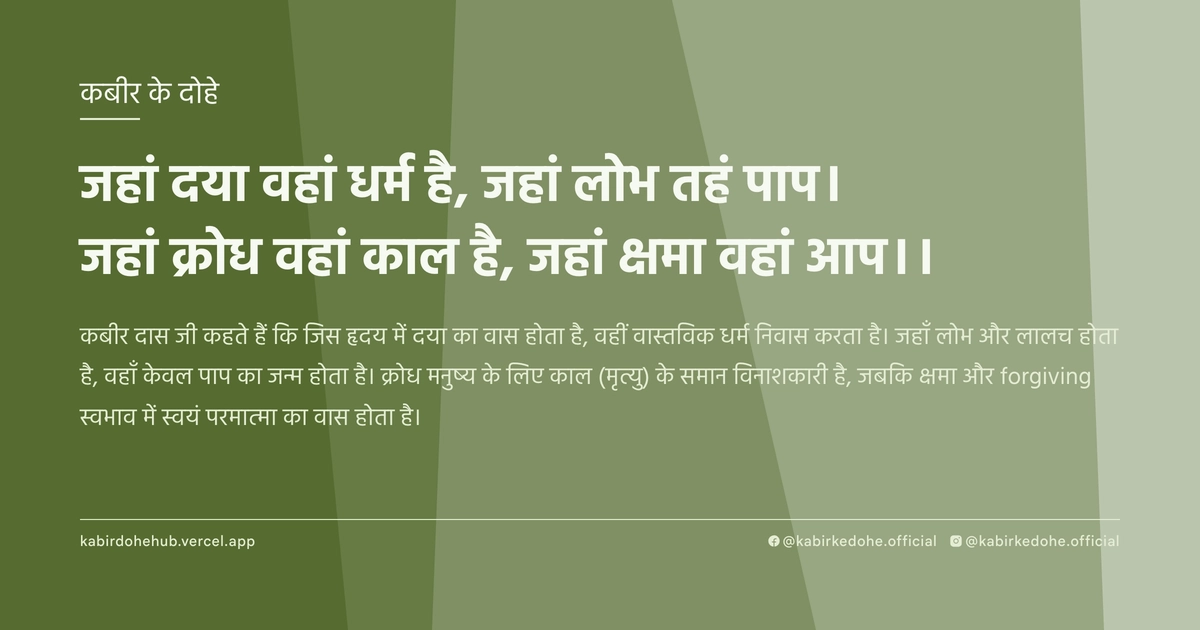
जहां दया वहां धर्म है, जहां लोभ तहं पाप।
जहां क्रोध वहां काल है, जहां क्षमा वहां आप।।
Jahaan daya wahaan dharm hai, jahaan lobh tahan paap. Jahaan krodh wahaan kaal hai, jahaan kshama wahaan aap.
इस पृष्ठ पर इस कबीर दोहे का अर्थ (meaning), हिंदी व्याख्या और अंग्रेज़ी अनुवाद, दार्शनिक विश्लेषण और व्यावहारिक जीवन सीख दी गई है। यह दोहा करुणा (Compassion) विषय से जुड़ा है — Kabir doha meaning and explanation in Hindi and English.
अर्थ (Meaning):
कबीर दास जी कहते हैं कि जिस हृदय में दया का वास होता है, वहीं वास्तविक धर्म निवास करता है। जहाँ लोभ और लालच होता है, वहाँ केवल पाप का जन्म होता है। क्रोध मनुष्य के लिए काल (मृत्यु) के समान विनाशकारी है, जबकि क्षमा और forgiving स्वभाव में स्वयं परमात्मा का वास होता है।
Kabir asserts that true righteousness (Dharma) resides where there is compassion. Conversely, greed is the breeding ground for sin. Anger is equated to the destructive force of time or death (Kaal), while the act of forgiveness is the dwelling place of the Divine Presence itself.
व्याख्या (Interpretation):
यह दोहा केवल नैतिक उपदेश नहीं, बल्कि चेतना के स्तरों का विश्लेषण है। 'दया' यहाँ केवल बाहरी सहानुभूति नहीं, बल्कि जीव मात्र में अपनी ही आत्मा का दर्शन करना है, जो निर्गुण भक्ति का मूल है। लोभ माया का वह जाल है जो आत्मा को शरीर और भौतिकता से बांधता है, जिससे द्वैत पैदा होता है। क्रोध को 'काल' कहा गया है क्योंकि यह विवेक को नष्ट कर देता है, जिससे मनुष्य अपनी आध्यात्मिक मृत्यु का कारण बनता है। अंततः, 'क्षमा' वह अवस्था है जहाँ अहंकार पूरी तरह विलीन हो जाता है; जब 'मैं' मिटता है, तब केवल 'आप' (परमात्मा/ब्रह्म) शेष रहते हैं। यह अद्वैत वेदांत की उस स्थिति को दर्शाता है जहाँ भक्त और भगवान एक हो जाते हैं।
This couplet is not merely a moral lesson but an analysis of levels of consciousness. 'Compassion' here is not simple sympathy, but the realization of one's own soul in all living beings, the core of Nirgun Bhakti. Greed is the veil of Maya that binds the soul to the physical form, creating a sense of duality. Anger is termed 'Kaal' (Death/Time) because it annihilates discernment, leading to spiritual oblivion. Ultimately, 'Forgiveness' is the state where the ego is completely dissolved; when the 'I' vanishes, only 'Aap' (the Divine/Brahman) remains. This mirrors the Advaita Vedanta realization of non-duality, where the distinction between the seeker and the sought disappears.
दार्शनिक विश्लेषण (Philosophical Analysis):
कबीर का यह दर्शन उस समय के सामाजिक और धार्मिक पाखंड के विरुद्ध एक सशक्त प्रहार था। उन्होंने धर्म को कर्मकांडों, तीर्थों या जाति व्यवस्था से हटाकर मानवीय संवेदनाओं और आंतरिक शुद्धि पर केंद्रित किया। उनके लिए 'धर्म' कोई बाहरी पहचान नहीं, बल्कि एक आंतरिक गुण है। यह दृष्टिकोण सूफीवाद के 'इश्क' (प्रेम) और वेदांत के 'आत्म-साक्षात्कार' का संगम है।
लोभ का विश्लेषण करते हुए कबीर बताते हैं कि कैसे इच्छाएं आत्मा को संकुचित करती हैं। जब मनुष्य केवल अपने लाभ के बारे में सोचता है, तो वह ब्रह्मांडीय एकता से कट जाता है। यह अलगाव ही 'पाप' है। यहाँ पाप का अर्थ किसी कानूनी अपराध से नहीं, बल्कि सत्य से विमुख होने से है।
क्रोध को 'काल' कहना एक गहरा मनोवैज्ञानिक सत्य है। क्रोध में व्यक्ति वर्तमान क्षण को खो देता है और विनाश की ओर अग्रसर होता है। यह अहंकार की चरम प्रतिक्रिया है। जब अहंकार हावी होता है, तो वह व्यक्ति को अंधा कर देता है, जिससे वह अपने भीतर के ईश्वर को नहीं देख पाता।
क्षमा का दर्शन यहाँ सबसे महत्वपूर्ण है। क्षमा केवल दूसरे को माफ करना नहीं है, बल्कि यह स्वीकार करना है कि दूसरा भी उसी एक परमात्मा का अंश है। यह 'अहं' का विसर्जन है। जब हम क्षमा करते हैं, तो हम वास्तव में अपने भीतर के उस अवरोध को हटाते हैं जो हमें ब्रह्म से अलग करता है।
निष्कर्षतः, कबीर एक ऐसे मार्ग का प्रस्ताव देते हैं जहाँ नैतिकता और आध्यात्मिकता अलग नहीं हैं। उनके अनुसार, यदि आप ईश्वर को पाना चाहते हैं, तो आपको पहले दया, संतोष और क्षमा के गुणों को आत्मसात करना होगा। बिना इन गुणों के, सभी मंत्र और पूजा व्यर्थ हैं।
Kabir's philosophy serves as a potent critique of the ritualistic and caste-based religious structures of his era. He shifted the definition of 'Dharma' from external identity and performance of rites to internal disposition and emotional purity. For Kabir, righteousness is not a label but a lived quality of the soul, blending the Sufi concept of 'Ishq' (Divine Love) with the Vedantic pursuit of Self-realization.
In analyzing greed, Kabir illustrates how desires contract the soul. When a human focuses solely on personal gain, they disconnect from the cosmic unity. This separation is the essence of 'sin'—not as a legal transgression, but as a deviation from the Truth (Satya).
Equating anger to 'Kaal' (Time/Death) reveals a profound psychological insight. In a state of rage, an individual loses the present moment and accelerates their own spiritual decay. Anger is the peak reaction of the ego; when the ego dominates, it blinds the seeker to the Divine spark within.
The philosophy of forgiveness is the pinnacle of this Doha. Forgiveness is not merely an act of mercy toward another, but an acknowledgment that the other is an extension of the same universal consciousness. It is the dissolution of the 'I'. By forgiving, one removes the psychic barrier that separates the Atman from Brahman.
Ultimately, Kabir proposes a path where ethics and spirituality are indivisible. He suggests that the quest for God is impossible without the cultivation of compassion, contentment, and forgiveness. Without these, all mantras and rituals are empty shells, devoid of spiritual potency.
मूल संदेश (Core Message):
- दया ही वास्तविक धर्म का एकमात्र प्रमाण है।
- लोभ आत्मा को संकुचित कर उसे माया में बांधता है।
- क्रोध विवेक का विनाश कर आध्यात्मिक मृत्यु लाता है।
- क्षमा अहंकार का अंत और परमात्मा का मिलन है।
- बाहरी पूजा से श्रेष्ठ आंतरिक गुणों का विकास है।
- जब 'मैं' मिटता है, तभी 'परमात्मा' प्रकट होता है।
- Compassion is the only true evidence of righteousness.
- Greed contracts the soul, binding it to the illusion of Maya.
- Anger destroys discernment, leading to spiritual oblivion.
- Forgiveness is the death of ego and the union with the Divine.
- Cultivating inner virtues is superior to any external ritual.
- Only when the 'I' vanishes does the Universal Truth emerge.
व्यावहारिक उदाहरण (Practical Example):
एक समय की बात है, वाराणसी के घाटों पर माधव नाम का एक वृद्ध बुनकर रहता था। माधव अपनी कला में निपुण था, लेकिन उसका स्वभाव अत्यंत क्रोधी था। वह छोटी-छोटी बातों पर अपने पड़ोसियों और शिष्यों पर चिल्लाता था। उसका मानना था कि उसकी श्रेष्ठता उसके कौशल से आती है, और जो उसकी बात नहीं मानते, वे मूर्ख हैं।
एक दिन, एक युवा ग्राहक ने उसकी बुनी हुई साड़ी में एक छोटी सी त्रुटि निकाली। माधव क्रोध से आगबबूला हो गया और उसने उस युवक को अपमानित करते हुए दुकान से बाहर निकाल दिया। उस रात माधव को नींद नहीं आई; उसका मन उसी क्रोध की अग्नि में जल रहा था। उसे महसूस हुआ कि वह साड़ी तो ठीक कर सकता है, लेकिन अपने मन की कड़वाहट कैसे मिटाए?
अगले दिन वह एक संत के पास गया। संत ने उसे कबीर का यह दोहा सुनाया। संत ने कहा, "माधव, तुम्हारा क्रोध तुम्हें 'काल' की ओर ले जा रहा है। तुम जिसे अपनी श्रेष्ठता समझते हो, वह वास्तव में तुम्हारा अहंकार है जो तुम्हें दूसरों से अलग कर रहा है।"
माधव ने गहराई से विचार किया। उसने महसूस किया कि जिस युवक ने गलती निकाली थी, वह वास्तव में उसकी कला को सुधारने में मदद कर रहा था। उसने अपनी गलती स्वीकार की और उस युवक को ढूंढकर उससे क्षमा मांगी।
जैसे ही उसने क्षमा मांगी, माधव के हृदय पर एक भारी बोझ उतर गया। उसे एक ऐसी शांति महसूस हुई जो उसने जीवन में कभी अनुभव नहीं की थी। उसने महसूस किया कि क्षमा मांगने से वह छोटा नहीं हुआ, बल्कि उसका हृदय विस्तृत हो गया।
अब माधव ने अपने जीवन का तरीका बदल लिया। वह अब केवल कपड़े नहीं बुनता था, बल्कि प्रेम और दया के धागों से रिश्तों को बुनने लगा। उसने अपने घर के पास एक छोटा सा केंद्र खोला जहाँ वह गरीब बच्चों को मुफ्त में बुनाई सिखाता था।
उसकी दुकान अब केवल व्यापार का केंद्र नहीं, बल्कि शांति का ठिकाना बन गई। लोग उसकी साड़ियों के लिए नहीं, बल्कि उसकी बातों और उसके शांत स्वभाव के लिए आने लगे।
माधव ने सीखा कि जब उसने क्रोध को त्याग कर क्षमा को अपनाया, तो उसके भीतर का 'मैं' समाप्त हो गया और उसे हर इंसान में उसी परमात्मा की झलक दिखने लगी। यही उसका वास्तविक मोक्ष था।
Once, on the ghats of Varanasi, lived an elderly weaver named Madhav. Madhav was a master of his craft, but his temperament was volatile and prone to anger. He would shout at his neighbors and apprentices over the smallest mistakes, believing his skill granted him a superiority that justified his harshness.
One day, a young customer pointed out a minor flaw in a saree Madhav had woven. Consumed by rage, Madhav insulted the youth and threw him out of the shop. That night, Madhav could not sleep; his mind was a whirlwind of anger. He realized that while he could fix a thread in a fabric, he had no way to fix the bitterness in his heart.
Seeking peace, he visited a wandering saint. The saint recited this specific Doha by Kabir and told him, "Madhav, your anger is leading you toward 'Kaal'. What you perceive as superiority is actually an ego that isolates you from the rest of humanity."
Madhav reflected deeply on these words. He realized that the youth who pointed out the flaw was actually helping him refine his art. Overcome by a new understanding, he sought out the young man and sincerely asked for his forgiveness.
The moment he asked for forgiveness, a heavy weight lifted from Madhav's chest. He experienced a profound serenity he had never known. He discovered that in forgiving and seeking forgiveness, he did not become smaller; rather, his heart expanded.
Madhav transformed his life. He no longer just wove fabric; he began weaving relationships with threads of love and compassion. He opened a small center near his home to teach weaving to underprivileged children for free.
His shop ceased to be merely a place of commerce and became a sanctuary of peace. People began visiting him not just for his sarees, but for the tranquility and wisdom he radiated.
Madhav learned that by replacing anger with forgiveness, the 'I' within him dissolved, allowing him to see the Divine spark in every human being. This was his true liberation.
अभ्यास मार्गदर्शन (Practice Guidance):
- दैनिक आत्म-निरीक्षण: प्रतिदिन सोने से पहले 10 मिनट बैठें और विचार करें कि आज आपने कितनी बार क्रोध किया या लोभ दिखाया। बिना निर्णय के केवल इसे देखें।
- क्षमा का अभ्यास: हर सप्ताह एक ऐसे व्यक्ति को मन से क्षमा करें जिससे आपकी अनबन है। यह महसूस करें कि आप उन्हें नहीं, बल्कि अपनी आत्मा को बोझ से मुक्त कर रहे हैं।
- करुणा ध्यान: ध्यान के दौरान कल्पना करें कि आपके हृदय से प्रेम की किरणें निकलकर उन लोगों तक पहुँच रही हैं जिन्हें आप नापसंद करते हैं।
- निदान चेकलिस्ट: क्या मैं दूसरों की गलती पर तुरंत प्रतिक्रिया देता हूँ? (यदि हाँ, तो क्रोध हावी है)। क्या मैं दूसरों की सफलता से ईर्ष्या करता हूँ? (यदि हाँ, तो लोभ/अहंकार सक्रिय है)। क्या मैं दूसरों को माफ करने में असमर्थ हूँ? (यदि हाँ, तो 'मैं' अभी भी जीवित है)।
- Daily Self-Inquiry: Spend 10 minutes before sleep reflecting on how many times you succumbed to anger or greed today. Observe these emotions without judgment.
- Forgiveness Practice: Each week, consciously forgive someone with whom you have a conflict. Realize that you are not liberating them, but freeing your own soul from a burden.
- Compassion Meditation: During meditation, visualize rays of love emanating from your heart and reaching those you dislike or find difficult.
- Diagnostic Checklist: Do I react instantly to others' mistakes? (If yes, anger dominates). Do I feel envy at others' success? (If yes, greed/ego is active). Am I unable to let go of grudges? (If yes, the 'I' is still too strong).
चिंतन प्रश्न (Reflection Questions):
- मेरे जीवन में 'धर्म' का अर्थ क्या है—सामाजिक रीति-रिवाज या आंतरिक करुणा?
- वह कौन सा लोभ है जो मुझे चुपचाप नियंत्रित कर रहा है, भले ही वह भौतिक न हो (जैसे प्रशंसा या शक्ति का लोभ)?
- मेरा क्रोध वास्तव में क्या है—दूसरों के प्रति घृणा या मेरी अपनी अपेक्षाओं का टूटना?
- क्या मैं वास्तव में क्षमा करता हूँ, या मैं केवल अपनी श्रेष्ठता सिद्ध करने के लिए 'माफ' करने का नाटक करता हूँ?
- यदि मेरा अहंकार पूरी तरह समाप्त हो जाए, तो मेरी पहचान के रूप में क्या बचेगा?
- मैं अपनी डिजिटल पहचान (Social Media Ego) में कितना दयालु हूँ और वास्तविक जीवन में कितना?
- What does 'Dharma' mean in my life—social conventions or internal compassion?
- What is the subtle greed controlling me, even if it is not material (e.g., greed for praise or power)?
- Is my anger truly about the other person, or is it a reaction to my own shattered expectations?
- Do I truly forgive, or do I pretend to 'pardon' others just to maintain a sense of moral superiority?
- If my ego were completely annihilated, what would remain of my identity?
- How does my digital persona (Social Media Ego) differ from my actual capacity for compassion in real life?