
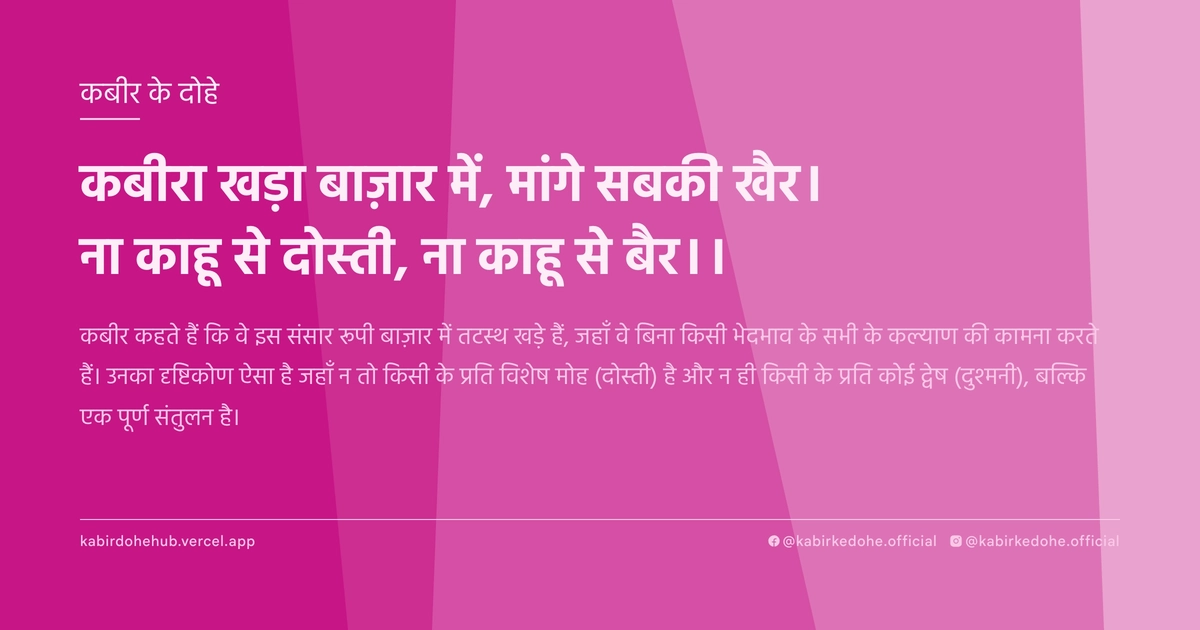
कबीरा खड़ा बाज़ार में, मांगे सबकी खैर।
ना काहू से दोस्ती, ना काहू से बैर।।
Kabira khada bazaar mein, maange sabki khair. Na kaahu se dosti, na kaahu se bair.
इस पृष्ठ पर इस कबीर दोहे का अर्थ (meaning), हिंदी व्याख्या और अंग्रेज़ी अनुवाद, दार्शनिक विश्लेषण और व्यावहारिक जीवन सीख दी गई है। यह दोहा करुणा (Compassion) विषय से जुड़ा है — Kabir doha meaning and explanation in Hindi and English.
अर्थ (Meaning):
कबीर कहते हैं कि वे इस संसार रूपी बाज़ार में तटस्थ खड़े हैं, जहाँ वे बिना किसी भेदभाव के सभी के कल्याण की कामना करते हैं। उनका दृष्टिकोण ऐसा है जहाँ न तो किसी के प्रति विशेष मोह (दोस्ती) है और न ही किसी के प्रति कोई द्वेष (दुश्मनी), बल्कि एक पूर्ण संतुलन है।
Kabir declares his presence in the marketplace of the world, standing as a witness who wishes well for every living soul. He maintains a state of profound equilibrium where he is neither bound by the attachments of friendship nor consumed by the fires of enmity, embodying a universal benevolence.
व्याख्या (Interpretation):
यहाँ 'बाज़ार' केवल व्यापार का केंद्र नहीं, बल्कि मायावी संसार का प्रतीक है जहाँ मानवीय भावनाएँ और वासनाएँ बिकती और खरीदी जाती हैं। कबीर का 'खड़ा होना' साक्षी भाव (Witness Consciousness) को दर्शाता है। जब वे कहते हैं कि न दोस्ती है न बैर, तो वे द्वैत (Duality) से ऊपर उठकर अद्वैत की स्थिति की बात कर रहे हैं। यह स्थिति राग और द्वेष के विसर्जन की है। Nirgun Bhakti के अनुसार, ईश्वर किसी व्यक्ति विशेष का नहीं बल्कि संपूर्ण अस्तित्व का है। अतः, किसी एक से विशेष लगाव या घृणा करना उस सार्वभौमिक सत्य को सीमित करना है। यह विरोधाभास है कि संसार के बीच रहकर भी संसार से मुक्त रहना ही वास्तविक वैराग्य है।
The 'marketplace' here is not merely a center of commerce, but a metaphor for the illusory world (Maya) where human emotions and desires are traded. Kabir's act of 'standing' signifies the state of the Sakshi or the Witness Consciousness. By stating he has neither friendship nor enmity, he transcends duality, moving toward the non-dual state of Advaita. This is the dissolution of Raga (attachment) and Dwesha (aversion). In the tradition of Nirgun Bhakti, the Divine is not a personal deity but the formless essence of all existence; thus, favoring one or hating another limits this universal truth. The central paradox presented is the attainment of liberation while remaining fully immersed in the chaos of worldly existence.
दार्शनिक विश्लेषण (Philosophical Analysis):
कबीर का यह दोहा उस युग की सामाजिक और धार्मिक उथल-पुथल के बीच एक क्रांतिकारी घोषणा है। उस समय समाज जाति, धर्म और संप्रदाय के आधार पर गहराई से विभाजित था। कबीर ने कर्मकांडों और बाहरी आडंबरों का पुरजोर विरोध किया, क्योंकि वे मानते थे कि ईश्वर मंदिर या मस्जिद में नहीं, बल्कि मनुष्य के भीतर है। यह विचार सूफी मत के 'वहदत-अल-वजूद' (अस्तित्व की एकता) और वेदांत के 'अहं ब्रह्मास्मि' के अत्यंत निकट है।
दार्शनिक स्तर पर, यह दोहा 'स्थितप्रज्ञ' की अवस्था का वर्णन करता है। जब मनुष्य अपनी पहचान को सामाजिक लेबल (जैसे हिंदू, मुस्लिम, उच्च जाति, निम्न जाति) से हटाकर केवल एक 'चेतना' के रूप में देखता है, तब वह राग और द्वेष से मुक्त हो जाता है। यह अहंकार का विसर्जन है। अहंकार ही वह पर्दा है जो हमें दूसरों में स्वयं को देखने से रोकता है।
कबीर यहाँ यह स्पष्ट कर रहे हैं कि 'दोस्ती' और 'बैर' दोनों ही अहंकार के अलग-अलग रूप हैं। दोस्ती में 'मेरा' होने का भाव है, और बैर में 'पराया' होने का। दोनों ही स्थितियाँ व्यक्ति को सत्य से दूर ले जाती हैं। वास्तविक प्रेम वह है जो किसी शर्त या अपेक्षा के बिना संपूर्ण मानवता के लिए हो।
सूफीवाद के संदर्भ में, यह 'फना' होने की प्रक्रिया है—जहाँ व्यक्तिगत इच्छाएँ और सामाजिक पहचान मिट जाती हैं और केवल ईश्वर की इच्छा शेष रहती है। कबीर का 'बाज़ार' में खड़ा होना यह दर्शाता है कि आध्यात्मिक यात्रा एकांत में नहीं, बल्कि जीवन की वास्तविकताओं के बीच होनी चाहिए।
अंततः, यह दोहा हमें सिखाता है कि तटस्थता का अर्थ उदासीनता नहीं है, बल्कि एक ऐसी करुणा है जो किसी विशेष व्यक्ति के लिए आरक्षित नहीं है। यह एक सार्वभौमिक प्रेम है जो न्याय और सत्य पर आधारित है, न कि व्यक्तिगत संबंधों पर।
This couplet serves as a revolutionary manifesto amidst the social and religious turbulence of Kabir's era. Society was deeply fractured by caste, creed, and dogma. Kabir vehemently rejected ritualism and external piety, asserting that the Divine resides within the human heart rather than in temples or mosques. This philosophy aligns closely with the Sufi concept of 'Wahdat-al-Wujud' (Unity of Existence) and the Vedantic realization of 'Aham Brahmasmi'.
Philosophically, the verse describes the state of a 'Sthitapragya'—one whose wisdom is steady. When a human shifts their identity from social labels to pure consciousness, they transcend the cycle of attachment and aversion. This is the annihilation of the ego. The ego is the veil that prevents us from recognizing ourselves in others.
Kabir clarifies that both 'friendship' and 'enmity' are merely different masks of the ego. Friendship implies a sense of 'mine,' while enmity implies 'the other.' Both states bind the soul to the material plane and distract it from the ultimate truth. True love is that which is unconditional and extended to all of humanity without preference.
In the context of Sufism, this represents the process of 'Fana'—the dissolution of the self where personal desires and social identities vanish, leaving only the Divine Will. Kabir's presence in the 'marketplace' suggests that the spiritual journey is not found in isolation, but within the crucible of daily life.
Ultimately, the verse teaches that neutrality is not indifference, but a form of compassion that is not reserved for a select few. It is a universal love based on truth and justice, rather than personal affinity or tribal loyalty.
मूल संदेश (Core Message):
- अहंकार का अंत ही वास्तविक स्वतंत्रता का द्वार है।
- राग और द्वेष दोनों ही आत्मा की यात्रा में बेड़ियाँ हैं।
- तटस्थता का अर्थ उदासीनता नहीं, बल्कि सार्वभौमिक करुणा है।
- सत्य किसी व्यक्ति या समूह का नहीं, बल्कि संपूर्ण अस्तित्व का है।
- साक्षी भाव से जीना ही माया के प्रभाव को समाप्त करना है।
- The dissolution of the ego is the only gateway to true liberation.
- Both attachment and aversion are shackles on the soul's journey.
- Neutrality is not indifference, but a state of universal compassion.
- Truth belongs to no single person or group, but to the entire existence.
- Living as a witness is the only way to dissolve the illusions of Maya.
व्यावहारिक उदाहरण (Practical Example):
एक समय की बात है, वाराणसी के घाटों पर माधव नाम का एक वृद्ध बुनकर रहता था। माधव अपने काम में निपुण था, लेकिन उसका स्वभाव अत्यंत शांत था। उसके पड़ोस में दो परिवार रहते थे जो पिछले बीस वर्षों से एक छोटी सी जमीन की सीमा को लेकर आपस में लड़ रहे थे।
दोनों परिवारों के बीच इतनी कड़वाहट थी कि वे एक-दूसरे का चेहरा तक नहीं देखना चाहते थे। पूरा मोहल्ला दो गुटों में बँटा हुआ था। लोग माधव से अक्सर पूछते, "माधव, तुम किस तरफ हो? तुम बताओ कि कौन सही है?"
माधव हमेशा मुस्कुराकर कहता, "मैं तो बस अपना कपड़ा बुन रहा हूँ और सबके लिए दुआ कर रहा हूँ।"
एक दिन गाँव में भारी बाढ़ आई। पानी तेजी से गलियों में घुसने लगा। एक परिवार का छोटा बच्चा तेज बहाव में बह गया और वह दूसरे परिवार के आंगन में लगे एक मजबूत पेड़ की टहनी से अटक गया।
जिस परिवार से उस बच्चे की सबसे अधिक दुश्मनी थी, उसी परिवार का मुखिया उसे बचाने के लिए पानी में कूदा। उसने अपनी जान जोखिम में डालकर बच्चे को बचाया। जब बच्चा सुरक्षित बाहर आया, तो दोनों परिवारों के लोग एक-दूसरे को देख रहे थे।
तभी माधव वहाँ पहुँचा। उसने किसी की प्रशंसा नहीं की और न ही किसी को पुरानी बातों के लिए टोका। उसने बस दोनों परिवारों को गर्म चाय पिलाई और कहा, "बाढ़ ने सबको एक जैसा कर दिया, हम तो पहले से ही एक थे, बस हमें याद नहीं था।"
उस क्षण, उन दोनों परिवारों को अहसास हुआ कि उनकी दुश्मनी कितनी तुच्छ थी। उन्होंने माधव की उस तटस्थता को देखा जिसने उन्हें कभी जज नहीं किया, बल्कि हमेशा सबके कल्याण की कामना की।
माधव की इस 'साक्षी' भावना ने उन्हें यह सिखाया कि जब हम किसी के प्रति न तो विशेष मोह रखते हैं और न ही घृणा, तभी हम वास्तव में दूसरों की मदद कर सकते हैं।
उस दिन के बाद, मोहल्ले की कड़वाहट खत्म हो गई। माधव अब भी उसी बाज़ार में खड़ा था, अपना कपड़ा बुन रहा था, लेकिन अब पूरा मोहल्ला उसके उस मौन प्रेम के प्रभाव में था।
Once, on the ghats of Varanasi, lived an elderly weaver named Madhav. Madhav was a master of his craft, but his true mastery lay in his profound inner stillness. In his neighborhood, two families had been locked in a bitter feud for twenty years over a trivial boundary dispute regarding a small piece of land.
The animosity was so deep that they refused to even look at one another. The entire neighborhood was split into two factions. People would often pressure Madhav, asking, "Madhav, whose side are you on? Tell us, who is right in this matter?"
Madhav would always respond with a gentle smile, "I am simply weaving my cloth and praying for the well-being of everyone."
One day, a devastating flood hit the city. Water rushed violently through the narrow lanes. A small child from one family was swept away by the current and became snagged on a sturdy tree branch in the courtyard of the rival family.
The patriarch of the family that harbored the most hatred for the child's kin leaped into the churning waters without a second thought. Risking his own life, he rescued the child and pulled him to safety.
As the child was safely returned, the members of both families stared at each other in stunned silence. At that moment, Madhav arrived. He did not praise the act, nor did he remind them of their past grievances.
He simply served them warm tea and remarked, "The flood has made us all equal; we were always one, we had simply forgotten it."
In that instant, both families realized the insignificance of their long-standing hatred. They looked at Madhav's neutrality—a state where he never judged them, but always wished them well.
Madhav's 'witness' consciousness taught them that only when we release both specific attachment and hatred can we truly serve others with a pure heart.
From that day forward, the bitterness of the neighborhood vanished. Madhav remained in that same marketplace, weaving his cloth, but the entire community was now transformed by the influence of his silent, universal love.
अभ्यास मार्गदर्शन (Practice Guidance):
- प्रतिदिन 20 मिनट 'साक्षी ध्यान' का अभ्यास करें, जहाँ आप अपने विचारों और भावनाओं को बिना किसी निर्णय (Judgment) के केवल देखें, जैसे आप बाज़ार में खड़े एक दर्शक हों।
- एक 'भावनात्मक जर्नल' लिखें। जब भी किसी के प्रति तीव्र राग (पसंद) या द्वेष (नापसंद) महसूस हो, तो लिखें कि यह भावना आपके अहंकार के किस हिस्से को संतुष्ट कर रही है।
- सचेत व्यवहार परिवर्तन: दिन में कम से कम एक बार ऐसे व्यक्ति के प्रति दयालुता दिखाएं जिसे आप पसंद नहीं करते, और एक बार ऐसे व्यक्ति के प्रति तटस्थ रहें जिससे आप बहुत अधिक जुड़े हैं।
- निदान चेकलिस्ट: क्या मैं दूसरों की गलतियों पर तुरंत प्रतिक्रिया देता हूँ? क्या मेरी खुशी दूसरों के व्यवहार पर निर्भर है? क्या मैं लोगों को श्रेणियों (दोस्त/दुश्मन) में बांटकर देखता हूँ? यदि हाँ, तो आप अभी भी 'बैर और दोस्ती' के जाल में हैं।
- Practice 'Witness Meditation' for 20 minutes daily. Observe your thoughts and emotions without judgment, as if you are a detached spectator standing in a crowded marketplace.
- Maintain an 'Emotional Journal'. Whenever you feel intense attachment (Raga) or aversion (Dwesha), record which part of your ego is being fed by this emotion.
- Conscious Behavioral Shift: Once a day, perform an act of kindness for someone you dislike, and once a day, practice emotional neutrality toward someone you are overly attached to.
- Diagnostic Checklist: Do I react instantly to others' mistakes? Is my happiness dependent on how others treat me? Do I categorize people strictly as 'friends' or 'enemies'? If yes, you are still entangled in the web of duality.
चिंतन प्रश्न (Reflection Questions):
- मेरे जीवन में वे कौन से 'दोस्त' हैं जिनके प्रति मेरा मोह मुझे सत्य देखने से रोक रहा है?
- मैं किन लोगों को अपना 'शत्रु' मानता हूँ, और क्या वह शत्रुता वास्तव में मेरे अपने भीतर के किसी डर का प्रतिबिंब है?
- यदि मेरी सामाजिक पहचान (नाम, पद, जाति) छीन ली जाए, तो क्या मैं अभी भी दूसरों के प्रति वैसा ही व्यवहार करूँगा?
- क्या मेरी 'अच्छाई' केवल उन लोगों के लिए है जो मुझे पसंद करते हैं, या यह वास्तव में निस्वार्थ है?
- डिजिटल युग में, मैं अपनी ऑनलाइन छवि (Digital Ego) को बनाए रखने के लिए कितनी बार अपनी आंतरिक शांति का बलिदान करता हूँ?
- Who are the 'friends' in my life whose presence creates an attachment that blinds me to the truth?
- Whom do I perceive as my 'enemy,' and is that enmity merely a reflection of a hidden fear within myself?
- If my social identity (name, rank, caste) were stripped away, would I still treat others with the same disposition?
- Is my 'kindness' reserved only for those who validate me, or is it truly selfless and universal?
- In this digital age, how often do I sacrifice my inner peace to maintain a curated online persona (Digital Ego)?