
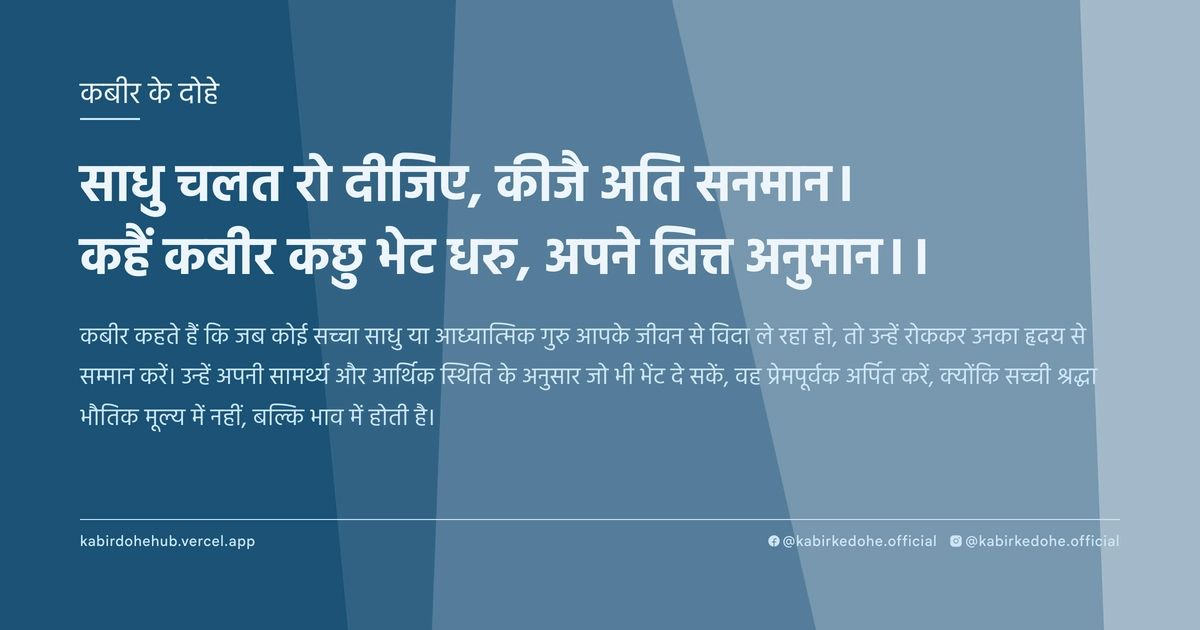
साधु चलत रो दीजिए, कीजै अति सनमान।
कहैं कबीर कछु भेट धरु, अपने बित्त अनुमान।।
Sadhu chalat ro deeje, keeje ati sanmaan. Kahen Kabir kachhu bhet dharu, apne bitt anuman.
इस पृष्ठ पर इस कबीर दोहे का अर्थ (meaning), हिंदी व्याख्या और अंग्रेज़ी अनुवाद, दार्शनिक विश्लेषण और व्यावहारिक जीवन सीख दी गई है। यह दोहा विनम्रता (Humility) विषय से जुड़ा है — Kabir doha meaning and explanation in Hindi and English.
अर्थ (Meaning):
कबीर कहते हैं कि जब कोई सच्चा साधु या आध्यात्मिक गुरु आपके जीवन से विदा ले रहा हो, तो उन्हें रोककर उनका हृदय से सम्मान करें। उन्हें अपनी सामर्थ्य और आर्थिक स्थिति के अनुसार जो भी भेंट दे सकें, वह प्रेमपूर्वक अर्पित करें, क्योंकि सच्ची श्रद्धा भौतिक मूल्य में नहीं, बल्कि भाव में होती है।
Kabir suggests that when a true seeker or spiritual guide is departing, one should stop them and offer profound respect. He advises giving a gift or offering according to one's own financial capacity and means, emphasizing that the value of the offering lies in the sincerity of the heart rather than the monetary cost.
व्याख्या (Interpretation):
इस दोहे का शाब्दिक अर्थ अतिथि सत्कार है, परंतु इसका आध्यात्मिक संकेत 'गुरु-तत्व' के प्रति समर्पण है। यहाँ 'साधु' केवल एक व्यक्ति नहीं, बल्कि उस जागृत चेतना का प्रतीक है जो हमें माया के अंधकार से बाहर निकालती है। 'रोकने' का अर्थ है उस दिव्य ऊर्जा को अपने भीतर बनाए रखने की तड़प। यह निर्गुण भक्ति का वह पहलू है जहाँ बाहरी कर्मकांडों के बजाय आंतरिक भाव को प्रधानता दी जाती है। जब हम अपनी 'बित्त अनुमान' यानी अपनी सीमित क्षमता के अनुसार देते हैं, तो हम वास्तव में अपने अहंकार का त्याग कर रहे होते हैं। यह अद्वैत वेदांत के उस सिद्धांत की ओर इशारा करता है जहाँ देने वाला और लेने वाला अंततः एक ही ब्रह्म हैं, और यह आदान-प्रदान केवल प्रेम की एक अभिव्यक्ति है।
While the literal meaning pertains to hospitality, the spiritual implication is the surrender to the 'Guru-Tattva' or the principle of the teacher. Here, the 'Sadhu' is not merely a person but a symbol of awakened consciousness that liberates us from the illusions of Maya. 'Stopping' the saint signifies the intense longing to retain that divine energy within one's own life. This reflects a facet of Nirgun Bhakti where internal devotion takes precedence over external rituals. By giving according to one's 'bitt anumaan' (means), the seeker is actually practicing the shedding of the ego. It points toward the Advaita Vedanta principle where the giver and the receiver are ultimately the same Brahman, and the act of giving is merely an expression of universal love.
दार्शनिक विश्लेषण (Philosophical Analysis):
कबीर का यह दोहा मध्यकालीन भारत के उस सामाजिक परिवेश में रचा गया जहाँ धर्म अक्सर बाहरी आडंबरों और कठोर नियमों में जकड़ा था। कबीर ने हमेशा इस बात पर जोर दिया कि ईश्वर किसी मंदिर या मस्जिद में नहीं, बल्कि मनुष्य के भीतर और सच्चे साधकों के सानिध्य में मिलता है। यहाँ 'साधु' का सम्मान करना वास्तव में उस सत्य का सम्मान करना है जिसे वह साधु आत्मसात कर चुका है।
दार्शनिक स्तर पर, यह सूफी मत के 'इश्क-ए-हकीकी' (ईश्वरीय प्रेम) से मेल खाता है, जहाँ गुरु और शिष्य का संबंध केवल ज्ञान का हस्तांतरण नहीं, बल्कि आत्माओं का मिलन होता है। कबीर यहाँ यह स्पष्ट करते हैं कि भक्ति में 'दिखावा' वर्जित है। यदि कोई व्यक्ति अपनी क्षमता से अधिक देकर प्रशंसा चाहता है, तो वह भक्ति नहीं, बल्कि अहंकार की तुष्टि है।
अद्वैत वेदांत के दृष्टिकोण से, यह दोहा 'साक्षी भाव' की शिक्षा देता है। जब हम एक सच्चे साधु का सम्मान करते हैं, तो हम वास्तव में अपनी ही आत्मा के उच्चतम स्वरूप का सम्मान कर रहे होते हैं। यह क्रिया हमें इस बोध की ओर ले जाती है कि संपूर्ण जगत एक ही चेतना का विस्तार है।
कबीर का विरोध उन पाखंडियों से था जो धर्म के नाम पर धन बटोरते थे। इसलिए वे 'अपनी सामर्थ्य' की बात करते हैं, ताकि भक्त कर्ज या दिखावे के जाल में न फंसे। यह एक मनोवैज्ञानिक परिवर्तन है जहाँ व्यक्ति 'पाने' की इच्छा को छोड़कर 'अर्पण' करने के आनंद को समझता है।
अंततः, यह दोहा हमें सिखाता है कि आध्यात्मिक मार्ग पर भौतिक वस्तुएं केवल माध्यम हैं, लक्ष्य नहीं। वास्तविक भेंट वह 'भाव' है जो साधक के हृदय से निकलता है। जब अहंकार मिट जाता है, तब एक साधारण फल भी ब्रह्मांड की सबसे मूल्यवान भेंट बन जाता है।
This couplet was composed in the socio-cultural milieu of medieval India, where religion was often entangled in external pomposity and rigid dogmas. Kabir consistently emphasized that the Divine is not found in temples or mosques, but within the human heart and in the company of awakened souls. Respecting the 'Sadhu' is, in essence, respecting the Truth that the saint has realized.
Philosophically, this aligns with the Sufi concept of 'Ishq-e-Haqiqi' (Divine Love), where the relationship between the Guru and the disciple is not just a transfer of knowledge, but a union of souls. Kabir clarifies that 'ostentation' is forbidden in devotion. If a person gives beyond their means to seek praise, it is not devotion but the feeding of the ego.
From the perspective of Advaita Vedanta, this verse teaches the 'Sakshi' or witness consciousness. When we honor a true saint, we are actually honoring the highest form of our own Atman. This act leads to the realization that the entire universe is an extension of a single consciousness.
Kabir's critique was aimed at hypocrites who exploited religion for financial gain. By emphasizing 'one's own means,' he ensures the devotee does not fall into the trap of debt or vanity. This represents a psychological shift from the desire to 'acquire' to the joy of 'offering.'
Ultimately, the verse teaches that in the spiritual journey, material objects are merely mediums, not the destination. The true offering is the 'Bhava' (emotion) that emanates from the seeker's heart. When the ego dissolves, even a simple fruit becomes the most precious offering in the universe.
मूल संदेश (Core Message):
- बाहरी आडंबरों का त्याग कर आंतरिक भाव को जगाएं।
- सच्ची श्रद्धा भौतिक मूल्य की मोहताज नहीं होती।
- अहंकार का विसर्जन ही वास्तविक दान है।
- गुरु-तत्व का सम्मान ही आत्म-साक्षात्कार का मार्ग है।
- अपनी सीमाओं को स्वीकार करना ही आध्यात्मिक प्रचुरता की शुरुआत है।
- Discard external pomposity and awaken the internal emotion.
- True devotion is not dependent on material value.
- The dissolution of ego is the only real charity.
- Honoring the Guru-principle is the path to self-realization.
- Accepting one's limitations is the start of spiritual abundance.
व्यावहारिक उदाहरण (Practical Example):
एक समय की बात है, वाराणसी के घाटों पर रामदीन नाम का एक वृद्ध बुनकर रहता था। रामदीन का जीवन अत्यंत साधारण था, वह दिन भर सूत कातता और जो कुछ मिलता उससे अपना गुजारा करता था। उसके पास धन की बहुत कमी थी, लेकिन उसके हृदय में सत्य के प्रति गहरी प्यास थी।
एक दिन, एक शांत और तेजस्वी साधु उसके घर आए। उस साधु की आँखों में एक ऐसी गहराई थी जिसने रामदीन को भीतर तक झकझोर दिया। कई दिनों तक वह साधु रामदीन के साथ रहे, उसे जीवन की नश्वरता और आत्मा के अमरत्व के बारे में सरल शब्दों में समझाया। रामदीन को महसूस हुआ कि उसने जीवन में पहली बार किसी ऐसे व्यक्ति को पाया है जो उसे बिना किसी निर्णय के समझता है।
जब साधु के जाने का समय आया, तो रामदीन का मन घबरा गया। उसे लगा कि इस प्रकाश के चले जाने के बाद वह फिर से अंधेरे में डूब जाएगा। उसने साधु के पैर पकड़ लिए और उनसे रुकने की प्रार्थना की। वह उन्हें रोकना चाहता था, लेकिन वह जानता था कि एक साधु का स्वभाव निरंतर चलते रहना है।
रामदीन ने सोचा कि वह उन्हें कुछ मूल्यवान भेंट दे, लेकिन उसके पास केवल कुछ पुराने वस्त्र और एक छोटा सा मिट्टी का बर्तन था। उसने अपने मन में द्वंद्व महसूस किया—क्या यह तुच्छ भेंट उस महान आत्मा के लिए पर्याप्त होगी? क्या साधु मेरी गरीबी को देखकर मुझे तुच्छ समझेंगे?
तभी उसे कबीर के शब्दों की याद आई कि भेंट 'अपनी बित्त अनुमान' यानी सामर्थ्य के अनुसार होनी चाहिए। उसने महसूस किया कि साधु को सोने-चांदी की नहीं, बल्कि उसके सच्चे प्रेम और सम्मान की आवश्यकता है।
रामदीन ने अपनी सबसे अच्छी सूती चादर, जिसे उसने महीनों की मेहनत से बुना था, निकाली। उसने उस चादर को पूरी श्रद्धा और नम आँखों से साधु के कंधों पर डाल दिया। उसने अपनी पूरी ईमानदारी और प्रेम को उस वस्त्र में पिरो दिया था।
साधु ने उस साधारण सी चादर को ऐसे स्वीकार किया जैसे वह कोई राजसी उपहार हो। उन्होंने रामदीन के सिर पर हाथ रखा और मुस्कुराए। उस क्षण रामदीन को एक अद्भुत शांति का अनुभव हुआ। उसे समझ आया कि जब देने वाले का अहंकार शून्य हो जाता है, तो भेंट की कीमत गौण हो जाती है।
रामदीन अब केवल एक बुनकर नहीं रहा था; वह एक ऐसा व्यक्ति बन गया था जिसने 'त्याग' के वास्तविक अर्थ को समझ लिया था। उसने सीखा कि सम्मान भौतिक वस्तुओं से नहीं, बल्कि उस भाव से आता है जिससे हम दूसरों को देखते हैं।
साधु के जाने के बाद भी, रामदीन के जीवन में वह प्रकाश बना रहा। उसने अपने जीवन के शेष वर्ष अन्य जरूरतमंदों की सेवा में लगा दिए, यह जानते हुए कि हर मनुष्य के भीतर एक साधु छिपा है।
यह 'कबीर ट्विस्ट' था—जहाँ एक गरीब बुनकर ने अपनी सीमित क्षमता को ही अपनी सबसे बड़ी शक्ति बना लिया और भौतिक अभाव को आध्यात्मिक प्रचुरता में बदल दिया।
Once, on the ghats of Varanasi, lived an elderly weaver named Ramdeen. Ramdeen's life was incredibly simple; he spent his days spinning yarn and barely made enough to survive. He lacked wealth, but his heart harbored a deep thirst for Truth.
One day, a serene and radiant saint visited his home. There was a depth in the saint's eyes that shook Ramdeen to his core. For several days, the saint stayed with him, explaining the transience of life and the immortality of the soul in simple words. Ramdeen felt that for the first time, he had found someone who understood him without judgment.
When it was time for the saint to depart, Ramdeen felt a surge of anxiety. He feared that with the departure of this light, he would sink back into darkness. He clung to the saint's feet, pleading with him to stay. He wanted to stop him, yet he knew that the nature of a true seeker is to keep moving.
Ramdeen wanted to offer something valuable, but he possessed only a few old clothes and a small clay pot. A conflict arose in his mind—would this meager offering be enough for such a great soul? Would the saint perceive him as insignificant due to his poverty?
Then, he recalled Kabir's words: the offering should be according to one's 'bitt anumaan' or capacity. He realized that the saint did not require gold or silver, but rather his genuine love and respect.
Ramdeen took out a cotton shawl, the finest he had woven over several months of hard labor. With trembling hands and moist eyes, he draped the shawl over the saint's shoulders. He had woven all his honesty and love into that fabric.
The saint accepted that simple cloth as if it were a royal treasure. He placed his hand on Ramdeen's head and smiled. In that moment, Ramdeen experienced an extraordinary peace. He understood that when the giver's ego becomes zero, the monetary value of the gift becomes irrelevant.
Ramdeen was no longer just a weaver; he had become a man who understood the true meaning of 'renunciation.' He learned that respect does not stem from material objects, but from the emotion with which we view others.
Even after the saint left, the light remained in Ramdeen's life. He spent his remaining years serving others in need, knowing that a 'saint' resides within every human being.
This was the 'Kabir Twist'—where a poor weaver turned his limited means into his greatest strength, transforming material scarcity into spiritual abundance.
अभ्यास मार्गदर्शन (Practice Guidance):
- प्रतिदिन 15 मिनट मौन ध्यान करें, यह अनुभव करते हुए कि आपके भीतर का 'साधु' (उच्चतम चेतना) हमेशा उपस्थित है।
- एक 'कृतज्ञता पत्रिका' (Gratitude Journal) लिखें, जिसमें उन लोगों के नाम दर्ज करें जिन्होंने अनजाने में ही आपको जीवन का कोई बड़ा सत्य सिखाया।
- व्यवहार परिवर्तन: किसी की मदद करते समय यह जांचें कि क्या आप प्रशंसा की इच्छा रखते हैं या वास्तव में देने का आनंद ले रहे हैं।
- निदान चेकलिस्ट: क्या मैं किसी की योग्यता को उसके कपड़ों या धन से आंक रहा हूँ? क्या मैं अपनी क्षमता से अधिक देकर खुद को श्रेष्ठ दिखाने की कोशिश कर रहा हूँ? यदि हाँ, तो अहंकार अभी सक्रिय है।
- Practice 15 minutes of silent meditation daily, realizing that the 'Sadhu' (Higher Consciousness) within you is always present.
- Maintain a 'Gratitude Journal', listing people who have unknowingly taught you a profound truth about life.
- Behavioral Shift: When helping someone, examine whether you are seeking validation/praise or genuinely experiencing the joy of giving.
- Diagnostic Checklist: Am I judging someone's worth by their clothes or wealth? Am I trying to appear superior by giving beyond my means? If yes, the ego is still active.
चिंतन प्रश्न (Reflection Questions):
- क्या मेरा सम्मान दूसरों के प्रति उनकी स्थिति देखकर बदल जाता है, या मैं उनमें छिपे दिव्य तत्व को देख पाता हूँ?
- जब मैं किसी को कुछ देता हूँ, तो क्या मैं वास्तव में 'दे' रहा हूँ, या मैं अपनी श्रेष्ठता का प्रमाण खोज रहा हूँ?
- मेरे जीवन में वह 'साधु' कौन है जिसने मुझे मेरी कमियों के बावजूद स्वीकार किया, और मैंने उन्हें क्या लौटाया?
- क्या मेरी डिजिटल पहचान (Social Media) मेरे वास्तविक आध्यात्मिक संघर्षों को ढक रही है?
- यदि मुझसे मेरा सारा धन और पद छीन लिया जाए, तो क्या मेरे पास देने के लिए कोई 'भाव' बचेगा?
- Does my respect for others change based on their status, or can I perceive the divine element within them?
- When I give to someone, am I truly 'giving,' or am I seeking evidence of my own superiority?
- Who is the 'Sadhu' in my life who accepted me despite my flaws, and what have I given back to them?
- Is my digital identity (Social Media) masking my actual spiritual struggles?
- If all my wealth and status were stripped away, would there be any 'emotion' left within me to offer?