
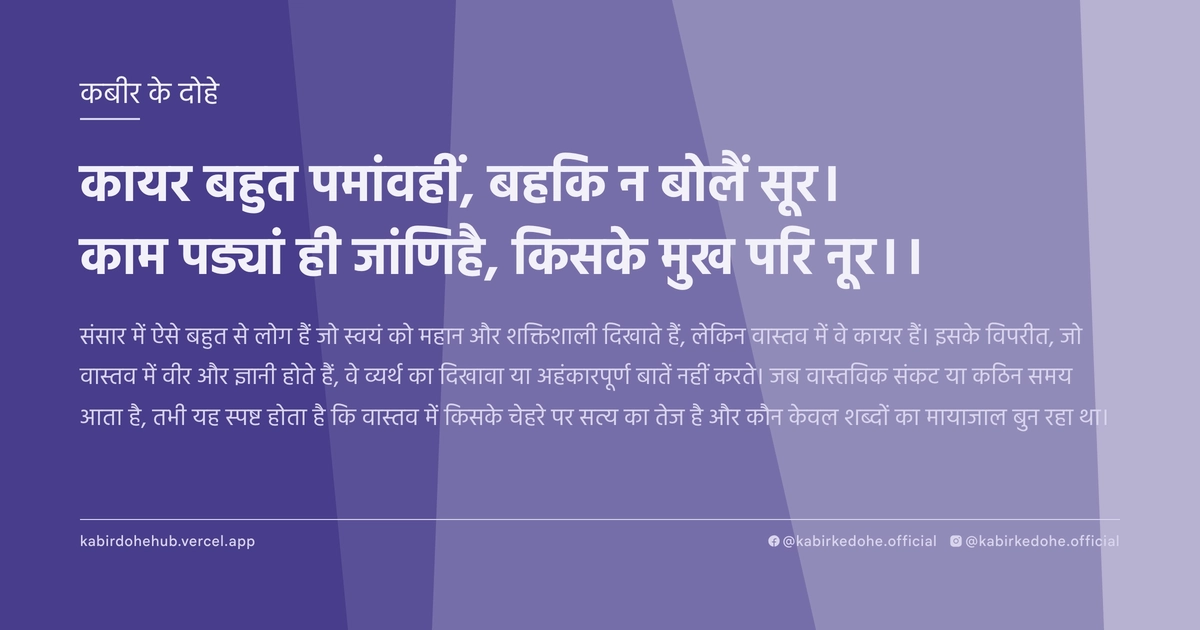
कायर बहुत पमांवहीं, बहकि न बोलैं सूर।
काम पड्यांं ही जांणिहै, किसके मुख परि नूर।।
Kayar bahut pamavahin, bahaki na bolain sur. Kaam padyan hi jaanihai, kiske mukh pari noor.
इस पृष्ठ पर इस कबीर दोहे का अर्थ (meaning), हिंदी व्याख्या और अंग्रेज़ी अनुवाद, दार्शनिक विश्लेषण और व्यावहारिक जीवन सीख दी गई है। यह दोहा आत्मनिरीक्षण (Self-introspection) विषय से जुड़ा है — Kabir doha meaning and explanation in Hindi and English.
अर्थ (Meaning):
संसार में ऐसे बहुत से लोग हैं जो स्वयं को महान और शक्तिशाली दिखाते हैं, लेकिन वास्तव में वे कायर हैं। इसके विपरीत, जो वास्तव में वीर और ज्ञानी होते हैं, वे व्यर्थ का दिखावा या अहंकारपूर्ण बातें नहीं करते। जब वास्तविक संकट या कठिन समय आता है, तभी यह स्पष्ट होता है कि वास्तव में किसके चेहरे पर सत्य का तेज है और कौन केवल शब्दों का मायाजाल बुन रहा था।
The world is filled with many who project an image of strength and superiority, yet they are cowards at heart. In contrast, the truly brave and enlightened do not engage in boastful chatter or arrogant displays. It is only when a genuine crisis or a moment of critical need arises that the true radiance of truth and courage is revealed on a person's face, distinguishing the authentic from the pretender.
व्याख्या (Interpretation):
यह दोहा बाहरी दिखावे और आंतरिक सत्य के बीच के गहरे विरोधाभास को उजागर करता है। यहाँ 'कायर' केवल शारीरिक डर से ग्रस्त व्यक्ति नहीं है, बल्कि वह है जिसका अहंकार उसकी कमजोरी को छिपाने का मुखौटा है। 'सूर' या वीर वह है जिसने अपनी इंद्रियों और अहंकार पर विजय प्राप्त कर ली है, इसलिए उसे अपनी महानता का विज्ञापन करने की आवश्यकता नहीं होती। यह निरगुण भक्ति के उस सिद्धांत से जुड़ा है जहाँ ईश्वर और सत्य किसी बाहरी आडंबर में नहीं, बल्कि आंतरिक स्थिरता में बसते हैं। माया हमें बाहरी चमक-धमक से भ्रमित करती है, लेकिन आत्मा का वास्तविक 'नूर' या प्रकाश केवल निस्वार्थ कर्म और कठिन परिस्थितियों में धैर्य के माध्यम से प्रकट होता है। यह अद्वैत वेदांत की उस स्थिति की ओर संकेत करता है जहाँ व्यक्ति अपनी पहचान बाहरी उपाधियों से हटाकर शुद्ध चेतना में स्थापित करता है।
This couplet exposes the profound paradox between external projection and internal reality. Here, the 'coward' is not merely someone afraid of physical danger, but one whose ego serves as a mask to hide deep-seated insecurity. The 'brave' or 'soor' is the one who has conquered their senses and ego, rendering the need for self-advertisement obsolete. This aligns with the philosophy of Nirgun Bhakti, where the Divine and Truth reside not in outward rituals, but in inner stillness. Maya lures us with superficial brilliance, but the true 'Noor' or spiritual radiance of the Atman manifests only through selfless action and equanimity during adversity. It points toward the Advaita Vedanta ideal where an individual shifts their identity from external labels to pure, unadorned consciousness, realizing that true power is silent.
दार्शनिक विश्लेषण (Philosophical Analysis):
कबीर का यह कथन उस सामाजिक और धार्मिक पाखंड पर प्रहार है जो उनके समय में चरम पर था। मध्यकालीन भारत में, धार्मिक गुरु और उच्च जाति के लोग अक्सर केवल शास्त्र ज्ञान और बाहरी वेशभूषा के माध्यम से अपनी श्रेष्ठता सिद्ध करने का प्रयास करते थे। कबीर ने इस 'बौद्धिक अहंकार' को कायरता का पर्याय माना। उनके अनुसार, वास्तविक ज्ञान वह नहीं है जो शब्दों में व्यक्त हो, बल्कि वह है जो आचरण में उतरे। यह दृष्टिकोण सूफीवाद के 'इन्सान-ए-कामिल' (पूर्ण मनुष्य) की अवधारणा से मिलता-जुलता है, जहाँ सत्य का अनुभव केवल आंतरिक रूपांतरण से होता है, न कि बाहरी दावों से।
दार्शनिक स्तर पर, यह दोहा अहंकार के विलीनीकरण (Fana) की बात करता है। जब तक व्यक्ति 'मैं' के भ्रम में रहता है, वह अपनी कमियों को छिपाने के लिए शोर मचाता है। लेकिन जब अहंकार मिट जाता है, तब केवल सत्य शेष रहता है। यह अद्वैत वेदांत के उस सिद्धांत को पुष्ट करता है कि ब्रह्म सत्य है और जगत मिथ्या; यहाँ 'मिथ्या' वह बाहरी दिखावा है जिसे लोग अपनी पहचान मान लेते हैं। कबीर हमें चेतावनी देते हैं कि शब्दों की चकाचौंध अक्सर सत्य को ढक लेती है।
कबीर यहाँ कर्म और चरित्र की प्रधानता पर बल देते हैं। वे कहते हैं कि ज्ञान की कसौटी शास्त्र नहीं, बल्कि 'संकट' है। जब जीवन में वास्तविक चुनौती आती है, तब व्यक्ति का मुखौटा उतर जाता है और उसकी वास्तविक प्रकृति प्रकट होती है। यह मनोवैज्ञानिक सत्य है कि तनाव और दबाव में ही मनुष्य का वास्तविक चरित्र उभरता है। जो व्यक्ति शांत रहता है और सही दिशा में कर्म करता है, वही वास्तव में 'नूर' या दैवीय प्रकाश से युक्त है।
यह दोहा जाति और वर्ण व्यवस्था के उस अहंकार को भी चुनौती देता है जहाँ जन्म के आधार पर श्रेष्ठता का दावा किया जाता था। कबीर स्पष्ट करते हैं कि श्रेष्ठता जन्म से नहीं, बल्कि संकट के समय दिखाए गए धैर्य और सत्यनिष्ठा से तय होती है। यह एक क्रांतिकारी विचार था जिसने उस समय के समाज में व्यक्ति की योग्यता को उसके बाहरी पहचान के बजाय उसके आंतरिक गुणों से जोड़ा।
अंततः, यह विश्लेषण हमें यह समझने की प्रेरणा देता है कि आध्यात्मिक यात्रा बाहरी प्रदर्शन से आंतरिक मौन की ओर जाने की यात्रा है। जो जितना अधिक मौन और स्थिर होता है, उसका प्रभाव उतना ही गहरा होता है। कबीर का संदेश स्पष्ट है: अपनी ऊर्जा को खुद को साबित करने में नष्ट न करें, बल्कि उसे आत्म-साक्षात्कार और सेवा में लगाएं, ताकि समय आने पर आपका चरित्र स्वयं आपकी गवाही दे।
Kabir's statement is a sharp critique of the social and religious hypocrisy prevalent during his era. In medieval India, religious leaders and high-caste individuals often attempted to establish their superiority through mere scriptural knowledge and outward attire. Kabir identifies this 'intellectual arrogance' as a form of cowardice. According to him, true knowledge is not that which is articulated in words, but that which is embodied in conduct. This perspective mirrors the Sufi concept of 'Al-Insan al-Kamil' (the Perfect Human), where truth is experienced through internal transformation rather than external claims.
On a philosophical level, this doha speaks of the annihilation of the ego (Fana). As long as a person remains trapped in the illusion of 'I', they create noise to mask their deficiencies. However, when the ego dissolves, only the Truth remains. This reinforces the Advaita Vedanta principle that Brahman is the only reality and the world is Maya; here, 'Maya' represents the external facade that people mistake for their identity. Kabir warns that the dazzle of words often obscures the light of truth.
Kabir emphasizes the primacy of action and character over rhetoric. He posits that the litmus test for knowledge is not scripture, but 'crisis'. When a genuine challenge arises in life, the mask falls away, and the true nature of the individual is revealed. This is a psychological truth: a person's authentic character emerges under pressure. The one who remains calm and acts with integrity is the one truly endowed with 'Noor' or divine radiance.
This doha also challenges the arrogance of the caste system, where superiority was claimed by birth. Kabir clarifies that greatness is determined not by lineage, but by the fortitude and integrity displayed during times of hardship. This was a revolutionary idea that shifted the metric of human worth from external labels to internal virtues.
Ultimately, this analysis inspires us to understand that the spiritual journey is a transition from external performance to internal silence. The more a person is silent and centered, the deeper their impact. Kabir's message is clear: do not waste energy proving yourself to the world; instead, invest it in self-realization and service, so that when the moment of truth arrives, your character speaks for itself.
मूल संदेश (Core Message):
- शब्दों का शोर अक्सर आंतरिक रिक्तता का संकेत होता है।
- सच्ची वीरता आत्म-प्रशंसा में नहीं, बल्कि आत्म-विजय में है।
- संकट ही वह दर्पण है जिसमें वास्तविक चरित्र प्रतिबिंबित होता है।
- अहंकार एक मुखौटा है जो हमारी कमजोरियों को छिपाता है।
- दिव्य प्रकाश (नूर) केवल निस्वार्थ और शांत हृदय में निवास करता है।
- बाहरी पहचान को त्यागकर आंतरिक सत्य को अपनाना ही वास्तविक मोक्ष है।
- The noise of words is often a signal of internal emptiness.
- True bravery lies not in self-praise, but in self-conquest.
- Crisis is the mirror that reflects the authentic character.
- Ego is a mask that conceals our deepest vulnerabilities.
- Divine radiance (Noor) resides only in a selfless and silent heart.
- Shedding the external identity to embrace inner truth is the only liberation.
व्यावहारिक उदाहरण (Practical Example):
एक समय की बात है, वाराणसी के एक पुराने मोहल्ले में दो बुनकर रहते थे। एक का नाम माधव था और दूसरे का नाम शिवदास। माधव अपनी कला और ज्ञान की बड़ी डींगें हांकता था। वह हर सभा में चिल्लाकर कहता था कि उसके जैसे कुशल बुनकर और धर्मपरायण व्यक्ति पूरे शहर में नहीं हैं। वह अक्सर दूसरों को नीचा दिखाता और अपनी महानता का बखान करता रहता था। लोग उसकी बातों से प्रभावित होकर उसे बहुत सम्मान देते थे, लेकिन शिवदास, जो एक शांत स्वभाव का व्यक्ति था, बस मुस्कुराकर सुनता रहता और चुपचाप अपने करघे पर काम करता था।
शिवदास कभी नहीं कहता था कि वह कितना कुशल है या उसने कितने कठिन वस्त्र बुने हैं। वह अपनी विनम्रता के कारण अक्सर माधव की बातों की छाया में दब जाता था। मोहल्ले के लोग शिवदास को साधारण मानते थे क्योंकि वह कभी अपनी उपलब्धियों का शोर नहीं मचाता था। माधव का अहंकार बढ़ता गया और वह खुद को शहर का सबसे बड़ा 'ज्ञानी' मानने लगा।
एक बार शहर में एक बहुत बड़ा संकट आया। भीषण बाढ़ आई और पूरा मोहल्ला पानी में डूब गया। लोग अपनी जान बचाने के लिए भाग रहे थे। उस अफरा-तफरी के बीच, कई परिवार अलग हो गए और लोग मदद के लिए चिल्ला रहे थे। माधव, जो अब तक अपनी बहादुरी और परोपकार की बड़ी-बड़ी बातें करता था, डर के मारे कांपने लगा। वह अपनी जान बचाने के लिए सबसे पहले भागा और अपने उन पड़ोसियों को अकेला छोड़ दिया जिनके बारे में वह हमेशा कहता था कि वह उनकी रक्षा करेगा।
वहीं दूसरी ओर, शिवदास ने बिना किसी शोर के अपनी जान जोखिम में डाली। उसने अपनी छोटी सी नाव का उपयोग करके दर्जनों लोगों को सुरक्षित स्थान पर पहुँचाया। वह घंटों तक पानी में रहकर दूसरों की मदद करता रहा, जबकि उसके अपने घर का सामान बह रहा था। उसने न तो किसी से मदद मांगी और न ही अपनी बहादुरी का कोई दावा किया।
जब पानी उतरा और लोग सुरक्षित स्थान पर एकत्र हुए, तो सबकी नजरें शिवदास पर थीं। उसके चेहरे पर एक अजीब सा सुकून और तेज था, जिसे लोग 'नूर' कह रहे थे। वहीं माधव, जो अब तक खुद को सूर (वीर) कहता था, शर्मिंदगी से अपना चेहरा छिपा रहा था। उसकी सारी बातें और दावे बाढ़ के पानी में बह चुके थे।
मोहल्ले के बुजुर्गों ने तब महसूस किया कि माधव की बातें केवल शब्दों का जाल थीं, जबकि शिवदास का मौन वास्तव में उसकी शक्ति थी। माधव का अहंकार उसकी कायरता को छिपाने का एक तरीका था, जबकि शिवदास की विनम्रता उसकी वास्तविक वीरता का प्रमाण थी।
इस घटना ने पूरे मोहल्ले की सोच बदल दी। लोगों ने समझा कि असली महानता वह नहीं है जो चिल्लाकर बताई जाए, बल्कि वह है जो कठिन समय में आचरण के माध्यम से प्रकट हो। माधव को अपनी गलती का अहसास हुआ और उसने पहली बार समझा कि 'नूर' शब्दों में नहीं, बल्कि निस्वार्थ कर्मों में होता है।
शिवदास ने किसी को उपदेश नहीं दिया, लेकिन उसके कार्यों ने सबको यह सिखा दिया कि सत्य हमेशा शांत होता है और झूठ हमेशा शोर मचाता है। वह साधारण दिखने वाला बुनकर वास्तव में उस मोहल्ले का सबसे बड़ा 'सूर' निकला।
Once upon a time, in an old neighborhood of Varanasi, lived two weavers named Madhav and Shivdas. Madhav was known for boasting about his art and knowledge. In every gathering, he would loudly proclaim that there was no weaver as skilled or as pious as he was in the entire city. He often belittled others and spent his time glorifying his own greatness. People, swayed by his confidence, gave him great respect, while Shivdas, a man of quiet nature, would simply listen with a smile and continue working silently at his loom.
Shivdas never spoke of his skills or the intricate fabrics he had woven. Due to his humility, he often remained overshadowed by Madhav's loud claims. The neighbors considered Shivdas ordinary because he never publicized his achievements. Meanwhile, Madhav's ego grew, and he began to view himself as the city's greatest 'sage'.
One day, a great calamity struck the city. A massive flood arrived, and the entire neighborhood was submerged. People ran for their lives in chaos, and families were separated. In the midst of this panic, Madhav, who had always spoken of his bravery and philanthropy, began to tremble with fear. He was the first to flee to save his own skin, abandoning the very neighbors he had claimed he would protect.
On the other hand, without any fanfare, Shivdas risked his own life. He used his small boat to rescue dozens of people and bring them to safety. For hours, he worked tirelessly in the freezing water, even as the belongings of his own home were swept away. He neither asked for help nor claimed any bravery.
When the waters receded and the people gathered at the shelter, everyone's eyes were on Shivdas. There was a strange peace and radiance on his face, which people described as 'Noor'. Meanwhile, Madhav, who had called himself a 'Soor' (brave), was hiding his face in shame. All his words and claims had been washed away by the floodwaters.
The elders of the neighborhood realized that Madhav's words were merely a web of illusions, while Shivdas's silence was his true strength. Madhav's ego had been a tool to hide his cowardice, whereas Shivdas's humility was the proof of his authentic courage.
This event transformed the thinking of the entire community. They understood that true greatness is not that which is shouted from the rooftops, but that which manifests through conduct during times of crisis. Madhav realized his mistake and understood for the first time that 'Noor' resides not in words, but in selfless action.
Shivdas gave no sermons, yet his actions taught everyone that truth is always silent and falsehood is always noisy. The man who appeared ordinary was, in reality, the greatest 'Soor' of the neighborhood.
अभ्यास मार्गदर्शन (Practice Guidance):
- मौन का अभ्यास: प्रतिदिन कम से कम एक घंटा पूर्ण मौन रहें। इस दौरान यह देखें कि क्या आपका मन दूसरों को अपनी योग्यता साबित करने के लिए छटपटा रहा है।
- आत्म-निरीक्षण जर्नल: हर रात लिखें कि आज आपने कितनी बार अपनी प्रशंसा की या दूसरों को नीचा दिखाया। विश्लेषण करें कि उस समय आपके भीतर कौन सा डर या असुरक्षा काम कर रही थी।
- सेवा का गुप्त मार्ग: सप्ताह में एक बार ऐसा कार्य करें जिससे किसी की मदद हो, लेकिन यह सुनिश्चित करें कि किसी को पता न चले कि वह कार्य आपने किया है।
- निदान चेकलिस्ट: यदि आप किसी की प्रशंसा पाने के लिए झूठ बोलते हैं, या संकट आने पर सबसे पहले पीछे हटते हैं, तो समझ लें कि आपका 'अहंकार' आपकी 'कायरता' को ढंक रहा है।
- Practice of Silence: Spend at least one hour in complete silence daily. Observe whether your mind is struggling with the urge to prove your worth to others.
- Self-Inquiry Journal: Every night, record how many times you praised yourself or belittled others. Analyze which fear or insecurity was driving that behavior.
- The Secret Path of Service: Once a week, perform an act of kindness for someone, ensuring that no one knows you were the one who did it.
- Diagnostic Checklist: If you find yourself lying to gain admiration or retreating first during a crisis, recognize that your 'ego' is merely masking your 'cowardice'.
चिंतन प्रश्न (Reflection Questions):
- मेरा वह कौन सा 'मुखौटा' है जिसे मैं दुनिया के सामने सबसे अधिक गर्व से पहनता हूँ?
- जब मैं दूसरों की प्रशंसा करता हूँ या अपनी करता हूँ, तो क्या मैं वास्तव में उन्हें देख रहा हूँ या केवल अपनी छवि को?
- यदि आज मेरी सभी उपाधियाँ और उपलब्धियाँ छीन ली जाएँ, तो मेरे भीतर क्या शेष बचेगा?
- क्या मेरा 'धार्मिक' या 'नैतिक' होना केवल एक सामाजिक छवि है, या यह मेरे एकांत के व्यवहार में भी झलकता है?
- मैं संकट के समय अपनी प्रतिक्रियाओं को कैसे देखता हूँ—क्या मैं समाधान बनता हूँ या केवल शिकायत करने वाला?
- मेरी चुप्पी में कितनी शांति है और कितनी घुटन?
- Which 'mask' do I wear with the most pride in front of the world?
- When I praise others or myself, am I truly seeing them, or just my own projected image?
- If all my titles and achievements were stripped away today, what would remain within me?
- Is my 'religious' or 'moral' identity merely a social image, or does it reflect in my behavior in solitude?
- How do I perceive my reactions during a crisis—do I become the solution or merely a complainant?
- How much of my silence is true peace, and how much is suppressed frustration?