
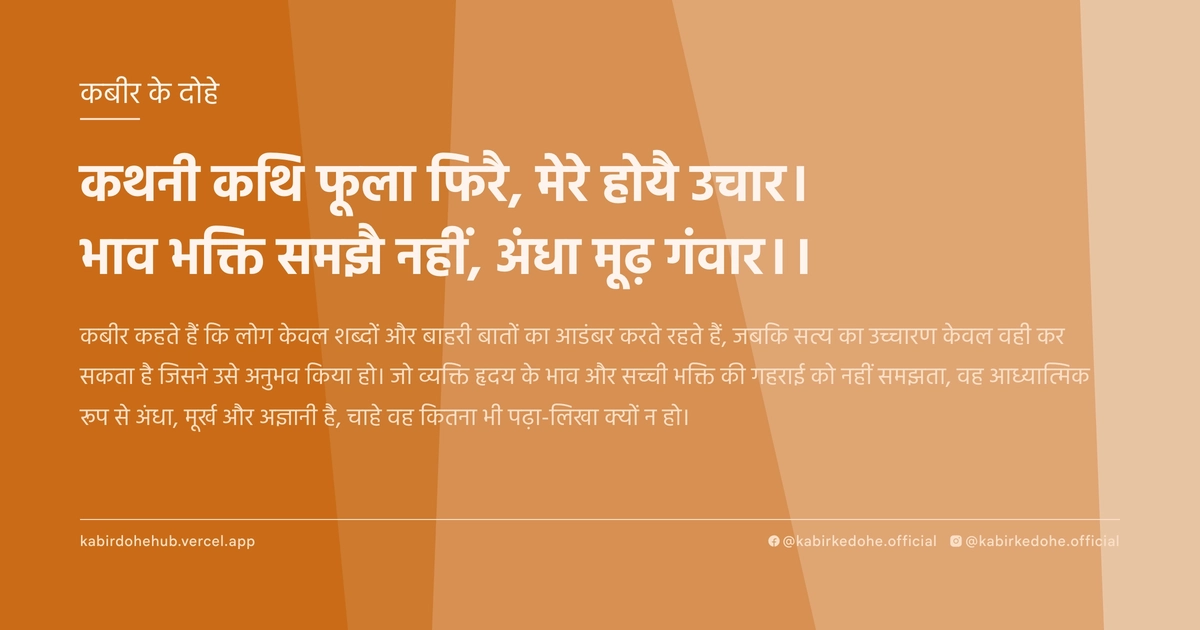
कथनी कथि फूला फिरै, मेरे होयै उचार।
भाव भक्ति समझै नहीं, अंधा मूढ़ गंवार।।
Kathni kathi phoola phirai, mere hoye uchaar. Bhav bhakti samajhai nahi, andha moodh ganvaar.
इस पृष्ठ पर इस कबीर दोहे का अर्थ (meaning), हिंदी व्याख्या और अंग्रेज़ी अनुवाद, दार्शनिक विश्लेषण और व्यावहारिक जीवन सीख दी गई है। यह दोहा धार्मिक पाखंड (Religious Hypocrisy) विषय से जुड़ा है — Kabir doha meaning and explanation in Hindi and English.
अर्थ (Meaning):
कबीर कहते हैं कि लोग केवल शब्दों और बाहरी बातों का आडंबर करते रहते हैं, जबकि सत्य का उच्चारण केवल वही कर सकता है जिसने उसे अनुभव किया हो। जो व्यक्ति हृदय के भाव और सच्ची भक्ति की गहराई को नहीं समझता, वह आध्यात्मिक रूप से अंधा, मूर्ख और अज्ञानी है, चाहे वह कितना भी पढ़ा-लिखा क्यों न हो।
Kabir asserts that people often wander in the vanity of mere words and superficial rhetoric, while true utterance comes only from lived experience. One who fails to grasp the essence of inner feeling (Bhaav) and true devotion (Bhakti) remains spiritually blind and ignorant, regardless of their intellectual or academic achievements.
व्याख्या (Interpretation):
इस दोहे का शाब्दिक अर्थ है कि केवल बोलने से सत्य सिद्ध नहीं होता। कबीर यहाँ 'कथनी' (वाणी) और 'करनी' (आचरण) के बीच के अंतराल पर प्रहार कर रहे हैं। आध्यात्मिक स्तर पर, यह 'माया' के उस जाल को दर्शाता है जहाँ मनुष्य शब्दों के माध्यम से अपनी पहचान बनाता है, न कि अनुभव से। निर्गुण भक्ति में, ईश्वर किसी मंत्र या शास्त्र में नहीं, बल्कि हृदय के शुद्ध भाव में बसता है। जब तक अहंकार (Ego) जीवित है, मनुष्य 'अंधा' रहता है, क्योंकि वह बाहर खोजता है जबकि सत्य भीतर है। यह द्वैतवाद से अद्वैत की ओर जाने की यात्रा है, जहाँ शब्द समाप्त हो जाते हैं और केवल मौन अनुभव शेष रहता है।
Literally, the verse suggests that mere speech does not validate truth. Kabir attacks the gap between 'Kathani' (speech) and 'Karni' (action). On a spiritual plane, this represents the veil of Maya, where humans construct identities through rhetoric rather than realization. In Nirgun Bhakti, the Divine resides not in mantras or scriptures, but in the purity of inner feeling (Bhaav). As long as the ego persists, the individual remains 'blind,' searching externally for a truth that is eternally internal. This is the transition from duality to non-duality (Advaita), where words dissolve and only the silent experience of the Atman remains.
दार्शनिक विश्लेषण (Philosophical Analysis):
कबीर का यह दोहा उनके युग के धार्मिक पाखंड और कर्मकांडीय कठोरता के विरुद्ध एक सशक्त विद्रोह है। उस समय समाज में पंडितों और मुल्लाओं का वर्चस्व था, जो शास्त्रों के रटने को ही ज्ञान मानते थे। कबीर ने इस 'बौद्धिक अहंकार' को चुनौती दी और यह स्थापित किया कि ज्ञान वह नहीं जो पन्नों पर लिखा है, बल्कि वह है जो आचरण में उतरा है।
दार्शनिक रूप से, यह अद्वैत वेदांत के उस सिद्धांत से मेल खाता है जहाँ 'माया' सत्य को ढक लेती है। यहाँ 'अंधा' शब्द शारीरिक दृष्टि के लिए नहीं, बल्कि आध्यात्मिक विवेक (Viveka) के अभाव के लिए प्रयुक्त हुआ है। जब तक साधक अपनी पहचान को शब्दों और उपाधियों से जोड़ता है, वह सत्य से दूर रहता है।
सूफी मत के 'इश्क-ए-हकीकी' (ईश्वरीय प्रेम) के समान, कबीर यहाँ 'भाव' को प्राथमिकता देते हैं। उनके लिए भक्ति कोई बाहरी क्रिया नहीं, बल्कि हृदय का रूपांतरण है। यदि हृदय में प्रेम और करुणा नहीं है, तो हज़ारों ग्रंथों का अध्ययन भी व्यर्थ है।
यह विश्लेषण हमें मनोवैज्ञानिक स्तर पर यह सिखाता है कि हम अक्सर अपनी कमियों को छिपाने के लिए शब्दों का सहारा लेते हैं। हम वह बनने का ढोंग करते हैं जो हम वास्तव में नहीं हैं। कबीर इस मुखौटे को उतारने की बात करते हैं।
अंततः, यह दोहा 'शून्य' की ओर संकेत करता है। जब कथनी और करनी एक हो जाती हैं, तब व्यक्ति का अहंकार विलीन हो जाता है और वह उस निराकार ब्रह्म के साथ एकाकार हो जाता है, जहाँ अब कुछ कहने की आवश्यकता नहीं रह जाती।
This couplet is a powerful rebellion against the religious hypocrisy and ritualistic rigidity of Kabir's era. At that time, society was dominated by priests and clerics who equated the rote memorization of scriptures with true knowledge. Kabir challenged this 'intellectual arrogance,' establishing that real knowledge is not what is written on pages, but what is integrated into one's conduct.
Philosophically, this aligns with the Advaita Vedanta principle where 'Maya' obscures the truth. The term 'blind' here does not refer to physical sight, but to the lack of spiritual discernment (Viveka). As long as a seeker ties their identity to words and titles, they remain distant from the Truth.
Similar to the Sufi concept of 'Ishq-e-Haqiqi' (Divine Love), Kabir prioritizes 'Bhaav' (inner feeling). For him, devotion is not an external ritual but a transformation of the heart. Without love and compassion, the study of a thousand scriptures is futile.
Psychologically, this analysis reveals how we often use words as a shield to hide our deficiencies. We pretend to be something we are not. Kabir calls for the stripping away of this social and spiritual mask.
Ultimately, the verse points toward the 'Shunya' (Void). When speech and action merge, the ego dissolves, and the individual merges with the formless Brahman, reaching a state where words are no longer necessary.
मूल संदेश (Core Message):
- शब्द केवल संकेत हैं, सत्य अनुभव है।
- बौद्धिक ज्ञान अक्सर आध्यात्मिक अंधापन पैदा करता है।
- सच्ची भक्ति हृदय के भाव में है, शब्दों के प्रदर्शन में नहीं।
- अहंकार का विसर्जन ही वास्तविक ज्ञान की शुरुआत है।
- कथनी और करनी का मिलन ही मोक्ष का मार्ग है।
- Words are mere pointers; Truth is the experience.
- Intellectual knowledge often breeds spiritual blindness.
- True devotion lies in the heart's feeling, not in verbal display.
- The dissolution of ego is the beginning of real wisdom.
- The union of speech and action is the path to liberation.
व्यावहारिक उदाहरण (Practical Example):
वाराणसी के एक पुराने मोहल्ले में रामदीन नाम का एक वृद्ध बुनकर रहता था। रामदीन अपनी पूरी उम्र धर्मग्रंथों की चर्चा करने और दूसरों को नैतिकता का पाठ पढ़ाने में बिताता था। वह शहर भर में अपनी विद्वत्ता के लिए जाना जाता था और हर सत्संग में सबसे ऊँची आवाज़ में बोलता था कि ईश्वर केवल प्रेम और सरलता से मिलता है।
लेकिन घर के भीतर, रामदीन का व्यवहार अत्यंत कठोर था। वह अपने छोटे बेटे और पत्नी पर छोटी-छोटी बातों के लिए चिल्लाता था और उन्हें नीचा दिखाता था। उसकी 'कथनी' तो दिव्य थी, परंतु उसकी 'करनी' अहंकार से भरी हुई थी।
एक दिन, उसके घर के पास एक फकीर आया। फकीर ने देखा कि रामदीन बाहर लोगों को विनम्रता सिखा रहा है, लेकिन जैसे ही उसका बेटा पानी लेकर आया और पानी की कुछ बूंदें उसके पैर पर गिर गईं, रामदीन उसे गालियाँ देने लगा।
फकीर ने मुस्कुराते हुए कहा, 'रामदीन, तुम्हारी वाणी तो गंगा जैसी पवित्र है, लेकिन तुम्हारा हृदय अभी भी सूखे रेगिस्तान जैसा है। तुम शब्दों के सौदागर हो, सत्य के खोजी नहीं।'
रामदीन को पहले तो गुस्सा आया, लेकिन फकीर की आँखों में एक ऐसी गहराई थी जिसने उसे अंदर तक झकझोर दिया। उसे एहसास हुआ कि उसने जीवन भर केवल 'शब्दों' को इकट्ठा किया, 'भाव' को नहीं।
उस रात रामदीन सो नहीं सका। उसने महसूस किया कि वह जिसे ज्ञान समझ रहा था, वह वास्तव में उसका अहंकार था जो उसे दूसरों से श्रेष्ठ महसूस कराता था।
अगले दिन से रामदीन ने उपदेश देना बंद कर दिया। उसने मौन धारण किया और अपना पूरा ध्यान अपने व्यवहार को सुधारने में लगाया। उसने अपने बेटे से माफ़ी मांगी और घर के सदस्यों की सेवा शुरू की।
महीनों बाद, जब वह फिर से सत्संग में गया, तो वह चुपचाप बैठा रहा। लोग उसकी चुप्पी से हैरान थे। लेकिन जब वह बोला, तो उसकी आवाज़ में वह अहंकार नहीं था, बल्कि एक ऐसी करुणा थी जिसने सुनने वालों की आँखों में आँसू ला दिए।
अब उसकी कथनी और करनी एक हो चुकी थी। वह अब 'अंधा' नहीं था; उसने अंततः 'भाव' और 'भक्ति' के वास्तविक अर्थ को समझ लिया था।
In an old neighborhood of Varanasi lived an elderly weaver named Ramdeen. Ramdeen spent his entire life discussing religious texts and preaching morality to others. He was known throughout the city for his erudition and would speak the loudest in every spiritual gathering about how God is found only through love and simplicity.
However, inside his home, Ramdeen's behavior was incredibly harsh. He would scream at his young son and wife over trivial matters, constantly belittling them. His 'speech' was divine, but his 'action' was saturated with ego.
One day, a wandering dervish arrived near his house. The dervish observed Ramdeen teaching humility to a crowd, but the moment his son brought water and a few drops spilled on his foot, Ramdeen began hurling insults at him.
The dervish smiled and said, 'Ramdeen, your words are as pure as the Ganges, but your heart is still like a dry desert. You are a merchant of words, not a seeker of truth.'
Ramdeen was initially angered, but there was a depth in the dervish's eyes that shook him to the core. He realized that he had spent his life collecting 'words' rather than cultivating 'feeling' (Bhaav).
Ramdeen could not sleep that night. He realized that what he had mistaken for knowledge was actually his ego, which served only to make him feel superior to others.
From the next day, Ramdeen stopped preaching. He embraced silence and focused all his energy on refining his behavior. He apologized to his son and began serving his family members.
Months later, when he returned to the spiritual gathering, he sat in absolute silence. People were surprised. But when he finally spoke, the arrogance was gone, replaced by a compassion that brought tears to the listeners' eyes.
Now, his speech and action had become one. He was no longer 'blind'; he had finally understood the true meaning of 'Bhaav' and 'Bhakti'.
अभ्यास मार्गदर्शन (Practice Guidance):
- दैनिक मौन अभ्यास: प्रतिदिन कम से कम एक घंटा पूर्ण मौन रहें। यह देखें कि जब आप बोल नहीं पाते, तो आपका अहंकार कैसे प्रतिक्रिया करता है।
- आचरण पत्रिका (Action Journal): रात को सोने से पहले लिखें कि आज आपकी 'कथनी' और 'करनी' में कहाँ अंतर था। क्या आपने वह किया जो आपने दूसरों को करने की सलाह दी?
- भाव-केंद्रित सेवा: किसी ऐसे व्यक्ति की मदद करें जिससे आपका कोई संबंध न हो, और इस बात का गर्व न करें कि आपने मदद की।
- निदान चेकलिस्ट: यदि आप दूसरों की गलतियों पर तुरंत प्रतिक्रिया देते हैं लेकिन अपनी गलतियों पर तर्क ढूंढते हैं, तो आप अभी भी 'अंधे' हैं। यदि आप शब्दों से अधिक अपने आचरण को महत्व देते हैं, तो आप सही मार्ग पर हैं।
- Daily Silence Practice: Maintain absolute silence for at least one hour daily. Observe how your ego reacts when you are unable to use words to define yourself.
- Action Journaling: Before sleep, record instances where your 'speech' diverged from your 'action'. Did you practice what you advised others to do?
- Bhaav-Centered Service: Help someone with whom you have no connection, and consciously suppress the pride of having helped them.
- Diagnostic Checklist: If you react instantly to others' mistakes but find justifications for your own, you are still 'blind'. If you value your conduct more than your vocabulary, you are on the right path.
चिंतन प्रश्न (Reflection Questions):
- क्या मेरी आध्यात्मिक पहचान केवल मेरी बातों और सोशल मीडिया प्रोफाइल तक सीमित है, या यह मेरे निजी व्यवहार में भी झलकती है?
- मैं उन शब्दों का उपयोग करके खुद को श्रेष्ठ महसूस कराने के लिए कितनी बार करता हूँ जिन्हें मैंने स्वयं कभी नहीं जिया?
- यदि आज मेरी वाणी छीन ली जाए, तो क्या मेरा व्यक्तित्व अभी भी दयालु और प्रेमपूर्ण रहेगा?
- मेरे जीवन का वह कौन सा 'अंधा कोना' है जहाँ मैं सत्य को जानते हुए भी उसे स्वीकार करने से डरता हूँ?
- क्या मैं वास्तव में सत्य की खोज कर रहा हूँ, या मैं केवल सत्य के बारे में बात करने का आनंद ले रहा हूँ?
- Is my spiritual identity limited to my words and social media profiles, or does it reflect in my private behavior?
- How often do I use words to feel superior, despite never having lived those truths myself?
- If my voice were taken away today, would my personality still remain compassionate and loving?
- What is that 'blind spot' in my life where I fear accepting the truth despite knowing it?
- Am I truly seeking the Truth, or am I merely enjoying the act of talking about the Truth?