
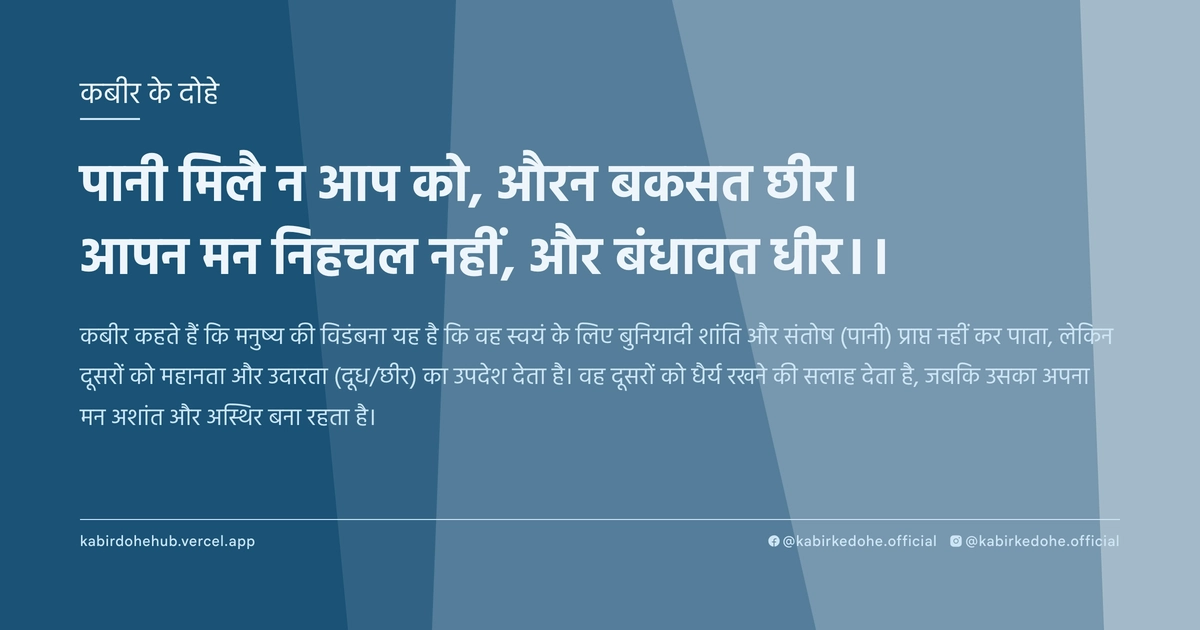
पानी मिलै न आप को, औरन बकसत छीर।
आपन मन निहचल नहीं, और बंधावत धीर।।
Paani milai na aap ko, oran baksat chheer. Aapan man nihchal nahi, aur bandhavat dheer.
इस पृष्ठ पर इस कबीर दोहे का अर्थ (meaning), हिंदी व्याख्या और अंग्रेज़ी अनुवाद, दार्शनिक विश्लेषण और व्यावहारिक जीवन सीख दी गई है। यह दोहा आत्मनिरीक्षण (Self-introspection) विषय से जुड़ा है — Kabir doha meaning and explanation in Hindi and English.
अर्थ (Meaning):
कबीर कहते हैं कि मनुष्य की विडंबना यह है कि वह स्वयं के लिए बुनियादी शांति और संतोष (पानी) प्राप्त नहीं कर पाता, लेकिन दूसरों को महानता और उदारता (दूध/छीर) का उपदेश देता है। वह दूसरों को धैर्य रखने की सलाह देता है, जबकि उसका अपना मन अशांत और अस्थिर बना रहता है।
Kabir highlights the profound hypocrisy of the human condition where an individual fails to secure basic peace and stability for themselves, yet presumes to offer the 'milk' of wisdom and generosity to others. While they instruct the world to be patient and steadfast, their own internal state remains chaotic and unsettled.
व्याख्या (Interpretation):
इस दोहे में 'पानी' और 'छीर' (दूध) प्रतीकात्मक हैं। पानी यहाँ न्यूनतम आत्म-संतोष और मानसिक शांति का प्रतीक है, जबकि दूध उच्च आध्यात्मिक ज्ञान और परोपकार का। कबीर यह संकेत दे रहे हैं कि जो व्यक्ति स्वयं के भीतर के द्वंद्वों को शांत नहीं कर सका, उसका बाहरी उपदेश केवल एक मुखौटा है। यह निर्गुण भक्ति के उस सिद्धांत को दर्शाता है जहाँ आंतरिक अनुभव (Anubhava) बाहरी प्रदर्शन (Pradarshan) से कहीं अधिक महत्वपूर्ण है। जब तक आत्मा (Atman) माया के प्रभाव से मुक्त होकर स्थिर नहीं होती, तब तक वह दूसरों को सही मार्ग नहीं दिखा सकती। यह विरोधाभास दर्शाता है कि मनुष्य अक्सर अपनी कमियों को छिपाने के लिए दूसरों को उपदेश देने का सहारा लेता है।
In this verse, 'water' and 'milk' serve as potent metaphors. Water represents the most basic level of self-contentment and mental stillness, while milk symbolizes the richness of spiritual wisdom and altruism. Kabir suggests that an individual who has not attained the simplest peace within themselves is unqualified to distribute the 'milk' of enlightenment to others. This aligns with the tenets of Nirgun Bhakti, emphasizing that direct experiential realization (Anubhava) outweighs ritualistic or theoretical preaching. The paradox lies in the human tendency to project a facade of stability while the internal Atman remains tossed by the waves of Maya. Until the ego is dissolved and the mind becomes 'sthir' (steady), any guidance offered to others is merely a reflection of the speaker's own unfulfilled longing for peace.
दार्शनिक विश्लेषण (Philosophical Analysis):
कबीर का यह प्रहार तत्कालीन समाज के उन धर्मगुरुओं और पाखंडियों पर है जो शास्त्रों का ज्ञान तो रखते थे, लेकिन उनके आचरण में वह शांति नहीं थी। यह विश्लेषण अद्वैत वेदांत के इस विचार से जुड़ता है कि जब तक 'अहं' (Ego) का विसर्जन नहीं होता, तब तक सत्य का अनुभव असंभव है। कबीर यहाँ 'बाह्य आडंबर' बनाम 'आंतरिक सत्य' की चर्चा कर रहे हैं।
सूफी मत के नजरिए से, यह 'नफ्स' (Kama/Ego) के नियंत्रण की बात है। यदि साधक स्वयं अपनी वासनाओं और मानसिक उथल-पुथल से लड़ रहा है, तो उसका उपदेश केवल शब्दों का जाल है। सच्चा मार्गदर्शक वह है जिसने स्वयं को शून्य कर लिया है।
कबीर जाति और कर्मकांड के विरोध में थे क्योंकि वे जानते थे कि बाहरी पहचान व्यक्ति को यह भ्रम देती है कि वह दूसरों से श्रेष्ठ है। यह श्रेष्ठता बोध ही उसे दूसरों को 'दूध' (ज्ञान) बांटने के लिए प्रेरित करता है, जबकि वह स्वयं प्यासा रहता है।
मनोवैज्ञानिक स्तर पर, यह 'प्रोजेक्शन' की प्रक्रिया है। मनुष्य वह गुण दूसरों में खोजने या सिखाने की कोशिश करता है जिसकी उसे स्वयं सबसे अधिक आवश्यकता होती है। यह आत्म-धोखा है जो आध्यात्मिक प्रगति को रोकता है।
अंततः, यह दोहा हमें आत्म-निरीक्षण (Self-Inquiry) की ओर ले जाता है। यह चेतावनी देता है कि आध्यात्मिक यात्रा 'बाहर से भीतर' की ओर होनी चाहिए, न कि 'भीतर से बाहर' की ओर प्रदर्शन करना।
Kabir's critique is aimed squarely at the religious elites and hypocrites of his era who possessed scriptural knowledge but lacked lived tranquility. This analysis intersects with Advaita Vedanta, which posits that until the 'Aham' (ego) is dissolved, the realization of the Absolute is impossible. Kabir contrasts 'external ostentation' with 'internal truth.'
From a Sufi perspective, this relates to the struggle with the 'Nafs' (the lower self). If a seeker is still battling their own desires and mental turbulence, their teachings are merely a linguistic construct devoid of spiritual power. A true guide is one who has achieved 'Fana' (annihilation of the self).
Kabir’s rejection of caste and ritualism stems from the understanding that external identities create a false sense of superiority. This perceived superiority drives the individual to distribute 'milk' (wisdom) to others, while remaining spiritually dehydrated themselves.
Psychologically, this is a classic case of projection. Humans often attempt to instill in others the very virtues they lack. This mechanism of self-deception acts as a barrier to genuine spiritual evolution.
Ultimately, the verse serves as a call for rigorous self-inquiry. It warns that the spiritual journey must move from the periphery to the center—from the external world to the internal silence—rather than using external preaching to mask internal void.
मूल संदेश (Core Message):
- बाहरी उपदेश अक्सर आंतरिक रिक्तता का पर्दा होते हैं।
- सच्ची आध्यात्मिकता प्रदर्शन में नहीं, बल्कि आत्म-रूपांतरण में है।
- जब तक मन स्थिर नहीं, तब तक शब्द केवल शोर हैं।
- स्वयं को जानना, दुनिया को सिखाने से कहीं अधिक कठिन और आवश्यक है।
- अहंकार का विसर्जन ही वास्तविक ज्ञान का द्वार है।
- External preaching is often a veil for internal emptiness.
- True spirituality lies in self-transformation, not in public performance.
- Until the mind is steady, words are merely noise.
- Knowing oneself is far more difficult and vital than teaching the world.
- The dissolution of ego is the only gateway to authentic wisdom.
व्यावहारिक उदाहरण (Practical Example):
वाराणसी के घाटों पर रहने वाले एक वृद्ध विधवा, जानकी का वर्णन करें। जानकी पूरे मोहल्ले में अपनी धार्मिकता और दूसरों को नैतिकता सिखाने के लिए जानी जाती थीं। वह हर सुबह दूसरों को बताती थीं कि क्रोध कैसे त्यागें और ईश्वर में कैसे लीन रहें।
लेकिन घर की चारदीवारी के भीतर, जानकी का जीवन अशांति से भरा था। वह छोटी-छोटी बातों पर अपने पोते पर चिल्लाती थीं और उनके मन में पुराने पारिवारिक विवादों की कड़वाहट अभी भी ताज़ा थी।
वह दूसरों को 'धैर्य' का पाठ पढ़ाती थीं, लेकिन जब उनकी अपनी चाय ठंडी हो जाती या कोई पड़ोसी देर से आता, तो उनका चेहरा क्रोध से लाल हो जाता था।
एक दिन, एक युवा साधु उनके पास आए। उन्होंने देखा कि जानकी सबको शांति का उपदेश दे रही हैं, लेकिन उनके हाथों की कंपन और उनकी आँखों की बेचैनी कुछ और ही कह रही थी।
साधु ने उनसे बस इतना कहा, 'माँ, जो पानी आप दूसरों को पिलाने की कोशिश कर रही हैं, क्या आपने अपनी प्यास बुझाई है?'
जानकी पहले तो चौंक गईं, फिर उन्हें महसूस हुआ कि उन्होंने जीवन भर दूसरों को सुधारने की कोशिश की, लेकिन स्वयं के भीतर के तूफ़ान को कभी शांत नहीं किया।
उन्हें समझ आया कि उनकी 'धार्मिकता' केवल एक सामाजिक कवच था, जिसने उन्हें अपनी आंतरिक रिक्तता का सामना करने से बचाया था।
उस दिन के बाद, जानकी ने उपदेश देना बंद कर दिया। उन्होंने मौन का अभ्यास शुरू किया और अपने क्रोध के मूल कारणों को खोजना शुरू किया।
धीरे-धीरे, उनकी बाहरी बातें कम हुईं, लेकिन उनके चेहरे पर एक वास्तविक, शांत मुस्कान आने लगी।
अब जब वह किसी की मदद करतीं, तो वह उपदेश नहीं, बल्कि एक शांत उपस्थिति होती थी। यही कबीर का 'ट्विस्ट' था—बाहरी वितरण से आंतरिक प्राप्ति की ओर मुड़ना।
Consider Janaki, an elderly widow living on the ghats of Varanasi. Janaki was renowned throughout her neighborhood for her piety and her tendency to lecture others on morality. Every morning, she would instruct neighbors on how to renounce anger and merge with the Divine.
However, within the four walls of her home, Janaki's life was fraught with turmoil. She would scream at her grandson over trivial matters, and the bitterness of old family disputes still burned vividly in her heart.
She preached 'patience' to the world, yet the moment her tea grew cold or a neighbor arrived late, her face would flush with uncontrollable rage.
One day, a young monk visited her. He observed Janaki dispensing wisdom on peace, but noticed the trembling in her hands and the restlessness in her eyes told a different story.
The monk simply asked, 'Mother, the water you are trying to give to others—have you quenched your own thirst first?'
Janaki was startled, and then a wave of realization hit her. She had spent her entire life trying to 'fix' others while ignoring the storm raging within her own soul.
She understood that her 'religiosity' was merely a social shield, a mechanism to avoid facing her own internal void.
From that day forward, Janaki stopped preaching. She began practicing silence and investigating the root causes of her anger through self-observation.
Gradually, her external lecturing ceased, but a genuine, serene smile began to illuminate her face.
Now, when she helped someone, it was not through a lecture, but through a tranquil presence. This was the 'Kabir Twist'—shifting from the distribution of borrowed knowledge to the attainment of lived truth.
अभ्यास मार्गदर्शन (Practice Guidance):
- प्रतिदिन 20 मिनट 'साक्षी भाव' (Witness Consciousness) का अभ्यास करें। जब आप किसी को सलाह देने की इच्छा महसूस करें, तो रुकें और देखें कि क्या आप वही गुण स्वयं में महसूस कर रहे हैं।
- एक 'अहंकार डायरी' लिखें। उन क्षणों को दर्ज करें जब आपने दूसरों को सही साबित करने की कोशिश की, और ईमानदारी से लिखें कि उस समय आपके भीतर कौन सा डर या कमी थी।
- व्यवहार परिवर्तन: अगले 30 दिनों तक किसी को भी अनचाही सलाह न दें। केवल तभी बोलें जब आपसे स्पष्ट रूप से पूछा जाए, और तब भी अपने अनुभव के आधार पर बोलें, सिद्धांतों के आधार पर नहीं।
- डायग्नोस्टिक चेकलिस्ट: क्या मैं दूसरों की गलतियों पर तुरंत प्रतिक्रिया देता हूँ? क्या मेरी शांति बाहरी परिस्थितियों पर निर्भर है? क्या मैं उपदेश देते समय श्रेष्ठता महसूस करता हूँ? यदि हाँ, तो आप 'छीर' बांट रहे हैं जबकि 'पानी' की कमी है।
- Practice 'Witness Consciousness' for 20 minutes daily. Whenever you feel the urge to advise someone, pause and observe whether you are embodying that very virtue in that moment.
- Maintain an 'Ego Journal.' Record instances where you tried to prove someone wrong and honestly analyze what internal fear or deficiency drove that need for superiority.
- Behavioral Shift: For the next 30 days, refrain from giving unsolicited advice. Speak only when explicitly asked, and base your response on lived experience rather than theoretical principles.
- Diagnostic Checklist: Do I react instantly to others' mistakes? Is my peace dependent on external circumstances? Do I feel a sense of superiority while guiding others? If yes, you are distributing 'milk' while lacking 'water'.
चिंतन प्रश्न (Reflection Questions):
- मेरे द्वारा दिए गए उपदेशों में से कितने प्रतिशत मैं स्वयं के जीवन में पूरी तरह उतारता हूँ?
- क्या मेरी दूसरों को सुधारने की इच्छा वास्तव में उनकी भलाई के लिए है, या यह मेरे अपने श्रेष्ठ होने के भ्रम को पुष्ट करती है?
- मेरे भीतर का वह कौन सा 'अशांत कोना' है जिसे मैं बाहरी धार्मिकता या सामाजिक प्रतिष्ठा के पीछे छिपाता हूँ?
- यदि आज मेरी सामाजिक पहचान (पद, प्रतिष्ठा, ज्ञान) छीन ली जाए, तो क्या मेरे पास देने के लिए कोई वास्तविक शांति बचेगी?
- मैं अपनी डिजिटल पहचान (सोशल मीडिया) पर जिस आदर्श व्यक्तित्व को प्रस्तुत करता हूँ, वह मेरे वास्तविक आंतरिक संघर्षों से कितना अलग है?
- What percentage of the advice I give to others do I actually embody in my own private life?
- Is my desire to 'correct' others truly for their benefit, or does it reinforce my own illusion of superiority?
- Which 'restless corner' of my being am I hiding behind a facade of religiosity or social status?
- If my social identity (title, prestige, knowledge) were stripped away today, would I have any genuine peace left to offer?
- How far does the idealized persona I project on social media diverge from my actual internal struggles?