
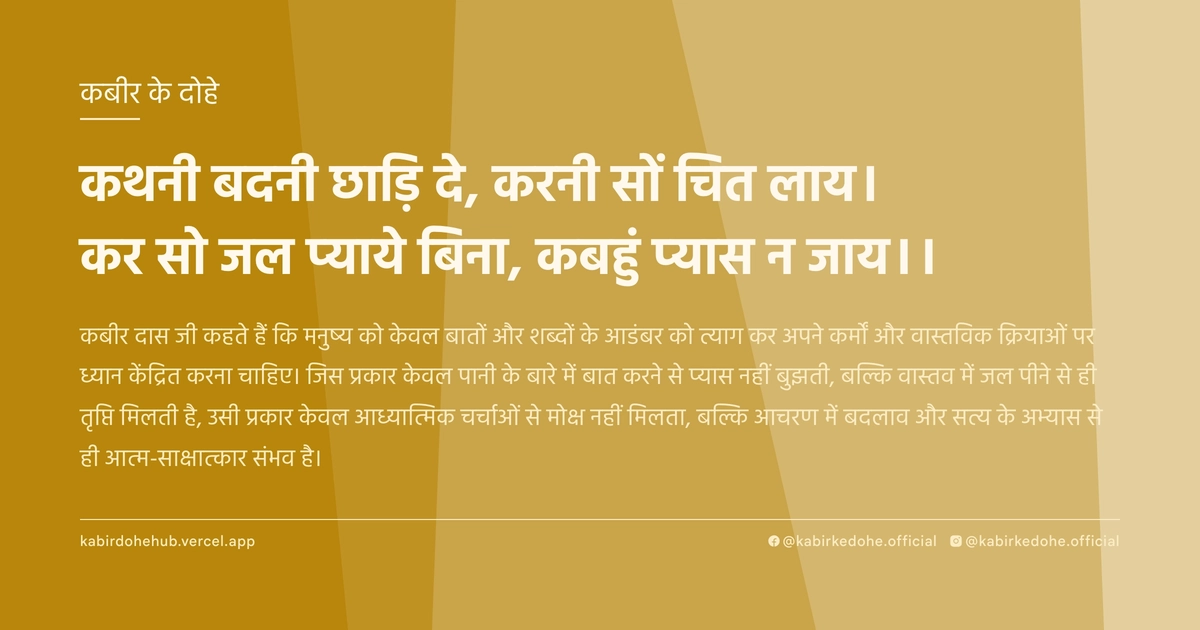
कथनी बदनी छाड़ि दे, करनी सों चित लाय।
कर सो जल प्याये बिना, कबहुं प्यास न जाय।।
Kathni badni chhad de, karni son chit laay. Kar so jal pyaaye bina, kabhun pyaas na jaaye.
इस पृष्ठ पर इस कबीर दोहे का अर्थ (meaning), हिंदी व्याख्या और अंग्रेज़ी अनुवाद, दार्शनिक विश्लेषण और व्यावहारिक जीवन सीख दी गई है। यह दोहा निष्ठा (Integrity) विषय से जुड़ा है — Kabir doha meaning and explanation in Hindi and English.
अर्थ (Meaning):
कबीर दास जी कहते हैं कि मनुष्य को केवल बातों और शब्दों के आडंबर को त्याग कर अपने कर्मों और वास्तविक क्रियाओं पर ध्यान केंद्रित करना चाहिए। जिस प्रकार केवल पानी के बारे में बात करने से प्यास नहीं बुझती, बल्कि वास्तव में जल पीने से ही तृप्ति मिलती है, उसी प्रकार केवल आध्यात्मिक चर्चाओं से मोक्ष नहीं मिलता, बल्कि आचरण में बदलाव और सत्य के अभ्यास से ही आत्म-साक्षात्कार संभव है।
Kabir urges the seeker to abandon the vanity of mere words and verbal assertions, directing their consciousness instead toward actual practice and action. He illustrates this with a powerful analogy: just as talking about water cannot quench a physical thirst—only the actual act of drinking water can—similarly, spiritual liberation cannot be achieved through theoretical discourse; it requires the lived experience of truth and the alignment of action with intention.
व्याख्या (Interpretation):
इस दोहे का शाब्दिक अर्थ है कि शब्दों के जाल को छोड़कर कर्म में लीन हो जाओ। रूपकात्मक स्तर पर, 'कथनी' और 'बदनी' उस अहंकार का प्रतीक हैं जो स्वयं को ज्ञानी दिखाने के लिए शास्त्रों और चर्चाओं का सहारा लेता है। यह 'माया' का एक सूक्ष्म रूप है जहाँ व्यक्ति ज्ञान के प्रदर्शन को ही ज्ञान मान बैठता है। निर्गुण भक्ति के संदर्भ में, ईश्वर शब्दों में नहीं बल्कि अनुभव में है। जब तक साधक 'अहं' (ego) को त्यागकर कर्म को साधना नहीं बनाता, तब तक वह द्वैत में फंसा रहता है। यह दोहा आत्मा और परमात्मा के मिलन के लिए 'क्रिया' की अनिवार्यता पर जोर देता है, क्योंकि बिना अनुभव के ज्ञान केवल एक मानसिक बोझ है।
Literally, the verse commands the abandonment of verbal claims in favor of action. Metaphorically, 'Kathni' and 'Badni' represent the intellectual ego that mistakes the description of the truth for the truth itself—a subtle layer of Maya. In the context of Nirgun Bhakti, the Divine is not found in the lexicon of scriptures but in the silence of realized action. The paradox presented is that the more one speaks of spirituality, the further one often drifts from the actual experience of the Atman. Non-duality (Advaita) is not a philosophy to be debated but a state to be inhabited. Thus, the 'thirst' represents the innate longing for liberation, which remains unquenched as long as the seeker remains a spectator of their own spiritual journey rather than a practitioner.
दार्शनिक विश्लेषण (Philosophical Analysis):
कबीर का यह दृष्टिकोण उनके युग के धार्मिक पाखंड और कर्मकांडों पर एक तीखा प्रहार है। उस समय समाज में पंडितों और मौलवियों का वर्चस्व था जो केवल ग्रंथों के पाठ और शब्दों के माध्यम से मोक्ष का मार्ग बताते थे। कबीर ने इस 'बौद्धिक पाखंड' को चुनौती दी और यह स्थापित किया कि सत्य का मार्ग बाहरी प्रदर्शन से नहीं, बल्कि आंतरिक रूपांतरण से प्रशस्त होता है।
अद्वैत वेदांत के नजरिए से, जब तक ज्ञाता और ज्ञान के बीच 'शब्द' का पर्दा रहता है, तब तक पूर्णता नहीं आती। कबीर यहाँ 'साधना' को 'सूचना' से ऊपर रखते हैं। सूफी मत के 'फना' (अहंकार का विनाश) की तरह, कबीर चाहते हैं कि साधक अपनी पहचान को शब्दों के अहंकार से मुक्त करे।
यह दोहा मनोवैज्ञानिक स्तर पर 'संज्ञानात्मक विसंगति' (cognitive dissonance) की बात करता है, जहाँ मनुष्य कहता कुछ है और करता कुछ और है। कबीर के अनुसार, यह विसंगति ही मानसिक क्लेश और आध्यात्मिक अवरोध का मुख्य कारण है। जब कथनी और करनी एक हो जाती हैं, तब व्यक्तित्व का विखंडन समाप्त हो जाता है और व्यक्ति 'पूर्ण' की ओर बढ़ता है।
कबीर का विरोध केवल बाहरी कर्मकांडों से नहीं था, बल्कि उस मानसिक स्थिति से था जो ज्ञान को एक सामाजिक प्रतिष्ठा (Social Status) का साधन मानती थी। उनके लिए भक्ति कोई बौद्धिक व्यायाम नहीं, बल्कि एक जीवित अनुभव था।
अंततः, यह विश्लेषण हमें यह सिखाता है कि सत्य का प्रमाण तर्क में नहीं, बल्कि जीवन के परिवर्तन में है। यदि कोई व्यक्ति शांति की बात करता है लेकिन उसके भीतर क्रोध है, तो उसकी 'कथनी' व्यर्थ है। वास्तविक धर्म वह है जो व्यवहार में उतरे और जीवन को करुणा और सत्य से भर दे।
Kabir’s perspective is a scathing critique of the religious hypocrisy and ritualism prevalent during his era. The society was dominated by a priestly class that claimed spiritual authority through the recitation of scriptures and the mastery of theological jargon. Kabir challenged this 'intellectual vanity,' asserting that the path to truth is paved not by external displays of knowledge, but by internal transformation.
From the lens of Advaita Vedanta, as long as the veil of 'words' exists between the knower and the known, total realization remains elusive. Kabir prioritizes 'Sadhana' (disciplined practice) over 'Suchna' (information). Much like the Sufi concept of 'Fana' (the annihilation of the ego), Kabir urges the seeker to dissolve the identity constructed through verbal claims of holiness.
Psychologically, this verse addresses the gap between intention and action. This dissonance is the primary source of mental unrest and spiritual blockage. When speech and action align, the fragmentation of the personality ceases, and the individual moves toward a state of wholeness and integrity.
Kabir's opposition was not merely to rituals, but to the tendency of treating spiritual knowledge as a tool for social prestige. For him, Bhakti was not an intellectual exercise but a visceral, lived experience. He suggests that the ego often hides behind 'holy words' to avoid the grueling work of actual self-purification.
Ultimately, this analysis reveals that the validity of truth is found not in logic or debate, but in the transformation of one's life. If a person speaks of peace while harboring hatred, their words are hollow. True religion is that which manifests in behavior, translating abstract virtues into concrete acts of compassion and truth.
मूल संदेश (Core Message):
- शब्द केवल संकेत हैं, सत्य का अनुभव ही गंतव्य है।
- बौद्धिक ज्ञान एक भ्रम है यदि वह व्यवहार में न उतरे।
- अहंकार अक्सर पवित्र शब्दों के पीछे छिपकर जीवित रहता है।
- वास्तविक भक्ति कर्म की शुद्धता में निहित है, चर्चा में नहीं।
- जब कथनी और करनी एक होते हैं, तब द्वैत समाप्त हो जाता है।
- Words are merely signposts; the experience of truth is the destination.
- Intellectual knowledge is an illusion if it does not manifest in behavior.
- The ego often survives by hiding behind a mask of holy words.
- True devotion resides in the purity of action, not in the eloquence of discourse.
- When speech and action align, the illusion of duality dissolves.
व्यावहारिक उदाहरण (Practical Example):
वाराणसी के एक पुराने घाट पर रहने वाले एक वृद्ध विधवा, जानकी, का जीवन इस दोहे का जीवंत उदाहरण है। जानकी पिछले बीस वर्षों से शहर के सबसे बड़े मंदिरों में जाती थीं और घंटों तक मोक्ष, त्याग और करुणा के बारे में चर्चा करती थीं। वे अन्य महिलाओं को उपदेश देती थीं कि कैसे सांसारिक मोह माया को छोड़कर ईश्वर की शरण में जाना चाहिए। उनकी 'कथनी' बहुत प्रभावशाली थी और लोग उन्हें एक महान साध्वी मानने लगे थे।
लेकिन उनके घर के भीतर का सच अलग था। वे अपने छोटे से घर में रहने वाली एक अनाथ बच्ची, जिसे उन्होंने आश्रय दिया था, उसके साथ बहुत कठोर व्यवहार करती थीं। वे बच्ची को अक्सर डांटती थीं और उसे नीचा दिखाती थीं, यह दावा करते हुए कि वे उसे 'अनुशासन' सिखा रही हैं। उनकी बातों में करुणा थी, लेकिन उनके कर्मों में अहंकार और क्रोध।
एक दिन, घाट पर एक साधारण सा फकीर आया। उसने जानकी को दूसरों को उपदेश देते सुना। फकीर ने मुस्कुराते हुए उनसे पूछा, "माता, क्या आपने कभी उस प्यास को महसूस किया है जो शब्दों से नहीं, बल्कि पानी से बुझती है?"
जानकी ने गर्व से कहा, "मैं शास्त्रों का ज्ञान रखती हूँ, मैं जानती हूँ कि आत्मा की प्यास क्या होती है।"
फकीर ने शांति से उत्तर दिया, "शास्त्रों का ज्ञान प्यास के बारे में पढ़ना है, लेकिन उस बच्ची के आंसू पोंछना प्यास बुझाना है। आपकी बातें गंगा की लहरों की तरह हैं, लेकिन आपका व्यवहार सूखे रेगिस्तान जैसा। जब तक आप अपनी करुणा को शब्दों से निकालकर अपने हाथों के स्पर्श में नहीं लाएंगी, आपकी आध्यात्मिक प्यास कभी नहीं बुझेगी।"
यह बात जानकी के हृदय में गहरे तक उतर गई। उन्हें एहसास हुआ कि वे अब तक केवल एक 'भूमिका' निभा रही थीं। उन्होंने महसूस किया कि उनकी 'कथनी' उनके अहंकार को पोषण दे रही थी, जबकि उनकी 'करनी' उनके आत्मिक पतन का कारण बन रही थी।
अगले दिन से जानकी ने उपदेश देना बंद कर दिया। उन्होंने अपनी ऊर्जा दूसरों को सिखाने के बजाय, उस बच्ची के प्रति अपने व्यवहार को बदलने में लगाई। उन्होंने उसे प्यार से गले लगाना शुरू किया और उसकी छोटी-छोटी खुशियों का ख्याल रखा।
धीरे-धीरे, उनके चेहरे पर एक वास्तविक शांति आई, जो पहले कभी नहीं थी। अब वे मंदिर में जाकर चर्चा नहीं करती थीं, बल्कि चुपचाप सेवा करती थीं।
जब लोगों ने उनसे पूछा कि वे अब उपदेश क्यों नहीं देतीं, तो उन्होंने बस इतना कहा, "मैं अब प्यास के बारे में बात नहीं करती, मैं पानी पी रही हूँ।"
जानकी का यह रूपांतरण 'कथनी' से 'करनी' की ओर संक्रमण था। उन्होंने पाया कि वास्तविक मोक्ष शास्त्रों के विश्लेषण में नहीं, बल्कि एक छोटे से जीव के प्रति निस्वार्थ प्रेम में छिपा है।
In the ancient ghats of Varanasi lived an elderly widow named Janaki. For twenty years, Janaki had been a regular at the city's largest temples, spending hours discussing salvation, renunciation, and compassion. She would lecture other women on how to abandon worldly attachments and surrender to the Divine. Her 'Kathni' (speech) was persuasive, and many regarded her as a spiritually advanced soul.
However, the reality inside her home was starkly different. Janaki provided shelter to an orphaned girl, but her treatment of the child was harsh and cold. She frequently belittled the girl and scolded her severely, claiming she was merely teaching her 'discipline.' While her words were filled with compassion, her actions were driven by ego and irritation.
One day, a simple wandering dervish arrived at the ghat. He overheard Janaki giving a sermon to a group of devotees. The dervish smiled and asked, "Mother, have you ever felt the thirst that is quenched not by words, but by water?"
Janaki replied with pride, "I am well-versed in the scriptures; I know exactly what the thirst of the soul is."
The dervish replied calmly, "Knowing the scriptures is like reading about thirst, but wiping the tears of that child is like drinking the water. Your words are like the waves of the Ganges, but your behavior is like a parched desert. Until you move your compassion from your tongue to your touch, your spiritual thirst will never be quenched."
These words pierced Janaki’s heart. She realized she had been playing a role. She saw that her 'Kathni' was feeding her ego, while her 'Karni' (action) was leading to her spiritual decay.
From the next day, Janaki stopped preaching. She redirected her energy from teaching others to transforming her relationship with the child. She began to embrace the girl with genuine love and tended to her needs with tenderness.
Gradually, a genuine peace settled upon her face—a peace she had never known during her years of scholarly discourse. She no longer spent her time in debates at the temple; instead, she performed silent acts of service.
When people asked why she no longer gave sermons, she simply replied, "I am no longer talking about thirst; I am drinking the water."
Janaki's transformation was the transition from the vanity of words to the authenticity of action. She discovered that true liberation lay not in the analysis of texts, but in the selfless love shown to a single living being.
अभ्यास मार्गदर्शन (Practice Guidance):
- मौन साधना: प्रतिदिन 30 मिनट का पूर्ण मौन धारण करें। इस दौरान किसी भी आध्यात्मिक विचार को शब्दों में न बदलें, केवल उसे महसूस करें।
- कर्म-विश्लेषण जर्नल: दिन के अंत में एक सूची बनाएं—'आज मैंने क्या कहा' बनाम 'आज मैंने वास्तव में क्या किया'। जहाँ अंतर हो, वहाँ सुधार का संकल्प लें।
- अहंकार की पहचान: जब भी आप किसी को उपदेश दें या अपनी श्रेष्ठता सिद्ध करें, तुरंत रुकें और स्वयं से पूछें, 'क्या यह मेरी आत्मा बोल रही है या मेरा अहंकार?'
- निदान चेकलिस्ट: (1) क्या मेरी शांति केवल अकेले में रहती है या दूसरों के साथ व्यवहार में भी है? (2) क्या मैं दूसरों की गलतियों को तुरंत पकड़ता हूँ लेकिन अपनी करनी पर मौन रहता हूँ? (3) क्या मेरा ज्ञान मुझे विनम्र बना रहा है या अभिमानी?
- Silence Practice: Observe 30 minutes of absolute silence daily. During this time, do not translate spiritual insights into words; simply experience them as raw energy.
- Action-Analysis Journal: At the end of each day, create two columns: 'What I Said' vs. 'What I Actually Did.' Identify the gaps and commit to closing them the following day.
- Ego Detection: Whenever you find yourself preaching or asserting spiritual superiority, stop immediately and ask, 'Is this my soul speaking, or my ego seeking validation?'
- Diagnostic Checklist: (1) Does my peace exist only in solitude or also in my interactions with others? (2) Do I instinctively spot the flaws in others' actions while ignoring my own? (3) Is my knowledge making me more humble or more arrogant?
चिंतन प्रश्न (Reflection Questions):
- मेरे जीवन का वह कौन सा हिस्सा है जहाँ मैं दुनिया को 'आदर्श' दिखाता हूँ, लेकिन भीतर कुछ और चल रहा है?
- क्या मैं वास्तव में सत्य की खोज कर रहा हूँ, या मैं केवल 'सत्य खोजने वाले' की छवि का आनंद ले रहा हूँ?
- यदि मेरे सभी शब्द छीन लिए जाएं, तो मेरा व्यवहार मेरे बारे में क्या बताएगा?
- मैं किन सामाजिक मुखौटों का उपयोग अपनी आंतरिक रिक्तता को छिपाने के लिए करता हूँ?
- क्या मेरी आध्यात्मिक प्रगति मेरे रिश्तों में सुधार ला रही है, या मुझे दूसरों से अलग कर रही है?
- मेरे डिजिटल व्यक्तित्व (Social Media) और मेरे वास्तविक जीवन के आचरण में कितना अंतर है?
- Which part of my life is a curated 'ideal' for the world, while the internal reality is entirely different?
- Am I truly seeking the truth, or am I merely enjoying the identity of being a 'seeker of truth'?
- If all my words were stripped away, what would my behavior reveal about my true nature?
- Which social masks do I employ to camouflage my internal emptiness?
- Is my spiritual progress improving my relationships, or is it isolating me from others through a sense of superiority?
- What is the gap between my digital persona and my actual lived conduct?