
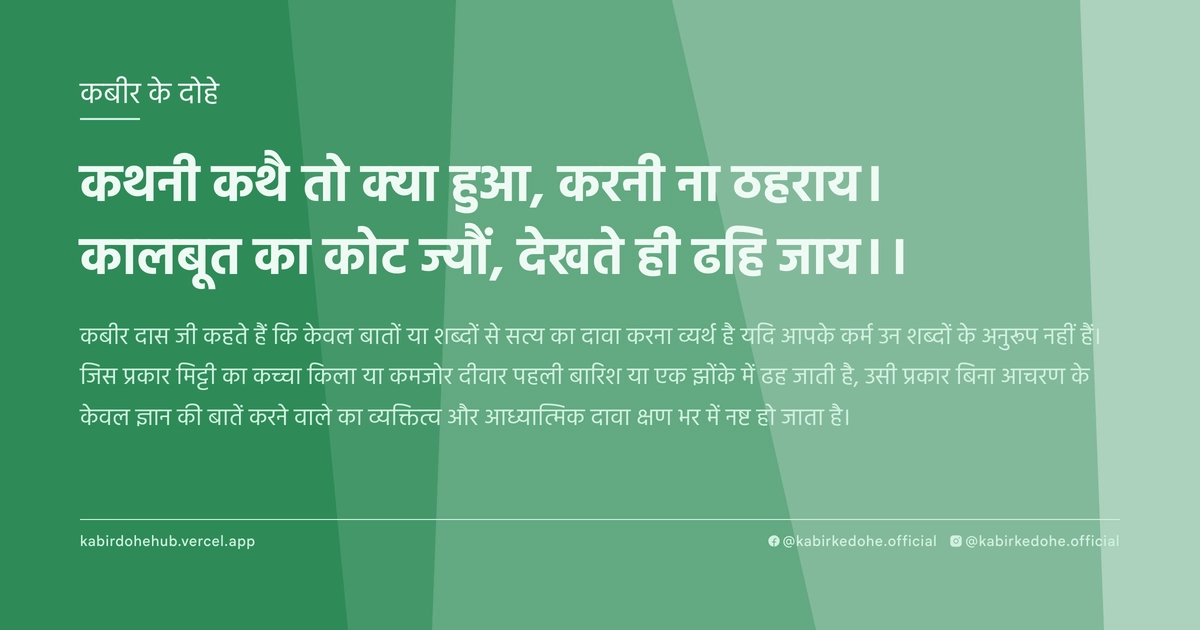
कथनी कथै तो क्या हुआ, करनी ना ठहराय।
कालबूत का कोट ज्यौं, देखते ही ढहि जाय।।
Kathni kathai to kya hua, karni na thahray. Kalboot ka kot jyon, dekhte hi dhahi jaaye.
इस पृष्ठ पर इस कबीर दोहे का अर्थ (meaning), हिंदी व्याख्या और अंग्रेज़ी अनुवाद, दार्शनिक विश्लेषण और व्यावहारिक जीवन सीख दी गई है। यह दोहा निष्ठा (Integrity) विषय से जुड़ा है — Kabir doha meaning and explanation in Hindi and English.
अर्थ (Meaning):
कबीर दास जी कहते हैं कि केवल बातों या शब्दों से सत्य का दावा करना व्यर्थ है यदि आपके कर्म उन शब्दों के अनुरूप नहीं हैं। जिस प्रकार मिट्टी का कच्चा किला या कमजोर दीवार पहली बारिश या एक झोंके में ढह जाती है, उसी प्रकार बिना आचरण के केवल ज्ञान की बातें करने वाले का व्यक्तित्व और आध्यात्मिक दावा क्षण भर में नष्ट हो जाता है।
Kabir asserts that mere verbal proclamations of truth are futile if they are not anchored in action. Just as a fortress made of unstable mud or weak materials collapses at the first sign of a storm, a spiritual identity built solely on words, without the foundation of lived practice, crumbles instantly when tested by reality or divine truth.
व्याख्या (Interpretation):
इस दोहे का शाब्दिक अर्थ है कि कथनी और करनी में सामंजस्य होना अनिवार्य है। रूपकात्मक स्तर पर, 'कालबूत का कोट' उस अहंकार और झूठे ज्ञान का प्रतीक है जिसे मनुष्य शब्दों के माध्यम से निर्मित करता है। यह निर्गुण भक्ति के उस सिद्धांत को दर्शाता है जहाँ ईश्वर बाहरी आडंबरों में नहीं, बल्कि आंतरिक सत्य और आचरण में बसता है। माया यहाँ उस भ्रम का रूप है जो हमें विश्वास दिलाता है कि शास्त्रों को रट लेना ही मोक्ष का मार्ग है। जब साधक अपनी 'कथनी' को 'करनी' में बदलता है, तब वह द्वैत (दोहराव) से मुक्त होकर अद्वैत की स्थिति में पहुँचता है, जहाँ विचार और क्रिया एक हो जाते हैं। यह विरोधाभास है कि मनुष्य सत्य को खोजने के लिए शब्दों का सहारा लेता है, जबकि सत्य शब्दों के पार मौन और कर्म में स्थित है।
Literally, the verse demands alignment between speech and action. Metaphorically, the 'fortress of mud' symbolizes the fragile ego and the illusory intellectualism that humans construct through rhetoric. This aligns with Nirgun Bhakti, where the Divine is not found in ritualistic chants but in the purity of conduct. Maya manifests here as the delusion that rote learning of scriptures equates to spiritual realization. When a seeker transforms 'speech' into 'action,' they transcend duality, reaching a state of Advaita where thought and deed merge into one. The central paradox lies in the human tendency to use language to seek a Truth that exists beyond language, in the silence of authentic living.
दार्शनिक विश्लेषण (Philosophical Analysis):
कबीर का यह प्रहार उनके समय के उन धार्मिक गुरुओं और पाण्डितों पर था जो धर्म की व्याख्या तो करते थे, लेकिन उनके निजी जीवन में करुणा और सत्य का अभाव था। वे कर्मकांडीय धर्म के विरुद्ध थे, क्योंकि उनका मानना था कि बाहरी अनुष्ठान केवल अहंकार को पुष्ट करते हैं, उसे मिटाते नहीं।
अद्वैत वेदांत के परिप्रेक्ष्य में, यह दोहा 'अविद्या' के विनाश की बात करता है। जब तक व्यक्ति केवल बोलता है, वह स्वयं को 'कर्ता' और 'ज्ञानी' के रूप में अलग देखता है, जो कि अहंकार का ही एक सूक्ष्म रूप है। वास्तविक ज्ञान वह है जो व्यवहार में उतरे और व्यक्ति के व्यक्तित्व को पूरी तरह बदल दे।
सूफी मत के 'नफ्स' (अहंकार) के विचार से जोड़ें तो, कथनी और करनी का अंतर 'नफ्स' की जीत है। जब तक शब्द कर्म में नहीं बदलते, तब तक आत्मा का परमात्मा से मिलन असंभव है क्योंकि बीच में झूठ की एक दीवार खड़ी रहती है।
मनोवैज्ञानिक रूप से, यह 'संज्ञानात्मक विसंगति' (Cognitive Dissonance) की स्थिति है। जब हम वह नहीं होते जो हम कहते हैं, तो हमारा आंतरिक संतुलन बिगड़ जाता है। कबीर इस विसंगति को मिटाकर पूर्णता की ओर बढ़ने का मार्ग दिखाते हैं।
अंततः, यह दोहा हमें सिखाता है कि आध्यात्मिक प्रगति का पैमाना पढ़ी हुई पुस्तकें नहीं, बल्कि बदला हुआ व्यवहार है। सत्य वह नहीं है जिसे सिद्ध किया जाए, बल्कि वह है जिसे जिया जाए।
Kabir’s critique is aimed at the religious authorities of his era—the pundits and mullahs—who preached morality but lived in contradiction to it. He rejected ritualism because he perceived it as a tool to inflate the ego rather than a means to dissolve it.
From the lens of Advaita Vedanta, this verse addresses the destruction of 'Avidya' (ignorance). As long as one only speaks of truth, they maintain a separation between the 'knower' and the 'known,' which is a subtle form of ego. True Gnosis is that which manifests in behavior, erasing the boundary between the self and the Absolute.
Connecting this to the Sufi concept of 'Nafs' (the lower self), the gap between word and deed is a victory for the ego. Until words are transmuted into action, the union of the soul with the Divine remains blocked by a wall of falsehood.
Psychologically, this describes 'Cognitive Dissonance.' When our identity is built on a persona of virtue that isn't backed by action, we live in a state of internal fragmentation. Kabir urges the annihilation of this fragmentation to achieve wholeness.
Ultimately, the verse posits that the metric of spiritual evolution is not the volume of scriptures memorized, but the transformation of character. Truth is not a proposition to be argued, but a lived experience to be embodied.
मूल संदेश (Core Message):
- शब्द केवल संकेत हैं, कर्म ही वास्तविक गंतव्य है।
- बिना आचरण के ज्ञान, बिना नींव के महल के समान है।
- सत्य को बोलना आसान है, सत्य को जीना कठिन।
- अहंकार शब्दों में छिपता है, कर्म में वह नष्ट होता है।
- आंतरिक शुद्धि ही वास्तविक आध्यात्मिक उपलब्धि है।
- Words are mere signposts; action is the actual destination.
- Knowledge without conduct is a palace without a foundation.
- Speaking the truth is easy; living the truth is the struggle.
- The ego hides in rhetoric but perishes in authentic action.
- Internal purification is the only true spiritual achievement.
व्यावहारिक उदाहरण (Practical Example):
वाराणसी के एक पुराने घाट पर माधव नाम का एक वृद्ध व्यक्ति रहता था, जो स्वयं को धर्म का बहुत बड़ा ज्ञाता मानता था। वह दिन भर आने-जाने वाले तीर्थयात्रियों को नैतिकता, दान और अहिंसा पर लंबे-लंबे प्रवचन देता था। उसकी वाणी में इतनी मिठास और विद्वत्ता थी कि लोग उसे महान संत मानने लगे थे।
किंतु, माधव का निजी जीवन अलग था। वह अपने घर के नौकरों पर चिल्लाता था और छोटी-छोटी बातों पर अपने पड़ोसियों से झगड़ता था। वह दान की महिमा तो बताता था, लेकिन जब कोई वास्तव में भूखा उसके द्वार पर आता, तो वह उसे डाँटकर भगा देता था।
एक दिन, एक साधारण सा बुनकर, जो कबीर के विचारों का अनुयायी था, माधव के पास आया। उसने देखा कि माधव एक गरीब बच्चे को उसकी गरीबी के लिए कोस रहा है, जबकि अभी कुछ देर पहले वह 'करुणा' पर उपदेश दे रहा था।
उस बुनकर ने माधव से बस इतना कहा, 'बाबा, आपकी बातें सोने के महल जैसी हैं, लेकिन आपका व्यवहार मिट्टी की उस दीवार जैसा है जो पहली बारिश में गिर जाएगी। क्या आपका ज्ञान आपके क्रोध को शांत नहीं कर सका?'
यह बात माधव के हृदय में तीर की तरह लगी। उसे एहसास हुआ कि उसने वर्षों तक केवल शब्दों का संग्रह किया था, लेकिन अपने भीतर के अहंकार को एक इंच भी कम नहीं किया।
उस रात माधव सो नहीं पाया। उसने महसूस किया कि उसकी सारी विद्वत्ता एक ढोंग थी, एक ऐसा 'कोट' जिसे उसने दुनिया को दिखाने के लिए बनाया था, लेकिन उसके भीतर कुछ भी नहीं था।
अगले दिन से माधव ने प्रवचन देना बंद कर दिया। उसने तय किया कि वह पहले अपने व्यवहार को सुधारेगा। उसने अपने नौकरों से क्षमा मांगी और चुपचाप लोगों की मदद करना शुरू किया।
महीनों बाद, जब वह फिर से बोलना शुरू किया, तो उसकी बातों में वह बनावटी चमक नहीं थी, बल्कि एक गहरा अनुभव था। अब लोग उसकी बातों को इसलिए नहीं सुनते थे क्योंकि वह विद्वान था, बल्कि इसलिए क्योंकि उसका जीवन उसकी बातों का प्रमाण था।
On an ancient ghat in Varanasi lived an elderly man named Madhav, who considered himself a profound scholar of Dharma. He spent his days delivering lengthy discourses on morality, charity, and non-violence to visiting pilgrims. His speech was so polished and scholarly that people began to revere him as a great saint.
However, Madhav’s private life was a stark contrast. He screamed at his domestic help and engaged in petty disputes with his neighbors. While he praised the glory of charity, he would harshly turn away any starving soul who knocked on his door.
One day, a simple weaver, a follower of Kabir’s path, approached Madhav. He witnessed Madhav berating a poor child for his poverty, moments after the old man had been preaching about 'universal compassion.'
The weaver calmly said, 'Baba, your words are like a golden palace, but your conduct is like a wall of mud that will collapse in the first rain. Has your knowledge not been able to silence your anger?'
These words pierced Madhav’s heart. He realized he had spent years collecting words, but had not diminished his ego by a single inch.
That night, Madhav could not sleep. He felt that his entire scholarship was a facade—a 'fortress' built for public display, while the interior was hollow.
From the next day, Madhav stopped giving lectures. He decided he would first refine his behavior. He apologized to his servants and began helping the needy in silence.
Months later, when he spoke again, his words lacked the artificial glitter of scholarship but possessed the weight of experience. People listened to him not because he was learned, but because his life was the living proof of his words.
अभ्यास मार्गदर्शन (Practice Guidance):
- मौन का अभ्यास: प्रतिदिन एक घंटा पूर्ण मौन रहें। इस समय में यह विचार करें कि क्या आपके विचार आपके शब्दों से मेल खाते हैं।
- आचरण डायरी: एक डायरी लिखें जिसमें आप दिन भर में बोले गए अपने वादों और वास्तव में किए गए कार्यों की तुलना करें। जहाँ अंतर हो, उसे स्वीकार करें।
- अहंकार का विसर्जन: किसी ऐसे व्यक्ति की सेवा करें जिसे आप नापसंद करते हैं, बिना किसी को बताए। यह आपकी 'कथनी' को 'करनी' में बदलने की पहली सीढ़ी है।
- निदान चेकलिस्ट: (1) क्या मैं दूसरों को वह सलाह देता हूँ जिसे मैं स्वयं नहीं मानता? (2) क्या मेरी प्रशंसा मेरी वास्तविक आदतों से अधिक है? (3) क्या मैं अपनी गलतियों को शब्दों से ढंकने की कोशिश करता हूँ?
- Practice of Silence: Spend one hour in complete silence daily. Use this time to contemplate whether your internal thoughts align with your external proclamations.
- Conduct Journaling: Maintain a journal comparing the promises you made during the day with the actions you actually performed. Acknowledge every gap without judgment.
- Ego Dissolution: Perform a selfless act of service for someone you personally dislike, keeping it a secret. This is the first step in transmuting 'speech' into 'action.'
- Diagnostic Checklist: (1) Do I give advice to others that I fail to follow myself? (2) Is the public perception of my virtue greater than my private reality? (3) Do I use intellectual arguments to mask my behavioral failures?
चिंतन प्रश्न (Reflection Questions):
- यदि आज मेरे जीवन के सभी शब्द छीन लिए जाएं, तो मेरा व्यवहार दुनिया को मेरे बारे में क्या बताएगा?
- मैं अपनी छवि को बनाए रखने के लिए किन झूठों का सहारा लेता हूँ, जिन्हें मैं 'सत्य' कहता हूँ?
- क्या मेरी आध्यात्मिक पहचान मेरे वास्तविक चरित्र का विस्तार है या केवल एक सामाजिक मुखौटा?
- वह कौन सा एक गुण है जिसे मैं दूसरों में सबसे अधिक प्रोत्साहित करता हूँ, लेकिन स्वयं अपनाने से डरता हूँ?
- क्या मैं सत्य की खोज कर रहा हूँ, या केवल सत्य के बारे में बात करने का आनंद ले रहा हूँ?
- If all my words were stripped away today, what would my behavior tell the world about who I am?
- What lies do I employ to maintain my public image while labeling them as 'truth'?
- Is my spiritual identity an extension of my actual character, or merely a social mask?
- Which single virtue do I most encourage in others while fearing to embody it myself?
- Am I truly seeking the Truth, or am I simply enjoying the act of talking about the Truth?