
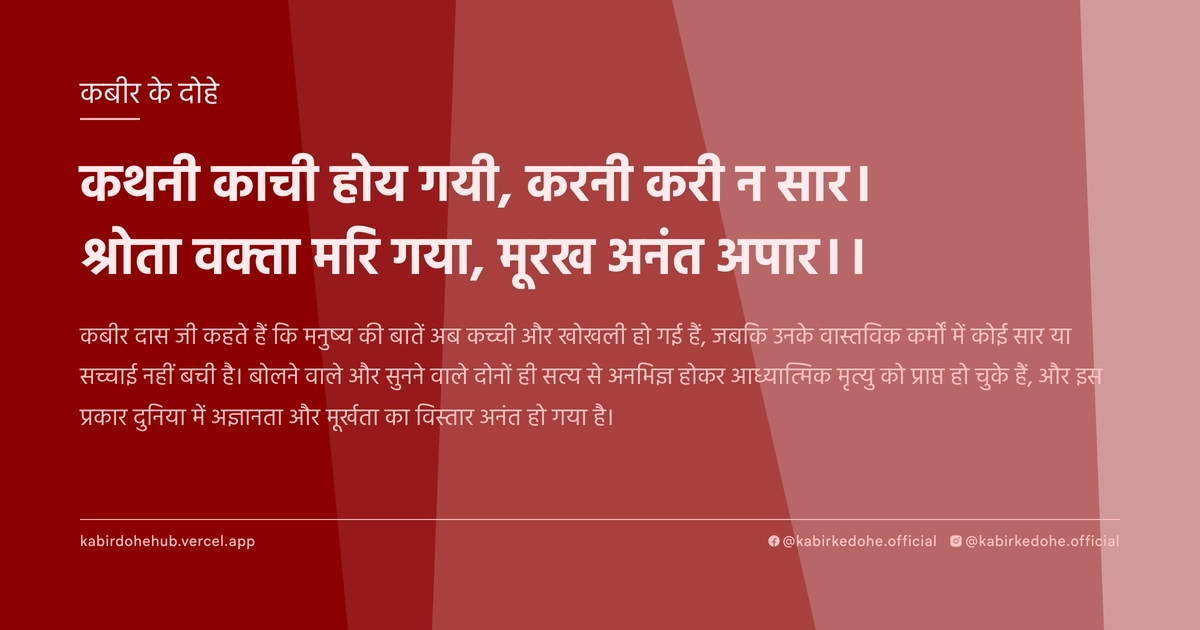
कथनी काची होय गयी, करनी करी न सार।
श्रोता वक्ता मरि गया, मूरख अनंत अपार।।
Kathni kachi hoye gayi, karni kari na saar. Shrota vakta mari gaya, moorakh anant apaar.
इस पृष्ठ पर इस कबीर दोहे का अर्थ (meaning), हिंदी व्याख्या और अंग्रेज़ी अनुवाद, दार्शनिक विश्लेषण और व्यावहारिक जीवन सीख दी गई है। यह दोहा निष्ठा (Integrity) विषय से जुड़ा है — Kabir doha meaning and explanation in Hindi and English.
अर्थ (Meaning):
कबीर दास जी कहते हैं कि मनुष्य की बातें अब कच्ची और खोखली हो गई हैं, जबकि उनके वास्तविक कर्मों में कोई सार या सच्चाई नहीं बची है। बोलने वाले और सुनने वाले दोनों ही सत्य से अनभिज्ञ होकर आध्यात्मिक मृत्यु को प्राप्त हो चुके हैं, और इस प्रकार दुनिया में अज्ञानता और मूर्खता का विस्तार अनंत हो गया है।
Kabir asserts that human speech has become superficial and hollow, while their actual deeds lack any essence or truth. Both the speaker and the listener have succumbed to a spiritual death by remaining ignorant of the True Self, leading to an infinite proliferation of foolishness and intellectual vanity in the world.
व्याख्या (Interpretation):
यह दोहा शब्दों और कर्मों के बीच की गहरी खाई को दर्शाता है। 'कथनी काची' का अर्थ है वह ज्ञान जो केवल बौद्धिक स्तर पर है और हृदय में नहीं उतरा। जब ज्ञान केवल वाणी तक सीमित रहता है, तो वह 'माया' का एक हिस्सा बन जाता है जो अहंकार को बढ़ाता है। निर्गुण भक्ति के संदर्भ में, ईश्वर शब्दों में नहीं बल्कि अनुभव में है। 'श्रोता वक्ता मरि गया' का अर्थ शारीरिक मृत्यु नहीं, बल्कि चेतना की मृत्यु है—जहाँ व्यक्ति केवल रटंत विद्या और कर्मकांडों में उलझा रहता है। यह अद्वैत वेदांत की उस स्थिति को दर्शाता है जहाँ जीव अपनी वास्तविक प्रकृति (ब्रह्म) को भूलकर बाहरी शोर में खो जाता है। अंततः, यह विरोधाभास है कि हम सत्य के बारे में सबसे अधिक बात करते हैं, लेकिन उसे जीने में सबसे पीछे हैं।
This couplet highlights the profound chasm between verbal proclamation and lived experience. 'Kathni kachi' refers to knowledge that remains purely intellectual, never descending into the heart; such knowledge becomes a tool of 'Maya', inflating the ego rather than dissolving it. In the context of Nirgun Bhakti, the Divine is found not in scriptures or sermons, but in direct experiential realization. The phrase 'shrota vakta mari gaya' does not imply physical death, but the death of consciousness—a state where the individual is trapped in rote learning and ritualistic performance. This mirrors the Advaita Vedanta concept of Avidya (ignorance), where the Atman forgets its non-duality with Brahman and becomes lost in the noise of the world. The central paradox is that while humanity speaks most frequently of Truth, it is least capable of embodying it.
दार्शनिक विश्लेषण (Philosophical Analysis):
कबीर का यह प्रहार उनके युग के धार्मिक पाखंडों पर है, जहाँ पंडित और मौलवी केवल शास्त्रों की व्याख्या करते थे लेकिन उनके जीवन में करुणा और सत्य का अभाव था। वे ritualism (कर्मकांड) का पुरजोर विरोध करते हैं क्योंकि उनके अनुसार बाहरी दिखावा आत्मा की प्रगति में बाधा है।
दार्शनिक रूप से, यह दोहा 'शब्द' और 'अर्थ' के द्वंद्व को संबोधित करता है। सूफी मत में 'ज़ाहिर' (बाहरी) और 'बातिन' (आंतरिक) का अंतर होता है। कबीर कहते हैं कि जब तक बातिन (आंतरिक सत्य) जागृत नहीं होता, ज़ाहिर (बाहरी भाषण) केवल एक मुखौटा है।
अद्वैत वेदांत के अनुसार, जब तक 'अहंकार' जीवित है, तब तक ज्ञान केवल सूचना है। वास्तविक ज्ञान वह है जो कर्ता भाव को मिटा दे। यहाँ 'मूरख' वह नहीं है जो अनपढ़ है, बल्कि वह है जो यह मानता है कि वह सत्य को 'जानता' है जबकि उसने उसे 'जिया' नहीं है।
यह मनोवैज्ञानिक रूपांतरण की मांग करता है। कबीर चाहते हैं कि साधक अपनी वाणी को मौन करे और अपने कर्मों को प्रार्थना बनाए। जब कथनी और करनी एक हो जाती है, तब व्यक्ति 'साधक' से 'सिद्ध' बन जाता है।
अंततः, यह दोहा हमें चेतावनी देता है कि आध्यात्मिक विमर्श (spiritual discourse) स्वयं में एक जाल हो सकता है। यदि चर्चा हमें आत्म-साक्षात्कार से दूर ले जा रही है, तो वह चर्चा हमें और अधिक अंधकार में धकेल रही है।
Kabir’s critique is directed at the religious hypocrisy of his era, where scholars and clerics offered endless interpretations of scriptures while their lives remained devoid of compassion and integrity. He vehemently rejects ritualism, viewing external displays of piety as obstacles to the soul's genuine evolution.
Philosophically, this doha addresses the duality between the 'word' and the 'meaning'. In Sufism, there is a distinction between 'Zahir' (the manifest/external) and 'Batin' (the hidden/internal). Kabir argues that unless the Batin is awakened, the Zahir remains a mere mask, a superficial performance of spirituality.
According to Advaita Vedanta, as long as the 'ego' persists, knowledge is merely information. True Gnosis (Jnana) is that which annihilates the sense of doership. Here, the 'fool' is not the illiterate person, but the one who believes they 'know' the Truth without having 'lived' it.
This requires a profound psychological transformation. Kabir urges the seeker to silence the tongue and transform their actions into a living prayer. When speech and action merge into a single stream of integrity, the seeker evolves into a realized soul (Siddha).
Ultimately, the doha warns that spiritual discourse can itself become a trap. If the act of talking about enlightenment replaces the act of seeking it, the discourse becomes a veil of Maya, further distancing the individual from the Absolute.
मूल संदेश (Core Message):
- शब्दों का अहंकार सत्य की खोज में सबसे बड़ी बाधा है।
- ज्ञान तब तक व्यर्थ है जब तक वह व्यवहार में न उतरे।
- मौन रहकर कर्म करना ही वास्तविक आध्यात्मिक प्रगति है।
- बाहरी प्रदर्शन आत्मा की आंतरिक शून्यता को नहीं भर सकता।
- सत्य को बोला नहीं, बल्कि जिया जाना चाहिए।
- The ego of words is the greatest obstacle to realizing Truth.
- Knowledge is futile until it is translated into lived behavior.
- Acting in silence is the only true mark of spiritual progress.
- External performance cannot fill the internal void of the soul.
- Truth is not something to be spoken, but something to be lived.
व्यावहारिक उदाहरण (Practical Example):
वाराणसी के एक पुराने घाट पर रामदीन नाम का एक वृद्ध व्यक्ति रहता था, जो स्वयं को धर्म का बहुत बड़ा ज्ञाता मानता था। वह दिन भर आने-जाने वाले तीर्थयात्रियों को यह उपदेश देता था कि दान देना सबसे बड़ा पुण्य है और मोह का त्याग करना ही मोक्ष का मार्ग है। उसकी बातें इतनी प्रभावशाली थीं कि लोग उसे महान संत मानने लगे थे।
लेकिन रामदीन के घर की कहानी अलग थी। वह अपनी पत्नी और बेटे के साथ छोटी-छोटी बातों पर झगड़ता था और अपने घर के नौकरों के साथ अत्यंत कठोर व्यवहार करता था। उसकी कथनी में तो करुणा थी, पर उसकी करनी में केवल क्रोध और अहंकार था।
एक दिन एक युवा साधु उसके पास आया। उसने रामदीन के लंबे प्रवचन सुने और फिर चुपचाप उठकर घाट की सीढ़ियों पर गिरे एक घायल कुत्ते की मदद करने लगा। साधु ने बिना एक शब्द बोले अपनी चादर फाड़कर कुत्ते के घाव पर पट्टी बांधी और उसे पानी पिलाया।
रामदीन ने साधु से कहा, 'महाराज, आप तो मौन रहे, जबकि मैं घंटों धर्म की व्याख्या करता हूँ। क्या आपको नहीं लगता कि ज्ञान का प्रसार करना अधिक आवश्यक है?'
साधु ने मुस्कुराकर कहा, 'बाबा, आपकी बातें कानों को सुख देती हैं, लेकिन मेरा यह छोटा सा कार्य उस कुत्ते के दर्द को कम कर रहा है। आपकी कथनी सोने की है, पर आपकी करनी मिट्टी की। जिस दिन आपकी करुणा आपकी वाणी से बड़ी हो जाएगी, उस दिन आप वास्तव में ज्ञानी कहलाएंगे।'
रामदीन को गहरा धक्का लगा। उसे एहसास हुआ कि वह अब तक केवल शब्दों का व्यापार कर रहा था। उसने महसूस किया कि वह 'श्रोता और वक्ता' के उस खेल में फंस गया था जहाँ अहंकार को पोषण मिलता है, सत्य को नहीं।
उस दिन के बाद रामदीन ने उपदेश देना बंद कर दिया। उसने अपने घर में शांति लाना शुरू किया और चुपचाप लोगों की सेवा में लग गया। उसने सीखा कि एक छोटा सा निस्वार्थ कार्य हजार उपदेशों से अधिक शक्तिशाली होता है।
वर्षों बाद, लोग उसे उसकी बातों के लिए नहीं, बल्कि उसकी दयालुता के लिए याद करने लगे। उसकी 'कच्ची कथनी' अब 'पक्की करनी' में बदल चुकी थी और उसका अहंकार विलीन हो गया था।
On an ancient ghat in Varanasi lived an elderly man named Ramdeen, who considered himself a profound scholar of Dharma. He spent his days preaching to pilgrims that charity is the highest virtue and that renouncing attachment is the only path to liberation. His words were so persuasive that people began to revere him as a great saint.
However, the reality inside Ramdeen's home was starkly different. He fought incessantly with his wife and son over trivial matters and treated his domestic help with extreme harshness. While his speech dripped with compassion, his actions were fueled by anger and ego.
One day, a young monk arrived. He listened to Ramdeen's lengthy discourse in silence and then quietly stood up to help an injured dog lying on the stone steps of the ghat. Without uttering a single word, the monk tore a piece of his cloth to bandage the dog's wound and offered it water.
Ramdeen asked the monk, 'Maharaj, you remained silent, while I spend hours explaining the depths of Dharma. Do you not think that spreading knowledge is more essential?'
The monk smiled and replied, 'Baba, your words please the ears, but my small act is easing the pain of this creature. Your speech is made of gold, but your actions are made of dust. The day your compassion becomes larger than your vocabulary, you will truly be a Knower.'
Ramdeen was shaken. He realized he had been trading in words, trapped in the game of 'speaker and listener' where only the ego is fed, never the soul.
From that day forward, Ramdeen stopped preaching. He began by cultivating peace within his own home and dedicated himself to the silent service of others. He learned that one small, selfless act is more powerful than a thousand sermons.
Years later, people remembered him not for his speeches, but for his kindness. His 'hollow words' had finally been replaced by 'substantial deeds', and his ego had finally dissolved into the Absolute.
अभ्यास मार्गदर्शन (Practice Guidance):
- मौन साधना: प्रतिदिन एक घंटा पूर्ण मौन रहें। इस दौरान यह निरीक्षण करें कि आपका मन कितनी बार 'कुछ बोलने' या 'अपनी श्रेष्ठता सिद्ध करने' की इच्छा करता है।
- कर्म-जागरूकता जर्नल: रात को सोने से पहले लिखें—'आज मैंने क्या कहा' बनाम 'आज मैंने वास्तव में क्या किया'। यदि दोनों में अंतर है, तो उस अंतर को स्वीकार करें।
- अहंकार का विसर्जन: किसी ऐसे व्यक्ति की मदद करें जिससे आप घृणा करते हैं, और इस मदद के बारे में किसी को न बताएं। यह आपकी 'कथनी' को 'करनी' में बदलने का अभ्यास है।
- निदान चेकलिस्ट: क्या मैं दूसरों को सलाह देने में अधिक समय बिताता हूँ बजाय खुद को सुधारने के? क्या मेरी आध्यात्मिक पहचान मेरे व्यवहार से अलग है? यदि हाँ, तो आप 'कच्ची कथनी' के जाल में हैं।
- Practice of Silence: Observe one hour of absolute silence daily. During this time, notice how often the mind urges you to 'say something' or 'prove your superiority'.
- Action-Awareness Journaling: Before sleep, record: 'What I said today' versus 'What I actually did today'. Acknowledge the gap between the two without judgment.
- Ego Dissolution: Perform a selfless act for someone you dislike, and keep it a complete secret. This trains the soul to value action over the recognition that comes from speech.
- Diagnostic Checklist: Do I spend more time advising others than improving myself? Is my spiritual identity disconnected from my behavior? If yes, you are trapped in the cycle of 'hollow speech'.
चिंतन प्रश्न (Reflection Questions):
- यदि मेरी वाणी पूरी तरह छीन ली जाए, तो क्या मेरा व्यवहार अभी भी मुझे एक 'अच्छा इंसान' साबित करेगा?
- मैं अपनी आध्यात्मिक पहचान (spiritual identity) का उपयोग दूसरों को नीचा दिखाने या खुद को श्रेष्ठ महसूस कराने के लिए कैसे करता हूँ?
- मेरे जीवन का वह कौन सा हिस्सा है जहाँ मेरी कथनी और करनी में सबसे बड़ा अंतर है, और मैं उस अंतर को क्यों बनाए रखना चाहता हूँ?
- क्या मैं सत्य को इसलिए खोज रहा हूँ ताकि मैं उसे दूसरों को बता सकूँ, या इसलिए कि मैं वास्तव में बदल सकूँ?
- डिजिटल युग में, जहाँ हम अपनी 'आदर्श छवि' को शब्दों और पोस्ट के माध्यम से गढ़ते हैं, मेरा वास्तविक 'अंधेरा' क्या है जिसे मैं छिपा रहा हूँ?
- If my voice were completely taken away, would my actions still prove me to be a 'good person'?
- How do I use my spiritual identity to subtly belittle others or inflate my own sense of superiority?
- In which area of my life is the gap between my words and deeds the widest, and why am I clinging to that contradiction?
- Am I seeking Truth so that I can describe it to others, or so that I can actually be transformed by it?
- In a digital age where we curate an 'ideal self' through words and posts, what is the actual 'shadow' I am desperately hiding?