
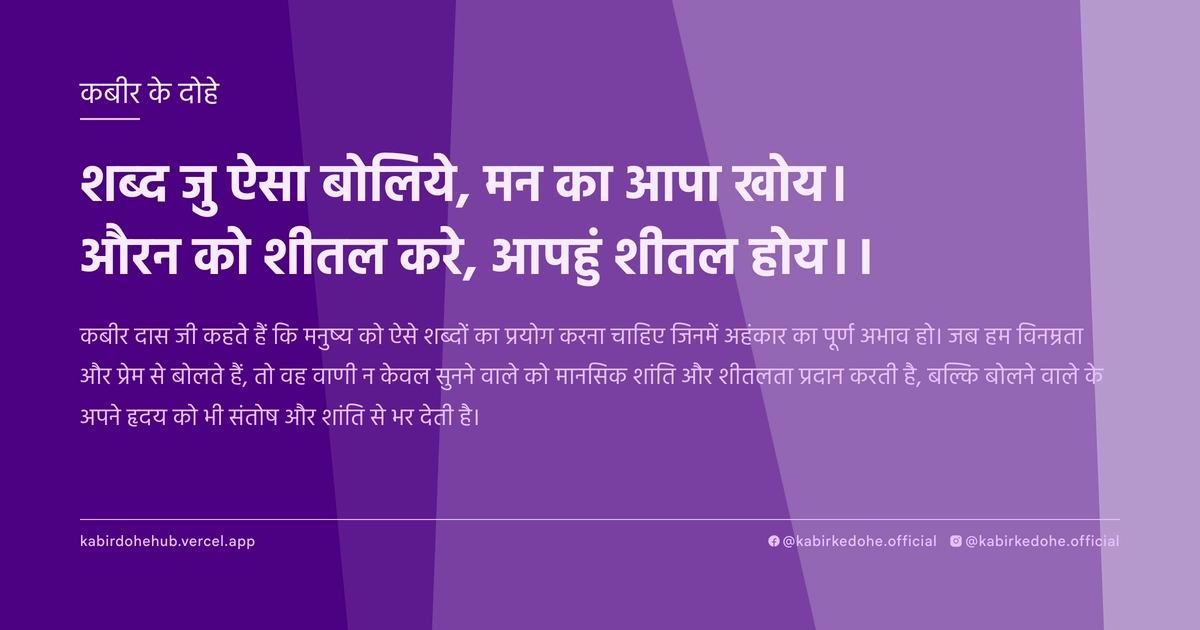
शब्द जु ऐसा बोलिये, मन का आपा खोय।
औरन को शीतल करे, आपहुं शीतल होय।।
Shabd ju aisa boliye, man ka aapa khoy. Auran ko sheetal kare, aapahun sheetal hoye.
इस पृष्ठ पर इस कबीर दोहे का अर्थ (meaning), हिंदी व्याख्या और अंग्रेज़ी अनुवाद, दार्शनिक विश्लेषण और व्यावहारिक जीवन सीख दी गई है। यह दोहा विनम्रता (Humility) विषय से जुड़ा है — Kabir doha meaning and explanation in Hindi and English.
अर्थ (Meaning):
कबीर दास जी कहते हैं कि मनुष्य को ऐसे शब्दों का प्रयोग करना चाहिए जिनमें अहंकार का पूर्ण अभाव हो। जब हम विनम्रता और प्रेम से बोलते हैं, तो वह वाणी न केवल सुनने वाले को मानसिक शांति और शीतलता प्रदान करती है, बल्कि बोलने वाले के अपने हृदय को भी संतोष और शांति से भर देती है।
Kabir suggests that one should speak words that are devoid of ego and pride. When speech is uttered with humility and genuine love, it acts as a soothing balm that brings peace and coolness to the listener, while simultaneously purifying and calming the heart of the speaker.
व्याख्या (Interpretation):
इस दोहे का शाब्दिक अर्थ मधुर वाणी के प्रयोग से है, परंतु इसका गहरा आध्यात्मिक अर्थ 'अहंकार के विसर्जन' में निहित है। 'आपा' का अर्थ है वह मिथ्या अहंकार (Maya) जो व्यक्ति को स्वयं को दूसरों से अलग और श्रेष्ठ दिखाता है। जब साधक इस 'आपा' को खो देता है, तो वह द्वैत से अद्वैत की ओर बढ़ता है। निर्गुण भक्ति के अनुसार, ईश्वर बाहर नहीं बल्कि भीतर है, और जब वाणी में अहंकार नहीं होता, तब वह वाणी सीधे आत्मा से आत्मा का संवाद बन जाती है। यह शीतलता केवल भौतिक सुख नहीं, बल्कि वह आध्यात्मिक शांति है जो तब आती है जब व्यक्ति अपनी पहचान को ब्रह्मांडीय चेतना (Brahman) में विलीन कर देता है। यहाँ वाणी एक उपकरण है जिसके माध्यम से साधक अपनी आंतरिक शुद्धि की परीक्षा करता है।
While the literal meaning emphasizes sweet speech, the deeper metaphorical layer lies in the 'dissolution of the ego.' 'Aapa' refers to the false sense of self (Maya) that creates a perceived separation between the individual and the universe. When the seeker loses this 'Aapa,' they transition from duality to non-duality (Advaita). In Nirgun Bhakti, the Divine is formless and resides within; thus, speech devoid of ego becomes a direct communication from soul to soul. The 'coolness' mentioned is not merely a pleasant feeling but the spiritual tranquility achieved when the individual identity merges into the universal consciousness (Brahman). Here, speech serves as a diagnostic tool for the seeker to measure their internal purification and the annihilation of the separate self.
दार्शनिक विश्लेषण (Philosophical Analysis):
कबीर का यह विचार उस समय के सामाजिक परिवेश में अत्यंत क्रांतिकारी था, जहाँ जाति, धर्म और संप्रदाय के नाम पर घोर विद्वान भी एक-दूसरे के प्रति कटुता रखते थे। कबीर ने कर्मकांडों और बाहरी आडंबरों का विरोध किया और 'सहज' मार्ग पर बल दिया। यह दोहा केवल शिष्टाचार की बात नहीं करता, बल्कि यह 'अद्वैत वेदांत' के उस सिद्धांत को पुष्ट करता है जहाँ 'मैं' और 'तू' का भेद समाप्त हो जाता है। जब हम किसी को चोट पहुँचाते हैं, तो हम वास्तव में स्वयं को ही चोट पहुँचा रहे होते हैं क्योंकि हम सब एक ही चेतना के अंश हैं।
सूफी मत के 'फना' (अहंकार का विनाश) के सिद्धांत से यह गहराई से जुड़ा है। सूफीवाद में माना जाता है कि जब तक 'मैं' जीवित है, तब तक 'वह' (ईश्वर) प्रकट नहीं होगा। कबीर का 'आपा खोना' इसी फना की प्रक्रिया है। यह मनोवैज्ञानिक रूपांतरण की वह अवस्था है जहाँ व्यक्ति अपनी श्रेष्ठता की भावना को त्यागकर करुणा को अपनाता है।
अक्सर लोग इस दोहे को केवल 'मीठा बोलने' की सलाह मानते हैं, जो एक बड़ी भूल है। यह मीठा बोलने के बारे में नहीं, बल्कि उस 'स्रोत' के बारे में है जहाँ से शब्द निकलते हैं। यदि शब्द शहद जैसे हों लेकिन उनके पीछे सूक्ष्म अहंकार या चालाकी छिपी हो, तो वह आध्यात्मिक शीतलता नहीं ला सकते। वास्तविक शीतलता केवल तभी आती है जब बोलने वाला स्वयं को शून्य कर लेता है।
यह शिक्षण हमें सिखाता है कि वाणी केवल संचार का माध्यम नहीं है, बल्कि यह हमारे आंतरिक राज्य का दर्पण है। यदि हृदय में क्रोध और द्वेष है, तो शब्द चाहे कितने भी परिष्कृत क्यों न हों, वे अग्नि की तरह जलाएंगे। अतः, वाणी का परिमार्जन वास्तव में हृदय का परिमार्जन है।
अंततः, कबीर यहाँ एक ऐसे समाज की कल्पना कर रहे हैं जहाँ संवाद का आधार सत्ता या शक्ति नहीं, बल्कि प्रेम और विनम्रता हो। यह एक ऐसी क्रांति है जो तलवार से नहीं, बल्कि शब्दों के मौन और प्रेम से संभव है। यह व्यक्ति को उसकी सामाजिक पहचान से ऊपर उठाकर एक वैश्विक मनुष्य बनाता है।
Kabir's insight was profoundly revolutionary within the socio-religious landscape of his era, where scholars and priests often clung to caste and sectarian pride, fostering bitterness. He rejected ritualism and external displays of piety, emphasizing the 'Sahaja' (natural/spontaneous) path. This couplet transcends mere etiquette; it reinforces the core tenet of Advaita Vedanta—the collapse of the distinction between 'I' and 'Thou.' When we hurt another, we are essentially hurting ourselves, as all beings are manifestations of the same singular consciousness.
This philosophy aligns closely with the Sufi concept of 'Fana' (annihilation of the self). In Sufism, it is believed that as long as the 'I' persists, the 'Divine' cannot be realized. Kabir's 'losing the Aapa' is precisely this process of Fana. It is a psychological metamorphosis where the individual discards the illusion of superiority and embraces universal compassion.
A common literalist misconception is to view this as a simple plea for 'politeness.' However, Kabir is not discussing social grace, but the 'source' from which words emerge. If words are honeyed but driven by a subtle ego or hidden manipulation, they cannot produce spiritual coolness. True tranquility only emerges when the speaker becomes a void, allowing the Divine will to speak through them.
This teaching posits that speech is not merely a tool for communication, but a mirror reflecting one's internal state. If the heart is clouded by anger or prejudice, no amount of linguistic refinement can hide the fire within. Therefore, the refinement of speech is, in reality, the refinement of the soul.
Ultimately, Kabir envisions a society where dialogue is based not on power or status, but on love and humility. This is a revolution achieved not through conflict, but through the silence of the ego and the potency of love. It elevates the individual from a narrow social identity to a universal human identity.
मूल संदेश (Core Message):
- अहंकार शब्दों को विषैला बनाता है, विनम्रता उन्हें औषधि बनाती है।
- दूसरों को शांति देना स्वयं को शांति प्रदान करने का एकमात्र मार्ग है।
- वाणी का परिमार्जन वास्तव में आत्मा का परिमार्जन है।
- जब 'मैं' मिटता है, तब केवल प्रेम शेष रहता है।
- सच्ची शीतलता बाहरी शब्दों में नहीं, आंतरिक शून्यता में है।
- Ego turns words into poison; humility transforms them into medicine.
- Bringing peace to others is the only true path to finding peace within.
- The refinement of speech is, in essence, the refinement of the soul.
- When the 'I' vanishes, only love remains.
- True coolness resides not in the words, but in the internal void.
व्यावहारिक उदाहरण (Practical Example):
वाराणसी के एक पुराने घाट पर माधव नाम का एक वृद्ध बुनकर रहता था। वह अपने काम में निपुण था, लेकिन उसका स्वभाव अत्यंत कठोर और अहंकारी था। वह मानता था कि उसकी बुनाई की कला पूरे शहर में सर्वश्रेष्ठ है, और वह अक्सर अपने साथी बुनकरों और ग्राहकों को नीचा दिखाता था। उसकी वाणी में एक ऐसी कड़वाहट थी कि लोग उससे बात करने से कतराते थे। माधव का घर समृद्ध था, लेकिन उसका मन अशांत था और वह अकेलापन महसूस करता था।
एक दिन, घाट पर एक फकीर आया जिसने माधव के अहंकार को पहचान लिया। फकीर ने माधव से कहा, 'तेरा कपड़ा तो सुंदर है, लेकिन तेरी वाणी में वह धागा नहीं है जो दिलों को जोड़ सके।' माधव को पहले तो गुस्सा आया, लेकिन फकीर की आँखों में एक अजीब सी शांति थी जिसने माधव को सोचने पर मजबूर कर दिया।
अगले कुछ दिनों तक माधव ने देखा कि वह फकीर हर किसी से, चाहे वह राजा हो या भिखारी, एक ही तरह की विनम्रता और प्रेम से बात करता था। फकीर की बातों से लोग शांत हो जाते थे और उनके चेहरों पर मुस्कान आ जाती थी। माधव ने महसूस किया कि उसकी अपनी श्रेष्ठता का गर्व वास्तव में एक दीवार थी जिसने उसे दुनिया से अलग कर दिया था।
माधव ने तय किया कि वह अपने व्यवहार को बदलेगा। शुरुआत में यह बहुत कठिन था। जब कोई ग्राहक उसकी गलती निकालता, तो उसका पुराना अहंकार उसे चिल्लाने के लिए उकसाता। लेकिन वह तुरंत कबीर के शब्दों को याद करता और अपनी सांसों को धीमा करता। वह जानबूझकर अपने शब्दों से 'मैं' और 'मेरी श्रेष्ठता' को हटाकर 'आप' और 'कृतज्ञता' को जोड़ने लगा।
धीरे-धीरे, माधव की वाणी बदलने लगी। उसने अपने साथी बुनकरों की मदद करना शुरू किया और उन्हें अपनी गुप्त तकनीकें सिखानी शुरू कीं, जिन्हें वह पहले छिपाकर रखता था। उसने महसूस किया कि जब वह दूसरों को सम्मान देता है, तो उसे बदले में जो सम्मान मिलता है, वह उसकी कला की प्रशंसा से कहीं अधिक सुखद है।
एक समय ऐसा आया जब माधव का घर केवल कपड़ों की दुकान नहीं, बल्कि एक ऐसा स्थान बन गया जहाँ लोग मानसिक शांति के लिए आते थे। उसकी वाणी अब शीतल थी, और वह शीतलता दूसरों के साथ-साथ उसके अपने जीवन में भी उतर आई थी। उसका पुराना तनाव और अनिद्रा गायब हो गई थी।
एक दिन एक युवा बुनकर ने उससे पूछा, 'काका, आपने यह सब कैसे किया?' माधव ने मुस्कुराते हुए कहा, 'मैंने बस अपने भीतर के उस अहंकारी व्यक्ति को मार दिया जो सोचता था कि वह सबसे बड़ा है। जब मैं शून्य हुआ, तब मुझे पता चला कि असली खुशी दूसरों को शीतल करने में है।'
माधव की कहानी यह दर्शाती है कि वाणी का परिवर्तन केवल बाहरी व्यवहार का बदलाव नहीं है, बल्कि यह एक आंतरिक मृत्यु और पुनर्जन्म है। उसने 'आपा' खोया और बदले में संपूर्ण मानवता को पाया।
On an ancient ghat in Varanasi lived an elderly weaver named Madhav. He was a master of his craft, but his nature was harsh and arrogant. He believed his weaving was the finest in the city and frequently belittled his fellow weavers and customers. His speech carried a bitterness that made people avoid him. Though Madhav's home was prosperous, his mind was turbulent, and he suffered from a profound sense of loneliness.
A wandering dervish arrived at the ghat and immediately recognized Madhav's ego. The dervish told him, 'Your fabric is beautiful, but your speech lacks the thread that binds hearts together.' Initially, Madhav was offended, but the inexplicable peace in the dervish's eyes forced him to reflect.
Over the next few days, Madhav observed the dervish. Whether speaking to a nobleman or a beggar, the dervish maintained the same level of humility and love. People were visibly calmed by his words, and smiles bloomed on their faces. Madhav realized that his pride in his superiority was actually a wall that had isolated him from the world.
Madhav decided to transform his behavior. At first, it was an uphill battle. Whenever a customer criticized his work, his old ego urged him to lash out. But he would immediately recall Kabir's words and consciously slow his breathing. He deliberately removed 'I' and 'my superiority' from his vocabulary, replacing them with 'you' and 'gratitude.'
Gradually, Madhav's speech shifted. He began helping fellow weavers and sharing the secret techniques he had previously guarded with jealousy. He discovered that the respect he received by honoring others was far more rewarding than the praise for his technical skill.
In time, Madhav's home became more than a shop; it became a sanctuary where people came for mental peace. His words were now cooling, and that coolness descended into his own life. His chronic stress and insomnia vanished.
One day, a young weaver asked him, 'Uncle, how did you achieve this?' Madhav smiled and replied, 'I simply killed the arrogant man within who thought he was the greatest. When I became a void, I discovered that true joy lies in bringing coolness to others.'
Madhav's story illustrates that changing one's speech is not merely a behavioral adjustment, but an internal death and rebirth. He lost his 'Aapa' (ego) and, in return, gained the entirety of humanity.
अभ्यास मार्गदर्शन (Practice Guidance):
- दैनिक मौन अभ्यास: दिन में कम से कम एक घंटा पूर्ण मौन रहें। इस दौरान अपने भीतर उठने वाले विचारों और शब्दों के आवेग का निरीक्षण करें।
- वाणी का सजग निरीक्षण: जब भी आप किसी से बात करें, स्वयं से पूछें—'क्या इस शब्द के पीछे मेरा अहंकार बोल रहा है या मेरी करुणा?'
- आत्म-पूछताछ जर्नल: प्रतिदिन रात को उन क्षणों को लिखें जब आपकी वाणी ने किसी को चोट पहुँचाई या जब आपने अहंकार को त्यागकर शांति चुनी।
- डायग्नोस्टिक चेकलिस्ट: यदि आप बातचीत के बाद थकान, क्रोध या श्रेष्ठता महसूस करते हैं, तो आप 'आपा' में हैं। यदि आप हल्कापन और शांति महसूस करते हैं, तो आप 'शीतलता' में हैं।
- Daily Silence Practice: Maintain complete silence for at least one hour a day. Observe the impulses of words and the nature of thoughts arising within.
- Mindful Speech Observation: During every conversation, ask yourself—'Is it my ego speaking these words, or is it my compassion?'
- Self-Inquiry Journaling: Every night, record moments where your speech caused harm or where you consciously chose peace over ego.
- Diagnostic Checklist: If you feel exhaustion, anger, or a sense of superiority after a conversation, you are operating from 'Aapa.' If you feel lightness and peace, you are embodying 'Coolness.'
चिंतन प्रश्न (Reflection Questions):
- मेरी सार्वजनिक छवि (Public Identity) और मेरे निजी संवादों के बीच कितना अंतर है?
- जब मैं दूसरों की प्रशंसा करता हूँ, तो क्या उसके पीछे उन्हें नियंत्रित करने की कोई सूक्ष्म इच्छा होती है?
- मेरे जीवन में वह कौन सा व्यक्ति है जिसे मेरी वाणी ने सबसे अधिक चोट पहुँचाई है, और वह चोट मेरे किस अहंकार का परिणाम थी?
- क्या मैं वास्तव में दूसरों की बात सुनता हूँ, या मैं केवल अपनी बारी आने का इंतज़ार करता हूँ ताकि मैं अपनी श्रेष्ठता सिद्ध कर सकूँ?
- यदि मेरी पहचान, पद और उपलब्धियाँ छीन ली जाएँ, तो क्या मेरी वाणी में तब भी वही विनम्रता रहेगी?
- How wide is the gap between my public persona and the way I speak in my private relationships?
- When I praise others, is there a subtle, hidden desire to control or influence them?
- Who is the person I have hurt most with my words, and which specific ego-driven impulse caused that pain?
- Do I truly listen to others, or am I merely waiting for my turn to speak to prove my superiority?
- If my titles, status, and achievements were stripped away, would the humility in my speech remain?