
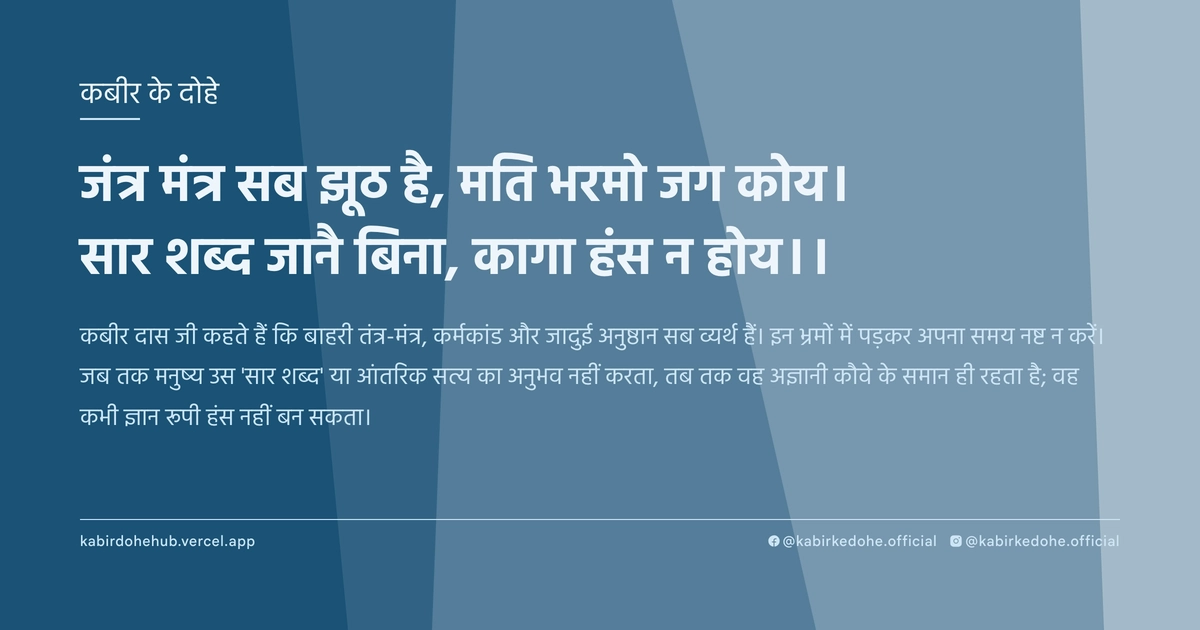
जंत्र मंत्र सब झूठ है, मति भरमो जग कोय।
सार शब्द जानै बिना, कागा हंस न होय।।
Jantra mantra sab jhooth hai, mati bharmo jag koy. Saar shabd jaanai bina, kaaga hans na hoye.
इस पृष्ठ पर इस कबीर दोहे का अर्थ (meaning), हिंदी व्याख्या और अंग्रेज़ी अनुवाद, दार्शनिक विश्लेषण और व्यावहारिक जीवन सीख दी गई है। यह दोहा धार्मिक पाखंड (Religious Hypocrisy) विषय से जुड़ा है — Kabir doha meaning and explanation in Hindi and English.
अर्थ (Meaning):
कबीर दास जी कहते हैं कि बाहरी तंत्र-मंत्र, कर्मकांड और जादुई अनुष्ठान सब व्यर्थ हैं। इन भ्रमों में पड़कर अपना समय नष्ट न करें। जब तक मनुष्य उस 'सार शब्द' या आंतरिक सत्य का अनुभव नहीं करता, तब तक वह अज्ञानी कौवे के समान ही रहता है; वह कभी ज्ञान रूपी हंस नहीं बन सकता।
Kabir asserts that all external rituals, occult practices, and mechanical incantations are illusions. He warns the world against being deceived by these superficialities. Without the realization of the 'Essential Word' or the inner Truth, a human remains as a crow—blinded by ignorance—and can never evolve into a swan of spiritual wisdom.
व्याख्या (Interpretation):
इस दोहे का शाब्दिक अर्थ है कि बाहरी आडंबरों से मुक्ति नहीं मिलती। रूपक के तौर पर, 'कागा' (कौवा) उस मन का प्रतीक है जो सांसारिक वासनाओं और अशुद्धियों में लिप्त है, जबकि 'हंस' उस शुद्ध चेतना का प्रतीक है जो विवेक और ज्ञान से परिपूर्ण है। कबीर यहाँ 'सार शब्द' की बात कर रहे हैं, जो किसी बाहरी ध्वनि नहीं बल्कि वह आंतरिक नाद है जो आत्मा को परमात्मा से जोड़ता है। यह निर्गुण भक्ति का मूल है, जहाँ ईश्वर किसी मूर्ति या मंत्र में नहीं, बल्कि स्वयं के भीतर स्थित है। माया हमें विश्वास दिलाती है कि बाहरी क्रियाओं से मोक्ष मिल सकता है, लेकिन यह एक भ्रम है। वास्तविक परिवर्तन केवल तब होता है जब अहंकार का विसर्जन होता है और साधक शून्य में लीन हो जाता है।
Literally, the verse dismisses the efficacy of external rituals. Metaphorically, the 'crow' represents the mind entangled in worldly desires and impurities, while the 'swan' symbolizes the purified consciousness endowed with discernment. Kabir refers to the 'Saar Shabd' (Essential Word), which is not a spoken mantra but the internal resonance connecting the Atman to Brahman. This is the core of Nirgun Bhakti, where the Divine is not found in idols or chants but within the self. Maya deceives the seeker into believing that mechanical rituals lead to liberation, creating a spiritual facade. True transformation occurs only when the ego is annihilated, allowing the seeker to transition from the darkness of ignorance to the light of non-dual awareness.
दार्शनिक विश्लेषण (Philosophical Analysis):
कबीर का यह दोहा उनके समय के सामाजिक और धार्मिक परिवेश पर एक तीखा प्रहार है। 15वीं शताब्दी में, समाज तंत्र-मंत्र, पाखंड और कर्मकांडों के जाल में फंसा था, जहाँ धर्म केवल बाहरी प्रदर्शन बन गया था। कबीर ने इस 'संस्थागत धर्म' को चुनौती दी और यह तर्क दिया कि मुक्ति किसी पुरोहित या जादुई सूत्र के अधीन नहीं है।
दार्शनिक रूप से, यह अद्वैत वेदांत के करीब है, जहाँ 'अविद्या' (अज्ञान) ही बंधन का कारण है। कबीर का 'सार शब्द' उसी आत्म-साक्षात्कार की प्रक्रिया है जिसे उपनिषदों में 'तत्वमसि' कहा गया है। वे बताते हैं कि जब तक हम बाहरी दुनिया में सत्य खोजते हैं, हम वास्तव में अपनी अज्ञानता को बढ़ा रहे होते हैं।
सूफीवाद के प्रभाव में, कबीर 'शब्द' या 'नाद' की महत्ता पर जोर देते हैं, जो ईश्वर की वह ध्वनि है जिससे सृष्टि का सृजन हुआ। उनके लिए, भक्ति का अर्थ है उस ध्वनि के साथ एकाकार होना, न कि किसी मंत्र का रट्टा मारना। यह एक मनोवैज्ञानिक रूपांतरण है जहाँ साधक बाहरी शोर को शांत कर आंतरिक मौन को सुनता है।
जाति और वर्ग के भेदभाव को नकारते हुए, कबीर यह संदेश देते हैं कि ज्ञान किसी विशेष कुल या विधि का विशेषाधिकार नहीं है। कोई भी व्यक्ति, चाहे वह किसी भी पृष्ठभूमि से हो, यदि वह आंतरिक सत्य को पहचान ले, तो वह 'हंस' बन सकता है। यह आध्यात्मिक लोकतंत्र की घोषणा है।
अंततः, यह दोहा हमें चेतावनी देता है कि हम 'आध्यात्मिक अहंकार' के शिकार न हों। अक्सर लोग मंत्रों के अभ्यास को ही अपनी उपलब्धि मान लेते हैं, जो वास्तव में एक सूक्ष्म अहंकार है। वास्तविक मुक्ति तब आती है जब 'करने वाला' (doer) समाप्त हो जाता है और केवल 'होना' (being) शेष रहता है।
This Doha is a sharp critique of the socio-religious landscape of the 15th century, where society was trapped in a web of occultism, hypocrisy, and mechanical rituals. Religion had become a performance of external gestures. Kabir challenged this 'institutionalized religion,' arguing that liberation is not contingent upon a priest or a magical formula.
Philosophically, this aligns with Advaita Vedanta, where 'Avidya' (ignorance) is the primary cause of bondage. Kabir's 'Saar Shabd' is the process of self-realization, echoing the Upanishadic realization of 'Tat Tvam Asi' (Thou Art That). He posits that searching for truth in the external world only reinforces the illusion of separation.
Influenced by Sufism, Kabir emphasizes the importance of the 'Word' or 'Naad'—the primordial sound of creation. For him, devotion is not the rote repetition of mantras but the synchronization of one's existence with this cosmic vibration. It is a psychological shift from listening to the external noise to hearing the internal silence.
By rejecting caste and class distinctions, Kabir asserts that spiritual knowledge is not the prerogative of a specific lineage or method. Anyone, regardless of their social standing, can evolve into a 'swan' if they realize the inner truth. This is a declaration of spiritual democracy.
Ultimately, the verse warns against the trap of 'spiritual ego.' Often, practitioners mistake the mastery of rituals for spiritual progress, which is merely a refined form of vanity. True liberation occurs when the 'doer' vanishes, and only 'being' remains, dissolving the boundary between the seeker and the sought.
मूल संदेश (Core Message):
- बाहरी आडंबर केवल मन का भ्रम हैं, सत्य भीतर है।
- मंत्रों का रट्टा मारना ज्ञान नहीं, अनुभव ही वास्तविक ज्ञान है।
- अहंकार का विसर्जन ही कौवे से हंस बनने की एकमात्र प्रक्रिया है।
- ईश्वर किसी विधि में नहीं, बल्कि शुद्ध चेतना में निवास करता है।
- प्रेम और करुणा ही वह 'सार शब्द' है जिसे खोजने की आवश्यकता है।
- External rituals are mere illusions; Truth resides within.
- Rote repetition is not wisdom; direct experience is the only truth.
- The dissolution of ego is the only path from crow to swan.
- The Divine dwells not in methods, but in pure consciousness.
- Love and compassion are the 'Essential Word' we must realize.
व्यावहारिक उदाहरण (Practical Example):
वाराणसी के एक पुराने मोहल्ले में माधव नाम का एक बुनकर रहता था। माधव बहुत धार्मिक था, लेकिन उसका धर्म केवल बाहरी था। वह हर साल महंगे अनुष्ठान करता, तांत्रिकों को दान देता और जटिल मंत्रों का जाप करता, यह सोचकर कि इससे उसके जीवन के दुख दूर हो जाएंगे और उसे मोक्ष मिलेगा।
उसका मन हमेशा अशांत रहता था। वह अपने परिवार से चिड़चिड़ा रहता और पड़ोसियों से ईर्ष्या करता। उसे लगता था कि उसके मंत्रों का असर इसलिए नहीं हो रहा क्योंकि वह सही विधि का पालन नहीं कर रहा है। वह और अधिक कठिन अनुष्ठानों की तलाश में भटकने लगा।
एक दिन उसकी मुलाकात एक फकीर से हुई, जिसने माधव के चेहरे पर छाई बेचैनी को देख लिया। फकीर ने उससे पूछा, 'तुम इन शब्दों को जीभ से दोहरा रहे हो, लेकिन क्या तुमने इन्हें अपने हृदय में सुना है?'
माधव हैरान था। उसने कहा, 'मैं तो सबसे शक्तिशाली मंत्रों का जाप करता हूँ!' फकीर मुस्कुराया और बोला, 'मंत्र केवल चाबियाँ हैं, लेकिन तुम दरवाजा खोलने के बजाय चाबियों को ही पूज रहे हो। असली शब्द वह है जो तुम्हें तुम्हारे भीतर के अहंकार से मुक्त करे।'
माधव को पहली बार यह अहसास हुआ कि वह धर्म को एक व्यापार की तरह देख रहा था—कुछ 'निवेश' करो और 'मोक्ष' प्राप्त करो। उसने महसूस किया कि उसकी बाहरी भक्ति वास्तव में उसके आंतरिक खालीपन को ढकने का एक तरीका थी।
अगले कुछ महीनों तक, माधव ने सभी बाहरी अनुष्ठान छोड़ दिए। उसने केवल मौन में बैठना शुरू किया। वह अपने करघे पर कपड़ा बुनते समय केवल अपनी सांसों और उस लय पर ध्यान देने लगा जो उसके भीतर गूँज रही थी।
धीरे-धीरे, उसकी चिड़चिड़ाहट कम होने लगी। उसने पाया कि जब वह शांत होता है, तो उसे दूसरों के प्रति करुणा महसूस होती है। वह अब मंदिर जाने के लिए नहीं, बल्कि स्वयं के भीतर के मंदिर में रहने के लिए जागृत होने लगा।
एक दिन, जब वह एक गरीब पड़ोसी की मदद कर रहा था, उसे अहसास हुआ कि वह अब उस 'कौवे' की तरह नहीं है जो केवल अपने लिए दाना खोजता है। वह एक 'हंस' बन चुका था, जो अब दूसरों के दुख को भी अपना समझता था।
उसका जीवन बदल गया था। अब उसे किसी तांत्रिक की जरूरत नहीं थी, क्योंकि उसने 'सार शब्द' को पहचान लिया था—वह शब्द जो प्रेम, करुणा और आत्म-जागरूकता में निहित था।
माधव की यह यात्रा दिखाती है कि कैसे बाहरी कर्मकांड केवल एक पर्दा होते हैं, और वास्तविक रूपांतरण केवल तब होता है जब हम उस पर्दे को हटाकर अपने वास्तविक स्वरूप का सामना करते हैं।
In an old neighborhood of Varanasi lived a weaver named Madhav. Madhav was deeply religious, but his faith was purely external. Every year, he performed expensive rituals, donated to tantriks, and chanted complex mantras, believing these would erase his suffering and guarantee salvation.
Despite this, his mind remained turbulent. He was irritable with his family and envious of his neighbors. He believed the mantras weren't working because he wasn't following the 'correct' method, leading him to seek even more rigorous and esoteric rituals.
One day, he encountered a wandering Sufi mystic who noticed the restlessness on Madhav's face. The mystic asked, 'You repeat these words with your tongue, but have you heard them in your heart?'
Madhav was puzzled. 'I chant the most powerful mantras!' he replied. The mystic smiled and said, 'Mantras are merely keys, but you are worshipping the keys instead of opening the door. The real Word is that which liberates you from your own ego.'
For the first time, Madhav realized he was treating religion as a transaction—investing rituals to receive salvation. He saw that his external piety was merely a mask for his internal void.
Over the next few months, Madhav abandoned all external rituals. He began to practice silence. While weaving on his loom, he focused solely on his breath and the rhythmic vibration echoing within him.
Slowly, his irritability faded. He discovered that in silence, he felt a profound compassion for others. He stopped seeking the temple outside and began inhabiting the temple within.
One day, while helping a destitute neighbor, he realized he was no longer like the 'crow' searching only for its own grain. He had become the 'swan,' perceiving the suffering of others as his own.
His life had transformed. He no longer needed a tantrik because he had recognized the 'Saar Shabd'—the Essential Word embedded in love, compassion, and self-awareness.
Madhav's journey illustrates how external rituals are often mere veils, and true transformation occurs only when we tear those veils to face our authentic self.
अभ्यास मार्गदर्शन (Practice Guidance):
- प्रतिदिन 20 मिनट 'मौन चिंतन' करें। किसी मंत्र का जाप करने के बजाय, केवल अपने भीतर उठने वाले विचारों को बिना किसी निर्णय के देखें।
- स्व-पूछताछ जर्नल: प्रतिदिन लिखें—'आज मैंने किस बात पर अहंकार किया?' और 'क्या मेरी धार्मिकता दूसरों को नीचा दिखाने का साधन बनी?'
- व्यवहार परिवर्तन: किसी भी बाहरी अनुष्ठान को करने से पहले स्वयं से पूछें, 'क्या मैं यह डर से कर रहा हूँ या प्रेम से?'
- निदान चेकलिस्ट: यदि आप अभी भी दूसरों की आध्यात्मिक स्थिति पर टिप्पणी कर रहे हैं या कर्मकांडों के बिना असुरक्षित महसूस करते हैं, तो आप अभी भी 'कागा' (अज्ञान) की अवस्था में हैं।
- Practice 20 minutes of 'Silent Contemplation' daily. Instead of chanting a mantra, simply observe the thoughts arising within you without judgment.
- Self-Inquiry Journaling: Daily record—'Where did my ego manifest today?' and 'Did my spirituality become a tool to feel superior to others?'
- Behavioral Shift: Before performing any external ritual, ask yourself, 'Am I doing this out of fear or out of love?'
- Diagnostic Checklist: If you still find yourself judging others' spiritual paths or feeling insecure without ritualistic anchors, you are still in the state of the 'crow' (ignorance).
चिंतन प्रश्न (Reflection Questions):
- क्या मेरी आध्यात्मिक पहचान मेरे वास्तविक चरित्र से बड़ी हो गई है?
- मैं किन बाहरी प्रतीकों (माला, तिलक, वस्त्र) के पीछे अपनी आंतरिक रिक्तता को छुपा रहा हूँ?
- यदि मुझसे मेरे सभी धार्मिक विश्वास छीन लिए जाएँ, तो क्या मेरे भीतर कोई शांति शेष रहेगी?
- क्या मैं वास्तव में सत्य की खोज कर रहा हूँ, या केवल अपनी मान्यताओं की पुष्टि चाहता हूँ?
- मेरे जीवन का वह कौन सा 'मंत्र' है जो मुझे वास्तव में बदलता है, न कि केवल सांत्वना देता है?
- Has my spiritual identity become larger than my actual character?
- Which external symbols (beads, marks, attire) am I using to mask my internal void?
- If all my religious beliefs were stripped away, would any peace remain within me?
- Am I truly seeking the Truth, or am I merely seeking confirmation of my existing beliefs?
- What is the 'mantra' in my life that actually transforms me, rather than just comforting me?