
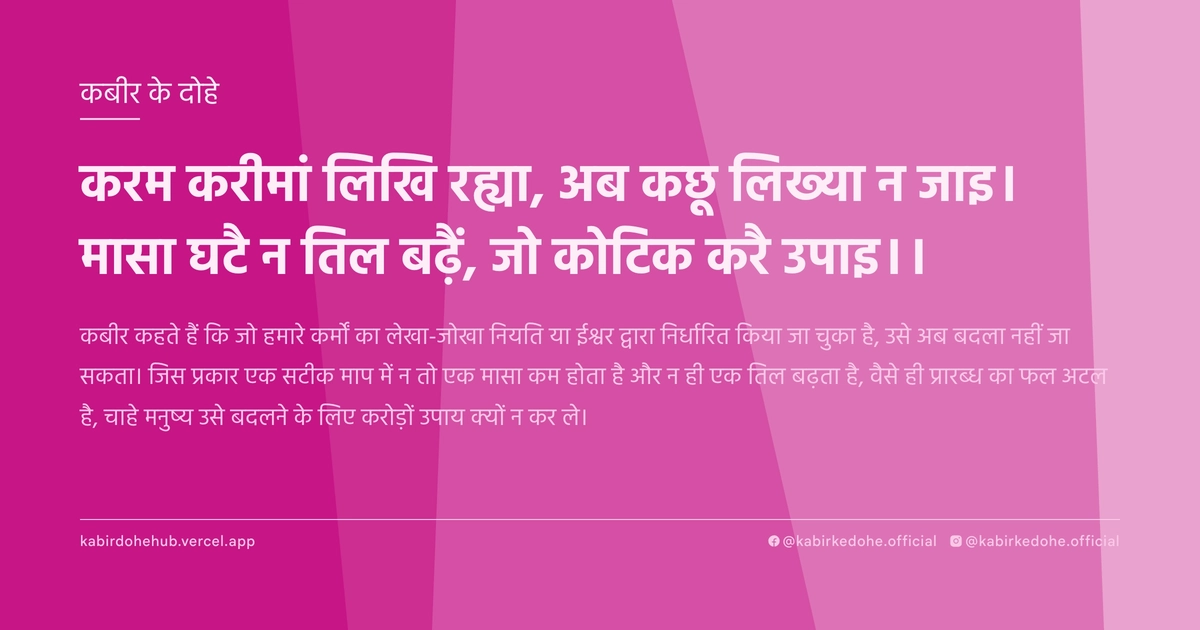
करम करीमां लिखि रह्या, अब कछू लिख्या न जाइ।
मासा घटै न तिल बढ़ैं, जो कोटिक करै उपाइ।।
Karam karima likhi rahya, ab kachhu likhya na jaai. Maasa ghatai na til badhain, jo kotik karai upai.
इस पृष्ठ पर इस कबीर दोहे का अर्थ (meaning), हिंदी व्याख्या और अंग्रेज़ी अनुवाद, दार्शनिक विश्लेषण और व्यावहारिक जीवन सीख दी गई है। यह दोहा कर्म (Karma) विषय से जुड़ा है — Kabir doha meaning and explanation in Hindi and English.
अर्थ (Meaning):
कबीर कहते हैं कि जो हमारे कर्मों का लेखा-जोखा नियति या ईश्वर द्वारा निर्धारित किया जा चुका है, उसे अब बदला नहीं जा सकता। जिस प्रकार एक सटीक माप में न तो एक मासा कम होता है और न ही एक तिल बढ़ता है, वैसे ही प्रारब्ध का फल अटल है, चाहे मनुष्य उसे बदलने के लिए करोड़ों उपाय क्यों न कर ले।
Kabir asserts that the ledger of our actions and the resulting destiny have been inscribed by the Divine and cannot be altered now. Just as a precise measurement neither decreases by a 'masa' nor increases by a 'til' (tiny seed), the fruits of one's destiny remain absolute, regardless of the millions of efforts one makes to circumvent them.
व्याख्या (Interpretation):
यह दोहा प्रारब्ध और कर्म के सिद्धांत की व्याख्या करता है। शाब्दिक अर्थ में यह नियतिवाद जैसा प्रतीत होता है, परंतु गहरा अर्थ यह है कि हम अपने वर्तमान के परिणामों को नहीं बदल सकते, जो पिछले कर्मों का संचय हैं। यहाँ 'मासा' और 'तिल' सूक्ष्मता और सटीकता के प्रतीक हैं, जो यह दर्शाते हैं कि ब्रह्मांडीय न्याय में कोई त्रुटि नहीं होती। यह निर्गुण भक्ति के उस पहलू को छूता है जहाँ साधक को अपनी स्थिति को स्वीकार कर अहंकार का त्याग करना होता है। माया हमें यह भ्रम देती है कि हम बाहरी उपायों से भाग्य बदल सकते हैं, जबकि वास्तविक परिवर्तन आंतरिक समर्पण से आता है। यह आत्मा और ब्रह्म के बीच के उस संतुलन को दर्शाता है जहाँ इच्छा का अंत ही शांति की शुरुआत है।
This couplet explores the profound interplay between destiny (Prarabdha) and action (Karma). While it appears fatalistic on the surface, the deeper metaphorical layer suggests that the consequences of past actions are immutable in the present moment. The 'masa' and 'til' serve as symbols of cosmic precision, indicating that the law of cause and effect is devoid of error. It aligns with Nirgun Bhakti by urging the seeker to surrender the ego's struggle against the inevitable. Maya creates the illusion that external manipulations can alter one's spiritual trajectory, whereas true liberation comes from accepting the present state. It highlights the paradox of the human condition: the struggle to control a destiny that is already woven into the fabric of the Atman-Brahman non-duality.
दार्शनिक विश्लेषण (Philosophical Analysis):
कबीर का यह दृष्टिकोण उनके युग के सामाजिक और धार्मिक संघर्षों की उपज है, जहाँ कर्मकांडों के माध्यम से भाग्य बदलने का दावा किया जाता था। उन्होंने पुरोहितवाद और अंधविश्वास का खंडन करते हुए यह स्पष्ट किया कि कोई भी बाहरी अनुष्ठान या दान प्रारब्ध के लिखे को नहीं मिटा सकता। यह विचार अद्वैत वेदांत के उस सिद्धांत से मेल खाता है जहाँ संसार को एक स्वप्न और कर्मों को एक चक्र माना गया है, जिससे केवल ज्ञान और वैराग्य द्वारा मुक्ति संभव है।
सूफीवाद के संदर्भ में, यह 'तवक्कुल' या ईश्वर की इच्छा (रज़ा) के प्रति पूर्ण समर्पण है। जब मनुष्य यह स्वीकार कर लेता है कि जो घटित हो रहा है वह दैवीय विधान है, तब उसका मानसिक संघर्ष समाप्त हो जाता है। यह अहंकार का विलोपन है, क्योंकि 'उपाय' करने की इच्छा वास्तव में 'मैं' (अहंकार) की शक्ति का प्रदर्शन है।
यहाँ कबीर यह नहीं कह रहे कि प्रयास करना छोड़ दें, बल्कि वे 'फल' के प्रति आसक्ति को समाप्त करने की बात कर रहे हैं। मनोवैज्ञानिक स्तर पर, यह स्वीकारोक्ति अवसाद और चिंता को कम करती है, क्योंकि व्यक्ति बाहरी परिणामों के बजाय अपनी आंतरिक स्थिति पर ध्यान केंद्रित करता है।
यह दोहा कर्म और भाग्य के बीच के द्वंद्व को सुलझाता है। यदि परिणाम अटल हैं, तो प्रयास का मूल्य क्या है? प्रयास का मूल्य परिणाम में नहीं, बल्कि प्रयास की प्रक्रिया में है, जो आत्मा को शुद्ध करती है।
अंततः, यह संदेश देता है कि वास्तविक स्वतंत्रता बाहरी परिस्थितियों को बदलने में नहीं, बल्कि उन परिस्थितियों के प्रति अपनी प्रतिक्रिया को बदलने में है। जब हम 'लिखे हुए' को स्वीकार करते हैं, तब हम उस लेखक (परमात्मा) के साथ एकाकार हो जाते हैं।
Kabir's perspective is a direct response to the ritualistic climate of his era, where priests claimed that specific ceremonies or donations could alter one's destiny. By asserting the immutability of the divine ledger, he dismantles the commercialization of spirituality and rejects the notion that the Divine can be bribed through rituals. This resonates with Advaita Vedanta, where the world is seen as a manifestation of Maya, and liberation is achieved not by altering external fate, but by realizing the unchanging nature of the Self.
In the context of Sufism, this reflects the concept of 'Tawakkul' or absolute trust in the Divine Will (Raza). When a seeker accepts that the unfolding of life is a divine decree, the internal friction caused by resistance vanishes. This is the annihilation of the ego (Fana), as the desire to 'find a way out' is often a manifestation of the ego's belief in its own agency over the cosmic order.
Crucially, Kabir is not advocating for lethargy or inaction, but for the cessation of attachment to the fruits of action. Psychologically, this acceptance acts as a catalyst for mental peace, shifting the focus from the anxiety of outcomes to the purity of the present moment.
The philosophical tension between free will and predestination is resolved here by suggesting that while the 'result' is fixed, the 'attitude' toward that result is the only area of true freedom. The effort itself becomes a spiritual discipline (Sadhana) rather than a means to an end.
Ultimately, the teaching suggests that true liberation is found not in changing the script of one's life, but in becoming the silent witness to the play. By accepting the 'written' word, the individual transcends the duality of success and failure, merging with the universal consciousness.
मूल संदेश (Core Message):
- बाहरी उपायों से प्रारब्ध नहीं बदलता।
- स्वीकृति ही मानसिक शांति का एकमात्र द्वार है।
- अहंकार का अंत ही दैवीय इच्छा का मिलन है।
- परिणामों के प्रति अनासक्ति ही वास्तविक स्वतंत्रता है।
- आंतरिक रूपांतरण बाहरी बदलाव से अधिक शक्तिशाली है।
- External rituals cannot alter the cosmic ledger.
- Acceptance is the only gateway to mental peace.
- The end of ego is the union with Divine Will.
- Non-attachment to results is true liberation.
- Internal transformation outweighs external change.
व्यावहारिक उदाहरण (Practical Example):
वाराणसी के घाटों पर रहने वाली एक वृद्ध विधवा, जानकी, का जीवन अत्यंत कठिन था। उनके पास न रहने को पक्का घर था और न ही कोई सहारा। उन्होंने अपना पूरा जीवन दूसरों की सेवा और मंदिर की सफाई में बिता दिया, लेकिन उनके जीवन में दुखों की कमी नहीं थी। वे अक्सर सोचती थीं कि उन्होंने इतने पुण्य कार्य किए, फिर भी उनके जीवन में इतनी कड़वाहट क्यों है? वे कई तांत्रिकों और पंडितों के पास गईं, जिन्होंने उनसे महंगे अनुष्ठान कराए ताकि उनका 'भाग्य' बदल सके।
एक दिन उन्होंने कबीर के इस दोहे को सुना। पहले तो उन्हें लगा कि यह निराशाजनक है, लेकिन धीरे-धीरे उन्हें समझ आया कि वे अपने दुखों को 'मिटाने' की कोशिश में और अधिक दुखी हो रही थीं। उन्होंने महसूस किया कि उनका संघर्ष वास्तव में उनके भाग्य से नहीं, बल्कि इस विचार से था कि 'मेरे साथ ऐसा नहीं होना चाहिए था'।
जानकी ने उन सभी महंगे उपायों को छोड़ दिया। उन्होंने यह स्वीकार कर लिया कि उनके जीवन की वर्तमान परिस्थितियाँ उनके पिछले कर्मों का परिणाम हैं और उन्हें बदला नहीं जा सकता। इस स्वीकारोक्ति ने एक चमत्कार किया। जिस क्षण उन्होंने लड़ना बंद किया, उनका मन शांत हो गया।
अब जब वे किसी भूखे को भोजन करातीं, तो वे इस उम्मीद में नहीं करती थीं कि इससे उनका भाग्य बदलेगा, बल्कि इसलिए करती थीं क्योंकि सेवा करना उनके स्वभाव में था। उनकी आंतरिक शांति उनके चेहरे पर झलकने लगी।
आस-पास के लोग, जो पहले उन्हें एक असहाय विधवा के रूप में देखते थे, अब उनकी शांति और गरिमा की ओर आकर्षित होने लगे। उन्हें अचानक छोटे-छोटे सहारे मिलने लगे, लेकिन अब वे उन सहारों के लिए लालायित नहीं थीं।
एक दिन एक धनी व्यापारी ने उनकी शांति देख उनसे पूछा, "आप इतने अभावों में भी इतनी प्रसन्न कैसे हैं?"
जानकी ने मुस्कुराकर कहा, "मैंने भाग्य को बदलना छोड़ दिया है, इसलिए अब मैं भाग्य के साथ जीना सीख गई हूँ।"
यह 'कबीर ट्विस्ट' था—परिस्थितियाँ नहीं बदलीं, लेकिन परिस्थितियों को देखने वाली दृष्टि बदल गई। जानकी का जीवन अब अभावों के बावजूद पूर्ण था क्योंकि उन्होंने अपनी इच्छा को दैवीय इच्छा में विलीन कर दिया था।
Janaki, an elderly widow living on the ghats of Varanasi, led a life of immense hardship. With no permanent shelter or family support, she spent her years serving others and cleaning temples, yet sorrow remained her constant companion. She often wondered why, despite her virtuous deeds, her life was filled with such bitterness. She visited numerous tantriks and priests, spending her meager savings on expensive rituals promised to 'rewrite' her fate.
One day, she encountered Kabir's couplet. Initially, it seemed bleak, but gradually she realized that her struggle was not with her fate, but with the stubborn belief that 'this should not be happening to me.' She was suffering more from the resistance to her pain than from the pain itself.
Janaki stopped seeking external remedies. She accepted that her current circumstances were the fruition of past karmas and were, for now, immutable. This acceptance triggered a profound internal shift. The moment she stopped fighting the inevitable, her mind fell into a deep silence.
When she fed the hungry now, it wasn't a transaction to improve her luck, but a spontaneous expression of her nature. A serene glow began to emanate from her, replacing the look of desperation.
People who once saw her as a pitiful figure began to admire her dignity and poise. Small helps and kindnesses started flowing her way, but she no longer craved them as a means of escape.
One day, a wealthy merchant, struck by her peace, asked, "How do you remain so content amidst such deprivation?"
Janaki smiled and replied, "I stopped trying to change my fate, and in doing so, I learned how to live with it."
This was the 'Kabir Twist'—the external circumstances remained unchanged, but the internal lens shifted. Janaki's life became full despite the lack of material possessions because she had dissolved her personal will into the Divine Will.
अभ्यास मार्गदर्शन (Practice Guidance):
- प्रतिदिन 20 मिनट मौन रहकर वर्तमान स्थिति का अवलोकन करें, बिना किसी निर्णय या शिकायत के।
- एक 'स्वीकृति जर्नल' बनाएँ जहाँ आप उन घटनाओं को लिखें जिन्हें आप बदलना चाहते थे, और फिर लिखें कि उन्हें स्वीकार करने से आपका मानसिक बोझ कैसे कम होगा।
- जब भी जीवन में कोई अप्रत्याशित बाधा आए, तो स्वयं से पूछें: "क्या मैं इस परिणाम से लड़ रहा हूँ या इसे स्वीकार कर समाधान खोज रहा हूँ?"
- डायग्नोस्टिक चेकलिस्ट: यदि आप बार-बार 'मेरे साथ ही ऐसा क्यों हुआ' सोचते हैं, तो आप अभी भी माया के प्रभाव में हैं। यदि आप 'जो हुआ वह आवश्यक था' महसूस करते हैं, तो आप इस ज्ञान को जी रहे हैं।
- Practice 20 minutes of daily silence, observing your current life situation without judgment or complaint.
- Maintain an 'Acceptance Journal' where you list events you desperately wanted to change, then analyze how accepting them reduces your mental burden.
- Whenever an unexpected obstacle arises, ask yourself: "Am I fighting the result, or am I accepting it to find a peaceful way forward?"
- Diagnostic Checklist: If you frequently think 'Why me?', you are still under the influence of Maya. If you feel 'This was necessary,' you are embodying this wisdom.
चिंतन प्रश्न (Reflection Questions):
- आपकी कौन सी ऐसी इच्छा है जिसे आप 'भाग्य' मानकर भी छोड़ नहीं पा रहे हैं?
- क्या आपकी 'उपाय' करने की कोशिशें वास्तव में समाधान के लिए हैं या केवल नियंत्रण पाने की इच्छा के लिए?
- यदि आपका पूरा जीवन एक पूर्व-निर्धारित नाटक है, तो आप एक अभिनेता के रूप में अपनी भूमिका का आनंद कैसे लेंगे?
- आपकी सार्वजनिक छवि (Digital Ego) और आपकी आंतरिक रिक्तता के बीच क्या संबंध है?
- क्या आप वास्तव में ईश्वर की इच्छा को स्वीकार करते हैं, या केवल तब करते हैं जब वह आपके अनुकूल होती है?
- Which desire are you clinging to, even while claiming to accept your fate?
- Are your efforts to 'fix' things truly for a solution, or just a desire for control?
- If your entire life is a pre-written play, how would you enjoy your role as an actor?
- What is the connection between your public persona (Digital Ego) and your internal void?
- Do you truly accept the Divine Will, or only when it aligns with your preferences?