
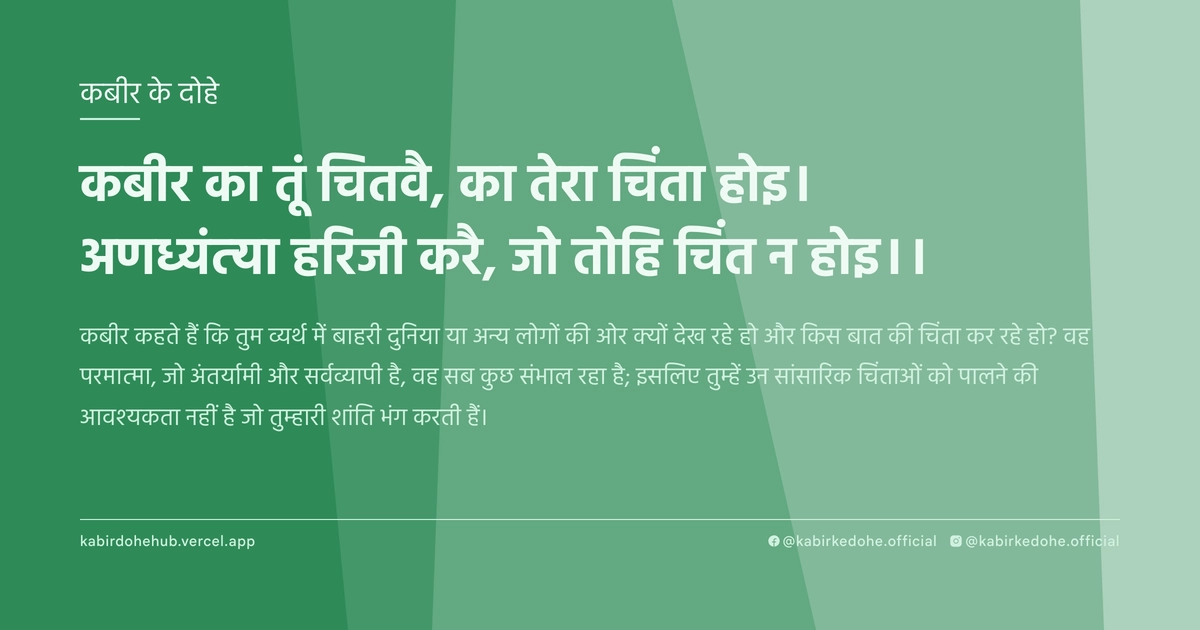
कबीर का तूं चितवै, का तेरा चिंता होइ।
अणध्यंत्या हरिजी करै, जो तोहि चिंत न होइ।।
Kabir ka tun chitvai, ka tera chinta hoi. Anadhyantya hariji karai, jo tohi chint na hoi.
इस पृष्ठ पर इस कबीर दोहे का अर्थ (meaning), हिंदी व्याख्या और अंग्रेज़ी अनुवाद, दार्शनिक विश्लेषण और व्यावहारिक जीवन सीख दी गई है। यह दोहा भक्ति (Bhakti) विषय से जुड़ा है — Kabir doha meaning and explanation in Hindi and English.
अर्थ (Meaning):
कबीर कहते हैं कि तुम व्यर्थ में बाहरी दुनिया या अन्य लोगों की ओर क्यों देख रहे हो और किस बात की चिंता कर रहे हो? वह परमात्मा, जो अंतर्यामी और सर्वव्यापी है, वह सब कुछ संभाल रहा है; इसलिए तुम्हें उन सांसारिक चिंताओं को पालने की आवश्यकता नहीं है जो तुम्हारी शांति भंग करती हैं।
Kabir asks why you gaze outward at the world and harbor anxieties. He reminds us that the Divine, who is the inner-knower and omnipresent, manages all existence; therefore, there is no need to cling to worldly worries that disrupt your inner peace.
व्याख्या (Interpretation):
इस दोहे का शाब्दिक अर्थ है कि मनुष्य अक्सर बाहरी परिस्थितियों और दूसरों के निर्णयों में उलझा रहता है। रूपकात्मक रूप से, 'चितवै' (देखना) अहंकार की उस प्रवृत्ति को दर्शाता है जहाँ हम सत्य को बाहर खोजते हैं। यह निर्गुण भक्ति का सार है, जहाँ ईश्वर किसी मूर्ति में नहीं बल्कि चेतना के भीतर है। माया हमें यह विश्वास दिलाती है कि हम अकेले अपने भाग्य के निर्माता हैं, जिससे चिंता जन्म लेती है। वास्तव में, जब आत्मा (Atman) यह जान लेती है कि वह ब्रह्म (Brahman) का ही अंश है, तो द्वैत समाप्त हो जाता है। यह विरोधाभास है कि हम उस शक्ति की चिंता करते हैं जिसने हमें बनाया है। अंततः, यह समर्पण (Surrender) की स्थिति है जहाँ व्यक्ति अपनी सीमित बुद्धि को अनंत चेतना को सौंप देता है।
Literally, the verse questions why humans remain entangled in external circumstances and others' judgments. Metaphorically, 'chitvai' (gazing) represents the ego's tendency to seek truth externally. This is the essence of Nirgun Bhakti, where the Divine is not an idol but the consciousness within. Maya creates the illusion that we are sole architects of our fate, breeding anxiety. In reality, when the Atman realizes its non-duality with Brahman, the sense of separation vanishes. It is a profound paradox that we worry about the very Power that sustains us. Ultimately, this describes a state of total surrender, where the limited intellect is offered to the infinite consciousness.
दार्शनिक विश्लेषण (Philosophical Analysis):
कबीर का यह दृष्टिकोण उनके समय के कट्टरपंथी कर्मकांडों और बाहरी आडंबरों के विरुद्ध एक सशक्त प्रहार था। उन्होंने देखा कि लोग तीर्थयात्राओं और बाहरी अनुष्ठानों में समय व्यर्थ करते हैं, जबकि सत्य उनके भीतर छिपा था। यह दर्शन अद्वैत वेदांत के करीब है, जो मानता है कि केवल ब्रह्म सत्य है और जगत मिथ्या है। जब हम चिंता करते हैं, तो हम स्वयं को ईश्वर से अलग मानते हैं, जो कि अज्ञानता की पराकाष्ठा है।
सूफीवाद के 'फना' (अहंकार का विनाश) के सिद्धांत की तरह, कबीर यहाँ 'मैं' और 'मेरा' के विसर्जन की बात कर रहे हैं। चिंता केवल वहीं होती है जहाँ 'कर्ता' (Doer) का भाव होता है। यदि मनुष्य यह अनुभव कर ले कि वह केवल एक माध्यम है और वास्तविक कर्ता परमात्मा है, तो तनाव स्वतः समाप्त हो जाता है।
ऐतिहासिक रूप से, कबीर ने जाति और धर्म की दीवारों को तोड़कर एक ऐसी आध्यात्मिकता पेश की जो अनुभवजन्य थी, न कि शास्त्रोक्त। उन्होंने सिखाया कि ईश्वर किसी विशेष मंदिर या मस्जिद में नहीं, बल्कि उस शून्य में है जहाँ विचार शांत हो जाते हैं।
मनोवैज्ञानिक स्तर पर, यह दोहा 'संज्ञानात्मक पुनर्गठन' की बात करता है। यह हमें बाहरी उत्तेजनाओं (External Stimuli) से हटाकर आंतरिक स्थिरता (Internal Stability) की ओर ले जाता है। चिंता वास्तव में भविष्य के प्रति एक गलत धारणा है, जबकि परमात्मा 'वर्तमान क्षण' में स्थित है।
अतः, यह संदेश केवल धार्मिक नहीं, बल्कि अस्तित्ववादी है। यह मनुष्य को उसकी सीमित पहचान से मुक्त कर उसे ब्रह्मांडीय चेतना से जोड़ने का प्रयास है, जिससे वह भय और चिंता से ऊपर उठकर आनंद की स्थिति प्राप्त कर सके।
Kabir's perspective is a powerful critique of the rigid rituals and external pomposity of his era. He observed people wasting lifetimes on pilgrimages and rites while the Truth remained hidden within. This philosophy aligns closely with Advaita Vedanta, which posits that only Brahman is real and the perceived world is Maya (illusion). Anxiety arises precisely when we perceive ourselves as separate from the Divine, which is the peak of ignorance.
Similar to the Sufi concept of 'Fana' (annihilation of the ego), Kabir advocates for the dissolution of 'I' and 'Mine'. Worry exists only where there is a sense of being the 'Doer'. If one realizes they are merely an instrument and the Divine is the actual actor, stress evaporates naturally.
Historically, Kabir dismantled the walls of caste and creed to present a spirituality based on direct experience rather than scriptural dogma. He taught that God resides not in specific temples or mosques, but in the 'Sunya' (void) where thoughts fall silent.
Psychologically, this verse suggests a 'cognitive restructuring'. It shifts the focus from external stimuli to internal stability. Anxiety is essentially a distorted perception of the future, whereas the Divine exists only in the 'Present Moment'.
Thus, this message is not merely religious but existential. It attempts to liberate the human from a limited identity and connect them to cosmic consciousness, allowing them to rise above fear and reach a state of perennial bliss.
मूल संदेश (Core Message):
- बाहरी खोज व्यर्थ है; सत्य भीतर स्थित है।
- चिंता अहंकार का लक्षण है, विश्वास आत्मा का।
- परमात्मा केवल रचयिता नहीं, बल्कि निरंतर संचालक है।
- कर्ता भाव का त्याग ही मानसिक शांति का एकमात्र मार्ग है।
- जब 'मैं' मिटता है, तब केवल 'वह' शेष रहता है।
- External searching is futile; Truth resides within.
- Anxiety is a symptom of ego; trust is a trait of the soul.
- The Divine is not just the Creator, but the constant Operator.
- Relinquishing the 'Doer' complex is the only path to peace.
- When the 'I' vanishes, only the 'Infinite' remains.
व्यावहारिक उदाहरण (Practical Example):
वाराणसी के एक पुराने घाट पर माधव नाम का एक वृद्ध बुनकर रहता था। वह अपनी कला में निपुण था, लेकिन उसका मन हमेशा इस चिंता में रहता था कि यदि उसके हाथ कांपने लगे या बाजार में उसकी साड़ियों की मांग कम हो गई, तो वह और उसका परिवार भूखे मर जाएंगे। वह रात भर जागकर भविष्य की गणना करता और अपनी नींद खो देता।
एक दिन उसकी मुलाकात एक घुमक्कड़ संत से हुई, जिसने माधव की बेचैनी को भांप लिया। संत ने उसे एक खाली बर्तन दिखाया और कहा, "माधव, इस बर्तन में क्या है?" माधव ने कहा, "कुछ नहीं, यह खाली है।"
संत मुस्कुराए और बोले, "ठीक वैसे ही तुम्हारा जीवन है। तुम इसे अपनी चिंताओं से भरने की कोशिश कर रहे हो, जबकि यह पहले से ही उस परमात्मा की कृपा से भरा हुआ है जिसने तुम्हें यह हुनर दिया। तुम बुनते हो, लेकिन धागा कौन देता है? तुम बेचते हो, लेकिन ग्राहक कौन भेजता है?"
माधव को पहली बार महसूस हुआ कि वह 'कर्ता' बनने की कोशिश में खुद को जला रहा था। उसने महसूस किया कि उसकी चिंता वास्तव में उसके अहंकार का एक रूप थी, जो यह मानता था कि सब कुछ उसके नियंत्रण में होना चाहिए।
अगले कुछ हफ्तों तक, माधव ने एक प्रयोग किया। जब भी चिंता का विचार आता, वह अपनी आंखें बंद करता और कहता, "मैं केवल एक माध्यम हूँ, चलाने वाला वह है।"
धीरे-धीरे उसका तनाव कम होने लगा। उसकी नींद वापस आई और आश्चर्यजनक रूप से, जब उसका मन शांत हुआ, तो उसकी बुनाई में और अधिक सूक्ष्मता और सुंदरता आने लगी।
उसके ग्राहकों ने महसूस किया कि उसकी साड़ियों में अब एक अलग तरह की शांति और दिव्यता है। उसकी आय बढ़ने लगी, लेकिन अब वह आय के लिए नहीं, बल्कि सृजन के आनंद के लिए काम करता था।
माधव ने जान लिया कि जब हम 'चिंता' को 'विश्वास' में बदलते हैं, तो जीवन एक बोझ नहीं बल्कि एक उत्सव बन जाता है। उसने अपनी पूरी उम्र की घबराहट को एक मुस्कान में बदल दिया।
On an ancient ghat in Varanasi lived an elderly weaver named Madhav. He was masterly in his craft, yet his mind was perpetually plagued by the fear that if his hands began to shake or the demand for his sarees dropped, he and his family would starve. He spent sleepless nights calculating future disasters.
One day, he met a wandering saint who sensed Madhav's restlessness. The saint showed him an empty vessel and asked, "Madhav, what is in this pot?" Madhav replied, "Nothing, it is empty."
The saint smiled and said, "Your life is exactly like this. You are trying to fill it with worries, while it is already overflowing with the grace of the Divine who gave you this skill. You weave, but who provides the thread? You sell, but who sends the customer?"
For the first time, Madhav realized he was burning himself out by trying to be the sole 'Doer'. He understood that his anxiety was actually a form of ego, believing that everything must be under his absolute control.
Over the next few weeks, Madhav experimented. Whenever a worrying thought surfaced, he would close his eyes and whisper, "I am merely an instrument; He is the Driver."
Gradually, his tension dissipated. His sleep returned, and surprisingly, as his mind grew still, his weaving became even more intricate and beautiful.
His customers noticed a new sense of peace and divinity in his sarees. His income grew, but he no longer worked for the money; he worked for the joy of creation.
Madhav learned that when we transform 'worry' into 'trust', life ceases to be a burden and becomes a celebration. He turned a lifetime of dread into a permanent smile.
अभ्यास मार्गदर्शन (Practice Guidance):
- प्रतिदिन 20 मिनट 'साक्षी भाव' का अभ्यास करें: अपने विचारों को बिना किसी निर्णय के केवल देखें, जैसे आप किसी और की चिंता देख रहे हों।
- आत्म-पूछताछ जर्नल: हर रात लिखें कि आज किस बात की चिंता हुई और फिर पूछें, "क्या यह चिंता वास्तव में मेरी है, या यह मेरे अहंकार की नियंत्रण पाने की इच्छा है?"
- समर्पण क्रिया: दिन में तीन बार गहरी सांस लें और मानसिक रूप से कहें, "मैं परिणाम का मोह छोड़ता हूँ और इसे उस अंतर्यामी को सौंपता हूँ।"
- निदान चेकलिस्ट: यदि आप चिड़चिड़े हैं, नींद की कमी है, या भविष्य के बारे में बार-बार सोचते हैं, तो इसका अर्थ है कि आप 'कर्ता' भाव में फंसे हैं और परमात्मा के प्रवाह से कटे हुए हैं।
- Practice 'Witness Consciousness' for 20 minutes daily: Observe your thoughts without judgment, as if you are watching someone else's anxiety.
- Self-Inquiry Journaling: Every night, record what caused you worry and ask, "Is this worry truly mine, or is it my ego's desire for absolute control?"
- Act of Surrender: Three times a day, take a deep breath and mentally affirm, "I release the attachment to the outcome and surrender it to the Inner Knower."
- Diagnostic Checklist: If you feel irritable, suffer from insomnia, or obsess over future scenarios, you are trapped in the 'Doer' complex and disconnected from the Divine flow.
चिंतन प्रश्न (Reflection Questions):
- मेरी कौन सी चिंताएं वास्तव में मेरी सुरक्षा के लिए हैं और कौन सी केवल मेरी सामाजिक छवि (Digital/Social Ego) को बचाने के लिए?
- यदि मैं आज यह मान लूँ कि मेरा जीवन पूरी तरह से किसी और के नियंत्रण में है, तो मुझे डर लगेगा या शांति मिलेगी?
- मैं किन चीजों को नियंत्रित करने की कोशिश कर रहा हूँ जो वास्तव में मेरे नियंत्रण से बाहर हैं?
- क्या मेरी भक्ति केवल संकट के समय याद आने वाली प्रार्थना है, या यह एक निरंतर समर्पण है?
- मेरे भीतर का वह कौन सा हिस्सा है जो अभी भी यह मानता है कि वह 'अकेला' संघर्ष कर रहा है?
- Which of my worries are truly for my survival, and which are merely to protect my social image or digital ego?
- If I accepted today that my life is entirely in someone else's control, would I feel terror or liberation?
- What specific aspects of my life am I trying to control that are fundamentally beyond my reach?
- Is my devotion merely a prayer recalled during crises, or is it a state of continuous surrender?
- Which part of me still clings to the belief that I am struggling in this universe alone?