
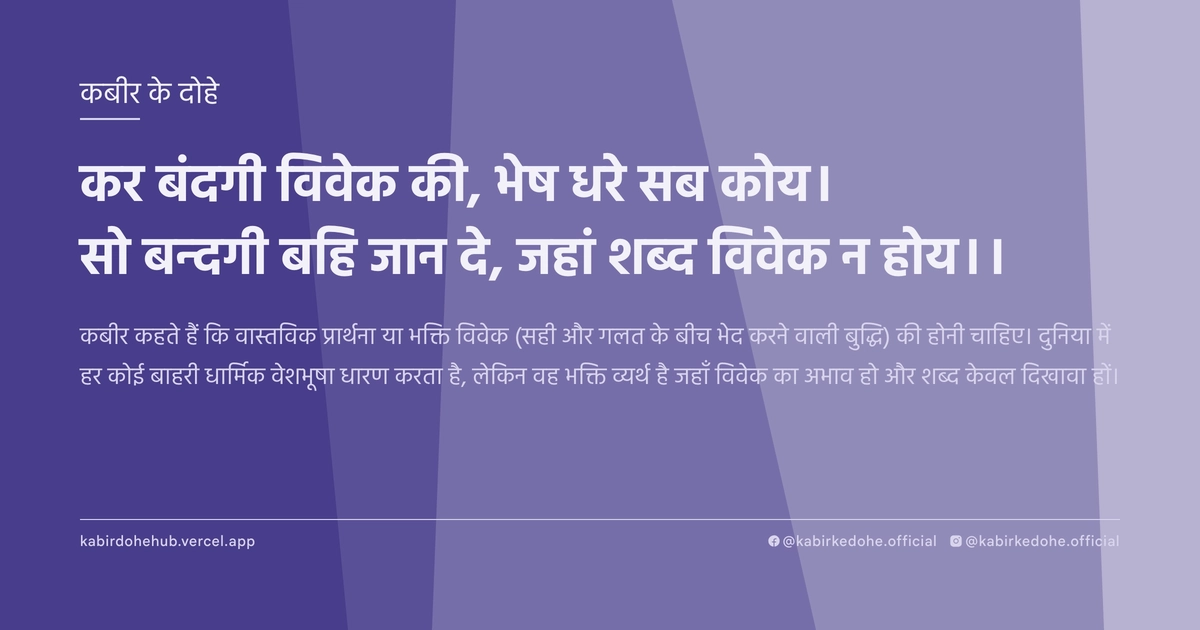
कर बंदगी विवेक की, भेष धरे सब कोय।
सो बन्दगी बहि जान दे, जहां शब्द विवेक न होय।।
Kar bandagi vivek ki, bhesh dhare sab koy. So bandagi bahi jaan de, jahan shabd vivek na hoye.
इस पृष्ठ पर इस कबीर दोहे का अर्थ (meaning), हिंदी व्याख्या और अंग्रेज़ी अनुवाद, दार्शनिक विश्लेषण और व्यावहारिक जीवन सीख दी गई है। यह दोहा सत्य (Truth) विषय से जुड़ा है — Kabir doha meaning and explanation in Hindi and English.
अर्थ (Meaning):
कबीर कहते हैं कि वास्तविक प्रार्थना या भक्ति विवेक (सही और गलत के बीच भेद करने वाली बुद्धि) की होनी चाहिए। दुनिया में हर कोई बाहरी धार्मिक वेशभूषा धारण करता है, लेकिन वह भक्ति व्यर्थ है जहाँ विवेक का अभाव हो और शब्द केवल दिखावा हों।
Kabir asserts that true devotion or worship must be rooted in 'Vivek' (spiritual discernment). While many people adopt the outward appearance and attire of holiness, such rituals are meaningless and void if they are not guided by a conscious, discerning intellect and genuine understanding.
व्याख्या (Interpretation):
इस दोहे में कबीर बाहरी आडंबर और आंतरिक बोध के बीच के द्वंद्व को स्पष्ट करते हैं। 'भेष' शब्द यहाँ माया के उस आवरण को दर्शाता है जिसके पीछे मनुष्य अपनी अज्ञानता को छिपाता है। निरगुण भक्ति के अनुसार, ईश्वर किसी विशेष पोशाक या कर्मकांड में नहीं, बल्कि शुद्ध विवेक में निवास करता है। जब साधक यह समझ जाता है कि आत्मा और ब्रह्म एक हैं (अद्वैत), तब उसे बाहरी दिखावे की आवश्यकता नहीं रहती। यहाँ 'शब्द' का अर्थ केवल वाणी नहीं, बल्कि वह सत्य है जो विवेक द्वारा छना हुआ हो। बिना विवेक के भक्ति केवल एक मानसिक भ्रम है जो अहंकार को और पुष्ट करता है।
In this couplet, Kabir illuminates the conflict between external ostentation and internal realization. The term 'Bhesh' refers to the veil of Maya, where humans hide their ignorance behind religious costumes. According to Nirgun Bhakti, the Divine does not reside in specific attire or rituals but in pure discernment. When a seeker realizes the non-duality of Atman and Brahman, the need for external displays vanishes. Here, 'Shabd' refers not merely to speech, but to the Truth filtered through wisdom. Devotion without discernment is merely a psychological delusion that further strengthens the ego rather than dissolving it.
दार्शनिक विश्लेषण (Philosophical Analysis):
कबीर का यह दृष्टिकोण उनके समय के कट्टरपंथ और कर्मकांडीय धर्म के विरुद्ध एक सशक्त प्रहार था। उन्होंने देखा कि लोग केवल तिलक, माला और वस्त्रों से अपनी धार्मिकता सिद्ध करने का प्रयास करते हैं, जबकि उनके भीतर करुणा और विवेक का पूर्ण अभाव होता है। यह विश्लेषण अद्वैत वेदांत के उस सिद्धांत से मेल खाता है जहाँ 'विवेक' को ज्ञान की पहली सीढ़ी माना गया है। विवेक ही वह उपकरण है जो नित्य (शाश्वत) और अनित्य (क्षणिक) के बीच अंतर करना सिखाता है।
सूफी मत के 'इश्क-ए-हकीकी' (ईश्वरीय प्रेम) की तरह, कबीर भी बाहरी स्वरूप के बजाय आंतरिक सत्य की खोज पर बल देते हैं। उनके लिए, धर्म कोई सामाजिक पहचान नहीं, बल्कि एक व्यक्तिगत मनोवैज्ञानिक रूपांतरण है। जब तक व्यक्ति अपने 'अहं' को विवेक की अग्नि में नहीं जलाता, तब तक उसकी प्रार्थना केवल एक यांत्रिक क्रिया है।
कबीर यहाँ यह स्पष्ट करते हैं कि विवेकहीन भक्ति वास्तव में भक्ति नहीं, बल्कि एक सामाजिक मुखौटा है। वे चेतावनी देते हैं कि जो लोग केवल शब्दों के जाल में फंसे हैं और जिनके जीवन में विवेक का प्रकाश नहीं है, वे सत्य से और दूर हो जाते हैं। यह 'शब्द' और 'अर्थ' के बीच का अंतर है; एक केवल ध्वनि है, दूसरा जीवंत अनुभव।
ऐतिहासिक रूप से, कबीर ने जाति और धर्म की सीमाओं को तोड़कर एक ऐसे मार्ग का 제시 किया जहाँ केवल 'सत्य' की प्रधानता थी। उन्होंने सिखाया कि ईश्वर को पाने के लिए किसी मंदिर या मस्जिद जाने की आवश्यकता नहीं, बल्कि अपने भीतर के विवेक को जाग्रत करना पर्याप्त है। यह मार्ग कठिन है क्योंकि यह व्यक्ति को अपनी मान्यताओं पर प्रश्न उठाने के लिए मजबूर करता है।
अंततः, यह दोहा हमें सिखाता है कि आध्यात्मिक प्रगति का पैमाना यह नहीं है कि हम कितने अनुष्ठान करते हैं, बल्कि यह है कि हमारा विवेक कितना परिष्कृत हुआ है। अहंकार का विलीनीकरण तभी संभव है जब हम बाहरी पहचानों को त्यागकर उस निराकार सत्य के साथ एकाकार हो जाएं, जो विवेक के माध्यम से ही सुलभ है।
Kabir's perspective is a powerful strike against the bigotry and ritualistic religion of his era. He observed people attempting to prove their piety through tilaks, beads, and specific garments, while lacking compassion and discernment. This analysis aligns with Advaita Vedanta, where 'Vivek' (discernment) is considered the first step toward liberation. Vivek is the tool that teaches the distinction between the Eternal (Nitya) and the Ephemeral (Anitya).
Similar to the Sufi concept of 'Ishq-e-Haqiqi' (Divine Love), Kabir emphasizes the search for internal truth over external form. For him, religion is not a social identity but a personal psychological transformation. Unless a person burns their ego in the fire of discernment, their prayer remains a mere mechanical action.
Kabir clarifies that devotion without discernment is not true devotion, but a social mask. He warns that those trapped in the web of words, lacking the light of wisdom, drift further from the Truth. This is the distinction between 'Shabd' (sound) and 'Arth' (meaning); one is a mere vibration, the other a living experience.
Historically, Kabir broke the boundaries of caste and creed to propose a path where only Truth prevailed. He taught that reaching the Divine requires no temple or mosque, but only the awakening of the inner intellect. This path is arduous because it forces the individual to question their own deeply held beliefs.
Ultimately, this couplet teaches us that the metric of spiritual progress is not the number of rituals performed, but the refinement of one's discernment. The annihilation of the ego is possible only when we discard external identities and merge with the Formless Truth, accessible only through Vivek.
मूल संदेश (Core Message):
- बाहरी दिखावा आध्यात्मिक प्रगति का प्रमाण नहीं है।
- विवेक ही वह कुंजी है जो कर्मकांड को वास्तविक भक्ति में बदलती है।
- सत्य शब्दों में नहीं, बल्कि उनके द्वारा प्रेरित आचरण में होता है।
- अहंकार को मिटाना ही वास्तविक प्रार्थना है।
- आंतरिक बोध के बिना हर धार्मिक क्रिया एक रिक्त आवरण है।
- External appearance is not evidence of spiritual progress.
- Discernment is the key that transforms ritual into real devotion.
- Truth resides not in words, but in the conduct they inspire.
- The dissolution of the ego is the only true prayer.
- Without internal realization, every religious act is a hollow shell.
व्यावहारिक उदाहरण (Practical Example):
एक समय की बात है, वाराणसी के घाटों पर रहने वाला एक वृद्ध बुनकर था, जिसका नाम माधव था। माधव अपनी कला में निपुण था, लेकिन वह बहुत अहंकारी था क्योंकि वह शहर के सबसे बड़े मंदिर के लिए रेशमी वस्त्र बुनता था। वह खुद को बहुत धार्मिक मानता था और दिन भर मंत्र जाप करता था, लेकिन अपने पड़ोसियों और गरीब मजदूरों के साथ बहुत रूखा व्यवहार करता था।
माधव का मानना था कि उसकी धार्मिकता उसके द्वारा पहने गए गेरुए वस्त्रों और उसके निरंतर जाप से सिद्ध होती है। वह अक्सर दूसरों को उनके 'अधार्मिक' व्यवहार के लिए टोकता था, जबकि वह स्वयं भीतर से क्रोध और ईर्ष्या से भरा रहता था।
एक दिन, एक फकीर उसके पास आया। फकीर ने देखा कि माधव एक तरफ तो ईश्वर की स्तुति कर रहा है और दूसरी तरफ अपने सहायक को उसकी एक छोटी सी गलती के लिए बुरी तरह डांट रहा है। फकीर ने मुस्कुराते हुए माधव से पूछा, 'तुम्हारी यह माला तुम्हारे हृदय को कोमल बना रही है या केवल तुम्हारी उंगलियों को व्यस्त रख रही है?'
माधव को यह बात चुभी। उसने गर्व से कहा, 'मैं धर्म के मार्ग पर हूँ, मैं विवेकपूर्ण हूँ।' फकीर ने शांति से उत्तर दिया, 'विवेक वह नहीं जो दूसरों की गलतियाँ पकड़े, विवेक वह है जो स्वयं के भीतर के अंधकार को देखे। तुम्हारा भेष तो साधु का है, लेकिन तुम्हारा व्यवहार अभी भी अज्ञानता के बंधन में है।'
यह बात माधव के हृदय में गहरे तक उतर गई। उसने महसूस किया कि वह अब तक केवल 'भेष' बदल रहा था, अपनी चेतना नहीं। उसने देखा कि उसकी भक्ति केवल एक सामाजिक प्रदर्शन थी ताकि लोग उसे 'ज्ञानी' कहें।
अगले कुछ महीनों में, माधव ने बाहरी दिखावे को कम किया और अपने व्यवहार पर ध्यान देना शुरू किया। उसने अपने सहायकों के साथ सम्मानपूर्वक बात करना शुरू किया और अपनी कला का उपयोग केवल धन कमाने के लिए नहीं, बल्कि दूसरों की सेवा के लिए किया।
उसने पाया कि जब उसने दूसरों के प्रति करुणा विकसित की, तो उसका मंत्र जाप अधिक गहरा और अर्थपूर्ण हो गया। अब उसे किसी को यह बताने की आवश्यकता नहीं थी कि वह धार्मिक है; उसकी शांति और व्यवहार स्वयं गवाही दे रहे थे।
माधव ने सीखा कि वास्तविक 'बंदगी' वह नहीं है जो दुनिया को दिखाई दे, बल्कि वह है जो आत्मा को शुद्ध करे। उसने अपने अहंकार के मुखौटे को उतार फेंका और वास्तव में विवेक के मार्ग पर चलना शुरू किया।
Once, in the ghats of Varanasi, lived an elderly weaver named Madhav. Madhav was masterly in his craft, but he was profoundly arrogant because he wove silk garments for the city's largest temple. He considered himself highly religious and spent his days chanting mantras, yet he treated his neighbors and poor laborers with extreme harshness.
Madhav believed his piety was proven by the saffron robes he wore and his constant chanting. He often corrected others for their 'unreligious' behavior, while he himself remained filled with inner rage and jealousy.
One day, a wandering Sufi dervish visited him. The dervish noticed Madhav praising God on one hand while harshly berating his assistant for a minor mistake on the other. The dervish smiled and asked, 'Does your rosary make your heart tender, or does it merely keep your fingers busy?'
Madhav felt stung. He replied proudly, 'I am on the path of Dharma; I am discerning.' The dervish calmly answered, 'Discernment is not catching the mistakes of others; it is seeing the darkness within oneself. Your attire is that of a saint, but your behavior is still bound by ignorance.'
These words pierced Madhav's heart. He realized he had only been changing his 'costume,' not his consciousness. He saw that his devotion was a social performance designed to make people call him 'wise.'
Over the next few months, Madhav reduced his external displays and focused on his behavior. He began speaking respectfully to his assistants and used his art not just for profit, but for the service of others.
He discovered that as he developed compassion for others, his chanting became deeper and more meaningful. He no longer felt the need to tell anyone he was religious; his peace and conduct spoke for themselves.
Madhav learned that true 'Bandagi' is not what is visible to the world, but what purifies the soul. He cast off the mask of ego and truly began to walk the path of Vivek.
अभ्यास मार्गदर्शन (Practice Guidance):
- प्रतिदिन 20 मिनट मौन अभ्यास करें, जहाँ आप अपने विचारों को बिना किसी निर्णय के केवल देखें।
- एक 'विवेक जर्नल' बनाएँ: दिन भर में जब भी आप किसी के प्रति निर्णय लें, लिखें कि वह निर्णय आपके अहंकार से प्रेरित था या वास्तविक करुणा से।
- व्यवहार परिवर्तन: दिन में कम से कम एक बार किसी ऐसे व्यक्ति की मदद करें जिससे आपका वैचारिक मतभेद हो, बिना किसी बाहरी प्रदर्शन के।
- निदान चेकलिस्ट: क्या मैं अपनी धार्मिक पहचान का उपयोग दूसरों को छोटा दिखाने के लिए कर रहा हूँ? क्या मेरी प्रार्थना मेरे व्यवहार में विनम्रता ला रही है? क्या मैं सत्य को स्वीकार करने के लिए तैयार हूँ यदि वह मेरी मान्यताओं के विपरीत हो?
- Practice 20 minutes of daily silence, observing your thoughts without judgment to separate the observer from the ego.
- Maintain a 'Vivek Journal': Whenever you judge someone during the day, record whether that judgment was driven by ego or genuine compassion.
- Behavioral Shift: At least once a day, help someone with whom you have a conceptual disagreement, doing so without any external display of virtue.
- Diagnostic Checklist: Am I using my religious identity to make others feel inferior? Is my prayer manifesting as humility in my behavior? Am I willing to accept a truth that contradicts my current beliefs?
चिंतन प्रश्न (Reflection Questions):
- मेरे जीवन में ऐसा कौन सा 'भेष' या मुखौटा है जिसे मैं दुनिया के सामने अपनी श्रेष्ठता सिद्ध करने के लिए पहनता हूँ?
- क्या मेरी आध्यात्मिक मान्यताएँ मुझे अधिक समावेशी बना रही हैं, या वे मुझे दूसरों से अलग करने का एक साधन बन गई हैं?
- यदि मुझसे मेरी सभी धार्मिक और सामाजिक पहचानें छीन ली जाएँ, तो मेरे भीतर क्या बचेगा?
- मैं कितनी बार सत्य को केवल इसलिए नकारता हूँ क्योंकि वह मेरे अहंकार को चोट पहुँचाता है?
- क्या मेरी प्रार्थनाएँ मुझे शांत कर रही हैं, या वे केवल मेरी इच्छाओं को पुष्ट करने का एक तरीका हैं?
- What 'costume' or mask do I wear in my life to prove my superiority to the world?
- Are my spiritual beliefs making me more inclusive, or have they become a tool to separate me from others?
- If all my religious and social identities were stripped away, what would remain within me?
- How often do I deny the truth simply because it wounds my ego?
- Are my prayers bringing me peace, or are they merely a way to reinforce my personal desires?