
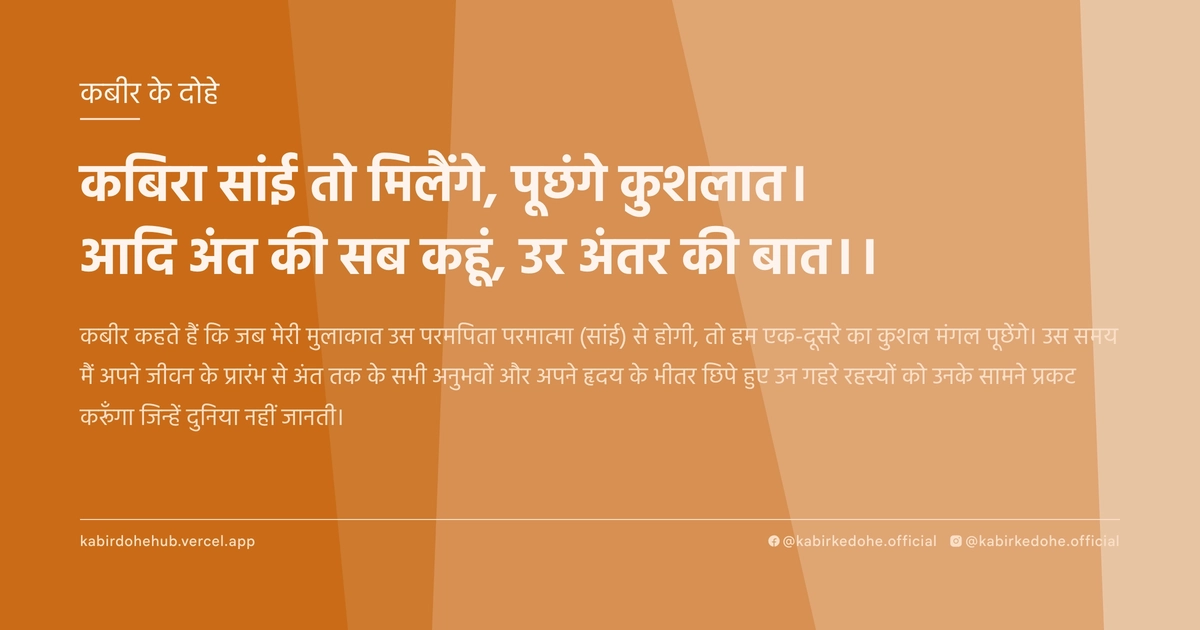
कबिरा सांई तो मिलैंगे, पूछंगे कुशलात।
आदि अंत की सब कहूं, उर अंतर की बात।।
Kabira sai to milenge, poochenge kushlaat. Aadi ant ki sab kahun, ur antar ki baat.
इस पृष्ठ पर इस कबीर दोहे का अर्थ (meaning), हिंदी व्याख्या और अंग्रेज़ी अनुवाद, दार्शनिक विश्लेषण और व्यावहारिक जीवन सीख दी गई है। यह दोहा ईश्वर मिलन (Divine Connection) विषय से जुड़ा है — Kabir doha meaning and explanation in Hindi and English.
अर्थ (Meaning):
कबीर कहते हैं कि जब मेरी मुलाकात उस परमपिता परमात्मा (सांई) से होगी, तो हम एक-दूसरे का कुशल मंगल पूछेंगे। उस समय मैं अपने जीवन के प्रारंभ से अंत तक के सभी अनुभवों और अपने हृदय के भीतर छिपे हुए उन गहरे रहस्यों को उनके सामने प्रकट करूँगा जिन्हें दुनिया नहीं जानती।
Kabir proclaims that upon meeting the Divine Beloved (Saai), there will be an exchange of well-being. In that sacred union, he intends to recount the entire trajectory of his existence—from the primordial beginning to the final end—unveiling the deepest secrets and silent whispers harbored within the sanctuary of his heart.
व्याख्या (Interpretation):
यह दोहा आत्मा और परमात्मा के मिलन की तीव्र लालसा को दर्शाता है। यहाँ 'कुशलता पूछना' केवल औपचारिक बातचीत नहीं, बल्कि एक गहन आध्यात्मिक संवाद है जहाँ द्वैत समाप्त हो जाता है। कबीर 'आदि और अंत' की बात कर रहे हैं, जो समय के चक्र (कालचक्र) से परे जाने का संकेत है। यह निरगुण भक्ति का सार है, जहाँ ईश्वर किसी मंदिर या मस्जिद में नहीं, बल्कि 'उर अंतर' यानी हृदय के भीतर निवास करता है। माया के पर्दे हटने पर, आत्मा अपनी वास्तविक पहचान को पहचानती है। यह अद्वैत वेदांत के उस सत्य को पुष्ट करता है जहाँ जीव और ब्रह्म एक ही हैं। अंततः, यह मिलन एक ऐसी स्थिति है जहाँ शब्दों की आवश्यकता नहीं रहती, फिर भी यह संवाद आत्मा की पूर्णता की अभिव्यक्ति है।
This couplet encapsulates the intense longing for the union of the Atman (soul) and Paramatman (Supreme Soul). The act of 'asking after well-being' is not a mundane formality but a profound spiritual dialogue marking the dissolution of duality. By referencing the 'beginning and the end,' Kabir hints at transcending the linear constraints of time (Kala). This is the essence of Nirgun Bhakti, where the Divine resides not in external shrines but within the 'ur antar'—the innermost cavern of the heart. As the veil of Maya lifts, the soul recognizes its primordial identity. It reinforces the Advaita Vedanta truth that the individual soul and the universal consciousness are non-different. Ultimately, this meeting represents a state where silence speaks louder than words, yet the dialogue symbolizes the soul's total surrender and realization.
दार्शनिक विश्लेषण (Philosophical Analysis):
कबीर का यह दृष्टिकोण उनके युग के कर्मकांडीय धर्म के विरुद्ध एक सशक्त प्रहार था। उस समय धर्म बाहरी आडंबरों, तीर्थयात्राओं और कठोर नियमों में जकड़ा हुआ था। कबीर ने 'सांई' को एक व्यक्तिगत और अंतरंग मित्र के रूप में प्रस्तुत किया, न कि किसी डराने वाले न्यायाधीश के रूप में। यह सूफी मत के 'इश्क-ए-हकीकी' (ईश्वरीय प्रेम) से गहराई से प्रेरित है, जहाँ प्रेमी और प्रियतम के बीच कोई पर्दा नहीं रहता।
दार्शनिक स्तर पर, यह दोहा अहंकार के विसर्जन की बात करता है। जब कबीर कहते हैं कि वे 'हृदय की बात' कहेंगे, तो इसका अर्थ है कि उन्होंने अपनी पूरी चेतना को परमात्मा में विलीन कर दिया है। यहाँ 'उर अंतर' वह शून्य है जहाँ विचार समाप्त होते हैं और केवल अस्तित्व बचता है। यह अद्वैतवाद की वह स्थिति है जहाँ ज्ञाता, ज्ञान और ज्ञेय एक हो जाते हैं।
कबीर जाति और वर्ग के भेदों को नकारते हुए यह स्थापित करते हैं कि ईश्वर तक पहुँचने का एकमात्र मार्ग आंतरिक सत्य और ईमानदारी है। उनके लिए भक्ति कोई बाहरी क्रिया नहीं, बल्कि एक आंतरिक रूपांतरण है। वे सिखाते हैं कि जब तक मनुष्य अपने भीतर के झूठ और मुखौटों को नहीं उतारता, वह उस 'सांई' से नहीं मिल सकता।
यह कविता मनोवैज्ञानिक स्तर पर 'छाया' (Shadow) के एकीकरण की प्रक्रिया है। मनुष्य समाज के सामने एक मुखौटा पहनता है, लेकिन परमात्मा के सामने वह पूरी तरह नग्न और सत्य होता है। यह पूर्ण पारदर्शिता ही मोक्ष का द्वार है।
अंततः, कबीर का दर्शन यह है कि जीवन एक लंबी यात्रा है जिसका गंतव्य स्वयं के भीतर की खोज है। 'आदि और अंत' का ज्ञान केवल उसे ही होता है जिसने अपनी इंद्रियों पर विजय प्राप्त कर ली है और जो अब केवल साक्षी भाव में स्थित है।
Kabir's perspective serves as a potent critique of the ritualistic religion of his era. At a time when spirituality was shackled by external pomposity, pilgrimages, and rigid dogmas, Kabir reimagined the 'Saai' (Divine) not as a distant, judging deity, but as an intimate companion. This approach is deeply influenced by the Sufi concept of 'Ishq-e-Haqiqi' (Divine Love), where the barrier between the lover and the Beloved is completely obliterated.
On a philosophical plane, this doha speaks to the annihilation of the ego. When Kabir mentions sharing the 'secrets of the heart,' he refers to the state where the individual consciousness has merged into the universal. The 'ur antar' is the void or the stillness where conceptual thought ceases and pure existence remains. This aligns with Advaita Vedanta, where the knower, the known, and the process of knowing become one.
By rejecting caste and class hierarchies, Kabir establishes that the only authentic path to the Divine is through internal truth and radical honesty. For him, Bhakti is not a performative act but an internal alchemy. He suggests that until a human sheds their social masks and internal lies, the encounter with the 'Saai' remains impossible.
Psychologically, this represents the integration of the 'Shadow.' While humans wear masks to navigate society, before the Divine, one is stripped of all pretenses. This absolute transparency is the gateway to liberation (Mukti).
Ultimately, Kabir's philosophy posits that life is a journey whose destination is the discovery of the self. The knowledge of the 'beginning and the end' is accessible only to those who have mastered their senses and now exist in the state of the 'Sakshi' or the Eternal Witness.
मूल संदेश (Core Message):
- बाहरी आडंबरों को त्यागकर आंतरिक सत्य की खोज करें।
- परमात्मा के साथ संबंध औपचारिक नहीं, बल्कि अत्यंत व्यक्तिगत है।
- जीवन का सार अपनी आत्मा की ईमानदारी में निहित है।
- अहंकार का विसर्जन ही दिव्य मिलन की एकमात्र शर्त है।
- सत्य को स्वीकार करना ही वास्तविक आध्यात्मिक मुक्ति है।
- Abandon external rituals to seek the truth within.
- The relationship with the Divine is personal, not formal.
- The essence of life lies in the honesty of the soul.
- Dissolution of ego is the only prerequisite for divine union.
- Accepting one's truth is the path to genuine spiritual liberation.
व्यावहारिक उदाहरण (Practical Example):
वाराणसी के एक पुराने घाट पर रहने वाले माधव नाम के एक वृद्ध नाविक थे। माधव का पूरा जीवन दूसरों को नदी पार कराने में बीत गया, लेकिन उनके अपने मन में एक गहरा अकेलापन और कई अनकहे दुख थे। वे समाज में एक सरल और खुशमिजाज व्यक्ति के रूप में जाने जाते थे, लेकिन रात के सन्नाटे में वे अपनी गलतियों और पछतावे से जूझते थे।
एक दिन माधव की मुलाकात एक घुमंतू फकीर से हुई, जिसने उन्हें कबीर का यह दोहा सुनाया। फकीर ने कहा, "माधव, तुम दुनिया को पार कराते हो, लेकिन अपने भीतर के बोझ को कब उतारोगे? जिस दिन तुम अपने भीतर के उस 'सांई' से मिलोगे, तुम्हें किसी और के सामने सफाई देने की जरूरत नहीं होगी।"
माधव को यह बात चुभ गई। उन्होंने महसूस किया कि वे वर्षों से एक मुखौटा पहनकर जी रहे थे। उन्होंने तय किया कि वे अब झूठ नहीं बोलेंगे, चाहे वह छोटा ही क्यों न हो। उन्होंने अपने परिवार के उन सदस्यों से बात की जिनसे वे सालों से नाराज थे और अपनी कमजोरियों को स्वीकार किया।
शुरुआत में यह बहुत कठिन था। लोग उन्हें अजीब समझने लगे। लेकिन जैसे-जैसे वे अपने 'उर अंतर' की बातों को स्वीकार करने लगे, उनका मानसिक बोझ हल्का होने लगा। उन्हें महसूस हुआ कि जिस शांति की तलाश वे गंगा की लहरों में कर रहे थे, वह उनके अपने सत्य को स्वीकार करने में थी।
एक शाम, जब वे नाव किनारे लगा रहे थे, उन्हें एक असीम शांति का अनुभव हुआ। उन्हें लगा कि वे अब किसी बाहरी ईश्वर की तलाश में नहीं हैं, बल्कि वे स्वयं उस परमात्मा के साथ एक संवाद में हैं।
उनकी व्यवहारिक प्रतिक्रिया यह थी कि उन्होंने अब केवल नाव ही नहीं चलाई, बल्कि घाट पर आने वाले दुखी लोगों की बातें सुनना शुरू किया। वे उनके लिए एक ऐसे दर्पण बन गए जहाँ लोग बिना डरे अपना सच बोल सकते थे।
माधव का जीवन अब एक प्रदर्शन नहीं, बल्कि एक प्रार्थना बन गया था। उन्होंने सीखा कि जब हम अपने आंतरिक अंधकार को स्वीकार कर लेते हैं, तो प्रकाश स्वतः ही आ जाता है।
अंत में, माधव ने पाया कि 'सांई' से मिलना कोई मृत्यु के बाद की घटना नहीं है, बल्कि जीवित रहते हुए अपने वास्तविक स्वरूप में जाग जाना है। उनकी नाव अब केवल शरीर को नहीं, बल्कि आत्माओं को शांति की ओर ले जा रही थी।
In the ancient ghats of Varanasi lived an elderly boatman named Madhav. Madhav had spent his entire life ferrying others across the river, yet within him resided a profound loneliness and a reservoir of unspoken sorrows. To the world, he was a simple, cheerful man, but in the silence of the night, he wrestled with his past mistakes and regrets.
One day, Madhav encountered a wandering fakir who recited this specific doha of Kabir to him. The fakir remarked, "Madhav, you ferry the world across, but when will you unload the burden within yourself? The day you meet the 'Saai' within, you will no longer need to justify yourself to the world."
These words pierced Madhav's heart. He realized he had been living behind a mask for decades. He decided that from that moment on, he would stop lying, no matter how trivial the lie. He reached out to family members with whom he had been estranged for years and openly admitted his vulnerabilities.
Initially, this was agonizing. People began to perceive him as strange or unstable. However, as he continued to acknowledge the 'ur antar'—the secrets of his heart—his mental burden began to lighten. He discovered that the peace he sought in the ripples of the Ganges was actually found in the acceptance of his own truth.
One evening, while mooring his boat, he experienced an overwhelming sense of serenity. He felt that he was no longer searching for an external God, but was instead engaged in a continuous, silent dialogue with the Divine within.
His behavioral transformation was concrete: he stopped merely transporting passengers and began listening to the grieving souls who came to the ghats. He became a mirror for others, a safe space where people could speak their truth without fear of judgment.
Madhav's life ceased to be a performance and became a prayer. He learned that when we embrace our internal darkness, the light manifests spontaneously.
Ultimately, Madhav realized that meeting the 'Saai' is not an event that occurs after death, but an awakening to one's true nature while still alive. His boat now carried not just bodies, but souls toward a state of inner peace.
अभ्यास मार्गदर्शन (Practice Guidance):
- प्रतिदिन 20 मिनट मौन बैठें और अपने भीतर उठने वाले विचारों को बिना किसी निर्णय के देखें, जैसे आप किसी पुराने मित्र की बातें सुन रहे हों।
- एक 'सत्य पत्रिका' (Truth Journal) बनाएँ जहाँ आप उन बातों को लिखें जिन्हें आप दुनिया से छिपाते हैं; यह आपके 'उर अंतर' को साफ करने की प्रक्रिया है।
- दिन में कम से कम एक बार किसी ऐसे व्यक्ति से ईमानदारी से बात करें जिससे आप अपनी भावनाओं को व्यक्त करने में डरते रहे हैं।
- निदान चेकलिस्ट: क्या मैं अभी भी दूसरों की प्रशंसा के लिए मुखौटा पहन रहा हूँ? क्या मेरी आंतरिक स्थिति और बाहरी व्यवहार में गहरा अंतर है? क्या मैं अपनी गलतियों को स्वीकार करने के बजाय उन्हें सही ठहरा रहा हूँ?
- Practice 20 minutes of daily silence, observing the thoughts arising within you without judgment, as if you are listening to an old friend.
- Maintain a 'Truth Journal' to record the thoughts and feelings you hide from the world; this is the process of cleansing the 'ur antar'.
- At least once a day, engage in a conversation of radical honesty with someone you have previously feared being vulnerable with.
- Diagnostic Checklist: Am I still wearing a mask for social validation? Is there a wide gap between my internal state and external behavior? Am I justifying my mistakes instead of owning them?
चिंतन प्रश्न (Reflection Questions):
- यदि आज आपकी मुलाकात उस 'सांई' से हो जाए, तो वह कौन सी बात होगी जिसे बताने में आपको सबसे अधिक संकोच होगा?
- आपका 'सार्वजनिक व्यक्तित्व' (Public Persona) आपके 'वास्तविक स्वरूप' से कितना अलग है, और यह अंतर आपको कितना थकाता है?
- क्या आप अपने जीवन के 'आदि और अंत' को देख पा रहे हैं, या आप केवल वर्तमान की छोटी समस्याओं में उलझे हैं?
- वह कौन सा झूठ है जिसे आप इतने समय से सच मान चुके हैं कि अब वह आपकी पहचान बन गया है?
- क्या आप वास्तव में अकेले रहने में सक्षम हैं, या आप अकेलेपन के डर से शोर और भीड़ का सहारा लेते हैं?
- If you were to meet the 'Saai' today, what is the one thing you would feel most hesitant to reveal?
- How far does your 'Public Persona' diverge from your 'True Self,' and how much does this gap exhaust you?
- Are you able to perceive the 'beginning and the end' of your life, or are you merely entangled in trivial present problems?
- What is the lie you have told yourself for so long that it has now become your identity?
- Are you truly capable of being alone, or do you rely on noise and crowds to escape the fear of solitude?