
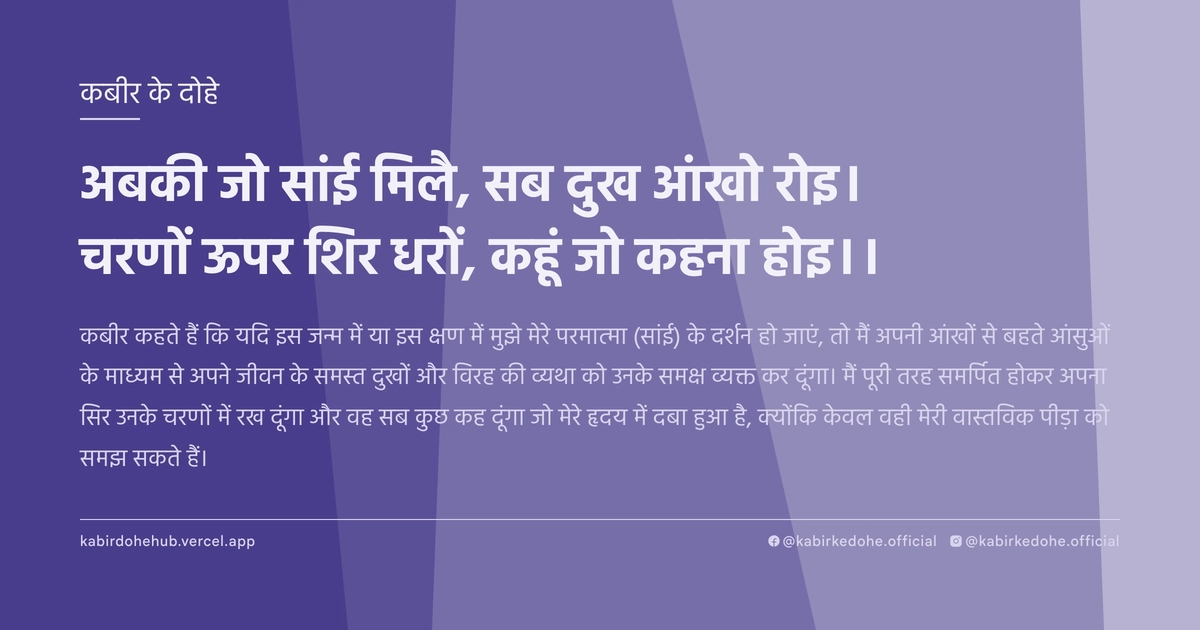
अबकी जो सांई मिलै, सब दुख आंखो रोइ।
चरणों ऊपर शिर धरों, कहूं जो कहना होइ।।
Abki jo sai milai, sab dukh aankho roi. Charnon upar shir dharon, kahun jo kehna hoi.
इस पृष्ठ पर इस कबीर दोहे का अर्थ (meaning), हिंदी व्याख्या और अंग्रेज़ी अनुवाद, दार्शनिक विश्लेषण और व्यावहारिक जीवन सीख दी गई है। यह दोहा प्रपत्ति (Surrender) विषय से जुड़ा है — Kabir doha meaning and explanation in Hindi and English.
अर्थ (Meaning):
कबीर कहते हैं कि यदि इस जन्म में या इस क्षण में मुझे मेरे परमात्मा (सांई) के दर्शन हो जाएं, तो मैं अपनी आंखों से बहते आंसुओं के माध्यम से अपने जीवन के समस्त दुखों और विरह की व्यथा को उनके समक्ष व्यक्त कर दूंगा। मैं पूरी तरह समर्पित होकर अपना सिर उनके चरणों में रख दूंगा और वह सब कुछ कह दूंगा जो मेरे हृदय में दबा हुआ है, क्योंकि केवल वही मेरी वास्तविक पीड़ा को समझ सकते हैं।
Kabir expresses a profound longing, stating that if he were to encounter the Divine (Saai) now, he would let all his accumulated sorrows flow out through his tears. He envisions himself in total surrender, bowing his head at the Divine's feet, finally voicing the unspoken agonies and spiritual yearnings of his soul to the only entity capable of truly understanding his pain.
व्याख्या (Interpretation):
यह दोहा केवल भौतिक दुख की बात नहीं करता, बल्कि 'विरह' की उस पराकाष्ठा को दर्शाता है जहाँ आत्मा अपने मूल स्रोत (परमात्मा) से बिछड़ने के कारण तड़प रही है। 'आंखो रोइ' यहाँ केवल शोक नहीं, बल्कि शुद्धिकरण की प्रक्रिया है, जहाँ अहंकार के आंसू बहकर हृदय को निर्मल करते हैं। चरणों में सिर रखना पूर्ण शरणागति (Prapatti) का प्रतीक है, जो अद्वैत वेदांत के उस बिंदु को छूता है जहाँ 'मैं' और 'तू' का भेद मिट जाता है। यह निरगुण भक्ति की वह अवस्था है जहाँ भक्त को किसी मूर्ति की नहीं, बल्कि उस आंतरिक अनुभूति की आवश्यकता है जो उसे शून्य में विलीन कर दे। यहाँ विरोधाभास यह है कि जब साधक यह अनुभव करता है कि वह स्वयं ब्रह्म है, तब भी वह इस मानवीय विरह के माध्यम से अपनी भक्ति को प्रगाढ़ करता है।
This couplet transcends mere physical suffering, depicting the pinnacle of 'Viraha'—the agonizing separation of the soul from its primordial source. The act of weeping is not mere grief but a process of spiritual purification, where the tears of the ego wash away the illusions of the self. Bowing the head symbolizes total surrender (Prapatti), aligning with the Advaita Vedantic realization where the duality between the seeker and the sought dissolves. In the context of Nirgun Bhakti, Kabir seeks not a sculpted idol but an internal realization that merges the drop with the ocean. The central paradox lies in the fact that while the soul is essentially one with the Divine, it utilizes the human emotion of longing to bridge the perceived gap, transforming pain into a vehicle for liberation.
दार्शनिक विश्लेषण (Philosophical Analysis):
कबीर का यह दोहा उस युग की उपज है जब धर्म कर्मकांडों और बाहरी आडंबरों में जकड़ा हुआ था। कबीर ने मंदिर-मस्जिद के बजाय 'हृदय के मंदिर' पर जोर दिया। यहाँ 'सांई' शब्द सूफीवाद के 'इश्क-ए-हकीकी' (ईश्वरीय प्रेम) और भारतीय भक्ति परंपरा के मिलन को दर्शाता है। कबीर का दर्शन यह है कि जब तक मनुष्य अपने अहंकार (I-ness) को नहीं मिटाता, वह परमात्मा से नहीं मिल सकता।
अद्वैत वेदांत के अनुसार, आत्मा और ब्रह्म एक ही हैं, लेकिन माया के कारण हम अलग महसूस करते हैं। कबीर यहाँ उस माया के पर्दे को हटाने की बात कर रहे हैं। उनके लिए रोना एक मनोवैज्ञानिक विरेचन (Catharsis) है, जो साधक को मानसिक बोझ से मुक्त कर उसे शून्य की स्थिति में ले जाता है।
उन्होंने जाति और वर्ण व्यवस्था को पूरी तरह नकारा क्योंकि उनके अनुसार परमात्मा किसी विशेष वर्ग का नहीं, बल्कि सबके भीतर व्याप्त है। यह दोहा यह संदेश देता है कि ईश्वर तक पहुँचने का मार्ग शास्त्र पढ़ने या कठिन तपस्या से नहीं, बल्कि सरल, निश्छल प्रेम और पूर्ण समर्पण से होकर गुजरता है।
सूफी संतों की तरह, कबीर भी 'फना' (अहंकार का विनाश) की बात करते हैं। जब वह कहते हैं कि 'चरणों ऊपर शिर धरों', तो वह वास्तव में अपनी व्यक्तिगत पहचान को मिटाकर सार्वभौमिक चेतना में विलीन होने की इच्छा प्रकट कर रहे हैं।
अतः, यह दोहा केवल एक प्रार्थना नहीं है, बल्कि एक आध्यात्मिक क्रांति है जो मनुष्य को बाहरी दुनिया के शोर से हटाकर उसके भीतर के मौन और उस मौन में छिपे परमात्मा से जोड़ती है।
Kabir's couplet emerges from an era where religion was stifled by rigid rituals and external dogmas. He shifted the focus from the temple and mosque to the 'temple of the heart.' The term 'Saai' reflects a synthesis of the Sufi concept of 'Ishq-e-Haqiqi' (Divine Love) and the Indian Bhakti tradition, suggesting that the Divine is accessible through love rather than law.
According to Advaita Vedanta, the Atman and Brahman are identical, yet the veil of Maya creates a perceived separation. Kabir addresses the tearing of this veil. For him, weeping is a psychological catharsis, a shedding of the ego's weight to reach a state of 'Shunya' or emptiness, which is the prerequisite for union.
His rejection of caste and ritualism is rooted in the belief that the Divine is immanent in all beings. He posits that the path to liberation is not through the scholarly study of scriptures or ascetic rigor, but through an honest, unfiltered emotional surrender.
Similar to the Sufi path of 'Fana' (annihilation of the self), Kabir's act of bowing is a metaphor for the dissolution of the individual identity into the universal consciousness. He is not asking for a favor from a deity, but seeking the erasure of the 'I' that prevents the realization of oneness.
Ultimately, this verse is an invitation to move from the noise of the external world to the silence of the interior, where the seeker discovers that the one they were searching for was the one doing the searching.
मूल संदेश (Core Message):
- अहंकार का विसर्जन ही परमात्मा से मिलन की पहली शर्त है।
- दुख जब विरह बन जाता है, तो वह मुक्ति का मार्ग प्रशस्त करता है।
- पूर्ण समर्पण (Surrender) कमजोरी नहीं, बल्कि सर्वोच्च आध्यात्मिक शक्ति है।
- आंतरिक शुद्धि के बिना बाहरी अनुष्ठान व्यर्थ हैं।
- परमात्मा कहीं बाहर नहीं, बल्कि हमारे पूर्ण आत्म-समर्पण के क्षण में प्रकट होता है।
- The dissolution of the ego is the primary prerequisite for union with the Divine.
- When suffering transforms into longing (Viraha), it paves the way for liberation.
- Absolute surrender is not a sign of weakness, but the highest form of spiritual power.
- External rituals are futile without the internal purification of the heart.
- The Divine is not found externally, but manifests in the moment of total self-surrender.
व्यावहारिक उदाहरण (Practical Example):
एक समय की बात है, वाराणसी के घाटों पर माधव नाम का एक वृद्ध नाविक रहता था। माधव का जीवन केवल नाव चलाने और लोगों को पार उतारने में बीता था, लेकिन उसके भीतर एक गहरा अकेलापन था। उसने जीवन भर ईमानदारी से काम किया, फिर भी उसके परिवार ने उसे त्याग दिया और वह एक छोटी सी कुटिया में अकेला रहता था।
माधव अक्सर रात में गंगा की लहरों को देखता और सोचता कि उसके जीवन के दुखों का अंत कब होगा। वह मंदिर जाता, पूजा करता, लेकिन उसे कभी वह शांति नहीं मिली जिसकी उसे तलाश थी। उसे लगता था कि ईश्वर उससे बहुत दूर है, किसी ऊंचे सिंहासन पर बैठा हुआ।
एक दिन, उसने कबीर के इस दोहे को सुना। उसे समझ आया कि वह अब तक ईश्वर को 'पाने' की कोशिश कर रहा था, जबकि उसे केवल 'समर्पित' होना था। उसने महसूस किया कि उसके आंसू केवल दुख के नहीं, बल्कि एक पुकार थे।
उस रात, माधव ने अपनी नाव किनारे लगाई और चुपचाप अंधेरे में बैठ गया। उसने अपनी आँखें बंद कीं और कल्पना की कि वह उस निराकार सांई के सामने खड़ा है। उसने अपने जीवन की हर कड़वाहट, हर अपमान और हर तन्हाई को याद किया।
वह फूट-फूट कर रोने लगा। वह रोया इस बात के लिए नहीं कि उसके पास कुछ नहीं था, बल्कि इसलिए कि उसने अब तक अपने अहंकार को पकड़े रखा था कि 'मैं' दुखी हूँ।
जैसे-जैसे उसके आंसू बहे, उसे महसूस हुआ कि उसका भारीपन कम हो रहा है। उसने मानसिक रूप से अपना सिर उस अनंत चेतना के चरणों में रख दिया। उसने कहा, "हे सांई, मैं अब और बोझ नहीं उठा सकता, मैं सब कुछ आपको सौंपता हूँ।"
अचानक, उसे एक असीम शांति का अनुभव हुआ। उसे लगा कि वह अकेला नहीं है, बल्कि पूरी कायनात उसके साथ है। उसका दुख गायब नहीं हुआ, लेकिन दुख के प्रति उसका नजरिया बदल गया।
अगली सुबह जब माधव उठा, तो उसके चेहरे पर एक ऐसी मुस्कान थी जो उसने दशकों से नहीं पहनी थी। उसने अपनी नाव फिर से पानी में उतारी, लेकिन अब वह केवल सवारी नहीं ढो रहा था, बल्कि हर यात्री में उस 'सांई' को देख रहा था।
उसने अपने उन रिश्तेदारों को भी माफ कर दिया जिन्होंने उसे छोड़ा था, क्योंकि अब वह जानता था कि असली रिश्ता तो उस निराकार परमात्मा से है।
माधव का जीवन अब एक उत्सव बन गया था, क्योंकि उसने सीख लिया था कि पूर्ण समर्पण ही वास्तविक मुक्ति का द्वार है।
In the ancient lanes of Varanasi, there lived an elderly boatman named Madhav. His life had been spent ferrying pilgrims across the Ganges, yet within him resided a profound, echoing loneliness. Despite a lifetime of honesty, his own kin had abandoned him, leaving him to dwell in a fragile hut by the river.
Madhav would spend his nights watching the rhythmic flow of the river, wondering when the tide of his sorrows would finally recede. He visited temples and performed rituals, but the peace he sought remained elusive; he perceived God as a distant entity seated on a remote, celestial throne.
One evening, he encountered Kabir's words: "Abki jo saai milai..." The verse struck a chord. He realized he had been trying to 'attain' God as a prize, rather than 'surrendering' to the Divine as a flow. He understood that his tears were not just signs of grief, but a subconscious call for home.
That night, Madhav moored his boat and sat in the enveloping darkness. Closing his eyes, he envisioned himself before the Formless Divine. He recalled every bitterness, every insult, and every moment of isolation he had endured.
He began to weep uncontrollably. He did not cry because of his poverty, but because he realized he had been clinging to the identity of being a 'sufferer'—the ego of the victim.
As the tears flowed, he felt a physical lightness, as if a heavy shroud was being lifted from his chest. In his mind, he bowed his head completely at the feet of the Infinite, whispering, "O Saai, I can no longer carry this burden; I surrender everything to You."
In that moment of total collapse, an overwhelming sense of peace descended upon him. He felt that he was no longer a solitary man on a riverbank, but a part of a vast, cosmic embrace.
When Madhav woke the next morning, his face bore a serenity he hadn't known in decades. He returned to his boat, but he no longer saw himself as a mere laborer; he began to see the Divine in every passenger he ferried.
He forgave the relatives who had cast him aside, realizing that human bonds are fleeting, while the bond with the Formless is eternal.
Madhav's life transformed into a quiet celebration, for he had discovered that absolute surrender is the only true gateway to liberation.
अभ्यास मार्गदर्शन (Practice Guidance):
- प्रतिदिन 20 मिनट के लिए 'मौन विलाप' या गहन आत्म-चिंतन करें, जहाँ आप अपने आंतरिक दुखों को बिना किसी निर्णय के केवल महसूस करें और उन्हें परमात्मा को समर्पित कर दें।
- एक 'समर्पण जर्नल' बनाएँ। प्रतिदिन एक ऐसी बात लिखें जिसे आप नियंत्रित करने की कोशिश कर रहे हैं, और फिर उसे लिखकर यह कहें: "यह मेरा नहीं है, यह सांई का है।"
- व्यवहार परिवर्तन: जब भी क्रोध या ईर्ष्या महसूस हो, तो कल्पना करें कि आप अपना अहंकार उस निराकार शक्ति के चरणों में रख रहे हैं, जिससे आपका अहंकार विलीन हो जाए।
- डायग्नोस्टिक चेकलिस्ट: क्या आप अभी भी अपनी समस्याओं के लिए दूसरों को दोष दे रहे हैं? (यदि हाँ, तो समर्पण अधूरा है)। क्या आप शांति के लिए बाहरी वस्तुओं पर निर्भर हैं? (यदि हाँ, तो आप अभी भी माया में हैं)। क्या आप अपने आंसुओं को कमजोरी मानते हैं या शुद्धि? (शुद्धि मानना ही सही दिशा है)।
- Engage in 20 minutes of 'Silent Lament' or deep contemplation daily, allowing your internal sorrows to surface without judgment and consciously offering them to the Divine.
- Maintain a 'Surrender Journal.' Each day, write down one thing you are desperately trying to control, and then conclude with the phrase: "This is not mine; it belongs to the Saai."
- Behavioral Shift: Whenever anger or jealousy arises, visualize yourself placing that ego-driven emotion at the feet of the Formless Power, allowing the 'I' to dissolve into the 'All.'
- Diagnostic Checklist: Are you still blaming others for your suffering? (If yes, surrender is incomplete). Are you relying on external objects for peace? (If yes, you are still trapped in Maya). Do you view your tears as a weakness or as a purification? (Viewing them as purification indicates spiritual progress).
चिंतन प्रश्न (Reflection Questions):
- मेरे जीवन का वह कौन सा 'दुख' है जिसे मैं पकड़े हुए हूँ क्योंकि वह मेरी पहचान (Identity) बन चुका है?
- क्या मैं वास्तव में समर्पित होना चाहता हूँ, या मैं केवल अपनी इच्छाओं की पूर्ति के लिए प्रार्थना कर रहा हूँ?
- मेरे भीतर का 'अहंकार' किस रूप में छिपा है—श्रेष्ठता के रूप में या स्वयं को पीड़ित (Victim) मानकर?
- यदि आज मेरा सारा सामाजिक और डिजिटल अस्तित्व मिट जाए, तो मेरे और मेरे 'सांई' के बीच क्या बचेगा?
- क्या मैं अपने आंसुओं को अपनी कमजोरी मानता हूँ, या मैं उन्हें आत्मा की पुकार के रूप में स्वीकार कर सकता हूँ?
- Which specific 'sorrow' in my life am I clinging to because it has become a core part of my identity?
- Do I truly desire surrender, or am I merely praying to have my personal desires fulfilled?
- In what form does my ego hide—as a sense of superiority, or as the identity of a perpetual victim?
- If my entire social and digital persona were erased today, what would remain between me and my 'Saai'?
- Do I perceive my tears as a sign of weakness, or can I accept them as the soul's authentic cry for the Infinite?