
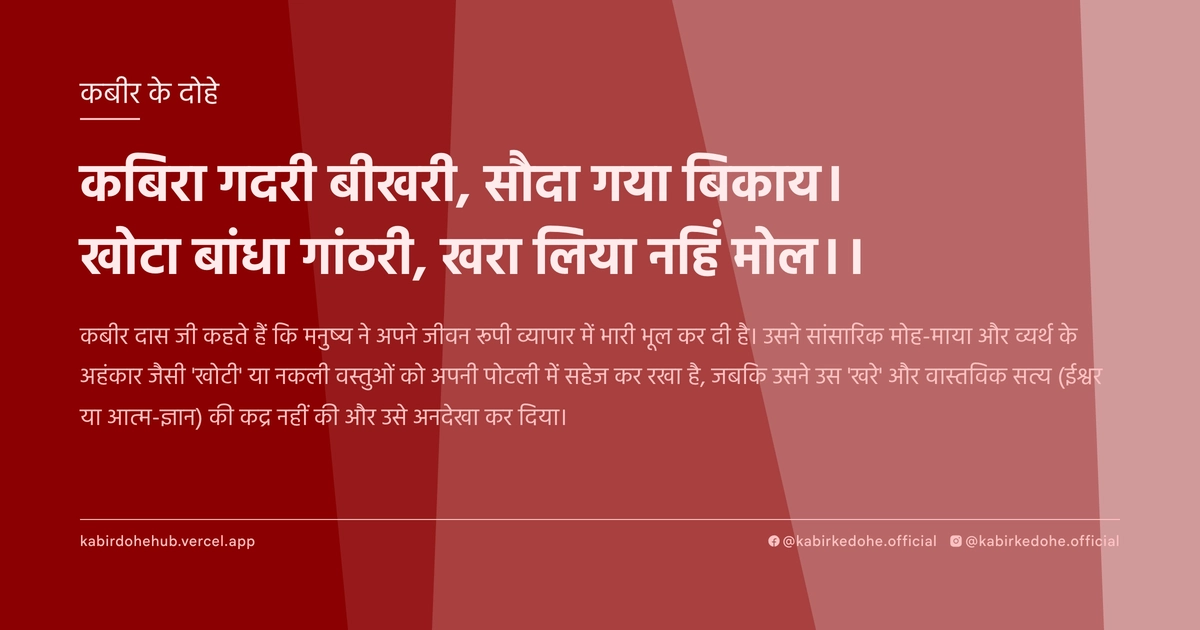
कबिरा गदरी बीखरी, सौदा गया बिकाय।
खोटा बांधा गांठरी, खरा लिया नहिं मोल।।
Kabira gadri bikhari, sauda gaya bikay. Khota bandha ganthari, khara liya nahin mol.
इस पृष्ठ पर इस कबीर दोहे का अर्थ (meaning), हिंदी व्याख्या और अंग्रेज़ी अनुवाद, दार्शनिक विश्लेषण और व्यावहारिक जीवन सीख दी गई है। यह दोहा माया (Maya) विषय से जुड़ा है — Kabir doha meaning and explanation in Hindi and English.
अर्थ (Meaning):
कबीर दास जी कहते हैं कि मनुष्य ने अपने जीवन रूपी व्यापार में भारी भूल कर दी है। उसने सांसारिक मोह-माया और व्यर्थ के अहंकार जैसी 'खोटी' या नकली वस्तुओं को अपनी पोटली में सहेज कर रखा है, जबकि उसने उस 'खरे' और वास्तविक सत्य (ईश्वर या आत्म-ज्ञान) की कद्र नहीं की और उसे अनदेखा कर दिया।
Kabir suggests that humanity has failed in the ultimate trade of existence. We have spent our lives meticulously gathering 'counterfeit' goods—worldly attachments, ego, and superficial rituals—while completely ignoring and failing to value the 'pure gold' of spiritual awakening and the eternal truth of the soul.
व्याख्या (Interpretation):
यहाँ 'गदरी' और 'सौदा' व्यापार के रूपक हैं। literal अर्थ में यह एक व्यापारी की कहानी है जिसने असली माल छोड़कर नकली माल इकट्ठा किया। आध्यात्मिक स्तर पर, 'खोटा' माया और अहंकार का प्रतीक है, जबकि 'खरा' निर्गुण ब्रह्म और आत्म-साक्षात्कार है। यह दोहा अद्वैत वेदांत के उस सिद्धांत को दर्शाता है जहाँ जीव अपनी वास्तविक पहचान (ब्रह्म) को भूलकर मिथ्या जगत (माया) को सत्य मान बैठता है। यह विरोधाभास है कि हम जिसे अनमोल समझते हैं वह नश्वर है, और जिसे हम तुच्छ समझते हैं वही शाश्वत है। अंततः, यह आत्मा की उस त्रासदी को दर्शाता है जहाँ वह सत्य के सामने अंधा होकर भ्रम की पोटली ढो रहा है।
The 'gadri' (bundle) and 'sauda' (trade) serve as potent metaphors for the human journey. Literally, it describes a merchant who mistakenly collects counterfeit goods while discarding genuine gold. Metaphorically, the 'khota' (counterfeit) represents Maya—the illusion of the material world and the ego—while the 'khara' (pure) symbolizes the Nirgun Brahman and the realization of the Self. This aligns with Advaita Vedanta, where the soul forgets its non-dual nature and identifies with the transient. The central paradox lies in the human tendency to cherish the perishable and despise the eternal. It highlights the spiritual tragedy of prioritizing social status and sensory pleasure over the silent, formless truth of the Atman.
दार्शनिक विश्लेषण (Philosophical Analysis):
कबीर का यह दोहा उनके युग के धार्मिक पाखंड और बाहरी आडंबरों पर एक तीखा प्रहार है। उन्होंने देखा कि लोग तीर्थयात्रा, कठिन व्रत और जातिगत श्रेष्ठता जैसी 'खोटी' चीजों में उलझे थे, जबकि हृदय की शुद्धि और प्रेम जैसे 'खरे' मूल्यों को भुला दिया गया था। यह दृष्टिकोण सूफी मत के 'फना' (अहंकार का विनाश) और भक्ति आंदोलन के आंतरिक समर्पण से मेल खाता है।
दार्शनिक रूप से, कबीर यहाँ 'मूल्य' (Value) की अवधारणा को चुनौती दे रहे हैं। समाज जिसे सफलता मानता है, कबीर उसे आध्यात्मिक विफलता कहते हैं। जब तक मनुष्य अपनी पहचान को शरीर, नाम या पद से जोड़ता है, वह 'खोटी गांठरी' बांध रहा होता है।
अद्वैत वेदांत के अनुसार, अज्ञान (Avidya) ही वह पर्दा है जो हमें असली और नकली के बीच भेद करने से रोकता है। कबीर इस अज्ञान को मिटाने के लिए 'सत्य' के प्रति जागरूकता का आह्वान करते हैं।
यह दोहा केवल धार्मिक नहीं, बल्कि मनोवैज्ञानिक भी है। यह बताता है कि मनुष्य अक्सर उस चीज़ के पीछे भागता है जो उसे तात्कालिक संतुष्टि दे, भले ही वह अंततः उसे खाली हाथ छोड़ दे।
अंततः, कबीर का संदेश यह है कि मोक्ष किसी बाहरी वस्तु या कर्मकांड से नहीं, बल्कि स्वयं के भीतर छिपे उस 'खरे' तत्व को पहचानने से मिलता है जिसे हमने दुनिया की भीड़ में खो दिया है।
This couplet is a sharp critique of the religious hypocrisy and outward ostentation prevalent during Kabir's era. He observed people obsessing over 'counterfeit' pursuits—pilgrimages, rigid fasting, and caste superiority—while neglecting the 'pure' values of heart-centered devotion and inner purity. This perspective resonates deeply with the Sufi concept of 'Fana' (annihilation of the ego) and the Bhakti movement's emphasis on internal surrender.
Philosophically, Kabir challenges the societal definition of 'Value.' What the world perceives as success, Kabir defines as spiritual bankruptcy. As long as a human identifies themselves through the body, a title, or a social rank, they are merely tightening the knots of a 'counterfeit bundle.'
According to Advaita Vedanta, it is Avidya (ignorance) that blinds the seeker to the distinction between the Real (Sat) and the Unreal (Asat). Kabir calls for a radical awakening to strip away these illusions.
Psychologically, the poem addresses the human tendency to seek immediate, sensory gratification over long-term spiritual liberation. We are wired to collect the tangible, even if it is worthless, while ignoring the intangible truth.
Ultimately, Kabir asserts that liberation is not found in external rituals but in recognizing the 'pure gold' of the Atman residing within, which has been ignored in the clamor of worldly ambitions.
मूल संदेश (Core Message):
- सांसारिक मोह एक भ्रम है जो हमें सत्य से दूर ले जाता है।
- अहंकार की पोटली भारी तो होती है, पर उसमें मूल्य शून्य होता है।
- सच्चा लाभ भौतिक संचय नहीं, बल्कि आत्म-बोध है।
- बाहरी आडंबरों को त्यागकर आंतरिक शुद्धता को अपनाएं।
- ईश्वर और आत्मा ही जीवन के एकमात्र 'खरे' सिक्के हैं।
- Worldly attachment is an illusion that veils the ultimate truth.
- The bundle of ego is heavy, yet its intrinsic value is zero.
- True profit is not material accumulation, but self-realization.
- Discard external pretenses to embrace internal purity.
- The Divine and the Soul are the only 'pure coins' of existence.
व्यावहारिक उदाहरण (Practical Example):
एक समय की बात है, वाराणसी के घाटों पर माधव नाम का एक बूढ़ा बुनकर रहता था। माधव अपनी पूरी जिंदगी बेहतरीन रेशमी कपड़े बुनने में लगा रहा। उसने अपनी सारी ऊर्जा और समय इस बात में लगाया कि उसके कपड़े शहर के सबसे अमीर सेठों द्वारा खरीदे जाएं। उसने अपनी साख बनाने के लिए झूठ बोला, अपने परिवार को समय नहीं दिया और केवल धन संचय को ही जीवन का लक्ष्य माना।
माधव को लगता था कि उसकी 'गांठरी' (सफलता की पोटली) बहुत भारी और मूल्यवान है। वह अक्सर अपने पड़ोसियों को नीचा दिखाता था जो साधारण जीवन जीते थे।
एक दिन, माधव बहुत बीमार पड़ गया। उसके पास धन की कोई कमी नहीं थी, लेकिन उसके पास एक भी ऐसा मित्र या संबंधी नहीं था जो उसके सिरहाने बैठकर उसका हाथ पकड़ सके। उसके बच्चे, जिन्हें उसने केवल पैसे भेजे थे, अब उसकी संपत्ति के बंटवारे की योजना बना रहे थे।
उस बिस्तर पर लेटे हुए, माधव ने महसूस किया कि उसने जीवन भर जिस 'सौदा' को खरा समझा था, वह वास्तव में 'खोटा' था। रेशम के कपड़े, सोने के सिक्के और सामाजिक प्रतिष्ठा—सब मिट्टी की तरह बेजान थे।
तभी उसकी मुलाकात एक फकीर से हुई, जिसने उससे कहा, "माधव, तूने पूरी उम्र नकली धागों से रिश्ता जोड़ा, असली धागा तो वह था जो तुझे तेरे भीतर के ईश्वर से जोड़ता।"
यह 'कबीर ट्विस्ट' माधव के हृदय को झकझोर गया। उसने महसूस किया कि उसने रिश्तों की गर्माहट और आत्म-शांति को त्याग कर केवल भौतिक वस्तुओं का ढेर लगाया था।
अपने अंतिम दिनों में, माधव ने अपनी सारी संपत्ति गरीबों में बांट दी और चुपचाप ध्यान में बैठने लगा।
उसने अब बाहरी दुनिया की 'खोटी गांठरी' को छोड़कर, अपने भीतर के 'खरे' मौन को पकड़ लिया था।
उसकी मृत्यु के समय उसके चेहरे पर एक ऐसी शांति थी जो उसने अपने सबसे महंगे रेशमी कपड़े बेचकर भी कभी नहीं खरीदी थी।
माधव ने अंततः समझ लिया कि असली व्यापार वह है जहाँ हम अहंकार को बेचकर प्रेम और सत्य को खरीदते हैं।
Once, in the ghats of Varanasi, lived an elderly weaver named Madhav. Madhav spent his entire life weaving the finest silk fabrics. He poured all his energy and time into ensuring his textiles were bought by the wealthiest merchants in the city. To build his reputation, he lied, neglected his family, and viewed the accumulation of wealth as the sole purpose of existence.
Madhav believed his 'bundle' (the collection of his achievements) was heavy and immensely valuable. He often looked down upon his neighbors who lived simple, unassuming lives.
One day, Madhav fell gravely ill. He had no shortage of money, but he didn't have a single friend or relative who would sit by his bedside and hold his hand. His children, to whom he had sent only money, were now plotting the division of his estate.
Lying on that bed, Madhav realized that the 'trade' he had considered genuine for a lifetime was, in fact, 'counterfeit.' The silk fabrics, the gold coins, and the social prestige—all were as lifeless as dust.
During this time, he met a wandering dervish who told him, "Madhav, you spent your whole life bonding with fake threads; the real thread was the one that connects you to the Divine within."
This 'Kabir Twist' shook Madhav to his core. He realized he had discarded the warmth of relationships and inner peace to pile up material objects.
In his final days, Madhav distributed all his wealth among the poor and began to sit in silent meditation.
He had finally let go of the 'counterfeit bundle' of the external world and grasped the 'pure' silence within.
At the moment of his passing, there was a serenity on his face that he had never been able to buy, even by selling his most expensive silks.
Madhav finally understood that the only true trade is the one where we sell our ego to purchase love and truth.
अभ्यास मार्गदर्शन (Practice Guidance):
- प्रतिदिन 20 मिनट मौन अभ्यास करें, जहाँ आप अपने विचारों को 'खोटे' (अस्थायी) और 'खरे' (शाश्वत) के रूप में वर्गीकृत करें।
- एक डायरी लिखें जिसमें आप उन तीन सामाजिक उपलब्धियों को लिखें जिन्हें आप सबसे महत्वपूर्ण मानते हैं, और फिर विश्लेषण करें कि क्या वे आपकी मृत्यु के समय किसी काम आएंगी।
- व्यवहार परिवर्तन: किसी ऐसे व्यक्ति की निस्वार्थ सेवा करें जिससे आपका कोई निजी स्वार्थ न जुड़ा हो, ताकि अहंकार की गांठ ढीली हो सके।
- डायग्नोस्टिक चेकलिस्ट: क्या मैं अपनी पहचान अपने पद/संपत्ति से करता हूँ? क्या मैं दूसरों की प्रशंसा पर निर्भर हूँ? क्या मैं आंतरिक शांति से अधिक बाहरी दिखावे को महत्व देता हूँ? (यदि हाँ, तो आप 'खोटी गांठरी' बांध रहे हैं)।
- Practice 20 minutes of daily silence, categorizing your thoughts into 'counterfeit' (transient) and 'pure' (eternal).
- Maintain a journal listing three social achievements you value most, then analyze if they hold any significance in the face of mortality.
- Behavioral Shift: Perform a selfless act of service for someone from whom you expect nothing in return, to loosen the knots of the ego.
- Diagnostic Checklist: Do I identify myself by my title or possessions? Am I dependent on external validation? Do I value appearance over inner peace? (If yes, you are gathering the 'counterfeit bundle').
चिंतन प्रश्न (Reflection Questions):
- मेरी वह कौन सी 'खोटी' उपलब्धि है जिसे मैं दुनिया के सामने सबसे ज्यादा गर्व से प्रदर्शित करता हूँ?
- यदि आज मेरी सारी सामाजिक पहचान छीन ली जाए, तो मेरे भीतर क्या बचेगा?
- मैं अपनी डिजिटल पहचान (Social Media Ego) को संवारने में कितना समय व्यर्थ करता हूँ?
- क्या मेरा धर्म केवल रीति-रिवाजों का पालन है, या यह मुझे वास्तव में करुणा की ओर ले जा रहा है?
- मैं किन डर और असुरक्षाओं के कारण 'नकली' चीजों को पकड़ कर बैठा हूँ?
- क्या मैं सत्य को सुनने के लिए तैयार हूँ, या मैं केवल अपनी मान्यताओं की पुष्टि चाहता हूँ?
- What is the 'counterfeit' achievement that I display with the most pride to the world?
- If all my social identities were stripped away today, what would remain within me?
- How much time do I waste polishing my digital ego on social media?
- Is my spirituality merely a set of rituals, or is it actually leading me toward compassion?
- What fears and insecurities drive me to cling to these 'fake' attachments?
- Am I truly ready to hear the truth, or am I only seeking confirmation of my own biases?