
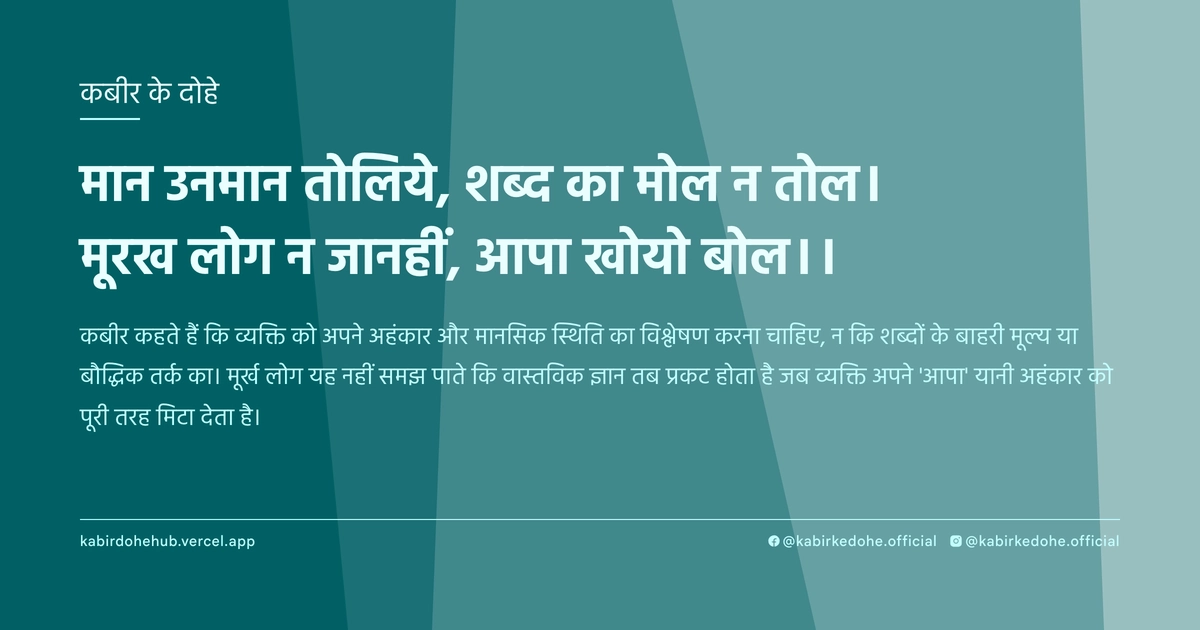
मान उनमान तोलिये, शब्द का मोल न तोल।
मूरख लोग न जानहीं, आपा खोयो बोल।।
Maan unmaan toliye, shabd ka mol na tol. Murakh log na janahin, aapa khoyo bol.
इस पृष्ठ पर इस कबीर दोहे का अर्थ (meaning), हिंदी व्याख्या और अंग्रेज़ी अनुवाद, दार्शनिक विश्लेषण और व्यावहारिक जीवन सीख दी गई है। यह दोहा अहंकार (The Ego) विषय से जुड़ा है — Kabir doha meaning and explanation in Hindi and English.
अर्थ (Meaning):
कबीर कहते हैं कि व्यक्ति को अपने अहंकार और मानसिक स्थिति का विश्लेषण करना चाहिए, न कि शब्दों के बाहरी मूल्य या बौद्धिक तर्क का। मूर्ख लोग यह नहीं समझ पाते कि वास्तविक ज्ञान तब प्रकट होता है जब व्यक्ति अपने 'आपा' यानी अहंकार को पूरी तरह मिटा देता है।
Kabir suggests that one should weigh their own ego and state of consciousness rather than attempting to measure the value of words through intellectual logic. The ignorant fail to realize that true spiritual utterance only occurs when the 'Aapa' or the individual ego is completely dissolved.
व्याख्या (Interpretation):
यहाँ 'मान' और 'उनमान' का अर्थ सामाजिक प्रतिष्ठा और मानसिक भ्रम से है। कबीर चेतावनी देते हैं कि शब्दों का विश्लेषण करना केवल बौद्धिक व्यायाम है, जो सत्य तक नहीं पहुँचाता। जब तक 'आपा' (अहंकार) मौजूद है, शब्द केवल शोर हैं। निर्गुण भक्ति के अनुसार, ईश्वर शब्दों में नहीं, बल्कि शून्य में है। यह अद्वैत वेदांत के उस सिद्धांत को दर्शाता है जहाँ ज्ञाता और ज्ञेय का भेद मिट जाता है। जब अहंकार विलीन होता है, तब जो बोलता है वह व्यक्ति नहीं, बल्कि स्वयं ब्रह्म होता है। यह विरोधाभास है कि मौन रहकर ही सबसे प्रभावशाली बात कही जा सकती है।
Here, 'Maan' and 'Unmaan' refer to social prestige and mental delusions. Kabir warns that analyzing words is merely an intellectual exercise that does not lead to Truth. As long as 'Aapa' (the ego) exists, words remain mere noise. According to Nirgun Bhakti, the Divine is not found in words but in the Void. This aligns with Advaita Vedanta, where the distinction between the knower and the known vanishes. When the ego is dissolved, it is no longer the individual speaking, but Brahman itself. It is the central paradox that the most profound speech emerges only after the death of the speaking self.
दार्शनिक विश्लेषण (Philosophical Analysis):
कबीर का यह दोहा उनके समय के उस वातावरण पर प्रहार करता है जहाँ पंडित और मुल्ला शब्दों के जाल और शास्त्रार्थ में उलझे रहते थे। वे तर्क देते हैं कि सत्य 'तर्क' का विषय नहीं, बल्कि 'अनुभव' का विषय है। यह दृष्टिकोण सूफीवाद के 'फना' (अहंकार का विनाश) के समान है, जहाँ साधक अपनी पहचान को ईश्वर में विलीन कर देता है।
कबीर कर्मकांड और बाहरी दिखावे को पूरी तरह नकारते हैं। उनके लिए, शब्दों का मोल तब तक शून्य है जब तक वे हृदय की गहराई से न निकले हों। वे समझाते हैं कि बौद्धिक अहंकार अक्सर सत्य के मार्ग में सबसे बड़ी बाधा बनता है, क्योंकि व्यक्ति यह सोचने लगता है कि वह सत्य को 'जानता' है, जबकि सत्य को केवल 'होने' का अनुभव किया जा सकता है।
अद्वैत वेदांत के परिप्रेक्ष्य में, 'आपा' वह माया है जो आत्मा को शरीर और मन से जोड़ती है। जब यह बंधन टूटता है, तब व्यक्ति को बोध होता है कि वह अलग नहीं, बल्कि संपूर्ण ब्रह्मांड का हिस्सा है। कबीर इस मनोवैज्ञानिक परिवर्तन पर जोर देते हैं जहाँ 'मैं' का विलोपन ही वास्तविक ज्ञान की शुरुआत है।
ऐतिहासिक रूप से, कबीर ने जाति और धर्म की दीवारों को गिराने के लिए इसी 'अहंकार-शून्यता' का उपयोग किया। उन्होंने दिखाया कि एक जुलाहा, जो शास्त्रों का ज्ञाता नहीं है, वह भी उस परम सत्य को पा सकता है जिसे बड़े-बड़े विद्वान अपनी किताबों में खोजते रहे।
अंततः, यह दोहा हमें यह सिखाता है कि आध्यात्मिक प्रगति शब्दों के संचय से नहीं, बल्कि अहंकार के विसर्जन से होती है। जो व्यक्ति स्वयं को शून्य कर लेता है, वही वास्तव में पूर्ण हो जाता है।
This couplet strikes at the heart of the contemporary environment of Kabir's era, where pundits and mullahs were entangled in the webs of linguistic gymnastics and scholastic debates. He argues that Truth is not a subject of 'logic' but a matter of 'experience.' This perspective mirrors the Sufi concept of 'Fana' (annihilation of the self), where the seeker merges their identity into the Divine.
Kabir completely rejects ritualism and outward displays of piety. For him, the value of words remains zero unless they emanate from the depths of the heart. He explains that intellectual ego often becomes the greatest obstacle on the path to Truth, as the individual begins to believe they 'know' the Truth, whereas Truth can only be 'experienced' by becoming it.
From the lens of Advaita Vedanta, 'Aapa' is the Maya that binds the Atman to the body and mind. When this bond is severed, the individual realizes they are not separate, but an integral part of the universal Brahman. Kabir emphasizes this psychological transformation where the dissolution of the 'I' marks the beginning of actual enlightenment.
Historically, Kabir used this 'ego-lessness' to dismantle the walls of caste and religion. He demonstrated that a weaver, devoid of formal scriptural education, could attain the Supreme Truth that great scholars spent lifetimes searching for in books.
Ultimately, this Doha teaches us that spiritual progress is achieved not through the accumulation of words, but through the surrender of the ego. He who renders themselves as zero becomes, in essence, the Infinite.
मूल संदेश (Core Message):
- बौद्धिक तर्क सत्य का मार्ग नहीं, बल्कि एक बाधा है।
- शब्दों के मूल्य से अधिक महत्वपूर्ण बोलने वाले की चेतना है।
- अहंकार का विसर्जन ही वास्तविक ज्ञान का एकमात्र द्वार है।
- जब 'मैं' मिटता है, तब केवल 'सत्य' शेष रहता है।
- मौन में वह शक्ति है जो हज़ारों शब्दों को अर्थहीन कर देती है।
- Intellectual logic is not the path to Truth, but often a barrier.
- The consciousness of the speaker is more vital than the value of the words.
- The dissolution of ego is the only gateway to authentic knowledge.
- When the 'I' vanishes, only the 'Truth' remains.
- Silence possesses a power that renders thousands of words meaningless.
व्यावहारिक उदाहरण (Practical Example):
वाराणसी के एक पुराने घाट पर, माधव नाम का एक वृद्ध मूर्तिकार रहता था। वह अपनी कला में इतना निपुण था कि लोग दूर-दूर से उसकी मूर्तियाँ देखने आते थे। माधव को अपनी कला का बहुत अहंकार था; वह मानता था कि उसकी उंगलियाँ ईश्वरीय हैं और कोई भी उसकी बराबरी नहीं कर सकता।
एक दिन, एक साधारण सा साधु उसके पास आया और उसकी सबसे सुंदर मूर्ति को देखकर बस इतना कहा, "पत्थर तो सुंदर है, पर इसमें वह कलाकार कहाँ है जो इसे तराश रहा था?"
माधव क्रोधित हो गया। उसने साधु को अपनी वर्षों की मेहनत, अपनी तकनीक और अपनी प्रसिद्धि के बारे में लंबे-चौड़े तर्क दिए। उसने शब्दों के जाल बुने कि वह कैसे दुनिया का सर्वश्रेष्ठ मूर्तिकार है।
साधु मुस्कुराया और बोला, "तुम अपनी कला की बात कर रहे हो, लेकिन तुम्हारी कला में केवल 'तुम' दिख रहे हो, वह 'शून्य' नहीं दिख रहा जहाँ से सृजन आता है। जब तक तुम खुद को महान मानोगे, तुम्हारी मूर्ति केवल पत्थर रहेगी, वह जीवित नहीं होगी।"
माधव को पहले तो यह बात समझ नहीं आई, लेकिन उस रात उसे नींद नहीं आई। उसने महसूस किया कि वह अपनी मूर्तियों को अपनी श्रेष्ठता सिद्ध करने का माध्यम बना चुका था।
अगले दिन, माधव ने एक नई मूर्ति बनानी शुरू की। इस बार उसने यह नहीं सोचा कि दुनिया क्या कहेगी या वह कितना प्रसिद्ध होगा। उसने अपनी पूरी पहचान, अपना नाम और अपना अहंकार उस पत्थर में विलीन कर दिया।
उसने खुद को पूरी तरह भुला दिया और केवल उस प्रक्रिया में खो गया। वह अब 'मूर्तिकार' नहीं था, वह केवल एक माध्यम था।
जब मूर्ति पूरी हुई, तो उसमें एक ऐसी अलौकिक शांति और जीवंतता थी जो उसकी पिछली किसी भी कृति में नहीं थी। माधव अब शब्दों से अपनी महानता सिद्ध नहीं करना चाहता था।
उसने महसूस किया कि जब उसने 'आपा' खोया, तब उसकी कला वास्तव में बोलना शुरू हुई। वह अब एक अहंकारी कलाकार नहीं, बल्कि एक विनम्र साधक बन चुका था।
On an ancient ghat in Varanasi lived an elderly sculptor named Madhav. He was so skilled in his craft that people traveled from afar to see his sculptures. Madhav was deeply proud of his art; he believed his fingers were divine and that no one could equal his precision.
One day, a simple monk approached him, looked at his most beautiful sculpture, and simply asked, "The stone is beautiful, but where is the artist who carved it?"
Madhav became enraged. He gave the monk long, elaborate arguments about his years of hard work, his techniques, and his fame. He wove a web of words to prove he was the world's greatest sculptor.
The monk smiled and said, "You speak of your art, but in your art, only 'you' are visible. The 'Void' from which creation flows is missing. As long as you consider yourself great, your sculpture will remain mere stone; it will never breathe."
Madhav did not understand at first, but that night, sleep eluded him. He realized that he had turned his sculptures into tools for proving his own superiority.
The next day, Madhav began a new sculpture. This time, he did not think about what the world would say or how famous he would become. He dissolved his entire identity, his name, and his ego into the stone.
He completely forgot himself and became lost in the process. He was no longer the 'sculptor'; he was merely a medium.
When the sculpture was finished, it possessed a divine peace and vitality that had been absent in all his previous works.
Madhav no longer felt the need to prove his greatness through words. He realized that when he lost his 'Aapa' (ego), his art truly began to speak.
He was no longer an arrogant artist, but a humble seeker who understood that the disappearance of the self is the birth of true creation.
अभ्यास मार्गदर्शन (Practice Guidance):
- प्रतिदिन 20 मिनट मौन अभ्यास करें, जहाँ आप किसी भी विचार को 'सही' या 'गलत' ठहराने के बजाय केवल उसे देखें।
- एक डायरी लिखें जिसमें आप उन क्षणों को दर्ज करें जब आपने अपनी बुद्धिमत्ता का उपयोग दूसरों को नीचा दिखाने या खुद को श्रेष्ठ सिद्ध करने के लिए किया।
- जब भी आप किसी बहस में हों, तो रुककर खुद से पूछें: "क्या मैं सत्य की खोज कर रहा हूँ या केवल अपनी जीत चाहता हूँ?"
- निदान चेकलिस्ट: क्या आप दूसरों की प्रशंसा पर बहुत अधिक निर्भर हैं? क्या आप अपनी उपलब्धियों का जिक्र बार-बार करते हैं? यदि हाँ, तो आपका 'आपा' अभी भी हावी है।
- Practice 20 minutes of daily silence, where you observe thoughts without labeling them as 'right' or 'wrong.'
- Maintain a journal recording moments where you used your intellect to belittle others or assert your own superiority.
- Whenever engaged in an argument, pause and ask yourself: "Am I seeking the Truth, or am I merely seeking a victory?"
- Diagnostic Checklist: Are you overly dependent on external praise? Do you frequently mention your achievements? If yes, your 'Aapa' (ego) is still dominant.
चिंतन प्रश्न (Reflection Questions):
- क्या मेरी शिक्षा और ज्ञान मुझे विनम्र बना रहे हैं, या वे मेरे अहंकार के लिए एक नया मुखौटा बन गए हैं?
- मैं अपनी सार्वजनिक छवि (Digital Ego) को बनाए रखने के लिए कितनी ऊर्जा खर्च करता हूँ, और वह ऊर्जा मेरे आंतरिक विकास को कैसे रोक रही है?
- यदि मुझसे मेरी सारी उपाधियाँ और उपलब्धियाँ छीन ली जाएँ, तो मेरे भीतर क्या बचेगा?
- क्या मैं वास्तव में दूसरों को सुनता हूँ, या मैं केवल अपनी बारी आने का इंतज़ार करता हूँ ताकि मैं अपनी बात कह सकूँ?
- मेरे जीवन का वह कौन सा क्षेत्र है जहाँ मैं 'सही' होने के जुनून में सत्य को अनदेखा कर रहा हूँ?
- Is my education and knowledge making me humble, or have they become a new mask for my ego?
- How much energy do I spend maintaining my public image (Digital Ego), and how is that hindering my internal growth?
- If all my titles and achievements were stripped away, what would remain within me?
- Do I truly listen to others, or am I merely waiting for my turn to speak my piece?
- In which area of my life am I ignoring the Truth in my obsession with being 'right'?