
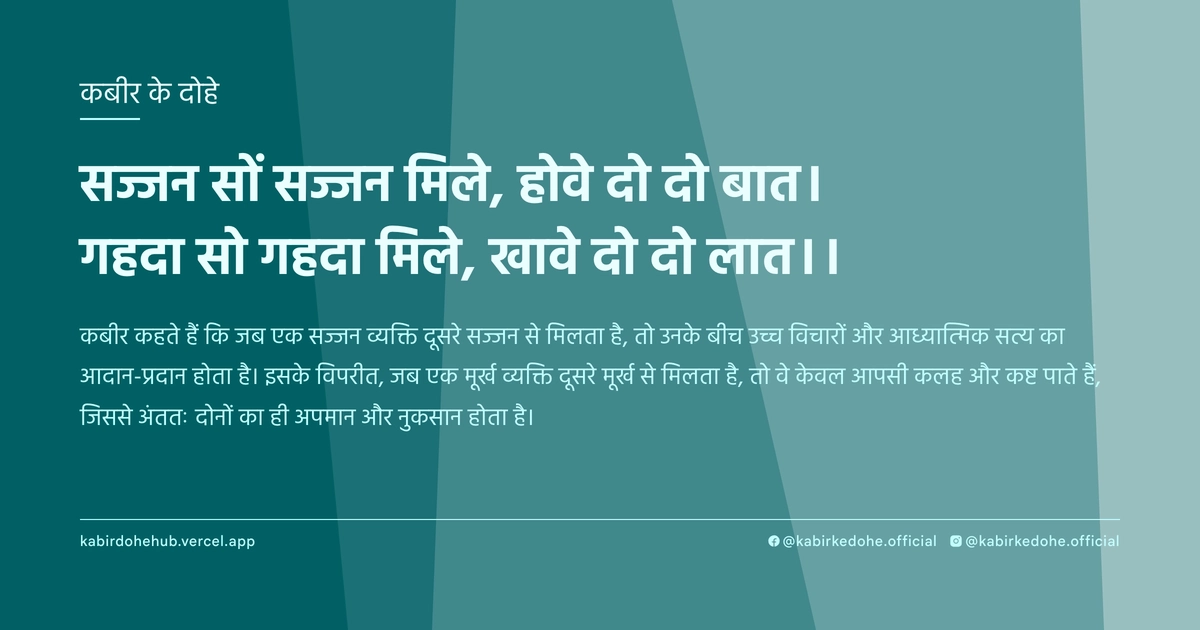
सज्जन सों सज्जन मिले, होवे दो दो बात।
गहदा सो गहदा मिले, खावे दो दो लात।।
Sajjan son sajjan mile, hove do do baat. Gahda so gahda mile, khave do do laat.
इस पृष्ठ पर इस कबीर दोहे का अर्थ (meaning), हिंदी व्याख्या और अंग्रेज़ी अनुवाद, दार्शनिक विश्लेषण और व्यावहारिक जीवन सीख दी गई है। यह दोहा सत्संग (Satsang) विषय से जुड़ा है — Kabir doha meaning and explanation in Hindi and English.
अर्थ (Meaning):
कबीर कहते हैं कि जब एक सज्जन व्यक्ति दूसरे सज्जन से मिलता है, तो उनके बीच उच्च विचारों और आध्यात्मिक सत्य का आदान-प्रदान होता है। इसके विपरीत, जब एक मूर्ख व्यक्ति दूसरे मूर्ख से मिलता है, तो वे केवल आपसी कलह और कष्ट पाते हैं, जिससे अंततः दोनों का ही अपमान और नुकसान होता है।
Kabir asserts that when a wise person encounters another wise soul, they engage in a meaningful exchange of spiritual truths and elevated thoughts. Conversely, when a fool meets another fool, their interaction leads only to mutual conflict and ignorance, resulting in shared suffering and degradation for both.
व्याख्या (Interpretation):
यह दोहा संगति के प्रभाव और चेतना के स्तर पर आधारित है। 'सज्जन' यहाँ केवल अच्छे व्यवहार वाले लोग नहीं, बल्कि वे हैं जिन्होंने अपनी इंद्रियों पर विजय प्राप्त कर ली है और जो 'निर्गुण' सत्य को पहचानते हैं। जब दो ऐसी चेतनाएँ मिलती हैं, तो 'दो दो बात' का अर्थ है संवाद जो आत्मा को ऊपर उठाता है। दूसरी ओर, 'गहदा' (गधा) अज्ञानता और अहंकार का प्रतीक है। यह माया के प्रभाव में फँसे उन लोगों को दर्शाता है जो केवल बाहरी दिखावे और संकीर्ण सोच में विश्वास करते हैं। यहाँ विरोधाभास यह है कि अज्ञानी लोग अक्सर एक-दूसरे की ओर आकर्षित होते हैं, लेकिन उनका मिलन केवल विनाशकारी होता है क्योंकि उनमें आत्म-साक्षात्कार का अभाव होता है। यह अद्वैत वेदांत के उस सिद्धांत को पुष्ट करता है जहाँ ज्ञान ही एकमात्र मुक्ति का मार्ग है और अज्ञानता बंधन का कारण है।
This couplet focuses on the profound impact of association and the vibrational levels of consciousness. 'Sajjan' does not merely refer to polite people, but to those who have conquered their senses and recognized the 'Nirgun' (formless) truth. When two such consciousnesses meet, 'do do baat' signifies a dialogue that elevates the soul. Conversely, the 'gahda' (donkey) symbolizes ignorance and the heavy burden of the ego. It represents those trapped in Maya, clinging to superficialities and narrow perspectives. The paradox lies in the fact that the ignorant are often drawn to one another, yet their union is destructive because it lacks the spark of self-realization. This reinforces the Advaita Vedanta principle that while knowledge is the only path to liberation, ignorance ensures continued bondage and suffering.
दार्शनिक विश्लेषण (Philosophical Analysis):
कबीर का यह विचार उनके युग के सामाजिक और धार्मिक पाखंड के विरुद्ध एक प्रहार है। उन्होंने देखा कि कैसे लोग केवल जाति, धर्म या बाहरी अनुष्ठानों के आधार पर समूह बनाते हैं, जबकि वास्तविक 'सज्जनता' आंतरिक शुद्धता में निहित है। यह सूफी मत के 'इन्सान-ए-कामिल' (पूर्ण मनुष्य) की अवधारणा से मेल खाता है, जहाँ सत्य की खोज के लिए एक योग्य मार्गदर्शक या साथी की आवश्यकता होती है।
दार्शनिक स्तर पर, कबीर यहाँ 'सत्संग' के महत्व को रेखांकित कर रहे हैं। उनके लिए सत्संग का अर्थ केवल साथ बैठना नहीं, बल्कि समान आध्यात्मिक आवृत्ति (frequency) पर संवाद करना है। जब अहंकार (Ego) हावी होता है, तो मनुष्य 'गधे' के समान हो जाता है, जो केवल बोझ ढोता है और प्रहार सहता है। यह अहंकार ही है जो उसे सत्य देखने से रोकता है।
अद्वैत वेदांत के अनुसार, जब दो व्यक्ति अपनी व्यक्तिगत पहचान (अहंकार) को त्यागकर ब्रह्म के स्वरूप में मिलते हैं, तो वह मिलन मोक्षदायी होता है। लेकिन जब दो व्यक्ति अपनी सीमित पहचान और पूर्वाग्रहों के साथ मिलते हैं, तो वे केवल संघर्ष पैदा करते हैं। कबीर यहाँ चेतावनी दे रहे हैं कि यदि हम अपनी संगति नहीं बदलेंगे, तो हम अपनी अज्ञानता के चक्र में ही फंसे रहेंगे।
यह दोहा कर्म और संस्कार के सिद्धांत को भी दर्शाता है। हम जिन लोगों के साथ समय बिताते हैं, हमारे संस्कार वैसे ही हो जाते हैं। यदि हम मूर्खों की मंडली में रहते हैं, तो हम उनकी तरह ही प्रतिक्रिया करना शुरू कर देते हैं, जिससे जीवन में केवल 'लात' यानी कष्ट और अपमान ही मिलता है।
अंततः, कबीर यह संदेश देते हैं कि आध्यात्मिक प्रगति के लिए आत्म-निरीक्षण आवश्यक है। हमें यह पहचानना होगा कि हम 'सज्जन' की श्रेणी में हैं या 'गधे' की। यह भेद बाहरी नहीं, बल्कि आंतरिक है। जो व्यक्ति अपने भीतर के अंधकार को पहचान लेता है, वही प्रकाश की ओर बढ़ने का प्रयास करता है।
Kabir’s insight is a direct critique of the social and religious hypocrisy of his era. He observed how people formed groups based on caste, creed, or external rituals, whereas true 'sajjanata' (nobility) resides in internal purity. This aligns with the Sufi concept of 'Insan-e-Kamil' (the Perfect Human), where the quest for truth requires a compatible guide or companion.
On a philosophical level, Kabir emphasizes the importance of 'Satsang' (company of truth). For him, Satsang is not merely sitting together, but communicating on a shared spiritual frequency. When the ego dominates, a human becomes like the 'donkey,' carrying burdens of illusion and enduring the blows of life's hardships. It is this ego that blinds the individual to the ultimate reality.
According to Advaita Vedanta, when two beings meet by transcending their individual identities (ego) and recognizing the Brahman within, the union is liberating. However, when two people meet while clinging to their limited identities and prejudices, they create nothing but conflict. Kabir warns that unless we change our associations, we remain trapped in the cycle of ignorance.
This couplet also reflects the laws of Karma and Sanskaras. Our tendencies are shaped by the company we keep. If we dwell within a circle of fools, we begin to react with the same ignorance, resulting in 'laat'—the metaphorical blows of suffering and humiliation.
Ultimately, Kabir suggests that spiritual progress demands rigorous self-examination. We must discern whether we are operating from the state of a 'Sajjan' or a 'Gahda.' This distinction is not external or social, but internal. Only the one who recognizes their own inner darkness can strive toward the light.
मूल संदेश (Core Message):
- संगति ही आपकी चेतना का दर्पण है।
- अहंकार का साथ केवल अपमान और कष्ट लाता है।
- सच्चा संवाद आत्मा को ऊपर उठाता है।
- मूर्खता का मिलन विनाश का आमंत्रण है।
- आंतरिक सज्जनता ही वास्तविक सामाजिक प्रतिष्ठा है।
- विवेकपूर्ण चुनाव ही जीवन की दिशा बदलते हैं।
- Your association is the mirror of your consciousness.
- The company of ego brings only humiliation and pain.
- True dialogue elevates the soul to higher planes.
- The union of ignorance is an invitation to ruin.
- Inner nobility is the only true social prestige.
- Discriminating choices change the trajectory of life.
व्यावहारिक उदाहरण (Practical Example):
वाराणसी के एक पुराने घाट पर रामदीन नाम का एक वृद्ध नाविक रहता था। वह स्वभाव से अत्यंत क्रोधी था और हर बात पर दूसरों को कोसता रहता था। वह मानता था कि दुनिया उसके प्रति अन्याय कर रही है। उसकी संगति उन लोगों के साथ थी जो दिन भर दूसरों की बुराई करते और व्यवस्था को कोसते थे। उनके साथ बैठकर रामदीन का क्रोध और बढ़ जाता था, और अंततः वह अपनी ही नाव चलाने में गलतियाँ करता, जिससे उसे आर्थिक नुकसान और समाज में अपमान मिलता।
एक दिन घाट पर एक शांत स्वभाव के संन्यासी आए। उन्होंने देखा कि रामदीन गुस्से में एक ग्राहक पर चिल्ला रहा है। संन्यासी ने मुस्कुराते हुए रामदीन से कहा, 'बेटा, तुम जिस नाव पर सवार हो, उसका बोझ केवल सामान नहीं, बल्कि तुम्हारा क्रोध भी है।'
शुरुआत में रामदीन ने उन्हें अनसुना किया, लेकिन संन्यासी की स्थिरता ने उसे आकर्षित किया। धीरे-धीरे रामदीन ने उन नकारात्मक लोगों का साथ छोड़कर संन्यासी के साथ समय बिताना शुरू किया। संन्यासी उसे मौन और आत्म-अवलोकन की कला सिखाने लगे।
रामदीन ने महसूस किया कि जब वह उन 'मूर्खों' के साथ बैठता था, तो उसकी बातें केवल शिकायतें होती थीं, जिससे उसका मन और भारी हो जाता था। लेकिन संन्यासी के साथ उसकी बातें अब जीवन के उद्देश्य और शांति पर होने लगी थीं।
एक दिन, एक पुराना विवाद हुआ जब एक अन्य नाविक ने रामदीन की नाव से उसकी जगह छीनने की कोशिश की। पहले वाला रामदीन लड़ाई करता और शायद मारपीट पर उतर आता, जिससे उसे पुलिस या समाज की 'लात' मिलती।
लेकिन अब रामदीन ने शांति से उस व्यक्ति की समस्या को सुना और उसे एक वैकल्पिक रास्ता सुझाया। उसकी इस सज्जनता ने दूसरे नाविक का हृदय बदल दिया और वह उसका मित्र बन गया।
रामदीन ने अनुभव किया कि जब वह अज्ञानी लोगों के साथ था, तो वह केवल कष्ट बटोर रहा था। लेकिन जब उसने 'सज्जन' की संगति चुनी, तो उसके जीवन में विवादों की जगह सहयोग ने ले ली।
उसने समझा कि उसकी पिछली समस्याएँ बाहरी नहीं थीं, बल्कि उसकी संगति का परिणाम थीं। वह 'गधे' की तरह केवल बोझ ढो रहा था, जबकि अब वह एक मुक्त आत्मा की तरह जीवन जी रहा था।
इस 'कबीर ट्विस्ट' ने रामदीन को यह सिखाया कि हम किसके साथ बैठते हैं, यही तय करता है कि हम जीवन में सम्मान पाएंगे या अपमान।
आज रामदीन केवल नाव ही नहीं चलाता, बल्कि घाट पर आने वाले भटके हुए लोगों को शांति का मार्ग भी दिखाता है।
On an ancient ghat in Varanasi lived an elderly boatman named Ramdeen. He was temperamentally volatile, prone to anger, and spent his days cursing others. He believed the world was inherently unfair to him. His social circle consisted of people who spent their entire day gossiping and complaining about the system. Sitting with them only fueled Ramdeen's rage, leading him to make mistakes in his work, resulting in financial loss and social ridicule.
One day, a serene monk arrived at the ghat. He observed Ramdeen shouting at a customer. The monk smiled and said, 'Son, the boat you steer carries not just cargo, but the heavy weight of your own anger.'
Initially, Ramdeen ignored him, but the monk's unwavering stillness eventually attracted him. Slowly, Ramdeen began distancing himself from the toxic circle and started spending time with the monk, who taught him the art of silence and self-observation.
Ramdeen realized that when he sat with the 'fools,' his conversations were merely complaints, which made his heart heavier. But with the monk, his dialogues shifted toward the purpose of life and inner peace.
One day, a conflict arose when another boatman tried to seize Ramdeen's docking spot. The old Ramdeen would have fought violently, likely resulting in a physical brawl and the 'blows' of legal or social punishment.
However, the transformed Ramdeen listened calmly to the other man's grievance and suggested a practical alternative. This nobility of character touched the other boatman, and they became friends.
Ramdeen experienced firsthand that while he was with the ignorant, he collected only suffering. But by choosing the company of the 'Sajjan,' conflicts were replaced by cooperation.
He understood that his previous struggles were not external misfortunes, but the direct result of his associations. He had been like the 'donkey,' carrying a burden of ignorance, whereas he was now living as a liberated soul.
This 'Kabir Twist' taught Ramdeen that who we associate with determines whether we receive honor or humiliation in life.
Today, Ramdeen does not just row boats; he guides lost souls visiting the ghat toward the path of peace.
अभ्यास मार्गदर्शन (Practice Guidance):
- सत्संग का विश्लेषण: प्रतिदिन अपने उन संपर्कों की सूची बनाएं जो आपको मानसिक रूप से नीचे गिराते हैं और उन्हें धीरे-धीरे कम करें।
- मौन चिंतन: प्रतिदिन 20 मिनट मौन रहें और विचार करें कि आपके संवादों में 'सज्जनता' है या केवल 'अहंकार' की प्रतिक्रिया।
- आत्म-पूछताछ जर्नल: लिखें कि पिछले एक सप्ताह में आपने कितनी बार बिना सोचे-समझे प्रतिक्रिया दी (गधे की तरह) और कितनी बार विवेक का उपयोग किया (सज्जन की तरह)।
- डायग्नोस्टिक चेकलिस्ट: क्या आप दूसरों की बुराई सुनकर संतुष्ट महसूस करते हैं? क्या आप विवादों में खुद को सही साबित करने के लिए लड़ते हैं? यदि हाँ, तो आप अभी भी 'गहदा' संगति में हैं।
- Association Audit: Daily list the contacts who mentally drain you or pull you down, and consciously reduce your interaction with them.
- Silent Contemplation: Spend 20 minutes in silence daily, observing whether your conversations stem from 'nobility' or merely from 'egoic' reactions.
- Self-Inquiry Journal: Document instances from the past week where you reacted impulsively (like the donkey) versus where you acted with discernment (like the wise).
- Diagnostic Checklist: Do you feel a sense of satisfaction while listening to gossip? Do you fight desperately to prove yourself right in trivial arguments? If yes, you are still in the company of the ignorant.
चिंतन प्रश्न (Reflection Questions):
- क्या मेरी वर्तमान मित्रता मेरी आध्यात्मिक वृद्धि में सहायक है या यह केवल मेरे अहंकार को संतुष्ट कर रही है?
- जब मैं दूसरों की आलोचना करता हूँ, तो क्या मैं वास्तव में उनकी गलती देख रहा हूँ या अपनी ही कमियों को उन पर प्रक्षेपित कर रहा हूँ?
- मेरे जीवन में 'लात' (कष्ट) के रूप में आने वाली चुनौतियाँ क्या वास्तव में बाहरी हैं, या मेरी गलत संगति का परिणाम?
- क्या मैं उस व्यक्ति के साथ बैठने का साहस रखता हूँ जो मुझे मेरी गलतियाँ आईना दिखा सके, या मैं केवल अपनी हाँ में हाँ मिलाने वालों को खोजता हूँ?
- डिजिटल युग में, सोशल मीडिया पर मेरी 'संगति' मेरी मानसिक शांति को बढ़ा रही है या घटा रही है?
- Does my current circle of friends aid my spiritual growth, or does it merely feed my ego?
- When I criticize others, am I truly seeing their flaws, or am I projecting my own shadows onto them?
- Are the 'blows' (hardships) in my life truly external, or are they the harvest of my poor associations?
- Do I have the courage to sit with someone who mirrors my faults, or do I only seek those who echo my own beliefs?
- In the digital age, is my online 'association' enhancing my mental peace or eroding it?