
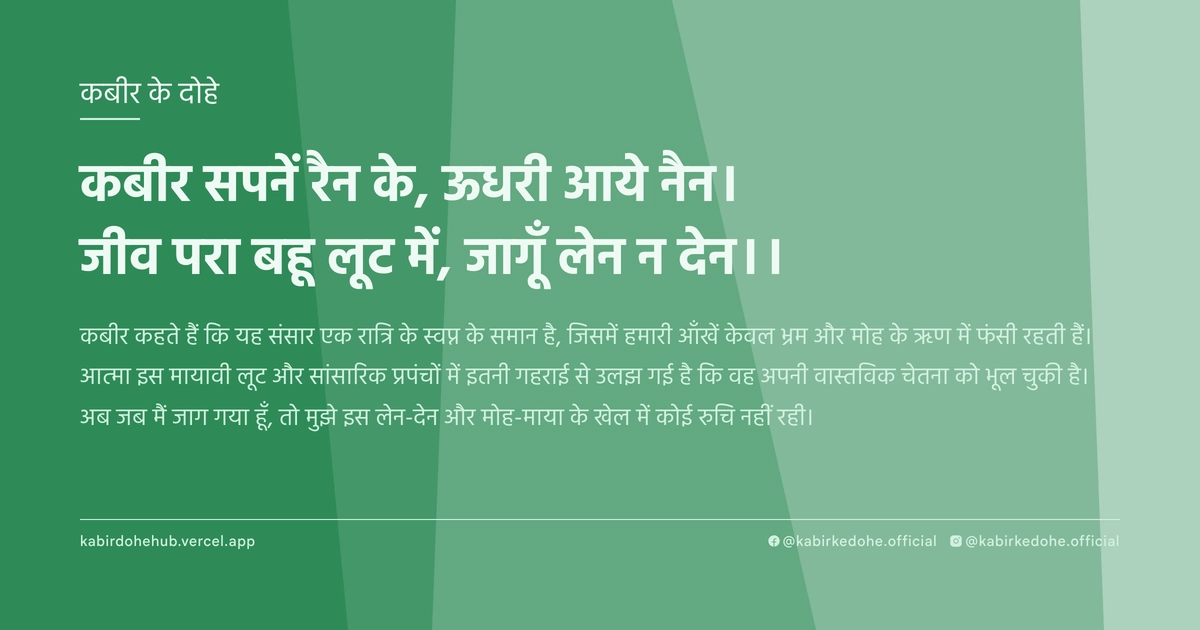
कबीर सपनें रैन के, ऊधरी आये नैन।
जीव परा बहू लूट में, जागूँ लेन न देन।।
Kabir sapne rain ke, udhari aaye nain. Jeev para bahu loot me, jaagun len na den.
इस पृष्ठ पर इस कबीर दोहे का अर्थ (meaning), हिंदी व्याख्या और अंग्रेज़ी अनुवाद, दार्शनिक विश्लेषण और व्यावहारिक जीवन सीख दी गई है। यह दोहा जागृति (The Wake-up Call) विषय से जुड़ा है — Kabir doha meaning and explanation in Hindi and English.
अर्थ (Meaning):
कबीर कहते हैं कि यह संसार एक रात्रि के स्वप्न के समान है, जिसमें हमारी आँखें केवल भ्रम और मोह के ऋण में फंसी रहती हैं। आत्मा इस मायावी लूट और सांसारिक प्रपंचों में इतनी गहराई से उलझ गई है कि वह अपनी वास्तविक चेतना को भूल चुकी है। अब जब मैं जाग गया हूँ, तो मुझे इस लेन-देन और मोह-माया के खेल में कोई रुचि नहीं रही।
Kabir asserts that this worldly existence is akin to a nocturnal dream, where our vision is clouded by the borrowed illusions of desire and attachment. The soul has been plundered by the deceptive lures of Maya, losing its essence in the chaotic exchange of material gains. Now that the poet has awakened to spiritual consciousness, he remains detached from the transactional nature of existence.
व्याख्या (Interpretation):
यहाँ 'सपनें रैन के' का अर्थ केवल नींद का सपना नहीं, बल्कि अविद्या या अज्ञान है। कबीर बताते हैं कि मनुष्य जिसे वास्तविकता मानता है, वह वास्तव में एक मानसिक प्रक्षेपण है। 'ऊधरी आये नैन' संकेत करता है कि हमारी दृष्टि उधार की है—हम दुनिया को अपनी आत्मा से नहीं, बल्कि सामाजिक कंडीशनिंग और अहंकार के चश्मे से देखते हैं। यह स्थिति निर्गुण भक्ति के उस सिद्धांत को पुष्ट करती है जहाँ संसार को 'मिथ्या' कहा गया है। जब जीव 'लूट' में पड़ता है, तो वह अपनी शाश्वत शांति को क्षणिक सुखों के लिए बेच देता है। अंततः, 'जागना' का अर्थ है समाधि या आत्म-साक्षात्कार, जहाँ द्वैत समाप्त हो जाता है और आत्मा ब्रह्म में विलीन हो जाती है। यह विरोधाभास है कि जागने के बाद व्यक्ति उस दुनिया के लिए 'मृत' हो जाता है जिसे वह पहले जीवित समझता था।
The phrase 'nocturnal dreams' refers not to literal sleep, but to Avidya (primordial ignorance). Kabir posits that what we perceive as reality is merely a mental projection. 'Borrowed eyes' suggests that our perception is not authentic; we view existence through the lens of social conditioning and ego. This aligns with Nirgun Bhakti, where the material world is viewed as 'Mithya' (illusory). When the soul is 'plundered,' it trades its eternal serenity for fleeting sensory pleasures. Ultimately, 'awakening' signifies Samadhi or self-realization, where duality dissolves and the Atman merges with Brahman. The central paradox is that upon awakening, the seeker becomes 'dead' to the world they once believed was the only reality.
दार्शनिक विश्लेषण (Philosophical Analysis):
कबीर का यह दोहा मध्यकालीन भारत के उस सामाजिक परिवेश से उपजा है जहाँ कर्मकांड और बाहरी आडंबरों का बोलबाला था। कबीर ने स्पष्ट रूप से उन सभी धार्मिक ढाँचों को नकारा जो मनुष्य को बाहरी दुनिया के लेन-देन में उलझाकर ईश्वर से दूर करते थे। उनका दृष्टिकोण अद्वैत वेदांत के करीब है, जहाँ माया को एक ऐसा पर्दा माना गया है जो सत्य को ढकता है। वे तर्क देते हैं कि जब तक मनुष्य स्वयं को शरीर या सामाजिक पहचान (जाति, धर्म) मानता है, वह उस 'लूट' का हिस्सा है।
सूफीवाद के 'फना' (अहंकार का विनाश) के सिद्धांत के साथ इसका गहरा संबंध है। जिस प्रकार एक सूफी अपनी व्यक्तिगत इच्छाओं को ईश्वर की इच्छा में विलीन कर देता है, कबीर भी 'लेन-देन' के त्याग की बात करते हैं। यह त्याग भौतिक गरीबी नहीं, बल्कि मानसिक वैराग्य है। वे समझाते हैं कि संसार की हर वस्तु एक ऋण है, जिसे अंततः चुकाना पड़ता है, और केवल आत्म-ज्ञान ही वह एकमात्र संपत्ति है जो स्थायी है।
मनोवैज्ञानिक स्तर पर, यह दोहा संज्ञानात्मक विसंगति (cognitive dissonance) को संबोधित करता है। हम जिसे 'जीवन' कहते हैं, वह अक्सर दूसरों की अपेक्षाओं और सामाजिक दबावों का एक संकलन होता है। कबीर इसे 'उधार की दृष्टि' कहते हैं। जब व्यक्ति इस पैटर्न को पहचान लेता है, तो वह मानसिक गुलामी से मुक्त हो जाता है।
अक्सर लोग इस दोहे को केवल संसार के त्याग के रूप में देखते हैं, लेकिन कबीर का संदेश 'सक्रिय वैराग्य' है। वे दुनिया छोड़ने को नहीं, बल्कि दुनिया के प्रति अपनी धारणा बदलने को कह रहे हैं। यह एक आंतरिक क्रांति है जहाँ व्यक्ति संसार में रहते हुए भी उससे अछूता रहता है, जैसे कमल का पत्ता पानी में रहकर भी गीला नहीं होता।
अंततः, यह विश्लेषण हमें बताता है कि मुक्ति किसी बाहरी देवता की कृपा से नहीं, बल्कि स्वयं के भीतर की नींद से जागने से मिलती है। जब 'मैं' और 'मेरा' का भ्रम टूटता है, तब जो शेष बचता है, वही शुद्ध चेतना है। यही वह बिंदु है जहाँ लेन-देन समाप्त होता है और अनंत प्रेम का आरम्भ होता है।
Kabir's couplet emerges from a medieval Indian milieu dominated by rigid ritualism and external piety. He explicitly rejects religious structures that tether the human spirit to the transactional nature of existence. His perspective resonates with Advaita Vedanta, where Maya is the veil obscuring the Absolute Truth. He argues that as long as one identifies with the body or a social label (caste, creed), they remain participants in the 'plunder' of the ego.
There is a profound connection here to the Sufi concept of 'Fana' (annihilation of the self). Just as a Sufi dissolves personal desire into the Divine Will, Kabir advocates for the cessation of 'give and take.' This is not a call for material poverty, but for mental detachment (Vairagya). He suggests that every worldly possession is a debt that must eventually be repaid, and only self-knowledge is a permanent asset.
Psychologically, this verse addresses cognitive dissonance. What we call 'life' is often a compilation of external expectations and social pressures. Kabir terms this 'borrowed vision.' Once an individual recognizes this pattern, they are liberated from mental servitude and the cycle of validation.
Common literalist interpretations suggest a total abandonment of the world, but Kabir proposes 'active detachment.' He does not ask us to leave the world, but to change our perception of it. It is an internal revolution where one remains in the world yet untouched by it, much like a lotus leaf in water.
Ultimately, this analysis reveals that liberation is not a gift from an external deity, but the result of awakening from one's own internal slumber. When the illusion of 'I' and 'Mine' shatters, what remains is pure consciousness. This is the point where transaction ends and infinite, selfless love begins.
मूल संदेश (Core Message):
- संसार एक मानसिक प्रक्षेपण है, इसे अंतिम सत्य न मानें।
- हमारी पहचान अक्सर उधार ली गई धारणाओं का संग्रह होती है।
- अहंकार का लेन-देन ही आत्मा की वास्तविक शांति को लूटता है।
- जागृति का अर्थ है बाहरी अपेक्षाओं से पूर्ण विरक्ति।
- सत्य वह है जो लेन-देन और द्वैत से परे स्थित है।
- The world is a mental projection; do not mistake it for ultimate truth.
- Our identity is often a collection of borrowed social perceptions.
- The transactions of the ego are what plunder the soul's peace.
- Awakening is the total detachment from external expectations.
- Truth exists beyond the realm of give-and-take and duality.
व्यावहारिक उदाहरण (Practical Example):
वाराणसी के घाटों पर रहने वाली एक वृद्ध विधवा, जानकी, का जीवन केवल एक ही लक्ष्य पर केंद्रित था—अपने मृत पति की यादों को सहेजना और अपने बेटों से मिलने वाले भरण-पोषण पर निर्भर रहना। वह हर दिन मंदिर जाती, लेकिन उसकी प्रार्थनाएँ केवल इस बात के लिए होती थीं कि उसके बेटे उसे और अधिक पैसे भेजें या उसे अपने साथ शहर ले जाएँ। वह अपनी खुशी को दूसरों के व्यवहार और धन के लेन-देन से जोड़ चुकी थी।
एक दिन, जानकी की मुलाकात एक घुमंतू साधु से हुई जो घाट की सीढ़ियों पर चुपचाप बैठे थे। उन्होंने जानकी की व्याकुलता देखी और उससे पूछा, 'तुम क्या ढूँढ रही हो जो तुम्हारे पास पहले से है?' जानकी ने अपनी गरीबी और अकेलेपन का रोना रोया। साधु ने मुस्कुराते हुए कहा, 'तुमने अपनी आँखों को दूसरों के मोह का उधार दे दिया है। तुम अपनी शांति को अपने बेटों के पैसों के लेन-देन में खोज रही हो, जबकि शांति तुम्हारे भीतर की वह नींद है जिससे तुम अभी तक जागी नहीं हो।'
जानकी को पहले यह बात समझ नहीं आई। लेकिन अगले कुछ हफ्तों तक, उसने गौर करना शुरू किया कि कैसे वह हर छोटी बात पर यह सोचती थी कि 'मुझे क्या मिला' और 'मुझे क्या दिया गया'। उसने महसूस किया कि उसकी पूरी पहचान 'एक उपेक्षित माँ' की थी, जो वास्तव में एक मानसिक बोझ था जिसे उसने खुद ओढ़ा हुआ था।
एक रात, जब वह गंगा की लहरों को देख रही थी, उसे अचानक अहसास हुआ कि उसकी उदासी वास्तव में एक 'सपना' थी—एक ऐसी कहानी जिसे वह सालों से खुद को सुना रही थी। उसने महसूस किया कि वह अपनी आत्मा की शांति को बाहरी दुनिया की 'लूट' में खो चुकी थी।
उस क्षण, जानकी के भीतर एक गहरा बदलाव आया। उसने बेटों से उम्मीद करना छोड़ दिया। उसने अपने पास मौजूद सीमित संसाधनों में संतोष ढूँढना शुरू किया और अन्य बेसहारा वृद्ध महिलाओं की मदद करने लगी।
अब वह मंदिर केवल माँगने के लिए नहीं, बल्कि कृतज्ञता व्यक्त करने के लिए जाती थी। उसके चेहरे पर एक ऐसी चमक आ गई जो किसी महंगे आभूषण से नहीं, बल्कि आंतरिक स्वतंत्रता से आई थी।
जब उसके बेटे एक दिन उसे शहर ले जाने आए, तो उसने विनम्रता से मना कर दिया। उसने कहा, 'मैं अब तक एक सपने में थी कि तुम मुझे बचा लोगे, लेकिन अब मैं जाग गई हूँ। मेरी मुक्ति तुम्हारे शहर में नहीं, मेरी अपनी चेतना में है।'
जानकी अब किसी लेन-देन के जाल में नहीं थी। वह अब उस 'जागृति' की स्थिति में थी जहाँ न कुछ खोने का डर था और न कुछ पाने की लालसा। वह वास्तव में स्वतंत्र हो गई थी।
Janaki, an elderly widow living on the ghats of Varanasi, spent her life clinging to the memories of her late husband and depending on the meager allowances sent by her sons. Her daily visits to the temple were not for spiritual communion, but pleas for her sons to send more money or finally take her to the city. She had tethered her happiness to the transactional nature of familial duty.
One day, Janaki encountered a wandering monk sitting silently on the stone steps. Observing her restlessness, he asked, 'What are you searching for that you already possess?' Janaki lamented her poverty and loneliness. The monk smiled and replied, 'You have lent your eyes to the illusions of others. You seek peace in the exchange of money, while peace is the awakening from the sleep you are still in.'
Initially, Janaki found these words cryptic. However, over the following weeks, she began to notice how every thought was framed as 'What did I get?' or 'What was given to me?' She realized her identity as a 'neglected mother' was a mental burden she had consciously worn, a role in a play of sorrow.
One night, watching the ripples of the Ganges, she suddenly perceived that her grief was a 'dream'—a narrative she had been telling herself for decades. She saw that she had allowed her soul's serenity to be plundered by the expectations of the external world.
In that moment, a profound shift occurred. Janaki stopped expecting from her sons. She began to find contentment in her limited means and started helping other homeless elderly women on the ghats.
She no longer visited the temple to ask for favors, but to express gratitude. A radiance appeared on her face, born not of jewelry, but of internal liberation.
When her sons eventually came to take her to the city, she gently declined. She told them, 'I lived in a dream that you were my saviors, but I have now awakened. My liberation is not in your city, but in my own consciousness.'
Janaki was no longer caught in the web of give-and-take. She had reached a state of awakening where there was neither the fear of loss nor the craving for gain. She was truly free.
अभ्यास मार्गदर्शन (Practice Guidance):
- दैनिक साक्षी भाव: दिन में तीन बार 10 मिनट के लिए बैठें और अपने विचारों को ऐसे देखें जैसे आप किसी और का सपना देख रहे हों। स्वयं से पूछें, 'क्या यह विचार मेरा है या समाज द्वारा उधार लिया गया है?'
- लेन-देन का विश्लेषण: जब भी आप किसी से कुछ माँगें या किसी के लिए कुछ करें, तो मन में देखें कि क्या उसके पीछे कोई गुप्त अपेक्षा (Expectation) है। यदि हाँ, तो उस अपेक्षा को पहचानें और उसे वहीं विसर्जित करें।
- स्व-पूछताछ जर्नल: प्रतिदिन एक ऐसी घटना लिखें जहाँ आपने अपनी शांति को किसी बाहरी व्यक्ति या वस्तु के कारण खोया। विश्लेषण करें कि वह 'लूट' क्या थी और आपने अपनी चेतना को कहाँ गिरवी रखा।
- निदान चेकलिस्ट: (1) क्या मैं अपनी खुशी के लिए दूसरों की प्रशंसा पर निर्भर हूँ? (2) क्या मैं अतीत की यादों को वर्तमान की वास्तविकता मान रहा हूँ? (3) क्या मैं रिश्तों को 'लेन-देन' के तराजू पर तौलता हूँ? यदि उत्तर 'हाँ' है, तो आप अभी भी 'सपनें रैन के' में हैं।
- Daily Witnessing: Three times a day, sit for 10 minutes and observe your thoughts as if watching someone else's dream. Ask yourself, 'Is this thought truly mine, or is it a borrowed perception from society?'
- Transactional Analysis: Whenever you ask for something or do something for others, observe if there is a hidden expectation. If so, identify that expectation and consciously release it.
- Self-Inquiry Journal: Daily record one instance where you lost your peace due to an external person or object. Analyze what the 'plunder' was and where you mortgaged your consciousness.
- Diagnostic Checklist: (1) Do I depend on others' praise for my happiness? (2) Do I mistake past memories for present reality? (3) Do I weigh relationships on a scale of give-and-take? If 'Yes,' you are still inhabiting the 'nocturnal dream.'
चिंतन प्रश्न (Reflection Questions):
- मेरे व्यक्तित्व का वह कौन सा हिस्सा है जो पूरी तरह से दूसरों की नजरों में 'अच्छा' दिखने के लिए उधार लिया गया है?
- यदि आज मेरे जीवन से सभी सामाजिक पद और रिश्ते हटा दिए जाएँ, तो 'मैं' के रूप में क्या शेष बचेगा?
- मैं किन यादों को पकड़कर बैठा हूँ जो वास्तव में एक मृत सपना हैं, लेकिन मैं उन्हें अपनी वास्तविकता मान रहा हूँ?
- मेरे डिजिटल जीवन (सोशल मीडिया) में मैं किस तरह की 'लूट' और 'लेन-देन' (Likes/Validation) में उलझा हुआ हूँ?
- क्या मेरी आध्यात्मिकता वास्तव में जागृति है, या यह केवल एक नया 'धार्मिक मुखौटा' है जिसे मैंने समाज के लिए पहना है?
- Which part of my personality is entirely borrowed just to appear 'good' in the eyes of others?
- If all social titles and relationships were stripped away today, what would remain of 'I'?
- What memories am I clinging to that are actually dead dreams, yet I treat them as my reality?
- In my digital existence, what kind of 'plunder' and 'transaction' (Likes/Validation) am I entangled in?
- Is my spirituality truly an awakening, or is it just a new 'religious mask' I wear for society?