
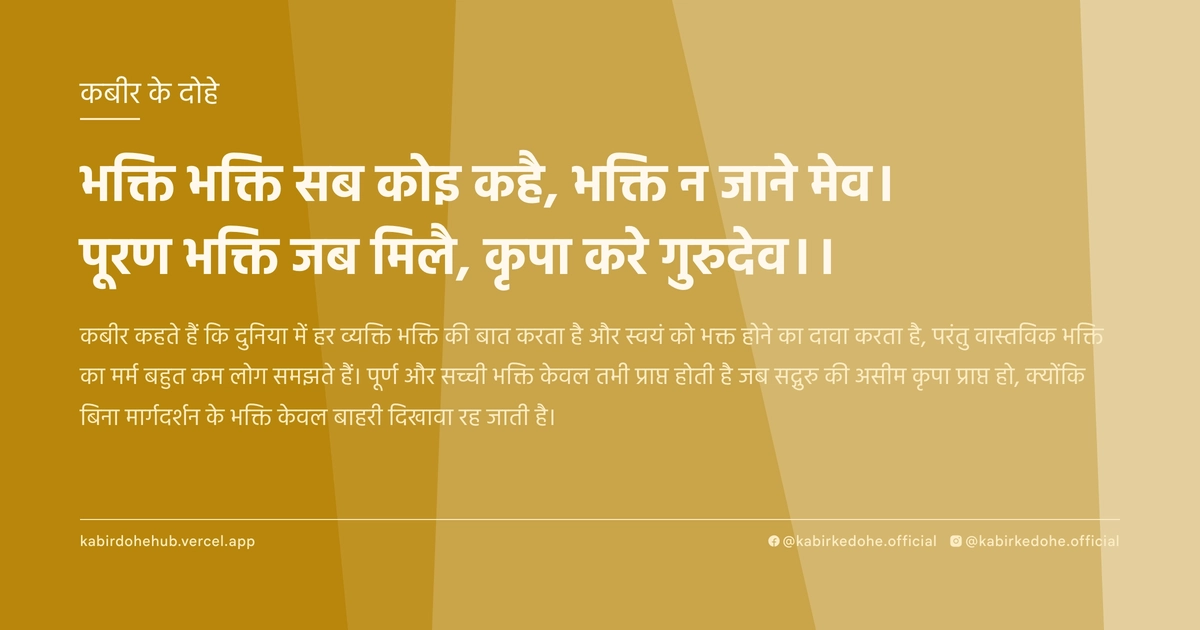
भक्ति भक्ति सब कोइ कहै, भक्ति न जाने मेव।
पूरण भक्ति जब मिलै, कृपा करे गुरुदेव।।
Bhakti bhakti sab koi kahai, bhakti na jaane mev. Pooran bhakti jab milai, kripa kare gurudev.
इस पृष्ठ पर इस कबीर दोहे का अर्थ (meaning), हिंदी व्याख्या और अंग्रेज़ी अनुवाद, दार्शनिक विश्लेषण और व्यावहारिक जीवन सीख दी गई है। यह दोहा गुरु महत्व (The Guru's Importance) विषय से जुड़ा है — Kabir doha meaning and explanation in Hindi and English.
अर्थ (Meaning):
कबीर कहते हैं कि दुनिया में हर व्यक्ति भक्ति की बात करता है और स्वयं को भक्त होने का दावा करता है, परंतु वास्तविक भक्ति का मर्म बहुत कम लोग समझते हैं। पूर्ण और सच्ची भक्ति केवल तभी प्राप्त होती है जब सद्गुरु की असीम कृपा प्राप्त हो, क्योंकि बिना मार्गदर्शन के भक्ति केवल बाहरी दिखावा रह जाती है।
Kabir observes that while everyone speaks of devotion and claims to be a devotee, very few truly understand the essence of 'Bhakti'. He asserts that complete and authentic devotion is only attainable through the grace of a true spiritual master, as without such guidance, devotion remains a mere superficial ritual.
व्याख्या (Interpretation):
इस दोहे का शाब्दिक अर्थ है कि भक्ति शब्द का उच्चारण तो सब करते हैं, पर उसका अनुभव विरल है। यहाँ 'भक्ति' केवल पूजा-पाठ नहीं, बल्कि आत्मा का परमात्मा में विलीनीकरण है। कबीर निरगुण भक्ति की बात कर रहे हैं, जहाँ भक्त और भगवान के बीच का द्वैत समाप्त हो जाता है। माया के प्रभाव के कारण मनुष्य भक्ति को कर्मकांड समझ बैठता है, जबकि यह वास्तव में अहंकार का विसर्जन है। यह अद्वैत वेदांत के उस सत्य को दर्शाता है जहाँ 'मैं' मिटता है और केवल 'वह' शेष रहता है। गुरु की कृपा यहाँ उस उत्प्रेरक (catalyst) की तरह है जो अज्ञान के पर्दे को हटाकर साधक को उसकी वास्तविक प्रकृति से परिचित कराती है। अंततः, यह दोहा इस विरोधाभास को उजागर करता है कि जिसे हम खोज रहे हैं, वह हमारे भीतर ही है, पर उसे देखने के लिए गुरु की दृष्टि आवश्यक है।
Literally, the verse suggests that while the word 'devotion' is common, the experience of it is rare. Here, 'Bhakti' is not mere ritualism but the total dissolution of the self into the Divine. Kabir refers to Nirgun Bhakti, where the duality between the devotee and the Deity vanishes. Under the influence of Maya (illusion), humans mistake ritual for devotion, whereas true Bhakti is the annihilation of the ego. This aligns with Advaita Vedanta, where the 'I' disappears, leaving only the Absolute. The Guru's grace acts as the catalyst that removes the veil of ignorance, awakening the seeker to their true nature. Ultimately, the doha highlights the paradox that the sought-after Truth resides within, yet a spiritual guide is essential to perceive it.
दार्शनिक विश्लेषण (Philosophical Analysis):
कबीर का यह दोहा उस समय के सामाजिक और धार्मिक परिवेश पर एक तीखा प्रहार है जहाँ धर्म केवल बाहरी आडंबरों, तीर्थों और जातिगत श्रेष्ठता तक सीमित था। कबीर ने देखा कि लोग 'भक्ति' शब्द का उपयोग अपनी सामाजिक प्रतिष्ठा बढ़ाने के लिए कर रहे थे, जबकि उनके भीतर क्रोध, लोभ और अहंकार यथावत थे। वे इस पाखंड का खंडन करते हुए यह स्पष्ट करते हैं कि भक्ति कोई ऐसी वस्तु नहीं है जिसे खरीदा जा सके या किसी विशेष कुल में जन्म लेकर प्राप्त किया जा सके।
दार्शनिक स्तर पर, यह सूफी मत के 'फना' (अहंकार का विनाश) और अद्वैत वेदांत के 'अहं ब्रह्मास्मि' के करीब है। कबीर के अनुसार, जब तक 'मैं' मौजूद है, तब तक भक्ति संभव नहीं है। जिसे दुनिया भक्ति कहती है, वह अक्सर इच्छा-पूर्ति का साधन होती है, जबकि 'पूर्ण भक्ति' वह है जिसमें कोई इच्छा शेष न रहे। यह मनोवैज्ञानिक रूपांतरण की प्रक्रिया है जहाँ साधक अपनी पहचान को सीमित शरीर से हटाकर अनंत चेतना में विस्थापित करता है।
गुरु की भूमिका यहाँ अत्यंत महत्वपूर्ण है। कबीर गुरु को केवल एक शिक्षक नहीं, बल्कि एक आध्यात्मिक द्वारपाल मानते हैं। गुरु वह है जो साधक को यह दिखाता है कि जिसे वह बाहर खोज रहा है, वह वास्तव में उसके अपने हृदय में स्थित है। यह 'गुरु-कृपा' कोई चमत्कार नहीं, बल्कि एक ऐसी जागृति है जो साधक के भीतर के अंधकार को मिटा देती है।
भक्ति आंदोलन के संदर्भ में, कबीर ने भक्ति का लोकतंत्रीकरण किया। उन्होंने इसे मंदिरों और मस्जिदों से निकालकर हृदय की पवित्रता से जोड़ा। उनके लिए भक्ति का अर्थ था—सत्य का साक्षात्कार। उन्होंने स्पष्ट किया कि बिना आत्म-साक्षात्कार के की गई कोई भी प्रार्थना केवल शब्दों का दोहराव है, जिसका आध्यात्मिक मूल्य शून्य है।
अंततः, यह विश्लेषण हमें बताता है कि पूर्ण भक्ति का अर्थ है पूर्ण समर्पण। जब साधक पूरी तरह से शून्य हो जाता है, तभी वह पूर्णता को प्राप्त करता है। यह शून्य होना ही वह बिंदु है जहाँ मानव और परमात्मा का भेद समाप्त हो जाता है और केवल एक अखंड सत्य शेष रह जाता है।
This doha is a sharp critique of the socio-religious climate of Kabir's era, where religion was reduced to external ostentation, pilgrimages, and caste superiority. Kabir observed that people used the word 'Bhakti' to enhance their social status, while their inner lives remained riddled with anger, greed, and ego. He rejects this hypocrisy, asserting that devotion is not a commodity to be bought nor a birthright of any specific caste.
Philosophically, this resonates with the Sufi concept of 'Fana' (annihilation of the self) and the Advaita Vedanta realization of 'Aham Brahmasmi' (I am Brahman). According to Kabir, as long as the 'I' exists, true devotion is impossible. What the world calls devotion is often a means to fulfill desires, whereas 'Pooran Bhakti' (Complete Devotion) is a state where no desire remains. It is a process of psychological transformation where the seeker shifts their identity from the limited body to the infinite consciousness.
The role of the Guru is pivotal here. Kabir views the Guru not merely as a teacher, but as a spiritual gatekeeper. The Guru is the one who reveals that the Truth the seeker searches for externally is actually residing within their own heart. This 'Guru-Kripa' (grace) is not a miracle, but an awakening that dispels the darkness of ignorance.
Within the context of the Bhakti movement, Kabir democratized devotion. He moved it from the confines of temples and mosques into the sanctuary of the heart. For him, Bhakti meant the realization of Truth. He clarified that any prayer performed without self-realization is merely a repetition of words, devoid of spiritual value.
Ultimately, this analysis reveals that complete devotion means total surrender. Only when the seeker becomes completely 'empty' or 'zero' can they attain fullness. This state of emptiness is the exact point where the distinction between the human and the Divine vanishes, leaving only one indivisible Truth.
मूल संदेश (Core Message):
- शब्दों की भक्ति केवल शोर है, अनुभव की भक्ति ही सत्य है।
- अहंकार का विसर्जन ही वास्तविक समर्पण की पहली सीढ़ी है।
- गुरु वह दर्पण है जो हमें हमारे वास्तविक स्वरूप से मिलाता है।
- बाहरी कर्मकांड आत्मा की गहराई तक पहुँचने में बाधा हैं।
- प्रेम और करुणा के बिना की गई प्रार्थना केवल एक मानसिक व्यायाम है।
- पूर्णता तब आती है जब साधक स्वयं को पूरी तरह शून्य कर लेता है।
- Devotion in words is mere noise; devotion in experience is the Truth.
- The dissolution of ego is the first step toward genuine surrender.
- The Guru is the mirror that reflects our true spiritual nature.
- External rituals are obstacles to reaching the depths of the soul.
- Prayer without love and compassion is merely a mental exercise.
- Fullness is attained only when the seeker becomes completely empty.
व्यावहारिक उदाहरण (Practical Example):
वाराणसी के घाटों पर रहने वाले एक वृद्ध विधवा, जानकी, का जीवन केवल अनुष्ठानों और नियमों के इर्द-गिर्द घूमता था। वह प्रतिदिन घंटों मंत्र जाप करती, कठोर उपवास रखती और स्वयं को एक 'परम भक्त' मानती थी। उसका विश्वास था कि उसकी यह कठोर तपस्या उसे मोक्ष दिलाएगी। वह अन्य महिलाओं को भी यही सिखाती थी कि केवल नियमों का पालन ही ईश्वर तक पहुँचने का एकमात्र मार्ग है।
एक दिन, उसकी मुलाकात एक घुमंतू साधु से हुई जो घाट की सीढ़ियों पर चुपचाप बैठे थे। जानकी ने उन्हें अपने कठिन व्रतों के बारे में बताया और गर्व से कहा कि वह भक्ति के उच्चतम स्तर पर है। साधु ने मंद मुस्कान के साथ उससे पूछा, "यदि ईश्वर तुम्हारे सामने एक भूखे भिखारी के रूप में आए, तो क्या तुम अपना उपवास तोड़कर उसे भोजन कराओगी या अपने नियम का पालन करोगी?"
जानकी ठिठक गई। उसने कभी इस तरह नहीं सोचा था। उसने हमेशा भक्ति को 'नियमों' के रूप में देखा था, 'करुणा' के रूप में नहीं। साधु ने उसे समझाया कि जिस भक्ति में दूसरे के प्रति प्रेम और करुणा नहीं, वह केवल अहंकार की तुष्टि है, ईश्वर की प्राप्ति नहीं।
कुछ दिनों बाद, जानकी ने देखा कि एक छोटा बच्चा ठंड से कांप रहा था और उसके पास ओढ़ने के लिए कुछ नहीं था। जानकी के पास एक पुराना लेकिन गर्म शॉल था जिसे वह अपनी 'पवित्रता' के लिए संजोकर रखती थी। एक पल के लिए उसका पुराना अहंकार जागा—'यह शॉल मेरी तपस्या का हिस्सा है'।
लेकिन तभी उसे साधु की बात याद आई। उसने पहली बार अपने 'नियमों' को किनारे रखा और वह शॉल उस बच्चे को ओढ़ा दिया। जैसे ही उसने वह शॉल दिया, उसे अपने भीतर एक ऐसी शांति और आनंद का अनुभव हुआ जो उसे हजारों मंत्रों के जाप से कभी नहीं मिला था।
उस क्षण जानकी को समझ आया कि उसकी अब तक की भक्ति केवल 'शब्द' थी, 'अनुभव' नहीं। उसने महसूस किया कि वह अब तक केवल अपनी छवि की पूजा कर रही थी, परमात्मा की नहीं।
उसका व्यवहार पूरी तरह बदल गया। अब वह केवल पूजा नहीं करती थी, बल्कि शहर के अनाथ बच्चों की देखभाल करने लगी। उसने पाया कि सेवा ही वास्तविक प्रार्थना है और करुणा ही वास्तविक मंत्र है।
यह जानकी का 'कबीर ट्विस्ट' था। उसने बाहरी कर्मकांडों की बेड़ियों को तोड़कर आंतरिक प्रेम के मार्ग को चुना। उसकी भक्ति अब प्रदर्शन नहीं, बल्कि एक मौन समर्पण बन गई थी।
अंततः, जानकी ने जाना कि गुरु की कृपा केवल शब्दों में नहीं, बल्कि उस एक विचार में होती है जो हमें हमारे अहंकार से मुक्त कर देता है। वह अब एक 'नाम' वाली भक्त नहीं, बल्कि एक 'भाव' वाली साधिका बन चुकी थी।
Janaki, an elderly widow living on the ghats of Varanasi, spent her life revolving around rituals and strict rules. She spent hours chanting mantras, observed rigorous fasts, and considered herself a 'supreme devotee'. She believed her austerity would grant her salvation and taught other women that adhering to rules was the only path to God.
One day, she met a wandering monk sitting silently on the steps of the ghat. Janaki told him about her difficult vows and proudly claimed to be at the highest level of devotion. The monk smiled and asked, "If God came before you in the form of a starving beggar, would you break your fast to feed him, or would you cling to your rules?"
Janaki froze. She had never thought of it this way. She had always viewed Bhakti as 'rules', not as 'compassion'. The monk explained that devotion lacking love and compassion for others is merely the gratification of the ego, not the attainment of the Divine.
Days later, Janaki saw a small child shivering in the cold with nothing to cover himself. Janaki possessed an old but warm shawl that she cherished as part of her 'purity'. For a moment, her old ego surfaced—'This shawl is part of my austerity'.
But then, she remembered the monk's words. For the first time, she set aside her 'rules' and wrapped the shawl around the child. As she did, she experienced a peace and joy within her that thousands of mantras had never provided.
In that moment, Janaki realized that her devotion until then had been mere 'words', not 'experience'. She understood that she had been worshipping her own image, not the Divine.
Her behavior transformed completely. She no longer just performed rituals but began caring for the orphaned children of the city. She discovered that service is the true prayer and compassion is the true mantra.
This was Janaki's 'Kabir Twist'. She broke the chains of external ritualism and chose the path of internal love. Her devotion was no longer a performance, but a silent surrender.
Ultimately, Janaki learned that the Guru's grace is not found in words, but in that single thought that liberates us from our ego. She was no longer a devotee in 'name', but a seeker in 'spirit'.
अभ्यास मार्गदर्शन (Practice Guidance):
- प्रतिदिन 20 मिनट मौन साधना करें, जहाँ आप किसी मंत्र का जाप न करें, बल्कि केवल अपनी सांसों और भीतर उठने वाले विचारों को बिना किसी निर्णय के देखें।
- स्व-अन्वेषण जर्नल: हर रात लिखें कि आज आपने कितनी बार 'मैं' (अहंकार) का उपयोग किया और कहाँ आपने निस्वार्थ भाव से कार्य किया।
- व्यवहार परिवर्तन: सप्ताह में एक बार किसी ऐसे व्यक्ति की मदद करें जिससे आपका वैचारिक मतभेद हो, ताकि आप अपनी पसंद-नापसंद के पार जा सकें।
- डायग्नोस्टिक चेकलिस्ट: क्या मैं अपनी धार्मिक पहचान पर गर्व करता हूँ? क्या मैं दूसरों की भक्ति को अपने से कमतर मानता हूँ? यदि हाँ, तो मेरी भक्ति अभी भी अहंकार के अधीन है।
- Practice 20 minutes of silent meditation daily, where you do not chant any mantra, but simply observe your breath and arising thoughts without judgment.
- Self-Inquiry Journal: Every night, record how many times you operated from the 'I' (ego) and where you acted with genuine selflessness.
- Behavioral Shift: Once a week, help someone with whom you have a fundamental ideological disagreement to transcend your personal biases.
- Diagnostic Checklist: Do I take pride in my religious identity? Do I view others' forms of devotion as inferior? If yes, my devotion is still bound by ego.
चिंतन प्रश्न (Reflection Questions):
- क्या मेरी भक्ति ईश्वर को पाने के लिए है, या अपनी नजरों में 'अच्छा' बनने के लिए?
- यदि मेरी सभी धार्मिक पहचानें (जाति, संप्रदाय, पद) छीन ली जाएं, तो मेरे भीतर क्या बचेगा?
- मैं अपने डिजिटल जीवन में जिस 'आध्यात्मिक छवि' को प्रस्तुत करता हूँ, वह मेरे वास्तविक आंतरिक संघर्षों से कितनी अलग है?
- क्या मैं वास्तव में गुरु के मार्गदर्शन के लिए तैयार हूँ, या मैं केवल अपनी मान्यताओं की पुष्टि चाहता हूँ?
- मेरे जीवन का वह कौन सा क्षेत्र है जहाँ मैं अभी भी 'मैं' के प्रभाव में हूँ और प्रेम को बाधित कर रहा हूँ?
- Is my devotion intended to reach the Divine, or to feel 'good' in my own eyes?
- If all my religious identities (caste, sect, status) were stripped away, what would remain within me?
- How different is the 'spiritual image' I project in my digital life from my actual internal struggles?
- Am I truly ready for a Guru's guidance, or am I merely seeking confirmation of my existing beliefs?
- In which area of my life am I still dominated by the 'I', thereby obstructing the flow of love?