
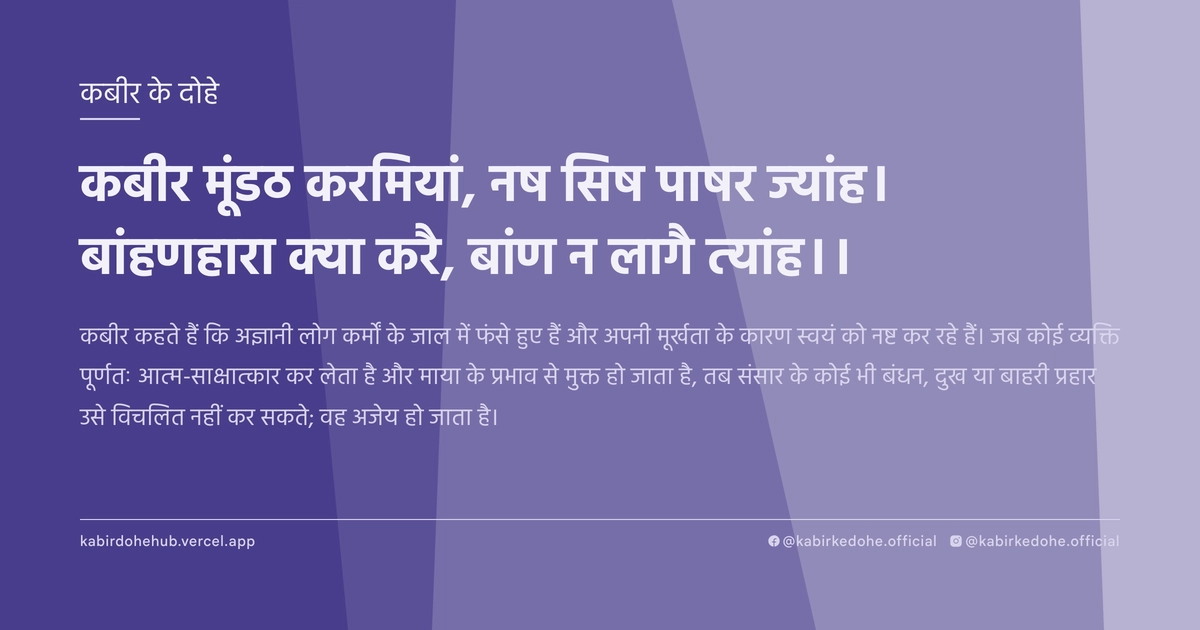
कबीर मूंडठ करमियां, नष सिष पाषर ज्यांह।
बांहणहारा क्या करै, बांण न लागै त्यांह।।
Kabir moondath karmiyan, nash sish pashar jyaanh. Baanhnahara kya karai, baan na laagai tyaanh.
इस पृष्ठ पर इस कबीर दोहे का अर्थ (meaning), हिंदी व्याख्या और अंग्रेज़ी अनुवाद, दार्शनिक विश्लेषण और व्यावहारिक जीवन सीख दी गई है। यह दोहा कर्म (Karma) विषय से जुड़ा है — Kabir doha meaning and explanation in Hindi and English.
अर्थ (Meaning):
कबीर कहते हैं कि अज्ञानी लोग कर्मों के जाल में फंसे हुए हैं और अपनी मूर्खता के कारण स्वयं को नष्ट कर रहे हैं। जब कोई व्यक्ति पूर्णतः आत्म-साक्षात्कार कर लेता है और माया के प्रभाव से मुक्त हो जाता है, तब संसार के कोई भी बंधन, दुख या बाहरी प्रहार उसे विचलित नहीं कर सकते; वह अजेय हो जाता है।
Kabir suggests that the ignorant are trapped in the cycle of karmic actions, blindly destroying themselves through their own delusions. However, once a seeker attains true self-realization and transcends the illusions of the material world, no worldly bond, sorrow, or external attack can affect them; they become spiritually invincible.
व्याख्या (Interpretation):
यहाँ 'मूंडठ करमियां' उन लोगों का प्रतीक है जो केवल बाहरी कर्मकांडों और अहंकारपूर्ण कार्यों में लीन हैं। कबीर एक गहरे विरोधाभास को दर्शाते हैं: हम जिसे 'कर्म' समझकर संचित कर रहे हैं, वह वास्तव में हमारे विनाश का कारण बन रहा है। यह स्थिति अज्ञानता (Avidya) की पराकाष्ठा है जहाँ जीव स्वयं को शरीर और मन मानता है। जब साधक 'निर्गुण भक्ति' के माध्यम से इस द्वैत को मिटा देता है, तो वह उस अवस्था में पहुँचता है जहाँ 'बाण' यानी संसार के दुख, आलोचनाएँ और मोह उसे स्पर्श नहीं कर पाते। यह अद्वैत वेदांत की उस स्थिति के समान है जहाँ आत्मा और ब्रह्म एक हो जाते हैं, और पृथकता का भ्रम समाप्त हो जाता है।
Here, 'mundath karmiyan' symbolizes those immersed in superficial rituals and ego-driven actions. Kabir highlights a profound paradox: what we perceive as 'merit' or 'action' is often the very chain leading to our spiritual downfall. This state represents the peak of ignorance (Avidya), where the soul identifies with the transient body and mind. Through 'Nirgun Bhakti' (devotion to the formless), the seeker dissolves this duality. When the realization of Atman-Brahman non-duality is achieved, the 'arrows'—representing worldly grief, social criticism, and emotional attachments—fail to find a target. The ego, which served as the target, has vanished, leaving only the indestructible consciousness.
दार्शनिक विश्लेषण (Philosophical Analysis):
कबीर का यह दोहा उनके युग के सामाजिक और धार्मिक पाखंड पर एक तीखा प्रहार है। उस समय समाज कर्मकांडों और जातिगत श्रेष्ठता के बोझ तले दबा था, जहाँ लोग मानते थे कि केवल विशिष्ट अनुष्ठानों से मोक्ष मिल सकता है। कबीर इस 'कर्म' की अवधारणा को चुनौती देते हैं और इसे 'मूंडठ' या मूर्खतापूर्ण बताते हैं यदि वह अहंकार से प्रेरित हो। वे सूफी मत के 'फना' (अहंकार का विनाश) और अद्वैत वेदांत के 'माया' के सिद्धांत को जोड़ते हैं, यह समझाते हुए कि जब तक 'मैं' मौजूद है, तब तक प्रहार संभव है।
दार्शनिक स्तर पर, कबीर यहाँ 'साक्षी भाव' की बात कर रहे हैं। जब मनुष्य स्वयं को कर्ता (doer) के बजाय केवल एक दृष्टा (observer) के रूप में देखता है, तो वह कर्मों के बंधन से मुक्त हो जाता है। यह मनोवैज्ञानिक रूपांतरण है जहाँ व्यक्ति बाहरी दुनिया की प्रतिक्रियाओं पर अपनी आंतरिक शांति निर्भर नहीं करता।
वे इस बात पर जोर देते हैं कि वास्तविक सुरक्षा किसी बाहरी कवच या धार्मिक पहचान में नहीं, बल्कि आंतरिक शून्यता में है। जो व्यक्ति स्वयं को शून्य कर लेता है, उसे दुनिया का कोई भी हथियार नहीं मार सकता क्योंकि मारने के लिए कोई 'अहंकार' शेष नहीं बचता।
यह विचार उस समय के कट्टरपंथियों के लिए एक चुनौती था, क्योंकि यह धर्म को मंदिर-मस्जिद से निकालकर अंतरात्मा के गहन मौन में ले जाता था। कबीर का मार्ग 'सहज' मार्ग है, जो कठिन तपस्या के बजाय जागरूकता और ईमानदारी पर आधारित है।
अंततः, यह दोहा हमें सिखाता है कि आध्यात्मिक परिपक्वता का अर्थ दुनिया से भागना नहीं, बल्कि दुनिया के बीच रहकर भी उससे अछूता रहना है। यह वह अवस्था है जहाँ प्रेम और करुणा तो रहती हैं, लेकिन व्यक्तिगत पीड़ा और आसक्ति समाप्त हो जाती है।
This couplet is a sharp critique of the social and religious hypocrisy of Kabir's era. Society was burdened by rigid rituals and caste superiority, believing that salvation could only be achieved through specific external rites. Kabir challenges this notion of 'karma' as a mere ritualistic accumulation, labeling it 'mundath' or foolish if driven by the ego. He bridges the Sufi concept of 'Fana' (annihilation of the self) with Advaita Vedanta's theory of 'Maya', explaining that as long as the 'I' exists, it remains a target for suffering.
Philosophically, Kabir is advocating for the state of the 'Sakshi' or the Witness. When a human ceases to identify as the 'doer' and instead becomes the 'observer', they break the chains of karmic bondage. This is a psychological transformation where inner peace is no longer contingent upon external validation or circumstances.
He emphasizes that true security does not lie in an external shield or a religious identity, but in internal emptiness. One who has become 'zero' cannot be struck by any worldly weapon because the target—the ego—has vanished. This is the ultimate liberation from the cycle of reaction and response.
This perspective was a direct challenge to the orthodoxies of his time, shifting the locus of spirituality from temples and mosques to the profound silence of the inner soul. Kabir's path is the 'Sahaj' path, rooted in awareness and honesty rather than grueling asceticism.
Ultimately, the doha teaches that spiritual maturity is not about escaping the world, but about remaining untouched while being fully immersed in it. It is a state where love and compassion persist, but personal agony and attachment are extinguished.
मूल संदेश (Core Message):
- अहंकार ही वह लक्ष्य है जहाँ संसार के दुखों के बाण लगते हैं।
- बाहरी कर्मकांडों के बजाय आंतरिक शुद्धि ही वास्तविक मोक्ष है।
- जब 'मैं' मिट जाता है, तब पीड़ा का कोई आधार नहीं रहता।
- सच्ची शक्ति प्रतिक्रिया न करने की क्षमता में निहित है।
- निर्गुण भक्ति का अर्थ है स्वयं को शून्य कर अनंत से जुड़ना।
- The ego is the only target where the arrows of worldly suffering can land.
- Inner purification, not external ritual, is the true path to liberation.
- When the 'I' vanishes, there is no longer a foundation for pain to exist.
- True power lies in the capacity to remain unreactive to external chaos.
- Nirgun Bhakti means becoming zero to merge with the Infinite.
व्यावहारिक उदाहरण (Practical Example):
एक समय की बात है, वाराणसी के घाटों पर माधव नाम का एक वृद्ध बुनकर रहता था। माधव अपनी कला में निपुण था, लेकिन उसका स्वभाव अत्यंत क्रोधी था। वह अपनी श्रेष्ठता के अहंकार में रहता और अक्सर अपने पड़ोसियों और शिष्यों को नीचा दिखाता था। वह मानता था कि उसकी बुनाई की तकनीक सबसे श्रेष्ठ है और जो उसकी बात नहीं मानता, वह मूर्ख है।
एक दिन, शहर में एक घुमक्कड़ संत आए। उन्होंने माधव के अहंकार को भांप लिया। जब माधव ने अपनी श्रेष्ठता का बखान करना शुरू किया, तो संत ने शांति से पूछा, "माधव, यदि तुम इतने महान हो, तो क्या तुम्हारी शांति किसी और के शब्दों पर निर्भर है?"
माधव ने चिढ़कर कहा, "बिल्कुल नहीं! मैं अपनी शर्तों पर जीता हूँ।"
अगले कुछ दिनों तक, संत ने माधव के सामने ऐसे लोगों को भेजा जो उसकी कला की खुलेआम आलोचना करते थे। कोई कहता कि उसके रंगों में गहराई नहीं है, तो कोई कहता कि उसकी बुनाई पुरानी पड़ चुकी है। माधव का क्रोध सातवें आसमान पर पहुँच गया। वह रातों को सो नहीं पाता था और दिन भर उन आलोचकों के बारे में सोचकर जलता रहता था।
अंततः, वह संत के पास गया और अपनी पीड़ा बताई। संत ने मुस्कुराते हुए कहा, "माधव, तुम एक ऐसे लक्ष्य की तरह हो जिसने खुद को बहुत बड़ा बना लिया है, इसलिए हर बाण तुम्हें आसानी से लग रहा है। तुम अपनी पहचान अपनी कला और अपने अहंकार से जोड़ चुके हो। जब तक तुम इस 'मैं' को पकड़ कर रखोगे, दुनिया का हर छोटा शब्द तुम्हें घायल करेगा।"
संत ने उसे एक प्रयोग दिया: "अगले एक महीने तक, जब भी कोई तुम्हारी बुराई करे, तो यह सोचना कि वह व्यक्ति वास्तव में तुम्हारी नहीं, बल्कि अपनी ही कुंठा की बात कर रहा है। तुम केवल एक दर्शक बनो, बुनकर नहीं।"
माधव ने धीरे-धीरे इस अभ्यास को अपनाया। उसने महसूस किया कि जब वह अपनी श्रेष्ठता के दावे को छोड़ देता है, तो आलोचनाएं उसे प्रभावित करना बंद कर देती हैं। एक दिन, एक व्यक्ति ने उसे सबके सामने अपमानित किया, लेकिन माधव के चेहरे पर एक शांत मुस्कान थी।
आस-पास के लोग हैरान थे। उन्होंने पूछा, "माधव, तुम्हें गुस्सा नहीं आया?"
माधव ने उत्तर दिया, "अब यहाँ कोई ऐसा नहीं बचा जिसे चोट पहुँचाई जा सके। मैंने अपना अहंकार त्याग दिया है, और अब बाणों के लिए कोई लक्ष्य ही नहीं रहा।"
माधव अब केवल कपड़े नहीं बुनता था, बल्कि शांति और प्रेम की एक नई चादर बुन रहा था। उसका जीवन अब कर्मों के बोझ से मुक्त होकर एक सहज प्रवाह बन गया था।
Once, on the ghats of Varanasi, lived an elderly weaver named Madhav. Madhav was a master of his craft, but he possessed an incredibly volatile temperament. He lived in the arrogance of his own superiority, often belittling his neighbors and apprentices, believing his weaving techniques were peerless and anyone who disagreed was a fool.
One day, a wandering saint arrived in the city. He quickly sensed Madhav's ego. As Madhav began boasting about his greatness, the saint calmly asked, "Madhav, if you are so great, is your peace dependent on the words of others?"
Irritated, Madhav replied, "Of course not! I live on my own terms."
Over the following days, the saint sent people to Madhav who openly criticized his art. Some claimed his colors lacked depth; others said his weaving style was obsolete. Madhav's rage peaked. He couldn't sleep at night and spent his days seething over the comments of these critics.
Eventually, he approached the saint in distress. The saint smiled and said, "Madhav, you are like a target that has made itself too large; that is why every arrow hits you easily. You have tied your identity to your skill and your ego. As long as you cling to this 'I', every small word from the world will wound you."
The saint gave him an exercise: "For the next month, whenever someone insults you, realize that the person is not talking about you, but expressing their own inner frustration. Be a witness, not the weaver of the conflict."
Madhav slowly adopted this practice. He realized that when he let go of the claim to superiority, the criticisms ceased to affect him. One day, a man insulted him publicly, but Madhav wore a serene smile.
The onlookers were stunned. They asked, "Madhav, aren't you angry?"
Madhav replied, "There is no longer anyone here to be hurt. I have discarded my ego, and now there is no target left for the arrows to hit."
Madhav no longer just wove fabric; he wove a new shroud of peace and love. His life, once burdened by the weight of karmic reactions, became a spontaneous, effortless flow.
अभ्यास मार्गदर्शन (Practice Guidance):
- दैनिक आत्म-निरीक्षण: प्रतिदिन 20 मिनट मौन बैठें और देखें कि दिन भर में किन बातों ने आपको विचलित किया। यह पहचानें कि वह 'बाण' आपकी किस पहचान (अहंकार) को लगा था।
- साक्षी भाव का अभ्यास: जब कोई आपकी आलोचना करे, तो तुरंत प्रतिक्रिया देने के बजाय 5 सेकंड रुकें। स्वयं से कहें, "यह शब्द उस व्यक्ति के हैं, मेरे नहीं। मैं केवल दृष्टा हूँ।"
- अहंकार विसर्जन जर्नल: एक डायरी लिखें जिसमें उन क्षणों का विवरण हो जब आपने अपनी 'श्रेष्ठता' सिद्ध करने की कोशिश की। विश्लेषण करें कि उस समय आपको डर किस बात का था।
- निदान चेकलिस्ट: यदि आप छोटी बातों पर क्रोधित हो रहे हैं, दूसरों के निर्णय से आपकी खुशी प्रभावित हो रही है, या आप अपनी उपलब्धियों का श्रेय केवल स्वयं को दे रहे हैं, तो समझ लें कि आपका 'अहंकार-लक्ष्य' अभी भी मौजूद है और बाण लग रहे हैं।
- Daily Self-Observation: Sit in silence for 20 minutes daily and observe what triggered you during the day. Identify which 'arrow' hit which part of your identity (ego).
- Practice of the Witness: When criticized, instead of reacting immediately, pause for 5 seconds. Tell yourself, "These words belong to that person, not to me. I am merely the observer."
- Ego-Dissolution Journal: Maintain a diary recording moments where you felt the need to prove your superiority. Analyze what fear was driving that need for validation.
- Diagnostic Checklist: If you are easily angered by trifles, if your happiness depends on others' opinions, or if you attribute all success solely to your own effort, recognize that your 'ego-target' is still present and vulnerable to arrows.
चिंतन प्रश्न (Reflection Questions):
- मेरी वह कौन सी पहचान है जिसे मैं सबसे अधिक बचाने की कोशिश करता हूँ, और क्यों?
- क्या मेरी 'अच्छाई' और 'परोपकार' भी वास्तव में मेरे अहंकार को पोषण देने का एक सूक्ष्म तरीका हैं?
- यदि कल मेरी सारी सामाजिक प्रतिष्ठा और उपलब्धियाँ छीन ली जाएँ, तो मेरे भीतर क्या बचेगा?
- मैं दूसरों की आलोचना से इतना विचलित क्यों होता हूँ? क्या मैं वास्तव में उनकी बात से डरता हूँ या अपनी छवि के टूटने से?
- मेरे जीवन में 'बाण' कौन हैं, और मैंने उन्हें अपने जीवन का हिस्सा क्यों बना रखा है?
- क्या मैं वास्तव में मुक्त होना चाहता हूँ, या मैं केवल अपनी शर्तों पर नियंत्रित होना चाहता हूँ?
- Which part of my identity do I strive most desperately to protect, and why?
- Are my 'good deeds' and 'philanthropy' actually subtle ways of feeding my ego?
- If all my social status and achievements were stripped away tomorrow, what would remain within me?
- Why does the criticism of others disturb me so much? Am I afraid of their words, or the shattering of my self-image?
- Who are the 'arrows' in my life, and why have I allowed them to become a central part of my existence?
- Do I truly desire liberation, or do I simply want to be controlled on my own terms?