
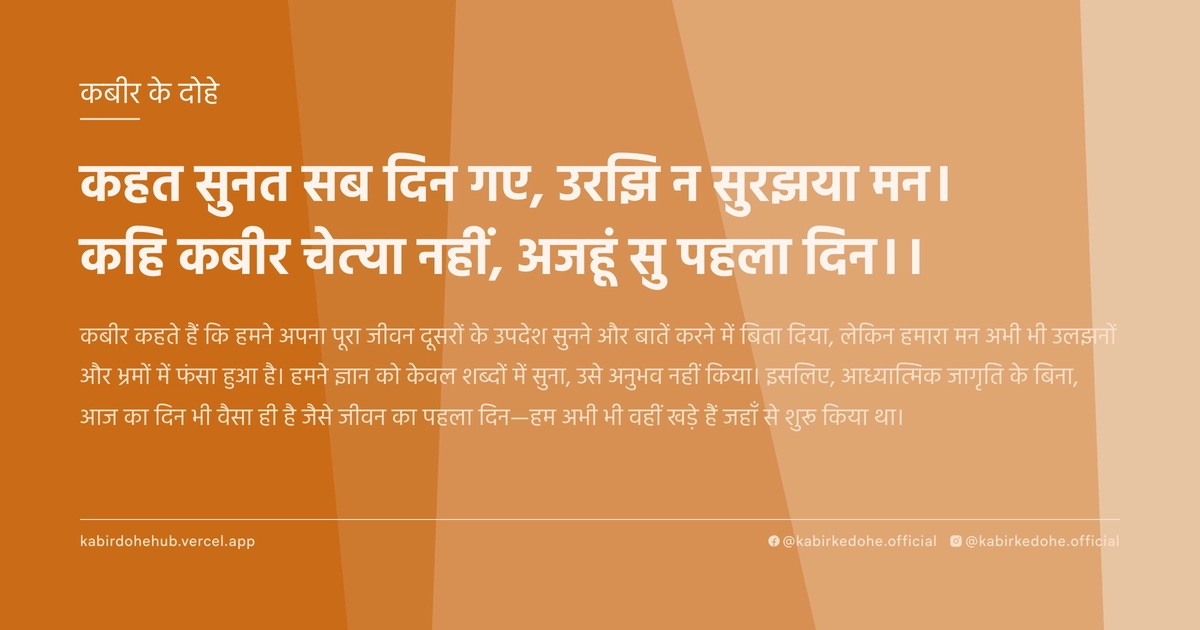
कहत सुनत सब दिन गए, उरझि न सुरझया मन।
कहि कबीर चेत्या नहीं, अजहूं सु पहला दिन।।
Kahat sunat sab din gaye, urjhi na surjhaya man. Kahi Kabir chetya nahi, ajahun su pahla din.
इस पृष्ठ पर इस कबीर दोहे का अर्थ (meaning), हिंदी व्याख्या और अंग्रेज़ी अनुवाद, दार्शनिक विश्लेषण और व्यावहारिक जीवन सीख दी गई है। यह दोहा जागृति (The Wake-up Call) विषय से जुड़ा है — Kabir doha meaning and explanation in Hindi and English.
अर्थ (Meaning):
कबीर कहते हैं कि हमने अपना पूरा जीवन दूसरों के उपदेश सुनने और बातें करने में बिता दिया, लेकिन हमारा मन अभी भी उलझनों और भ्रमों में फंसा हुआ है। हमने ज्ञान को केवल शब्दों में सुना, उसे अनुभव नहीं किया। इसलिए, आध्यात्मिक जागृति के बिना, आज का दिन भी वैसा ही है जैसे जीवन का पहला दिन—हम अभी भी वहीं खड़े हैं जहाँ से शुरू किया था।
Kabir observes that we spend our entire lives listening to spiritual discourses and talking about truth, yet the mind remains entangled in confusion. We have consumed knowledge intellectually but not experientially. Consequently, without actual awakening, today remains as ignorant as the first day of our existence; we have made no real progress in the journey of the soul.
व्याख्या (Interpretation):
इस दोहे का शाब्दिक अर्थ है कि सुनने और कहने से ज्ञान नहीं आता। रूपकात्मक रूप से, 'उरझि' (उलझा हुआ मन) माया के जाल और अहंकार की जटिलताओं को दर्शाता है। कबीर यहाँ 'निरगुण भक्ति' की बात कर रहे हैं, जहाँ सत्य बाहरी ग्रंथों में नहीं बल्कि आंतरिक अनुभव में है। यह अद्वैत वेदांत के उस सिद्धांत को पुष्ट करता है कि जब तक 'मैं' और 'ब्रह्म' का भेद बना रहता है, तब तक केवल सूचनाएं एकत्रित होती हैं, बोध नहीं। यह विरोधाभास है कि हम धर्म के बारे में सबसे अधिक जानते हैं, फिर भी स्वयं से सबसे अधिक दूर हैं। मन का न सुलझना इस बात का प्रमाण है कि हम केवल बौद्धिक स्तर पर सक्रिय हैं, आध्यात्मिक स्तर पर नहीं।
Literally, the verse warns that hearing and speaking do not equate to knowing. Metaphorically, the 'entangled mind' represents the web of Maya and the complexities of the ego. Kabir emphasizes Nirgun Bhakti, where truth is found in internal experience rather than external scriptures. This aligns with Advaita Vedanta, suggesting that as long as the duality between the 'I' and the 'Brahman' persists, one only collects information, not realization. The central paradox is that while we possess vast religious knowledge, we remain strangers to our own essence. The failure to 'untangle' the mind proves that our activity is merely intellectual, lacking the transformative fire of actual spiritual awakening.
दार्शनिक विश्लेषण (Philosophical Analysis):
कबीर का यह दोहा उस समय की सामाजिक-धार्मिक स्थिति पर प्रहार है जहाँ पंडित और मौलवी केवल रटने और रटाने में विश्वास रखते थे। कबीर ने कर्मकांड और शास्त्रवाद का विरोध किया क्योंकि वे जानते थे कि बिना आत्म-साक्षात्कार के शास्त्र केवल बोझ हैं। यह दृष्टिकोण सूफीवाद के 'इश्क' (प्रेम) और 'मारिफत' (ज्ञान) के करीब है, जहाँ सत्य को महसूस करना अनिवार्य है।
दार्शनिक स्तर पर, यह 'अविद्या' (ignorance) की चर्चा है। अविद्या वह पर्दा है जो हमें यह विश्वास दिलाता है कि हम शरीर या मन हैं। जब कबीर कहते हैं कि 'आज भी पहला दिन है', तो वे समय की रैखिकता को चुनौती दे रहे हैं। आध्यात्मिक समय वह नहीं है जो घड़ी बताती है, बल्कि वह है जो चेतना के स्तर से मापा जाता है। यदि चेतना नहीं बदली, तो सौ वर्ष भी शून्य के समान हैं।
यह विश्लेषण अहंकार के विलीनीकरण (annihilation of ego) की आवश्यकता पर जोर देता है। हम अक्सर 'आध्यात्मिक अहंकार' का शिकार हो जाते हैं, जहाँ हमें लगता है कि बहुत सारी किताबें पढ़ लेने से हम ज्ञानी हो गए हैं। कबीर इसे 'उलझन' कहते हैं। वास्तविक ज्ञान वह है जो अहंकार को मिटा दे, न कि उसे और बढ़ाए।
यहाँ 'सुनने' और 'जानने' के बीच का अंतर स्पष्ट है। सुनना एक बाहरी प्रक्रिया है, जबकि जानना एक आंतरिक रूपांतरण है। यह अद्वैत के उस सत्य की ओर इशारा है जहाँ ज्ञाता, ज्ञान और ज्ञेय एक हो जाते हैं। जब तक यह त्रुटी बनी रहती है, मन उलझा रहता है।
अंततः, कबीर हमें चेतावनी देते हैं कि समय तेजी से निकल रहा है। मृत्यु अटल है, और यदि हमने केवल शब्दों का संग्रह किया है, तो हम खाली हाथ लौटेंगे। यह आह्वान है कि हम बौद्धिक विलासिता को छोड़कर वास्तविक साधना की ओर बढ़ें, जहाँ मौन शब्दों से अधिक मुखर होता है।
This couplet strikes at the socio-religious climate of Kabir's era, where scholars and clerics prioritized rote memorization over realization. Kabir rejected ritualism and scriptural dogma, recognizing that without self-realization, scriptures are merely intellectual burdens. This perspective mirrors the Sufi concepts of 'Ishq' (divine love) and 'Ma'rifat' (gnosis), where truth must be felt to be known.
Philosophically, this addresses 'Avidya' (ignorance)—the veil that convinces us we are the body or the mind. When Kabir claims 'today is still the first day,' he challenges linear time. Spiritual time is not measured by clocks but by the evolution of consciousness. If consciousness remains stagnant, a century of study is equivalent to a single moment of ignorance.
The analysis emphasizes the necessity of the annihilation of the ego. We often fall prey to 'spiritual ego,' believing that reading numerous texts equates to wisdom. Kabir labels this as 'entanglement.' True knowledge is that which dissolves the ego, not that which inflates it.
There is a critical distinction between 'hearing' and 'knowing.' Hearing is an external process; knowing is an internal transformation. This points toward the Advaita truth where the knower, the known, and the process of knowing merge into one. As long as this duality exists, the mind remains knotted.
Ultimately, Kabir warns that time is fleeting and death is inevitable. If we have only collected words, we return empty-handed. It is a call to abandon intellectual luxury and embrace authentic Sadhana, where silence speaks louder than any scripture.
मूल संदेश (Core Message):
- सूचना ज्ञान नहीं है; अनुभव ही वास्तविक बोध है।
- बौद्धिक विलासिता आध्यात्मिक प्रगति का सबसे बड़ा अवरोध है।
- जब तक अहंकार जीवित है, हर उपदेश केवल एक कहानी है।
- सत्य को सुना नहीं, बल्कि स्वयं में जिया जाना चाहिए।
- मौन वह द्वार है जहाँ से वास्तविक रूपांतरण शुरू होता है।
- अद्वैत का अर्थ है शब्दों का अंत और अस्तित्व का प्रारंभ।
- Information is not wisdom; experience is the only true realization.
- Intellectual luxury is the greatest obstacle to spiritual progress.
- As long as the ego survives, every sermon is merely a story.
- Truth is not to be heard, but to be lived within oneself.
- Silence is the gateway where genuine transformation begins.
- Non-duality means the end of words and the beginning of existence.
व्यावहारिक उदाहरण (Practical Example):
वाराणसी के एक पुराने घाट पर माधव नाम का एक वृद्ध नाविक रहता था। माधव ने अपना पूरा जीवन संतों की बातें सुनने और धर्मग्रंथों के अंशों को याद करने में बिताया था। वह शहर के सबसे बड़े विद्वान माने जाते थे क्योंकि वे हर शास्त्र का हवाला दे सकते थे।
लेकिन माधव के भीतर एक गहरी अशांति थी। वह छोटी-छोटी बातों पर क्रोधित हो जाता और अपने परिवार के साथ उसके संबंध तनावपूर्ण थे। वह घंटों दूसरों को शांति का उपदेश देता, लेकिन स्वयं कभी शांत नहीं रह पाया।
एक दिन, एक मौन साधु उसकी नाव पर सवार हुए। माधव ने अपनी आदत के अनुसार साधु को महान ग्रंथों की बातें सुनानी शुरू कर दीं। वह यह सिद्ध करना चाहता था कि वह कितना जानता है।
साधु ने उसकी बातें सुनीं और बस एक सवाल पूछा, "माधव, इन शब्दों के पीछे जो सन्नाटा है, क्या तुमने कभी उसे सुना है? या तुम केवल शब्दों के शोर में खोए हो?"
माधव को लगा जैसे किसी ने उसके सीने पर प्रहार किया हो। उसने महसूस किया कि उसने हजारों बार 'शांति' शब्द पढ़ा था, लेकिन उसने कभी शांति का अनुभव नहीं किया था।
उस रात माधव सो नहीं सका। उसने महसूस किया कि उसकी सारी विद्वत्ता एक ढोंग थी। वह केवल एक 'पुस्तकालय' बन गया था, इंसान नहीं।
अगले दिन से माधव ने उपदेश देना बंद कर दिया। उसने मौन का अभ्यास शुरू किया और अपने क्रोध को देखना शुरू किया। उसने पाया कि जिस शांति को वह किताबों में खोज रहा था, वह उसके भीतर के अहंकार को मिटाने के बाद ही प्रकट होती है।
महीनों बाद, माधव का व्यवहार बदल गया। वह अब कम बोलता था, लेकिन उसकी उपस्थिति ही दूसरों को सुकून देती थी।
उसने समझा कि ज्ञान वह नहीं जो जुबान पर हो, बल्कि वह है जो आचरण में उतरे। उसकी उलझन अब सुलझ रही थी क्योंकि उसने 'सुनना' छोड़कर 'होना' शुरू किया था।
यह माधव का वास्तविक 'पहला दिन' था, जहाँ से उसकी असली आध्यात्मिक यात्रा शुरू हुई।
On an ancient ghat in Varanasi lived an elderly boatman named Madhav. Madhav had spent his entire life listening to saints and memorizing fragments of scriptures. He was regarded as one of the city's most learned men because he could cite any text with ease.
However, deep within Madhav lay a profound restlessness. He would flare up in anger over trivialities, and his relationships with his family were strained. He spent hours preaching peace to others, yet he himself was never at peace.
One day, a silent ascetic boarded his boat. Following his habit, Madhav began reciting great philosophical truths to the monk, eager to prove the extent of his knowledge.
The monk listened patiently and asked a single question: "Madhav, have you ever heard the silence behind these words? Or are you merely lost in the noise of vocabulary?"
Madhav felt as if he had been struck in the chest. He realized that while he had read the word 'peace' thousands of times, he had never actually experienced it.
That night, Madhav could not sleep. He recognized that his scholarship was a facade. He had become a 'library,' but not a realized human being.
From the next day, Madhav stopped preaching. He began practicing silence and observing his anger without judgment. He discovered that the peace he sought in books only emerged after the dissolution of his ego.
Months later, Madhav's demeanor changed. He spoke less, but his mere presence brought comfort to those around him.
He understood that knowledge is not what resides on the tongue, but what descends into conduct. His entanglement was unravelled because he stopped 'hearing' and started 'being.'
This was Madhav's true 'first day,' the actual beginning of his spiritual journey.
अभ्यास मार्गदर्शन (Practice Guidance):
- दैनिक मौन अभ्यास: प्रतिदिन 30 मिनट पूर्ण मौन रहें। न बोलें, न लिखें, न डिजिटल उपकरणों का उपयोग करें। केवल अपने विचारों के शोर को देखें।
- आत्म-पूछताछ (Self-Inquiry): एक डायरी लिखें जिसमें यह दर्ज करें कि दिन भर में कितनी बार आपने 'सही' होने के लिए तर्क दिया। पूछें: "यह तर्क मेरी आत्मा की शांति के लिए है या मेरे अहंकार की तुष्टि के लिए?"
- व्यवहारिक परिवर्तन: जब भी आप किसी को सलाह देने या उपदेश देने का प्रयास करें, रुकें और स्वयं से पूछें कि क्या आप उस सलाह का पालन स्वयं कर रहे हैं। यदि नहीं, तो मौन रहें।
- निदान चेकलिस्ट (Diagnostic Checklist): 1. क्या मैं आध्यात्मिक चर्चाओं के बाद अधिक अहंकारी महसूस करता हूँ? 2. क्या मेरी शांति बाहरी परिस्थितियों पर निर्भर है? 3. क्या मैं ज्ञान को केवल सूचना के रूप में संचित कर रहा हूँ? (यदि हाँ, तो आप अभी भी 'पहले दिन' पर हैं)।
- Daily Silence Practice: Spend 30 minutes in absolute silence daily. No speaking, writing, or digital devices. Simply observe the noise of your thoughts.
- Self-Inquiry Journaling: Keep a log of how many times a day you argued just to be 'right.' Ask: "Is this argument for the peace of my soul or the satisfaction of my ego?"
- Behavioral Shift: Whenever you feel the urge to give advice or preach, stop and ask if you are practicing that advice yourself. If not, choose silence.
- Diagnostic Checklist: 1. Do I feel more arrogant after spiritual discussions? 2. Is my peace dependent on external circumstances? 3. Am I accumulating knowledge merely as information? (If yes, you are still on 'Day One').
चिंतन प्रश्न (Reflection Questions):
- मेरे जीवन का कितना हिस्सा 'दिखावे के ज्ञान' में बीता है?
- यदि मुझसे मेरे सभी धार्मिक और आध्यात्मिक लेबल छीन लिए जाएं, तो मेरे पास क्या बचेगा?
- क्या मैं सत्य को खोज रहा हूँ, या मैं केवल सत्य के बारे में बात करने का आनंद ले रहा हूँ?
- मेरे भीतर का वह कौन सा 'उलझा हुआ' हिस्सा है जिसे मैं स्वीकार करने से डरता हूँ?
- क्या मेरी डिजिटल पहचान (Social Media) मेरे वास्तविक आंतरिक संघर्षों को छिपाने का एक साधन है?
- मैं कितनी बार 'सुनने' की प्रक्रिया में अपनी पूर्व-धारणाओं को थोपता हूँ?
- How much of my life has been spent in the pursuit of 'performative knowledge'?
- If all my religious and spiritual labels were stripped away, what would remain of me?
- Am I seeking the Truth, or am I merely enjoying the act of talking about the Truth?
- What is that 'entangled' part of my being that I am terrified to acknowledge?
- Is my digital identity a tool to mask my actual internal conflicts?
- How often do I impose my preconceptions while pretending to 'listen' to others?