
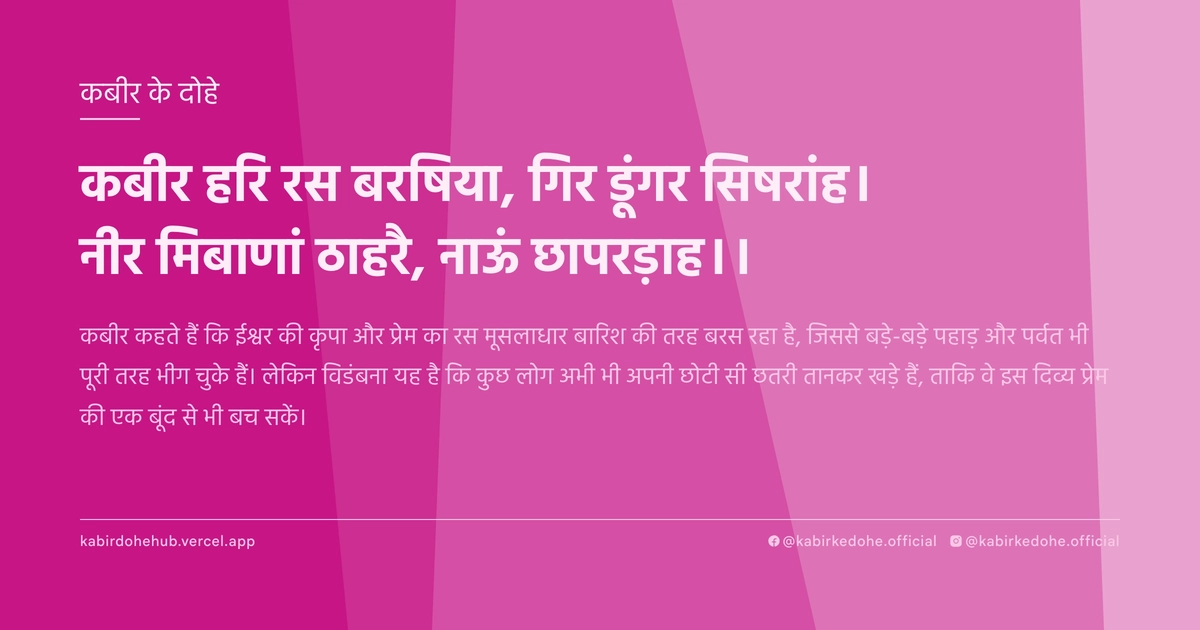
कबीर हरि रस बरषिया, गिर डूंगर सिषरांह।
नीर मिबाणां ठाहरै, नाऊं छापरड़ाह।।
Kabir hari ras barshiya, gir doongar sishraanh. Neer mibaanan thahrai, naoon chhapardah.
इस पृष्ठ पर इस कबीर दोहे का अर्थ (meaning), हिंदी व्याख्या और अंग्रेज़ी अनुवाद, दार्शनिक विश्लेषण और व्यावहारिक जीवन सीख दी गई है। यह दोहा भक्ति (Bhakti) विषय से जुड़ा है — Kabir doha meaning and explanation in Hindi and English.
अर्थ (Meaning):
कबीर कहते हैं कि ईश्वर की कृपा और प्रेम का रस मूसलाधार बारिश की तरह बरस रहा है, जिससे बड़े-बड़े पहाड़ और पर्वत भी पूरी तरह भीग चुके हैं। लेकिन विडंबना यह है कि कुछ लोग अभी भी अपनी छोटी सी छतरी तानकर खड़े हैं, ताकि वे इस दिव्य प्रेम की एक बूंद से भी बच सकें।
Kabir proclaims that the divine nectar of God's grace is raining down in torrents, saturating even the highest mountains and deepest valleys. Yet, in a profound irony, some individuals remain huddled under tiny umbrellas of ego and preconceived notions, desperately shielding themselves from being touched by a single drop of this universal love.
व्याख्या (Interpretation):
यह दोहा ईश्वर की सर्वव्यापी कृपा और मानवीय अहंकार के बीच के विरोधाभास को दर्शाता है। 'हरि रस' वह निर्गुण आनंद है जो बिना किसी भेदभाव के हर जीव पर बरस रहा है। पहाड़ यहाँ उन कठोर हृदय वाले लोगों का प्रतीक हैं जो अंततः इस प्रेम में पिघल जाते हैं। 'छापरड़ाह' या छतरी मनुष्य के अहंकार, धार्मिक कट्टरता और मानसिक पूर्वग्रहों का रूपक है। यह दर्शाता है कि ईश्वर की कृपा उपलब्ध है, लेकिन हमारा 'मैं' (अहंकार) ही वह एकमात्र बाधा है जो हमें उस सत्य का अनुभव करने से रोकता है। यह अद्वैत वेदांत के उस सिद्धांत की पुष्टि करता है जहाँ आत्मा और परमात्मा एक हैं, परंतु माया का पर्दा हमें अलग महसूस कराता है।
This couplet illustrates the paradox between the omnipresent grace of the Divine and the restrictive nature of the human ego. 'Hari Ras' represents the formless, attributeless bliss of Nirgun Bhakti, which descends upon all beings without discrimination. The mountains symbolize even the most stubborn or hardened hearts that eventually succumb to this divine saturation. The 'umbrella' serves as a potent metaphor for the ego, religious dogmatism, and intellectual pride. It suggests that while the Divine rain is falling everywhere, the individual's insistence on their separate identity—their 'I-ness'—is the only barrier preventing the soul's immersion. This aligns with Advaita Vedanta, where the illusion of duality (Maya) prevents the realization of the non-dual unity between Atman and Brahman.
दार्शनिक विश्लेषण (Philosophical Analysis):
कबीर का यह दृष्टिकोण उनके युग के कर्मकांडीय धर्म के विरुद्ध एक सशक्त प्रहार है। उस समय लोग मानते थे कि ईश्वर केवल विशेष अनुष्ठानों, तीर्थों या कठिन तपस्या से प्राप्त होते हैं। कबीर इस धारणा को उलट देते हैं; वे कहते हैं कि कृपा 'बरस' रही है, यानी यह सहज और उपलब्ध है। यह सूफी मत के 'इश्क-ए-हकीकी' (ईश्वरीय प्रेम) के समान है, जहाँ प्रेम ही एकमात्र मार्ग है।
दार्शनिक स्तर पर, यह दोहा 'अहंकार के विसर्जन' की बात करता है। जब तक व्यक्ति अपनी छतरी (अपनी पहचान, अपनी जाति, अपना ज्ञान) को पकड़े रहता है, वह भीग नहीं सकता। भीगने का अर्थ है—मिट जाना, अपनी सीमाओं को खो देना। यह 'फना' होने की प्रक्रिया है, जहाँ बूंद समुद्र में मिलकर समुद्र बन जाती है।
कबीर यहाँ यह स्पष्ट कर रहे हैं कि ईश्वर किसी मंदिर या मस्जिद में कैद नहीं है, बल्कि वह एक ब्रह्मांडीय ऊर्जा है जो निरंतर प्रवाहित है। जो लोग शास्त्रों के शब्दों में उलझे हैं, वे वास्तव में उस छतरी के नीचे हैं। वे सत्य के बारे में 'पढ़' रहे हैं, लेकिन सत्य को 'जी' नहीं रहे हैं।
यह विश्लेषण हमें बताता है कि आध्यात्मिक प्रगति बाहरी खोज नहीं, बल्कि आंतरिक बाधाओं को हटाने की प्रक्रिया है। जब हम यह दावा करते हैं कि 'मैं' भक्त हूँ या 'मैं' ज्ञानी हूँ, तो हम अनजाने में अपनी छतरी को और मजबूती से पकड़ लेते हैं।
अंततः, यह दोहा हमें सिखाता है कि समर्पण (Surrender) ही एकमात्र कुंजी है। जब छतरी गिरती है, तभी आत्मा का वास्तविक मिलन परमात्मा से होता है। यह एक मनोवैज्ञानिक रूपांतरण है जहाँ व्यक्ति अपनी संकीर्ण पहचान को त्यागकर सार्वभौमिक चेतना में विलीन हो जाता है।
Kabir's perspective is a powerful critique of the ritualistic religion of his era. During his time, the prevailing belief was that God could only be accessed through specific rituals, pilgrimages, or extreme asceticism. Kabir flips this narrative, asserting that grace is 'raining'—meaning it is spontaneous, effortless, and universally available. This mirrors the Sufi concept of 'Ishq-e-Haqiqi' (Divine Love), where love is the primary vehicle for transcendence.
On a philosophical level, this doha addresses the 'annihilation of the ego.' As long as a person clings to their umbrella—their social identity, caste, or intellectual pride—they cannot be saturated by the divine. To 'get wet' means to dissolve, to lose the boundaries of the self. This is the process of 'Fana' in Sufism, where the drop merges into the ocean and becomes the ocean itself.
Kabir clarifies that the Divine is not confined to temples or mosques but is a cosmic energy in constant flow. Those entangled in the literal interpretation of scriptures are effectively standing under the umbrella; they are 'studying' the truth but not 'experiencing' it. The intellectualization of spirituality often becomes a shield against the raw, transformative power of direct experience.
This analysis reveals that spiritual progress is not an external quest but a process of removing internal obstructions. When we claim 'I am a devotee' or 'I am a scholar,' we inadvertently tighten our grip on the umbrella. The ego uses spirituality as a new garment to hide its nakedness.
Ultimately, the doha teaches that surrender (Prapatti) is the only key. Only when the umbrella is dropped does the soul's true union with the Divine occur. This is a psychological transformation where the individual transcends the narrow 'I' to embrace the universal consciousness of the Brahman.
मूल संदेश (Core Message):
- अहंकार वह छतरी है जो हमें ईश्वरीय प्रेम से बचाती है।
- ईश्वर की कृपा सर्वव्यापी है, केवल हमारी पात्रता की कमी है।
- पवित्रता का दावा करना वास्तव में सबसे बड़ी अशुद्धि है।
- समर्पण ही वह द्वार है जहाँ से अद्वैत का अनुभव होता है।
- प्रेम किसी शास्त्र या अनुष्ठान का मोहताज नहीं होता।
- जब 'मैं' मिटता है, तभी 'वह' प्रकट होता है।
- The ego is the umbrella that shields us from Divine Love.
- God's grace is omnipresent; only our receptivity is lacking.
- Claiming purity is often the greatest form of impurity.
- Surrender is the only gateway to the experience of Non-duality.
- Love does not depend on scriptures or ritualistic performance.
- When the 'I' dissolves, the 'Infinite' reveals itself.
व्यावहारिक उदाहरण (Practical Example):
वाराणसी के एक पुराने घाट पर रामदीन नाम का एक वृद्ध नाविक रहता था। रामदीन अपनी ईमानदारी और अनुशासन के लिए प्रसिद्ध था, लेकिन वह बहुत अहंकारी था। उसे लगता था कि वह शहर का सबसे पवित्र और शुद्ध व्यक्ति है क्योंकि वह कभी झूठ नहीं बोलता था और नियमित रूप से पूजा करता था। वह अन्य नाविकों को 'पापी' और 'अशुद्ध' कहकर उनसे दूर रहता था।
एक दिन शहर में एक फकीर आया, जिसने रामदीन से कहा, "तुम अपनी पवित्रता की छतरी के नीचे इतने सुरक्षित हो कि तुम ईश्वर की करुणा को महसूस ही नहीं कर पा रहे हो।"
रामदीन को यह बात चुभी। उसने सोचा कि वह तो सबसे बड़ा भक्त है, फिर यह फकीर ऐसा क्यों कह रहा है? उसने फकीर को चुनौती दी कि वह उसे उसकी 'छतरी' दिखाए।
फकीर ने मुस्कुराते हुए कहा, "तुम्हारी छतरी तुम्हारा यह विश्वास है कि तुम दूसरों से बेहतर हो।"
कुछ दिनों बाद, गंगा में भीषण बाढ़ आई। रामदीन की नाव डूब गई और वह एक छोटे से टापू पर फंस गया। उसके साथ वही नाविक थे जिन्हें वह 'अशुद्ध' कहता था।
वहाँ भूख और प्यास से तड़पते हुए, रामदीन ने देखा कि जिन लोगों को उसने तुच्छ समझा था, वे अपनी बची-कुची रोटियाँ उसके साथ साझा कर रहे थे। उनके चेहरों पर कोई निर्णय नहीं था, केवल निस्वार्थ प्रेम था।
उस क्षण रामदीन को महसूस हुआ कि उसकी 'पवित्रता' वास्तव में एक दीवार थी जिसने उसे मानवता से अलग कर दिया था। वह जिसे अपना धर्म समझ रहा था, वह वास्तव में उसका अहंकार था।
उसने रोते हुए उन नाविकों के पैर पकड़ लिए। जैसे ही उसने अपनी श्रेष्ठता का गर्व छोड़ा, उसे एक अजीब सी शांति महसूस हुई।
उसने महसूस किया कि ईश्वर उन 'पापियों' के प्रेम में अधिक स्पष्ट रूप से मौजूद था, बजाय उसकी अपनी कठोर पूजा के।
रामदीन अब केवल एक नाविक नहीं रहा; वह एक ऐसा इंसान बन गया जो हर किसी में उसी 'हरि रस' को देखता था। उसने अपनी छतरी फेंक दी थी और अब वह जीवन की हर बारिश में भीगने के लिए तैयार था।
On an ancient ghat in Varanasi lived an elderly boatman named Ramdin. Ramdin was renowned for his honesty and discipline, but he harbored a deep, quiet arrogance. He believed himself to be the most pure and holy person in the city because he never lied and followed every ritual meticulously. He looked down upon other boatmen, labeling them as 'sinners' and 'impure,' keeping a distance from them.
One day, a wandering Sufi dervish arrived in the city. After observing Ramdin, the dervish remarked, "You are so well-protected under the umbrella of your own purity that you cannot feel the rain of God's compassion."
Ramdin was offended. He thought, 'I am the greatest devotee here; how dare this beggar mock me?' He challenged the dervish to show him this invisible 'umbrella.'
The dervish smiled and replied, "Your umbrella is your conviction that you are superior to others. It is a shield of pride disguised as piety."
Shortly after, a devastating flood hit the Ganges. Ramdin's boat capsized, and he found himself stranded on a small, muddy island. He was not alone; he was trapped with the very boatmen he had spent years despising as 'impure.'
As they struggled with hunger and thirst, Ramdin witnessed something unexpected. The men he had deemed worthless were sharing their last scraps of bread with him, their faces devoid of judgment, filled only with selfless love.
In that moment of vulnerability, Ramdin realized that his 'purity' had actually been a wall separating him from humanity. What he had mistaken for religion was merely his ego in a holy robe.
Overwhelmed with grief and gratitude, he fell at the feet of the other boatmen. As he let go of his pride of superiority, a profound sense of peace washed over him.
He realized that the Divine was more present in the love of these 'sinners' than in his own rigid, cold rituals.
Ramdin was no longer just a boatman; he became a man who saw the 'Hari Ras' in every living being. He had finally dropped his umbrella and was now ready to be drenched by the rain of existence.
अभ्यास मार्गदर्शन (Practice Guidance):
- प्रतिदिन 20 मिनट मौन बैठें और विचार करें कि आपकी कौन सी मान्यताएं (धर्म, जाति, पद) आपको दूसरों से अलग करती हैं।
- एक 'अहंकार डायरी' लिखें: दिन भर में जब भी आप किसी को खुद से कमतर महसूस करें, तो उसे लिखें और विश्लेषण करें कि वह कौन सी 'छतरी' थी।
- सचेत सेवा: किसी ऐसे व्यक्ति की मदद करें जिसे आप व्यक्तिगत रूप से नापसंद करते हैं, बिना उन्हें यह बताए कि आप ऐसा कर रहे हैं।
- निदान चेकलिस्ट: क्या आप अभी भी सही और गलत के कठोर विभाजन में जी रहे हैं? क्या आप दूसरों की गलतियों पर तुरंत निर्णय लेते हैं? यदि हाँ, तो आपकी छतरी अभी भी खुली है।
- Spend 20 minutes in daily silence, contemplating which labels (religion, caste, status) you use to distinguish yourself from others.
- Maintain an 'Ego Journal': Whenever you feel superior to someone during the day, record the instance and analyze which specific 'umbrella' of pride was active.
- Conscious Service: Perform an act of kindness for someone you personally dislike or judge, without letting them know the motive.
- Diagnostic Checklist: Do you still live in rigid binaries of right and wrong? Do you judge others instantly? If yes, your umbrella is still open and shielding you from grace.
चिंतन प्रश्न (Reflection Questions):
- मेरी वह कौन सी 'आध्यात्मिक उपलब्धि' है जिसका उपयोग मैं दूसरों को छोटा दिखाने के लिए करता हूँ?
- यदि मेरी सारी सामाजिक पहचान (नाम, पद, धर्म) छीन ली जाए, तो क्या मैं अभी भी खुद को 'पूर्ण' महसूस करूँगा?
- मैं किन लोगों को 'अपात्र' मानता हूँ, और क्या यह निर्णय मेरी अपनी असुरक्षा का परिणाम है?
- क्या मेरा धर्म मुझे दूसरों से जोड़ रहा है या मुझे एक सुरक्षित घेरे में कैद कर रहा है?
- मैं सत्य को जानने की इच्छा रखता हूँ या केवल सत्य के बारे में सही होने की इच्छा?
- Which of my 'spiritual achievements' do I secretly use to feel superior to others?
- If all my social identities (name, rank, religion) were stripped away, would I still feel 'complete'?
- Who do I consider 'unworthy' of grace, and is this judgment a reflection of my own inner insecurity?
- Is my faith connecting me to the world, or is it merely confining me within a safe, exclusionary circle?
- Do I truly desire to know the Truth, or do I simply desire to be 'right' about the truth?