
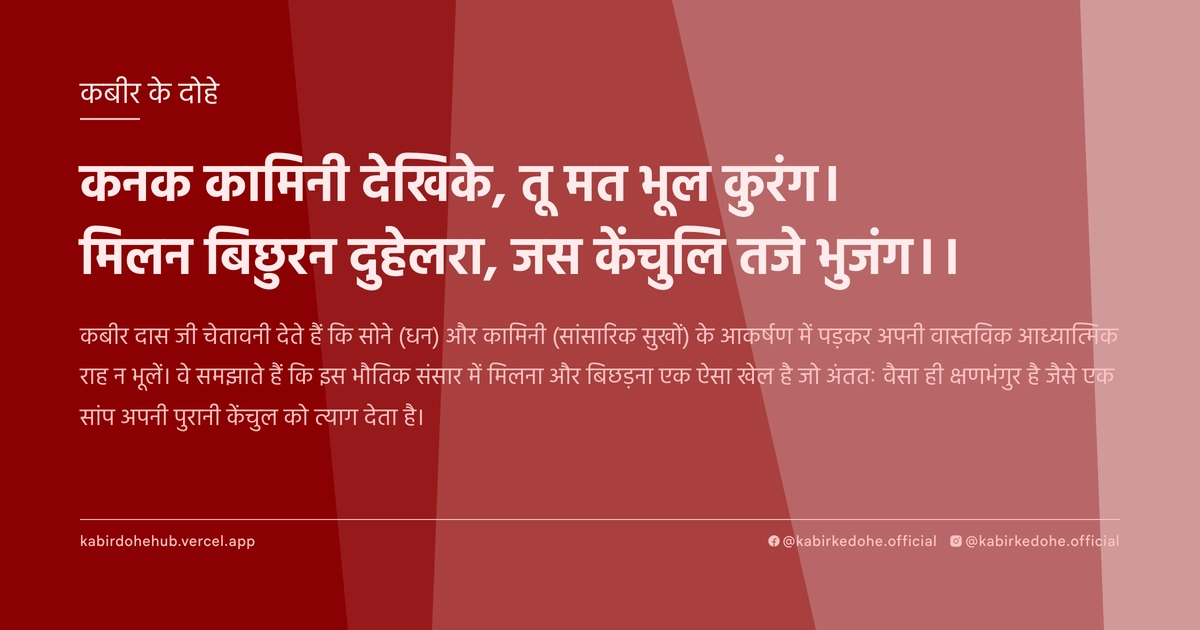
कनक कामिनी देखिके, तू मत भूल कुरंग।
मिलन बिछुरन दुहेलरा, जस केंचुलि तजे भुजंग।।
Kanak kaamini dekhike, tu mat bhool kurang. Milan bichuran duhelra, jas kenchuli taje bhujang.
इस पृष्ठ पर इस कबीर दोहे का अर्थ (meaning), हिंदी व्याख्या और अंग्रेज़ी अनुवाद, दार्शनिक विश्लेषण और व्यावहारिक जीवन सीख दी गई है। यह दोहा वैराग्य (Detachment) विषय से जुड़ा है — Kabir doha meaning and explanation in Hindi and English.
अर्थ (Meaning):
कबीर दास जी चेतावनी देते हैं कि सोने (धन) और कामिनी (सांसारिक सुखों) के आकर्षण में पड़कर अपनी वास्तविक आध्यात्मिक राह न भूलें। वे समझाते हैं कि इस भौतिक संसार में मिलना और बिछड़ना एक ऐसा खेल है जो अंततः वैसा ही क्षणभंगुर है जैसे एक सांप अपनी पुरानी केंचुल को त्याग देता है।
Kabir warns against being blinded by the allure of gold (wealth) and sensual pleasures. He explains that the cycle of meeting and parting in this material world is a deceptive game, as transient and disposable as a snake shedding its old skin to make way for the new.
व्याख्या (Interpretation):
यहाँ 'कनक' और 'कामिनी' केवल भौतिक वस्तुओं के प्रतीक नहीं हैं, बल्कि वे 'माया' के उन सूक्ष्म जालों को दर्शाते हैं जो आत्मा को उसके वास्तविक स्वरूप से दूर ले जाते हैं। 'कुरंग' (हिरण) उस साधक का प्रतीक है जो बाहरी चमक-धमक से भ्रमित हो जाता है। कबीर इस विरोधाभास को उजागर करते हैं कि जिसे हम स्थायी सुख समझते हैं, वह वास्तव में एक निरंतर परिवर्तनशील प्रक्रिया है। यह निरगुण भक्ति का सार है, जहाँ साधक को यह समझना होता है कि संसार की हर वस्तु परिवर्तनशील है। जैसे सांप अपनी केंचुल छोड़ता है, वैसे ही आत्मा को इस शरीर और अहंकार के मोह को त्यागना होगा ताकि वह ब्रह्म के साथ एकाकार हो सके। यह अद्वैत वेदांत के उस सिद्धांत को पुष्ट करता है कि केवल शुद्ध चेतना ही सत्य है, बाकी सब मिथ्या है।
Here, 'Kanak' (gold) and 'Kaamini' (sensual beauty) are not merely material objects but symbols of the subtle webs of 'Maya' that distract the soul from its primordial essence. The 'Kurang' (deer) represents the spiritual seeker who is easily mesmerized by external brilliance. Kabir highlights the paradox that what we perceive as permanent pleasure is actually a state of constant flux. This is the essence of Nirgun Bhakti, where the seeker must realize that everything in the phenomenal world is transient. Just as a snake sheds its skin, the soul must discard the attachment to the physical body and the ego to merge with the formless Brahman. This reinforces the Advaita Vedanta principle that only pure consciousness is real, while the material world is a fleeting illusion.
दार्शनिक विश्लेषण (Philosophical Analysis):
कबीर का यह दोहा उस समय के सामाजिक और धार्मिक परिवेश पर एक गहरा प्रहार है जहाँ बाहरी आडंबर और भौतिक समृद्धि को आध्यात्मिक उपलब्धि मान लिया जाता था। कबीर ने स्पष्ट रूप से कर्मकांडों और जातिगत श्रेष्ठता के बजाय आंतरिक शुद्धि पर जोर दिया। वे बताते हैं कि धन और वासना का मोह मनुष्य की विवेक शक्ति को नष्ट कर देता है, जिससे वह 'माया' के वशीभूत हो जाता है।
दार्शनिक स्तर पर, यह सूफीवाद के 'फना' (अहंकार का विनाश) के विचार से मेल खाता है। जब तक व्यक्ति अपनी बाहरी पहचान और भौतिक सुखों से चिपका रहता है, वह सत्य का अनुभव नहीं कर सकता। कबीर का तर्क है कि संसार का हर संबंध, चाहे वह कितना भी गहरा क्यों न लगे, अंततः विच्छेद में समाप्त होता है।
अद्वैत वेदांत के अनुसार, आत्मा और परमात्मा एक ही हैं, लेकिन अज्ञानता (अविद्या) के कारण हम खुद को शरीर और संपत्ति से जोड़ लेते हैं। कबीर इस अज्ञानता को दूर करने के लिए 'वैराग्य' का मार्ग सुझाते हैं। वे यह नहीं कहते कि संसार को पूरी तरह छोड़ दो, बल्कि यह कि संसार में रहते हुए भी उससे अनासक्त रहो।
मनोवैज्ञानिक रूप से, यह दोहा 'डोपामाइन' की अंतहीन खोज की चेतावनी है। मनुष्य एक सुख से दूसरे सुख की ओर भागता है, लेकिन वह कभी संतुष्ट नहीं होता क्योंकि वह स्रोत को गलत जगह खोज रहा है। वास्तविक शांति बाहरी वस्तुओं में नहीं, बल्कि आंतरिक मौन में है।
अंततः, कबीर का संदेश यह है कि जीवन एक निरंतर परिवर्तन है। जो व्यक्ति इस परिवर्तन को स्वीकार कर लेता है और अपनी पहचान को भौतिकता से ऊपर उठा लेता है, वही वास्तव में स्वतंत्र है। यह भौतिकवाद के विरुद्ध एक आध्यात्मिक विद्रोह है जो मनुष्य को उसकी शाश्वत प्रकृति की याद दिलाता है।
Kabir's couplet is a profound critique of the socio-religious climate of his era, where external rituals and material prosperity were often mistaken for spiritual attainment. He emphasizes internal purification over the superficiality of caste hierarchies and ritualistic displays. He argues that the obsession with wealth and desire erodes the faculty of discernment, leaving the individual enslaved by 'Maya'.
Philosophically, this aligns with the Sufi concept of 'Fana' (the annihilation of the ego). As long as a person clings to their external identity and material pleasures, they remain veiled from the Ultimate Truth. Kabir posits that every worldly relationship, regardless of its perceived depth, inevitably culminates in separation.
According to Advaita Vedanta, the Atman and Brahman are one, yet ignorance (Avidya) causes us to misidentify ourselves with the body and possessions. Kabir suggests the path of 'Vairagya' (dispassion) to dissolve this ignorance. He does not advocate for a complete abandonment of the world, but rather for living within it without attachment.
Psychologically, this verse serves as a warning against the endless pursuit of sensory gratification. Humans chase one pleasure after another, yet remain perpetually unsatisfied because they seek the source in the wrong place. True peace resides not in external acquisitions but in internal silence.
Ultimately, Kabir's message is that life is a process of constant transformation. The individual who accepts this transience and elevates their identity above the material plane achieves true liberation. It is a spiritual rebellion against materialism, reminding humanity of its eternal, non-physical nature.
मूल संदेश (Core Message):
- भौतिक आकर्षण एक मायावी जाल है जो आत्मा को भ्रमित करता है।
- संसार में हर मिलन का अंत विछोह है, इसलिए आसक्ति व्यर्थ है।
- अहंकार और शरीर की पहचान को त्यागना ही वास्तविक मुक्ति है।
- शाश्वत सत्य केवल वह है जो समय और परिवर्तन से परे है।
- आंतरिक संतोष बाहरी समृद्धि से कहीं अधिक मूल्यवान और स्थायी है।
- Material allure is a deceptive web that blinds the soul to its truth.
- Every union in this world ends in separation; thus, attachment is futile.
- Shedding the identity of the ego and body is the only path to liberation.
- Eternal truth is that which exists beyond the reach of time and change.
- Inner contentment is far more precious and enduring than external wealth.
व्यावहारिक उदाहरण (Practical Example):
एक समय की बात है, वाराणसी के घाटों पर माधव नाम का एक अत्यंत कुशल बुनकर रहता था। माधव अपनी कला में निपुण था और उसके द्वारा बनाए गए रेशमी वस्त्र राजमहलों की शोभा बढ़ाते थे। जैसे-जैसे उसकी प्रसिद्धि बढ़ी, उसके पास सोने की मोहरें और विलासिता के साधन आने लगे।
धीरे-धीरे माधव अपनी सादगी भूल गया। वह अब केवल उन लोगों से मिलता जो अमीर थे और उसने अपने पुराने गरीब मित्रों को नजरअंदाज करना शुरू कर दिया। वह अपनी नई हवेली और रेशमी बिस्तरों के मोह में इतना डूब गया कि उसने ईश्वर का ध्यान करना और अपनी आत्मा की शांति को पूरी तरह भुला दिया।
एक दिन माधव को खबर मिली कि उसके शहर में एक महान संत आए हैं। माधव अपनी शानो-शौकत दिखाने के लिए उनके पास गया। संत ने माधव की महंगी पोशाक को देखा और मुस्कुराते हुए एक पुराने, फटे हुए कपड़े के टुकड़े की ओर इशारा किया जो पास ही पड़ा था।
संत ने कहा, 'माधव, यह रेशम जिसे तुम अपनी पहचान मान रहे हो, कल तक एक कीड़े का घर था और परसों यह मिट्टी में मिल जाएगा। तुम इस चमक में इतने खो गए हो कि तुम्हें यह नहीं दिख रहा कि तुम खुद एक केंचुल की तरह हो, जो हर पल बदल रही है।'
माधव को पहले तो यह बात चुभी, लेकिन जब उसने अपनी हवेली के नौकरों और चाटुकारों के व्यवहार को देखा, तो उसे अहसास हुआ कि उसकी सारी 'शान' केवल दिखावा थी। जैसे ही उसकी सेहत बिगड़ी, वे सभी लोग जो उसके धन के पीछे थे, गायब हो गए।
अकेलेपन के उस क्षण में माधव को कबीर का वह दोहा याद आया। उसने महसूस किया कि उसने अपना पूरा जीवन 'कनक और कामिनी' (धन और सुख) को संजोने में बिता दिया, जबकि वह अपनी आत्मा के असली रंग को भूल गया था।
उसने अपनी सारी संपत्ति का एक बड़ा हिस्सा गरीबों में बाँट दिया और फिर से अपने करघे पर बैठ गया, लेकिन इस बार वह धन के लिए नहीं, बल्कि प्रेम और समर्पण के लिए बुनने लगा।
उसकी आँखों में अब लालच नहीं, बल्कि एक गहरा ठहराव था। उसने जान लिया था कि असली सुख उस चीज़ में नहीं है जिसे पकड़ा जा सके, बल्कि उस अवस्था में है जहाँ कुछ भी पकड़ने की इच्छा न रहे।
माधव अब एक अमीर बुनकर नहीं, बल्कि एक जागृत आत्मा बन चुका था, जिसने भौतिकता की केंचुल को उतार फेंका था।
Once, in the ghats of Varanasi, lived a master weaver named Madhav. Madhav was exceptionally skilled, and the silk garments he crafted graced the halls of royal palaces. As his fame grew, gold coins and luxuries began to flow into his life.
Gradually, Madhav forgot his simplicity. He began associating only with the wealthy and started ignoring his old, impoverished friends. He became so immersed in the allure of his new mansion and silk bedding that he completely forgot to meditate and seek inner peace.
One day, Madhav heard that a great saint had arrived in the city. Seeking to showcase his grandeur, Madhav visited him. The saint looked at Madhav's expensive attire and smiled, pointing toward a piece of old, torn cloth lying nearby.
The saint said, 'Madhav, this silk you consider your identity was once the home of a worm, and soon it will return to the dust. You are so lost in this glitter that you fail to see you are like a skin, constantly shedding and changing.'
At first, Madhav felt offended, but as he observed the behavior of his servants and flatterers, he realized his 'grandeur' was a mere facade. The moment his health declined, all those who were attracted to his wealth vanished.
In that moment of profound loneliness, Madhav recalled Kabir's verse. He realized he had spent his entire life hoarding 'Kanak and Kaamini' (wealth and pleasure), while forgetting the true color of his soul.
He distributed a large portion of his wealth among the poor and returned to his loom, but this time he wove not for profit, but for love and surrender.
There was no longer greed in his eyes, only a deep stillness. He had learned that true happiness does not lie in what can be grasped, but in the state where the desire to grasp ceases to exist.
Madhav was no longer just a wealthy weaver, but an awakened soul who had cast off the skin of materialism.
अभ्यास मार्गदर्शन (Practice Guidance):
- प्रतिदिन 20 मिनट मौन ध्यान करें, जहाँ आप अपने विचारों को केवल एक दर्शक की तरह देखें, बिना उनसे जुड़े।
- एक 'अनासक्ति जर्नल' बनाएँ: लिखें कि आज आपने किन भौतिक वस्तुओं या प्रशंसाओं के प्रति अत्यधिक मोह महसूस किया और फिर विश्लेषण करें कि वे वास्तव में कितने अस्थायी हैं।
- सप्ताह में एक दिन 'सादा जीवन' का अभ्यास करें—न्यूनतम भोजन, साधारण वस्त्र और बिना किसी विलासिता के समय बिताएँ।
- निदान चेकलिस्ट: क्या मैं किसी की प्रशंसा मिलने पर अत्यधिक उत्साहित होता हूँ? क्या किसी वस्तु के खोने पर मुझे गहरा दुख होता है? यदि हाँ, तो मैं अभी भी 'केंचुल' से चिपका हूँ।
- Practice 20 minutes of silent meditation daily, observing your thoughts as a detached witness without identifying with them.
- Maintain a 'Detachment Journal': Record instances where you felt excessive attachment to material objects or praise, then analyze their inherent transience.
- Observe one 'Simplicity Day' per week—minimal food, plain clothing, and zero luxuries to recalibrate your needs.
- Diagnostic Checklist: Do I feel an extreme high from external praise? Do I feel deep distress when a material possession is lost? If yes, I am still clinging to the 'skin'.
चिंतन प्रश्न (Reflection Questions):
- यदि आज मेरी सारी सामाजिक प्रतिष्ठा और संपत्ति छीन ली जाए, तो मेरे भीतर क्या बचेगा?
- मैं अपनी डिजिटल पहचान (सोशल मीडिया) को कितना सच मानता हूँ और वह मेरी वास्तविक आत्मा से कितनी अलग है?
- मेरे जीवन का वह कौन सा 'कनक' (मोह) है जिसे मैं कभी नहीं छोड़ना चाहता, और वह मुझे आगे बढ़ने से कैसे रोक रहा है?
- क्या मैं वास्तव में स्वतंत्र हूँ, या मैं अपनी इच्छाओं का एक परिष्कृत गुलाम हूँ?
- जब मैं दूसरों की मदद करता हूँ, तो क्या वह निस्वार्थ होता है या मेरी अपनी 'अच्छे इंसान' की छवि को पुष्ट करने का एक तरीका?
- If all my social status and wealth were stripped away today, what would remain of me?
- How much of my digital identity do I perceive as real, and how far does it deviate from my authentic soul?
- What is the 'Kanak' (attachment) in my life that I refuse to let go of, and how is it hindering my growth?
- Am I truly free, or am I merely a sophisticated slave to my own desires?
- When I help others, is it out of genuine selflessness or a subconscious effort to reinforce my image as a 'good person'?