
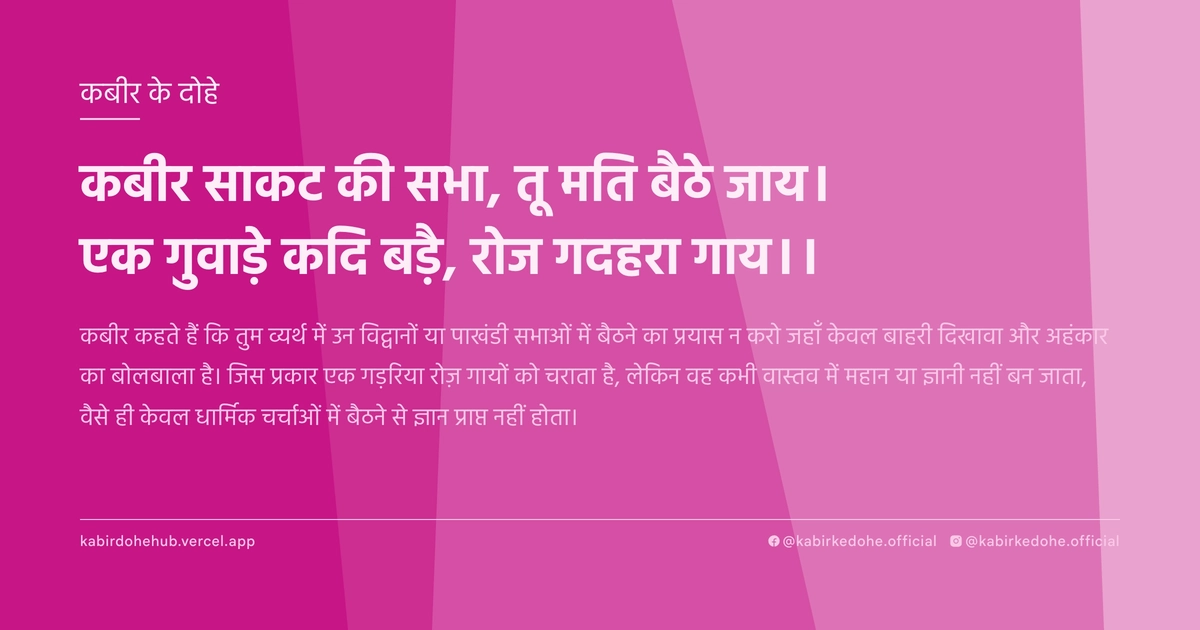
कबीर साकट की सभा, तू मति बैठे जाय।
एक गुवाड़े कदि बड़ै, रोज गदहरा गाय।।
Kabir saakat ki sabha, tu mati baithe jaaye. Ek guwade kadi badai, roj gadhara gaaye.
इस पृष्ठ पर इस कबीर दोहे का अर्थ (meaning), हिंदी व्याख्या और अंग्रेज़ी अनुवाद, दार्शनिक विश्लेषण और व्यावहारिक जीवन सीख दी गई है। यह दोहा पद-प्रतिष्ठा का अहंकार (The Vanity of Status) विषय से जुड़ा है — Kabir doha meaning and explanation in Hindi and English.
अर्थ (Meaning):
कबीर कहते हैं कि तुम व्यर्थ में उन विद्वानों या पाखंडी सभाओं में बैठने का प्रयास न करो जहाँ केवल बाहरी दिखावा और अहंकार का बोलबाला है। जिस प्रकार एक गड़रिया रोज़ गायों को चराता है, लेकिन वह कभी वास्तव में महान या ज्ञानी नहीं बन जाता, वैसे ही केवल धार्मिक चर्चाओं में बैठने से ज्ञान प्राप्त नहीं होता।
Kabir warns against seeking validation or spiritual growth by attending assemblies of pretentious scholars or ritualistic gatherings. He argues that mere presence in such circles is futile; just as a shepherd does not become a master of wisdom simply by tending to his cattle every day, one does not achieve enlightenment merely by associating with the outwardly religious.
व्याख्या (Interpretation):
यह दोहा बाहरी आडंबर और वास्तविक आंतरिक रूपांतरण के बीच के अंतर को स्पष्ट करता है। 'साकट की सभा' उन सामाजिक और धार्मिक संरचनाओं का प्रतीक है जो ज्ञान का दावा तो करती हैं, परंतु वास्तव में अहंकार को पोषित करती हैं। गड़रिये का उदाहरण यह दर्शाता है कि दोहराव और दिनचर्या (Ritual) बिना चेतना के केवल एक यांत्रिक क्रिया है। यहाँ कबीर निर्गुण भक्ति का समर्थन करते हैं, जहाँ ईश्वर किसी सभा या मंदिर में नहीं, बल्कि स्वयं के भीतर स्थित है। यह माया के उस जाल की ओर संकेत करता है जहाँ व्यक्ति बाहरी पहचान को ही आध्यात्मिक उपलब्धि मान लेता है, जबकि आत्मा और ब्रह्म की एकता केवल अहंकार के विसर्जन से संभव है।
This couplet elucidates the stark contrast between external ostentation and genuine internal transformation. The 'Sakat assembly' symbolizes social and religious structures that claim wisdom but primarily nurture the ego. The metaphor of the shepherd illustrates that repetition and ritual, devoid of conscious awareness, are merely mechanical acts. Kabir advocates for Nirgun Bhakti, asserting that the Divine resides within the self rather than in curated gatherings. He highlights the veil of Maya, where an individual mistakes a public religious identity for spiritual attainment, whereas the non-duality of Atman and Brahman is realized only through the annihilation of the ego.
दार्शनिक विश्लेषण (Philosophical Analysis):
कबीर का यह प्रहार उनके युग के उस सामाजिक परिवेश पर है जहाँ जाति, कुल और धार्मिक उपाधियाँ ज्ञान का पैमाना मानी जाती थीं। वे स्पष्ट रूप से कर्मकांडीय धर्म का विरोध करते हैं, क्योंकि उनके अनुसार सत्य किसी संस्था का मोहताज नहीं है। यह दृष्टिकोण अद्वैत वेदांत के उस सिद्धांत से मेल खाता है जहाँ 'अहं ब्रह्मास्मि' का बोध किसी बाहरी गुरु या सभा से नहीं, बल्कि आत्म-साक्षात्कार से होता है।
सूफी मत के 'फना' (अहंकार का विनाश) के समान, कबीर यहाँ यह समझा रहे हैं कि जब तक व्यक्ति खुद को दूसरों से श्रेष्ठ समझने वाली सभाओं का हिस्सा बना रहता है, वह सत्य से दूर रहता है। यहाँ 'गदहरा गाय' का अर्थ केवल पशुपालन नहीं, बल्कि उन मानसिक आदतों से है जिन्हें हम धर्म समझकर दोहराते रहते हैं।
दार्शनिक स्तर पर, यह दोहा 'साधना' और 'प्रदर्शन' के बीच के द्वंद्व को उजागर करता है। कबीर का तर्क है कि ज्ञान वह नहीं जो सुना जाए या जिसका प्रदर्शन किया जाए, बल्कि वह है जो अनुभव किया जाए। वे उस समय के पंडितों और मुल्लाओं की इस मानसिकता को चुनौती देते हैं कि केवल शास्त्रों के पाठ से या विशिष्ट सभाओं में बैठने से मोक्ष मिल जाता है।
यह विश्लेषण हमें मनोवैज्ञानिक रूपांतरण की ओर ले जाता है। जब हम बाहरी मान्यता प्राप्त करने की इच्छा छोड़ देते हैं, तब हमारी ऊर्जा आंतरिक खोज की ओर मुड़ती है। यह 'अविद्या' से 'विद्या' की ओर संक्रमण है, जहाँ व्यक्ति यह समझता है कि सत्य किसी बाहरी समूह की सहमति पर निर्भर नहीं है।
अंततः, कबीर यह संदेश देते हैं कि वास्तविक आध्यात्मिकता एकांत और ईमानदारी में निहित है। वे ritualism को एक मानसिक कारागार मानते हैं जो व्यक्ति को उसकी अपनी अंतरात्मा से काट देता है। सच्चा ज्ञान वह है जो व्यक्ति को विनम्र बनाए, न कि वह जो उसे एक 'विशेष' समूह का हिस्सा होने का भ्रम दे।
Kabir's critique targets the social milieu of his era, where caste, lineage, and religious titles were erroneously viewed as benchmarks of wisdom. He explicitly rejects ritualistic religion, asserting that Truth is not dependent on any institution. This perspective aligns with the Advaita Vedanta principle of 'Aham Brahmasmi,' where the realization of the self as Brahman occurs through self-realization rather than external validation or assembly.
Parallel to the Sufi concept of 'Fana' (annihilation of the ego), Kabir explains that as long as an individual seeks membership in circles that foster a sense of superiority, they remain distant from the Truth. The 'tending of cattle' serves as a metaphor for the mental habits and repetitive rituals we mistake for spiritual progress.
On a philosophical level, this couplet exposes the conflict between 'Sadhana' (disciplined practice) and 'Pradarshan' (performance). Kabir argues that knowledge is not something to be heard or displayed, but something to be experienced. He challenges the prevailing notion among the clergy that mere recitation of scriptures or attendance at elite gatherings guarantees liberation.
This analysis leads us toward psychological transformation. When the desire for external validation ceases, energy shifts toward internal inquiry. This is the transition from 'Avidya' (ignorance) to 'Vidya' (true knowledge), where one realizes that Truth does not require the consensus of a group.
Ultimately, Kabir suggests that authentic spirituality is rooted in solitude and honesty. He views ritualism as a mental prison that severs the individual's connection with their own inner voice. True wisdom is that which fosters humility, not that which creates the illusion of belonging to an 'exclusive' spiritual elite.
मूल संदेश (Core Message):
- बाहरी धार्मिकता अक्सर आंतरिक रिक्तता का मुखौटा होती है।
- सत्य किसी संस्था या सभा की सदस्यता में नहीं मिलता।
- पुनरावृत्ति और आदत को आध्यात्मिक प्रगति समझने की भूल न करें।
- अहंकार का विसर्जन ही वास्तविक ज्ञान का एकमात्र द्वार है।
- मौन और आत्म-अवलोकन, हज़ारों प्रवचनों से अधिक शक्तिशाली हैं।
- ईश्वर को खोजने के लिए सभाओं की नहीं, शुद्ध हृदय की आवश्यकता है।
- External religiosity is often a mask for internal emptiness.
- Truth is not found in the membership of any institution or assembly.
- Do not mistake repetition and habit for spiritual progress.
- The dissolution of the ego is the only gateway to true knowledge.
- Silence and self-observation are more powerful than a thousand sermons.
- Finding the Divine requires a pure heart, not a crowded assembly.
व्यावहारिक उदाहरण (Practical Example):
वाराणसी के घाटों पर रहने वाले एक वृद्ध विधवा, जानकी, का जीवन इस दोहे का जीवंत उदाहरण है। जानकी पिछले बीस वर्षों से शहर के सबसे बड़े धार्मिक सत्संगों में नियमित रूप से जाती थीं। वे हर सुबह सबसे पहले पहुँचतीं, सबसे शुद्ध वस्त्र पहनतीं और बड़े-बड़े संतों के चरणों में बैठकर घंटों प्रवचन सुनतीं। उन्हें गर्व था कि वे 'विद्वानों की सभा' का हिस्सा हैं।
परंतु, उनके भीतर की अशांति कम नहीं हुई। वे दूसरों को अपनी भक्ति के बारे में बतातीं, लेकिन घर लौटकर अपने छोटे से कमरे में वही क्रोध और ईर्ष्या महसूस करतीं जो पहले थी। वे एक ऐसी 'गड़रिये' की तरह थीं जो रोज़ धर्म की गायों को चरा रही थीं, लेकिन उनका मन अब भी अज्ञान के अंधेरे में था।
एक दिन, उन्होंने एक साधारण से बुनकर को देखा जो चुपचाप अपने काम में मग्न था, लेकिन उसके चेहरे पर एक ऐसी शांति थी जो जानकी ने बड़े-बड़े संतों के चेहरे पर नहीं देखी थी। जब उन्होंने उससे पूछा कि वह कौन सा मंत्र पढ़ता है, तो उस बुनकर ने मुस्कुराकर कहा, 'मैं कोई मंत्र नहीं पढ़ता, मैं बस अपने भीतर के शोर को सुनना बंद कर चुका हूँ।'
यह बात जानकी के लिए एक बिजली की तरह थी। उन्हें अहसास हुआ कि वे जिस 'सभा' में बैठती थीं, वह केवल उनके अहंकार को संतुष्ट करने का एक माध्यम थी। वे वहाँ ज्ञान के लिए नहीं, बल्कि यह महसूस करने के लिए जाती थीं कि वे 'धार्मिक' हैं।
उस दिन के बाद, जानकी ने उन भव्य सभाओं में जाना छोड़ दिया। उन्होंने बाहरी प्रदर्शन के बजाय अपने भीतर झांकना शुरू किया। उन्होंने पाया कि जिस शांति की तलाश में वे मीलों चलती थीं, वह उनके अपने मौन में छिपी थी।
उन्होंने अपने समय का उपयोग उन लोगों की सेवा करने में किया जिन्हें समाज उपेक्षित करता था, बिना यह बताए कि वे ऐसा किसी धर्म के कारण कर रही हैं। उनका व्यवहार अब उपदेशात्मक नहीं, बल्कि करुणामय हो गया था।
धीरे-धीरे, उनके चेहरे की झुर्रियों में एक ऐसी चमक आई जो किसी शास्त्र के पाठ से नहीं, बल्कि अहंकार के विसर्जन से आई थी। उन्होंने जान लिया कि सत्य किसी सभा का मोहताज नहीं होता।
अब वे किसी को यह नहीं बताती थीं कि वे कितनी 'भक्त' हैं; उनकी भक्ति उनके शांत स्वभाव और निस्वार्थ कार्यों में झलकती थी। यह उनका वास्तविक रूपांतरण था—एक गड़रिये से एक जागृत आत्मा बनने की यात्रा।
The life of Janaki, an elderly widow living on the ghats of Varanasi, serves as a living example of this couplet. For twenty years, Janaki regularly attended the city's largest religious congregations. She would arrive first, wear the purest white garments, and sit for hours at the feet of renowned saints, listening to discourses. She took immense pride in being part of the 'assembly of the learned.'
However, her inner turmoil never subsided. She would speak of her devotion to others, yet upon returning to her small room, she felt the same anger and jealousy as before. She was like the 'shepherd' who tended to the cattle of religion every day, but whose mind remained shrouded in ignorance.
One day, she noticed a simple weaver who was quietly absorbed in his work, yet his face radiated a peace that Janaki had never seen on the faces of the great saints. When she asked him what mantra he chanted, the weaver smiled and replied, 'I chant no mantra; I have simply stopped listening to the noise within me.'
These words struck Janaki like a bolt of lightning. She realized that the 'assemblies' she frequented were merely tools to satisfy her ego. She hadn't been going there for knowledge, but to feel 'religious.'
After that day, Janaki stopped attending those grand gatherings. Instead of external performance, she began to look inward. She discovered that the peace she had traveled miles to find was hidden within her own silence.
She began spending her time serving those neglected by society, without announcing that she was doing so for the sake of religion. Her behavior shifted from being preachy to being profoundly compassionate.
Gradually, a glow appeared in the wrinkles of her face—a radiance born not from the recitation of scriptures, but from the dissolution of the ego.
She no longer told anyone how 'devout' she was; her devotion was reflected in her calm demeanor and selfless actions. This was her true transformation—the journey from being a mere shepherd of rituals to an awakened soul.
अभ्यास मार्गदर्शन (Practice Guidance):
- प्रतिदिन 20 मिनट पूर्ण मौन में बैठें, जहाँ न कोई मंत्र हो और न कोई विचार, केवल अपनी सांसों और आंतरिक शोर का अवलोकन करें।
- एक 'अहंकार डायरी' बनाएँ: दिन भर में उन क्षणों को लिखें जब आपने दूसरों को अपनी धार्मिकता, ज्ञान या नैतिकता के बारे में बताकर श्रेष्ठ महसूस करने की कोशिश की।
- व्यवहार परिवर्तन: किसी भी धार्मिक या सामाजिक चर्चा में अपनी राय थोपने के बजाय, केवल सुनने और समझने का अभ्यास करें।
- निदान चेकलिस्ट: क्या मैं इस समूह का हिस्सा हूँ क्योंकि मैं सत्य चाहता हूँ, या इसलिए क्योंकि यहाँ होने से मेरी सामाजिक प्रतिष्ठा बढ़ती है? क्या मेरी शांति बाहरी परिस्थितियों पर निर्भर है?
- Sit in complete silence for 20 minutes daily, without mantras or structured thoughts, simply observing your breath and the internal noise.
- Maintain an 'Ego Journal': Record moments during the day when you attempted to feel superior by highlighting your religiosity, knowledge, or morality to others.
- Behavioral Shift: Practice listening and understanding in religious or social discussions instead of imposing your views or seeking validation.
- Diagnostic Checklist: Am I part of this group because I seek Truth, or because membership enhances my social status? Is my peace dependent on external validation?
चिंतन प्रश्न (Reflection Questions):
- मेरे जीवन में ऐसी कौन सी 'सभाएँ' हैं जहाँ मैं केवल अपनी छवि को बेहतर बनाने के लिए जाता हूँ?
- यदि मेरी सभी धार्मिक और सामाजिक पहचानें छीन ली जाएँ, तो मेरे भीतर क्या बचेगा?
- क्या मेरा आध्यात्मिक अभ्यास मुझे विनम्र बना रहा है, या मुझे दूसरों से श्रेष्ठ होने का अहसास करा रहा है?
- मैं अपनी डिजिटल पहचान (सोशल मीडिया) पर जिस 'आदर्श' व्यक्तित्व को दिखाता हूँ, वह मेरे वास्तविक आंतरिक संघर्षों से कितना अलग है?
- क्या मैं सत्य की खोज कर रहा हूँ, या केवल उस पुष्टि (validation) की जो मुझे एक 'अच्छे इंसान' के रूप में दिखाती है?
- What are the 'assemblies' in my life where I go merely to polish my public image?
- If all my religious and social identities were stripped away, what would remain within me?
- Is my spiritual practice making me humble, or is it fueling a sense of superiority over others?
- How different is the 'ideal' persona I project on social media from my actual internal struggles?
- Am I seeking the Truth, or am I merely seeking the validation that labels me as a 'good person'?