
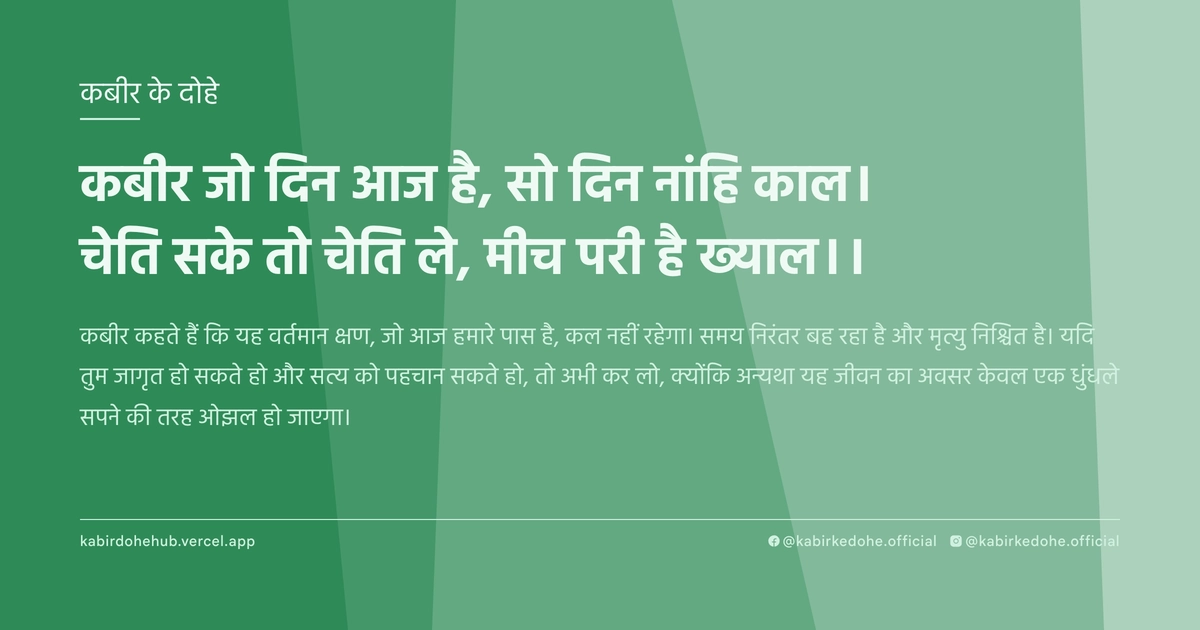
कबीर जो दिन आज है, सो दिन नांहि काल।
चेति सके तो चेति ले, मीच परी है ख्याल।।
Kabir jo din aaj hai, so din nahi kaal. Cheti sake to cheti le, meech pari hai khyal.
इस पृष्ठ पर इस कबीर दोहे का अर्थ (meaning), हिंदी व्याख्या और अंग्रेज़ी अनुवाद, दार्शनिक विश्लेषण और व्यावहारिक जीवन सीख दी गई है। यह दोहा जागृति (The Wake-up Call) विषय से जुड़ा है — Kabir doha meaning and explanation in Hindi and English.
अर्थ (Meaning):
कबीर कहते हैं कि यह वर्तमान क्षण, जो आज हमारे पास है, कल नहीं रहेगा। समय निरंतर बह रहा है और मृत्यु निश्चित है। यदि तुम जागृत हो सकते हो और सत्य को पहचान सकते हो, तो अभी कर लो, क्योंकि अन्यथा यह जीवन का अवसर केवल एक धुंधले सपने की तरह ओझल हो जाएगा।
Kabir asserts that the present day we possess today will not exist tomorrow. Time is an unrelenting flow and death is an absolute certainty. If you have the capacity to awaken and realize the ultimate truth, do so now, for otherwise, this opportunity of life will vanish like a fleeting, blurred dream.
व्याख्या (Interpretation):
इसका शाब्दिक अर्थ है समय की नश्वरता की चेतावनी। गहराई में, यह 'क्षण' (The Moment) की महत्ता को दर्शाता है। कबीर यहाँ 'चेतने' की बात कर रहे हैं, जो केवल शारीरिक जागृति नहीं बल्कि आध्यात्मिक बोध है। यह माया के उस पर्दे की ओर संकेत है जो हमें यह विश्वास दिलाता है कि हमारे पास अनंत समय है। निर्गुण भक्ति के परिप्रेक्ष्य में, यह आत्मा का परमात्मा से मिलन का आह्वान है, जहाँ 'काल' (समय) केवल एक भ्रम है और केवल 'अनादि' सत्य है। यहाँ विरोधाभास यह है कि हम अनंत की खोज उस शरीर में कर रहे हैं जो क्षणभंगुर है।
Literally, this is a warning about the transience of time. Deeply, it emphasizes the significance of the 'Moment'. Kabir speaks of 'awakening,' which is not mere physical consciousness but spiritual realization. He points toward the veil of Maya that deceives us into believing we have infinite time. In the context of Nirgun Bhakti, this is a call for the Atman to merge with the formless Brahman, where 'Kaal' (time) is merely an illusion and only the Eternal is real. The central paradox lies in our search for the infinite within a vessel that is inherently ephemeral.
दार्शनिक विश्लेषण (Philosophical Analysis):
कबीर का यह दोहा उनके युग की सामाजिक और धार्मिक जड़ता पर प्रहार है। उस समय लोग कर्मकांडों और भविष्य के मोक्ष के वादे में उलझे थे, जबकि कबीर 'अभी और यहीं' (Here and Now) के सत्य पर बल देते हैं। यह दृष्टिकोण अद्वैत वेदांत के उस सिद्धांत से मेल खाता है जहाँ जीव और ब्रह्म की एकता को अनुभव करना ही एकमात्र लक्ष्य है।
सूफी मत के 'फना' (अहंकार का विनाश) की अवधारणा यहाँ स्पष्ट है। जब व्यक्ति यह समझ जाता है कि उसका अस्तित्व समय की एक छोटी सी लहर है, तो उसका अहंकार स्वतः समाप्त होने लगता है। कबीर ritualism (कर्मकांड) को इसलिए नकारते हैं क्योंकि वे इसे समय की बर्बादी और सत्य से पलायन मानते हैं।
मनोवैज्ञानिक स्तर पर, यह दोहा 'मृत्यु-चेतना' (Death Awareness) को एक उपकरण के रूप में उपयोग करता है। जब हम अपनी मृत्यु को याद करते हैं, तो हमारी प्राथमिकताएं बदल जाती हैं। हम बाहरी दिखावे और सामाजिक प्रतिष्ठा के बजाय आंतरिक शुद्धि की ओर मुड़ते हैं।
यह शिक्षण हमें सिखाता है कि आध्यात्मिक यात्रा कोई भविष्य का लक्ष्य नहीं है, बल्कि वर्तमान की एक अवस्था है। जो व्यक्ति आज नहीं जागा, वह कल की प्रतीक्षा में केवल अपनी अज्ञानता को बढ़ाएगा।
अंततः, कबीर यह स्थापित करते हैं कि समय का उपयोग संचय के लिए नहीं, बल्कि विसर्जन के लिए किया जाना चाहिए। स्वयं को मिटाकर ही उस पूर्णता को प्राप्त किया जा सकता है जो समय और काल से परे है।
Kabir's couplet is a direct assault on the social and religious inertia of his era. During his time, people were entangled in rituals and promises of future salvation, whereas Kabir emphasized the truth of the 'Here and Now'. This perspective aligns with the Advaita Vedanta principle where experiencing the oneness of Jiva and Brahman is the sole objective.
The Sufi concept of 'Fana' (the annihilation of the ego) is evident here. When an individual realizes their existence is but a small ripple in the ocean of time, the ego begins to dissolve spontaneously. Kabir rejects ritualism because he views it as a waste of precious time and an escape from the raw truth.
On a psychological level, this verse utilizes 'Death Awareness' as a spiritual tool. By confronting the certainty of death, our priorities shift. We move away from external pretenses and social prestige toward internal purification.
This teaching posits that the spiritual journey is not a future destination but a present state of being. One who does not awaken today only deepens their ignorance by waiting for tomorrow.
Ultimately, Kabir establishes that time should be used not for accumulation, but for dissolution. Only by erasing the limited self can one attain the wholeness that exists beyond the constraints of time and space.
मूल संदेश (Core Message):
- समय का भ्रम ही सबसे बड़ा आध्यात्मिक अवरोध है।
- जागरूकता केवल ज्ञान नहीं, बल्कि एक जीवित अनुभव है।
- मृत्यु का स्मरण जीवन को अधिक सार्थक और सचेत बनाता है।
- वर्तमान क्षण ही परमात्मा से मिलन का एकमात्र द्वार है।
- अहंकार को मिटाकर ही शाश्वत सत्य का साक्षात्कार संभव है।
- The illusion of time is the greatest spiritual obstacle.
- Awareness is not mere knowledge, but a living experience.
- The remembrance of death makes life more meaningful and conscious.
- The present moment is the only gateway to union with the Divine.
- Realization of eternal truth is possible only by dissolving the ego.
व्यावहारिक उदाहरण (Practical Example):
वाराणसी के एक पुराने घाट पर रहने वाले एक वृद्ध बुनकर, माधव, का जीवन केवल सूत कातने और उसे बेचने तक सीमित था। वह हमेशा सोचता था कि जब वह बूढ़ा हो जाएगा और उसके बच्चे बड़े हो जाएंगे, तब वह ईश्वर की खोज करेगा और शांति पाएगा।
माधव का पूरा दिन केवल भविष्य की चिंताओं और पुरानी यादों में बीतता था। वह अक्सर कहता, 'अभी तो काम है, शांति तो बाद में मिलेगी।'
एक दिन, उसकी मुलाकात एक घुमंतू साधु से हुई जिसने उसे कबीर का यह दोहा सुनाया। साधु ने माधव से पूछा, 'यदि तुम्हारी सांसें अभी रुक जाएं, तो क्या तुम्हारा 'बाद में' कभी आएगा?'
माधव को गहरा झटका लगा। उसने महसूस किया कि उसने अपना पूरा जीवन 'तैयारी' में बिता दिया, लेकिन कभी 'जीया' नहीं।
उसने उसी क्षण निर्णय लिया कि वह अपनी वर्तमान स्थिति में ही सत्य को खोजेगा। उसने अपने काम को ही प्रार्थना बना लिया।
अब वह सूत काटते समय केवल धागे को नहीं, बल्कि अपने भीतर की चेतना को बुनने लगा। उसने क्रोध और लालच को त्याग कर वर्तमान क्षण में जीना शुरू किया।
उसने देखा कि जब वह पूरी तरह वर्तमान में होता है, तो उसका काम अधिक निखरता है और उसका मन शांत रहता है।
माधव ने समझा कि मोक्ष किसी दूरस्थ स्थान या भविष्य के समय में नहीं, बल्कि इसी क्षण की जागरूकता में छिपा है।
उसकी यह आंतरिक क्रांति उसके व्यवहार में दिखी; वह अब दूसरों की मदद बिना किसी स्वार्थ के करने लगा।
अंत में, माधव ने जाना कि 'आज' ही वह एकमात्र द्वार है जिससे होकर अनंत तक पहुँचा जा सकता है।
In the ancient ghats of Varanasi lived an elderly weaver named Madhav, whose life was confined to spinning and selling yarn. He always believed that once he grew older and his children were settled, he would seek God and find peace.
Madhav's entire day was spent in future anxieties and past memories. He often remarked, 'There is work to do now; peace will come later.'
One day, he encountered a wandering monk who recited this specific Doha of Kabir. The monk asked Madhav, 'If your breath stops now, will your "later" ever arrive?'
Madhav felt a profound shock. He realized he had spent his entire life in 'preparation' but had never actually 'lived'.
In that very moment, he decided to seek the truth within his current circumstances. He transformed his daily labor into a prayer.
Now, while spinning yarn, he didn't just weave threads, but began to weave his own consciousness. He abandoned anger and greed to live fully in the present.
He noticed that when he was entirely present, his craftsmanship improved and his mind remained serene.
Madhav understood that liberation is not in a distant place or a future time, but hidden within the awareness of this very moment.
This internal revolution manifested in his behavior; he began helping others selflessly and without expectation.
Ultimately, Madhav realized that 'Today' is the only gateway through which one can reach the Infinite.
अभ्यास मार्गदर्शन (Practice Guidance):
- प्रतिदिन 15 मिनट 'साक्षी भाव' का अभ्यास करें, जहाँ आप केवल अपनी सांसों और विचारों को बिना किसी निर्णय के देखें।
- एक डायरी लिखें जिसमें प्रतिदिन एक ऐसी घटना दर्ज करें जहाँ आपने भविष्य की चिंता में वर्तमान की शांति को खोया, और फिर उसे सुधारने का तरीका लिखें।
- व्यवहार परिवर्तन: जब भी आप 'कल' या 'बाद में' शब्द का प्रयोग करें, रुकें और स्वयं से पूछें, 'मैं इस कार्य को अभी पूर्ण जागरूकता के साथ कैसे कर सकता हूँ?'
- नैदानिक चेकलिस्ट: क्या आप अक्सर पुरानी यादों में खोए रहते हैं? क्या आप भविष्य के डर से वर्तमान का आनंद नहीं ले पा रहे? यदि हाँ, तो आप 'माया' के समय-जाल में फंसे हैं।
- Practice 'Witness Consciousness' for 15 minutes daily, observing your breath and thoughts without any judgment.
- Maintain a journal recording one instance each day where you lost present peace to future anxiety, and then write how to rectify it.
- Behavioral Shift: Whenever you use the words 'tomorrow' or 'later', pause and ask yourself, 'How can I perform this action with full awareness right now?'
- Diagnostic Checklist: Do you often dwell in old memories? Are you unable to enjoy the present due to fear of the future? If yes, you are trapped in the temporal web of Maya.
चिंतन प्रश्न (Reflection Questions):
- यदि आज आपका अंतिम दिन हो, तो आपके जीवन का कौन सा हिस्सा सबसे अधिक व्यर्थ प्रतीत होगा?
- आप अपनी सार्वजनिक छवि (Digital Ego) को बनाए रखने के लिए वर्तमान के कितने वास्तविक क्षणों का बलिदान कर रहे हैं?
- क्या आपकी आध्यात्मिक खोज वास्तव में सत्य की प्यास है, या केवल मृत्यु के भय से बचने का एक तरीका?
- आप किन उन पूर्वाग्रहों को ढो रहे हैं जो आपको वर्तमान में दूसरों के साथ प्रेमपूर्वक जुड़ने से रोकते हैं?
- क्या आप वास्तव में 'जागृत' हैं, या आप केवल समाज द्वारा निर्धारित आदतों के ऑटो-पायलट मोड पर चल रहे हैं?
- If today were your final day, which part of your life would seem most wasteful?
- How many authentic moments of the present are you sacrificing to maintain your public image (Digital Ego)?
- Is your spiritual quest truly a thirst for truth, or merely a way to escape the fear of death?
- What biases are you carrying that prevent you from connecting lovingly with others in the present?
- Are you truly 'awake', or are you merely operating on the auto-pilot mode of socially conditioned habits?