
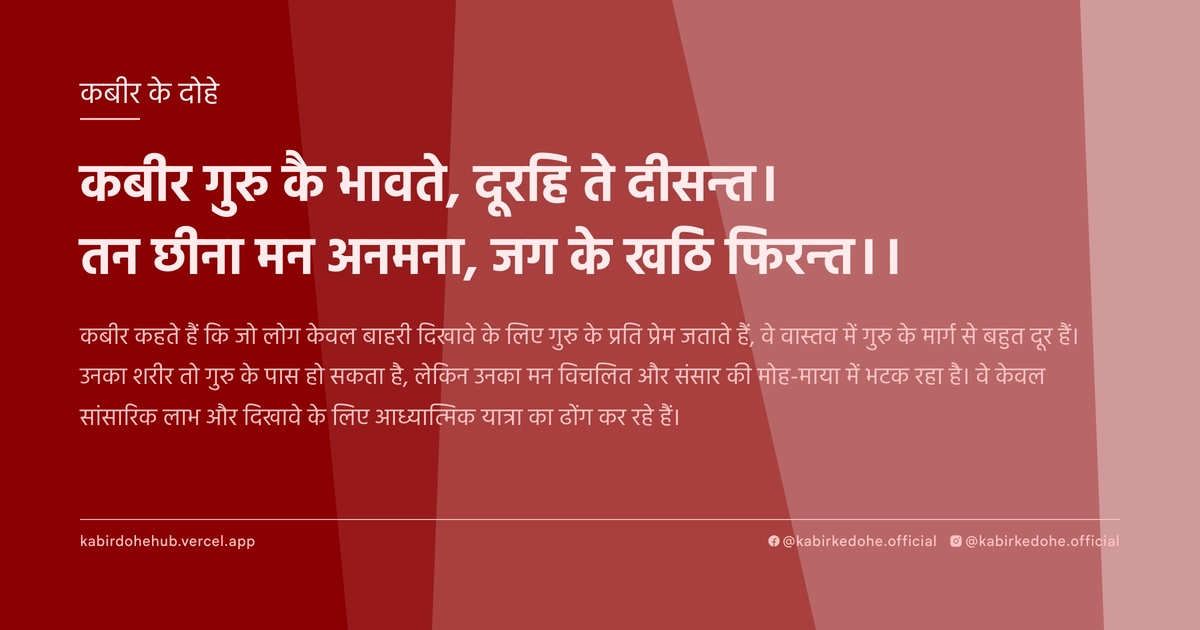
कबीर गुरु कै भावते, दूरहि ते दीसन्त।
तन छीना मन अनमना, जग के खठि फिरन्त।।
Kabir guru kai bhavte, doorahi te deesant. Tan chheena man anmana, jag ke khathi phirant.
इस पृष्ठ पर इस कबीर दोहे का अर्थ (meaning), हिंदी व्याख्या और अंग्रेज़ी अनुवाद, दार्शनिक विश्लेषण और व्यावहारिक जीवन सीख दी गई है। यह दोहा वैराग्य (Detachment) विषय से जुड़ा है — Kabir doha meaning and explanation in Hindi and English.
अर्थ (Meaning):
कबीर कहते हैं कि जो लोग केवल बाहरी दिखावे के लिए गुरु के प्रति प्रेम जताते हैं, वे वास्तव में गुरु के मार्ग से बहुत दूर हैं। उनका शरीर तो गुरु के पास हो सकता है, लेकिन उनका मन विचलित और संसार की मोह-माया में भटक रहा है। वे केवल सांसारिक लाभ और दिखावे के लिए आध्यात्मिक यात्रा का ढोंग कर रहे हैं।
Kabir observes that those who claim to love the Guru but remain distant in spirit are merely performing a charade. While their physical bodies may be present in the presence of the teacher, their minds are fragmented and wandering in the illusions of the world, seeking worldly gains rather than spiritual liberation.
व्याख्या (Interpretation):
यह दोहा बाहरी भक्ति और आंतरिक शून्यता के बीच के विरोधाभास को दर्शाता है। 'दूरहि ते दीसन्त' का अर्थ है कि आध्यात्मिक दूरी शारीरिक दूरी से अधिक घातक होती है। यहाँ 'तन छीना' उस स्थिति को दर्शाता है जहाँ साधक केवल शारीरिक अनुशासन का पालन करता है, जबकि 'मन अनमना' यह संकेत देता है कि उसकी चेतना अभी भी माया के अधीन है। यह निर्गुण भक्ति का सार है, जहाँ ईश्वर या गुरु बाहरी मूर्ति या व्यक्ति में नहीं, बल्कि भीतर की जागरूकता में स्थित हैं। जब तक अहंकार (Ego) जीवित है, साधक केवल 'जग के खठि' यानी संसार की गलियों में भटकता रहता है, सत्य तक नहीं पहुँचता।
This couplet highlights the paradox between external piety and internal void. 'Doorahi te deesant' implies that spiritual distance is far more perilous than physical separation. 'Tan chheena' refers to the state where a seeker adheres only to physical rituals, while 'man anmana' signals that their consciousness remains enslaved by Maya (illusion). This aligns with Nirgun Bhakti, where the Divine or Guru is not found in a physical form but in internal awareness. As long as the ego persists, the seeker merely wanders the 'streets of the world,' chasing shadows instead of the Eternal Truth, illustrating the non-duality of Atman and Brahman which cannot be realized through superficiality.
दार्शनिक विश्लेषण (Philosophical Analysis):
कबीर का यह प्रहार उनके युग के उस पाखंड पर है जहाँ धर्म केवल एक सामाजिक पोशाक बन गया था। वे उस समय के पंडितों और मौलवियों की आलोचना करते हैं जो बाहरी कर्मकांडों को मोक्ष का मार्ग बताते थे। कबीर के अनुसार, गुरु केवल वह व्यक्ति नहीं है जो उपदेश देता है, बल्कि वह है जो साधक के भीतर के 'अहं' को नष्ट कर दे।
अद्वैत वेदांत के परिप्रेक्ष्य में, यह दोहा 'माया' के प्रभाव को स्पष्ट करता है। माया वह पर्दा है जो हमें यह विश्वास दिलाता है कि हम शरीर हैं, जबकि हम वास्तव में शुद्ध चेतना हैं। जब मन 'अनमना' होता है, तो वह द्वैत (Duality) में जीता है—मैं और मेरा गुरु, मैं और मेरा संसार।
सूफी मत के 'फना' (annihilation) के सिद्धांत से इसे जोड़कर देखें तो, जब तक साधक अपनी व्यक्तिगत पहचान को ईश्वर की इच्छा में विलीन नहीं करता, वह केवल एक पर्यटक है, यात्री नहीं। कबीर यहाँ चेतावनी दे रहे हैं कि बिना आंतरिक रूपांतरण के, गुरु की शरण में जाना भी एक प्रकार का सांसारिक व्यापार (खठि) बन जाता है।
मनोवैज्ञानिक स्तर पर, यह 'संज्ञानात्मक विसंगति' (Cognitive Dissonance) की स्थिति है, जहाँ व्यक्ति वह होने का नाटक करता है जो वह वास्तव में नहीं है। यह आंतरिक संघर्ष आत्मा को विखंडित करता है और उसे सत्य से दूर ले जाता है।
अंततः, कबीर यह स्थापित करते हैं कि वास्तविक भक्ति 'भाव' में है, न कि 'प्रदर्शनी' में। जब तक साधक अपनी वासनाओं और सामाजिक प्रतिष्ठा की भूख को नहीं त्यागता, वह गुरु के सान्निध्य में रहकर भी अजनबी बना रहता है।
Kabir’s critique targets the hypocrisy of his era, where religion had become a mere social garment. He challenges the clergy who presented external rituals as the sole path to salvation. For Kabir, a Guru is not merely a lecturer of scriptures but a catalyst who annihilates the seeker's 'Aham' (ego).
From the lens of Advaita Vedanta, this doha elucidates the grip of 'Maya.' Maya is the veil that convinces us we are the physical body, whereas we are actually pure consciousness. When the mind is 'anmana' (unfocused/distracted), it exists in duality—separating the 'I' from the 'Guru' and the 'I' from the 'World.'
Connecting this to the Sufi concept of 'Fana' (annihilation), unless the seeker dissolves their individual identity into the Divine Will, they remain a tourist of spirituality rather than a true traveler. Kabir warns that without internal transformation, seeking a Guru becomes another form of worldly transaction (khathi).
Psychologically, this describes a state of cognitive dissonance, where an individual performs an identity they do not possess. This internal conflict fragments the soul and pushes it further away from the center of Truth.
Ultimately, Kabir establishes that true devotion lies in 'Bhava' (inner feeling) rather than 'Pradarshani' (exhibition). Until the seeker relinquishes the hunger for social prestige and sensory desires, they remain a stranger even in the closest proximity of the Master.
मूल संदेश (Core Message):
- बाहरी अनुष्ठान बिना आंतरिक समर्पण के व्यर्थ हैं।
- गुरु का सान्निध्य शरीर से नहीं, चेतना से होता है।
- अहंकार की उपस्थिति में सत्य का अनुभव असंभव है।
- दिखावा आध्यात्मिक प्रगति का सबसे बड़ा अवरोध है।
- वास्तविक भक्ति स्वयं के मिथ्या स्वरूप का विसर्जन है।
- External rituals are futile without internal surrender.
- Proximity to the Guru is a matter of consciousness, not physics.
- Experience of Truth is impossible in the presence of ego.
- Performative spirituality is the greatest obstacle to progress.
- True devotion is the dissolution of the false self.
व्यावहारिक उदाहरण (Practical Example):
वाराणसी के एक पुराने घाट पर रहने वाली एक वृद्ध विधवा, जानकी, का जीवन इस दोहे का जीवंत उदाहरण है। जानकी पिछले बीस वर्षों से शहर के सबसे प्रसिद्ध संत के आश्रम में सेवा करती थी। वह हर सुबह सबसे पहले उठती, मंदिर की सफाई करती और घंटों माला जपती। बाहरी दुनिया के लिए वह एक 'आदर्श भक्त' थी।
लेकिन जानकी के भीतर एक गहरा द्वंद्व था। वह संत की सेवा इसलिए नहीं करती थी कि उसे सत्य की खोज थी, बल्कि इसलिए कि वह चाहती थी कि शहर के लोग उसे 'पवित्र' और 'त्यागी' कहें। उसका मन हमेशा इस बात पर केंद्रित रहता था कि लोग उसकी प्रशंसा कैसे कर रहे हैं।
एक दिन, संत ने उसे अपने पास बुलाया और बिना कुछ कहे उसके हाथ में एक छोटा सा आईना थमा दिया। संत ने कहा, 'जानकी, तुम मुझे देख रही हो, लेकिन क्या तुम उस औरत को देख रही हो जो इस आईने में है?'
जानकी ने आईने में देखा। उसे अपनी झुर्रियों वाली त्वचा नहीं, बल्कि अपनी आँखों में छिपा हुआ अहंकार और दूसरों से प्रशंसा पाने की भूख दिखाई दी। उसे एहसास हुआ कि बीस साल तक वह शरीर से तो संत के पास थी, लेकिन मन से वह अपनी 'छवि' (Image) की पूजा कर रही थी।
उस क्षण, उसका 'तन' और 'मन' एक हो गए। उसने महसूस किया कि वह अब तक केवल एक आध्यात्मिक नाटक कर रही थी। उसने माला फेरना बंद किया और वास्तव में मौन रहना सीखा।
उसने अपनी प्रशंसा की भूख को त्याग दिया और बिना किसी दिखावे के, केवल प्रेमवश सेवा करना शुरू किया। अब वह दूसरों की नजरों में 'पवित्र' नहीं थी, क्योंकि उसने अपनी विशिष्टता का दावा छोड़ दिया था, लेकिन वह वास्तव में शांत थी।
उसका व्यवहार बदल गया; वह अब दूसरों को उपदेश नहीं देती थी, बल्कि उनकी पीड़ा को चुपचाप साझा करती थी।
यह 'कबीर ट्विस्ट' था—जब उसने अपनी बाहरी पहचान को नष्ट किया, तभी उसे वास्तविक गुरु का अनुभव हुआ।
Janaki, an elderly widow living on an ancient ghat in Varanasi, embodies the essence of this doha. For twenty years, she served at the ashram of the city's most renowned saint. She woke up before everyone, cleaned the temple, and spent hours chanting beads. To the outside world, she was the 'ideal devotee.'
However, a deep conflict raged within Janaki. She did not serve the saint out of a quest for Truth, but because she craved the label of being 'pure' and 'renounced' in the eyes of the community. Her mind was perpetually focused on the admiration she received from others.
One day, the saint called her and, without a word, handed her a small mirror. He asked, 'Janaki, you look at me, but do you see the woman in this mirror?'
Looking into the glass, Janaki saw not just her wrinkled skin, but the hidden ego and the hunger for validation lurking in her eyes. She realized that for twenty years, while her body was with the saint, her mind had been worshipping her own 'image.'
In that moment, her body and mind aligned. She realized she had been performing a spiritual play. She stopped the mechanical chanting and learned the art of true silence.
She relinquished her hunger for praise and began serving out of pure, selfless love, devoid of any exhibition.
She was no longer seen as 'holy' by the public because she stopped claiming a special spiritual status, but for the first time, she was truly at peace.
Her behavior shifted; she stopped giving unsolicited advice and began silently sharing the pain of others.
This was the 'Kabir Twist'—only when she destroyed her external identity did she actually experience the presence of the Guru.
अभ्यास मार्गदर्शन (Practice Guidance):
- दैनिक आत्म-निरीक्षण: प्रतिदिन 15 मिनट मौन बैठें और स्वयं से पूछें, 'आज मैंने जो भी धार्मिक या नैतिक कार्य किया, क्या उसके पीछे प्रशंसा पाने की इच्छा थी?'
- अहंकार का विसर्जन: दिन में कम से कम एक ऐसा कार्य करें जिससे आपकी छवि को कोई लाभ न हो और जिसके बारे में कोई अन्य व्यक्ति न जान पाए।
- साक्षी भाव का अभ्यास: जब आप किसी गुरु या मार्गदर्शक के सामने हों, तो अपने शरीर की उपस्थिति के साथ-साथ अपने मन की स्थिति को ट्रैक करें। क्या मन भटक रहा है?
- डायग्नोस्टिक चेकलिस्ट: यदि आप किसी की आलोचना करते समय स्वयं को श्रेष्ठ महसूस करते हैं, या अपनी भक्ति का प्रदर्शन करते हैं, तो समझें कि आप अभी भी 'जग के खठि' (संसार के भ्रम) में हैं।
- Daily Self-Inquiry: Sit in silence for 15 minutes daily and ask, 'Did the religious or moral acts I performed today stem from a desire for validation?'
- Dissolution of Ego: Perform at least one act of service daily that brings no benefit to your public image and remains completely anonymous.
- Practice of Witness Consciousness: While in the presence of a teacher or guide, consciously track whether your mind is present or wandering toward worldly distractions.
- Diagnostic Checklist: If you feel a sense of superiority while criticizing others or feel a need to showcase your devotion, recognize that you are still wandering in 'Jag ke khathi' (worldly illusions).
चिंतन प्रश्न (Reflection Questions):
- मेरे जीवन का कौन सा 'पवित्र' हिस्सा वास्तव में केवल दूसरों को दिखाने के लिए है?
- यदि मेरी आध्यात्मिक उपलब्धियों की प्रशंसा करने वाला कोई न हो, तो क्या मैं अभी भी इस मार्ग पर चलूँगा?
- क्या मैं गुरु की शिक्षाओं को अपने जीवन में उतार रहा हूँ, या केवल उनके शब्दों का संग्रह कर रहा हूँ?
- मेरे भीतर का वह कौन सा 'अनमना' हिस्सा है जो मुझे वर्तमान क्षण से दूर ले जाता है?
- क्या मेरी विनम्रता वास्तव में विनम्रता है, या यह श्रेष्ठता दिखाने का एक सूक्ष्म तरीका है?
- Which 'holy' part of my life is actually designed solely for public consumption?
- If there were no one to praise my spiritual achievements, would I still walk this path?
- Am I embodying the teachings of my guide, or am I merely collecting their words as intellectual trophies?
- Which 'distracted' part of my mind consistently pulls me away from the present moment?
- Is my humility genuine, or is it a subtle tool used to project superiority?