
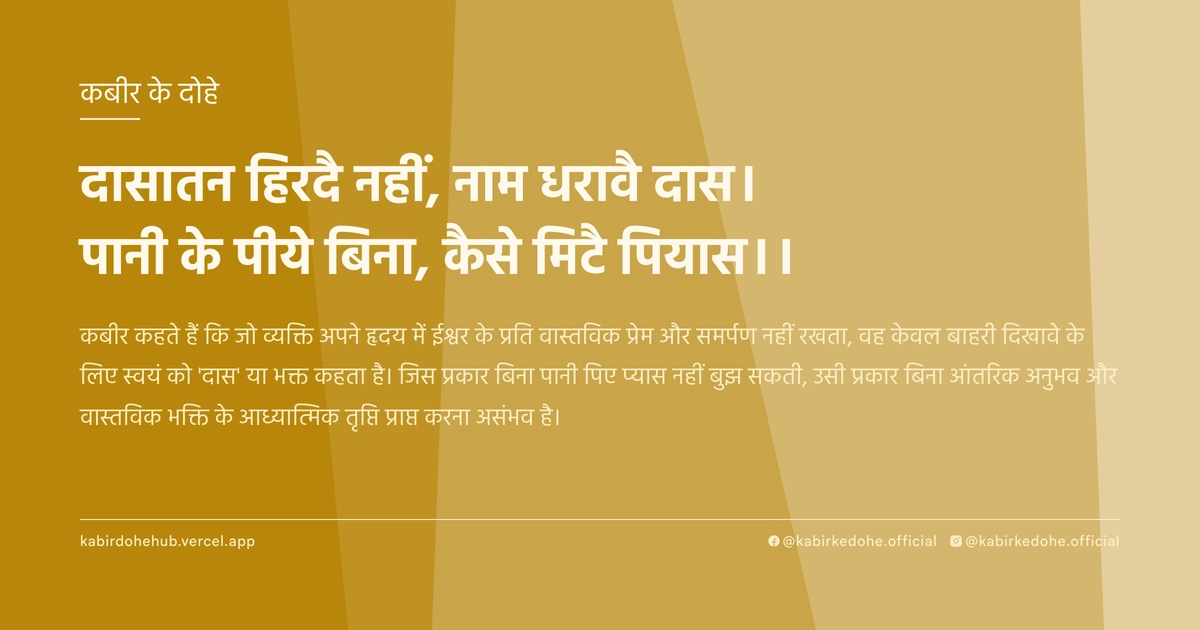
दासातन हिरदै नहीं, नाम धरावै दास।
पानी के पीये बिना, कैसे मिटै पियास।।
Dasatan hirdae nahi, naam dharavai das. Paani ke peeye bina, kaise mitai piyas.
इस पृष्ठ पर इस कबीर दोहे का अर्थ (meaning), हिंदी व्याख्या और अंग्रेज़ी अनुवाद, दार्शनिक विश्लेषण और व्यावहारिक जीवन सीख दी गई है। यह दोहा भक्ति (Bhakti) विषय से जुड़ा है — Kabir doha meaning and explanation in Hindi and English.
अर्थ (Meaning):
कबीर कहते हैं कि जो व्यक्ति अपने हृदय में ईश्वर के प्रति वास्तविक प्रेम और समर्पण नहीं रखता, वह केवल बाहरी दिखावे के लिए स्वयं को 'दास' या भक्त कहता है। जिस प्रकार बिना पानी पिए प्यास नहीं बुझ सकती, उसी प्रकार बिना आंतरिक अनुभव और वास्तविक भक्ति के आध्यात्मिक तृप्ति प्राप्त करना असंभव है।
Kabir asserts that one who lacks genuine love and surrender to the Divine within their heart is merely pretending to be a 'servant' or devotee through outward displays. Just as thirst cannot be quenched without actually drinking water, spiritual fulfillment is impossible without an internal, lived experience of devotion and the actual realization of the Divine.
व्याख्या (Interpretation):
इस दोहे का शाब्दिक अर्थ है कि केवल शब्दों से स्वयं को भक्त कहना पर्याप्त नहीं है। रूपक के माध्यम से कबीर 'प्यास' को आत्मा की परमात्मा से मिलने की तड़प और 'पानी' को उस वास्तविक अनुभव (साक्षात्कार) के रूप में परिभाषित करते हैं। यहाँ 'नाम' केवल शब्दों का जाप नहीं, बल्कि उस निराकार ब्रह्म का अनुभव है। यह निर्गुण भक्ति का सार है, जहाँ बाहरी कर्मकांडों को माया माना गया है। जब तक साधक अपने अहंकार को मिटाकर हृदय में प्रेम को स्थापित नहीं करता, वह केवल एक पाखंडी है। यह द्वैत (भक्त और भगवान) से अद्वैत (एकता) की ओर जाने की यात्रा है, जहाँ प्यास और पानी का मिलन ही मोक्ष है।
The literal meaning emphasizes that calling oneself a devotee is insufficient. Through a powerful metaphor, Kabir defines 'thirst' as the soul's longing for the Divine and 'water' as the actual experiential realization of that Truth. Here, 'Naam' is not mere chanting of words, but the internal resonance of the Formless Brahman. This is the essence of Nirgun Bhakti, where external rituals are dismissed as Maya (illusion). Until the seeker annihilates the ego and establishes true love within the heart, they remain a pretender. It is a journey from duality (the seeker and the sought) to Advaita (non-duality), where the merging of thirst and water signifies liberation.
दार्शनिक विश्लेषण (Philosophical Analysis):
कबीर का यह दोहा मध्यकालीन भारत के उस समय का है जब धर्म केवल बाहरी अनुष्ठानों, जातिगत श्रेष्ठता और लिपिकीय ज्ञान तक सीमित हो गया था। कबीर ने इस पाखंड पर प्रहार किया और 'सहज' मार्ग का प्रतिपादन किया। वे कहते हैं कि ईश्वर मंदिर या मस्जिद में नहीं, बल्कि हृदय के भीतर है। यह विचार अद्वैत वेदांत के करीब है, जहाँ आत्मा और परमात्मा को एक माना गया है।
सूफी मत के 'इश्क-ए-हकीकी' (ईश्वरीय प्रेम) का प्रभाव यहाँ स्पष्ट है। कबीर के लिए भक्ति कोई सामाजिक पहचान नहीं, बल्कि एक आंतरिक रूपांतरण है। वे 'दास' शब्द का प्रयोग करते हैं, लेकिन यह दासता किसी व्यक्ति की नहीं, बल्कि अहंकार के विसर्जन की स्थिति है। जब 'मैं' मिटता है, तभी 'वह' प्रकट होता है।
यहाँ ritualism (कर्मकांड) की अस्वीकृति इस तर्क पर आधारित है कि पानी के बारे में पढ़ना या पानी की प्रशंसा करना प्यास नहीं बुझाता; पानी को पीना पड़ता है। इसी तरह, शास्त्रों को रटना या माला फेरना आध्यात्मिक प्यास को शांत नहीं करता। केवल प्रत्यक्ष अनुभव (Anubhava) ही सत्य है।
मनोवैज्ञानिक स्तर पर, यह दोहा 'संज्ञानात्मक विसंगति' (Cognitive Dissonance) को दर्शाता है—जहाँ व्यक्ति का बाहरी व्यवहार उसकी आंतरिक स्थिति से अलग होता है। कबीर इस अंतर को पाटने का आह्वान करते हैं। वे चाहते हैं कि साधक अपनी सामाजिक छवि (Persona) को त्यागकर अपनी वास्तविक आत्मा (Self) से मिले।
अंततः, यह विश्लेषण हमें बताता है कि भक्ति का अर्थ समर्पण है, प्रदर्शन नहीं। जब तक हृदय में करुणा और प्रेम नहीं है, तब तक कोई भी धार्मिक उपाधि व्यर्थ है। यह संदेश आज भी प्रासंगिक है, जहाँ धर्म अक्सर पहचान की राजनीति का साधन बन जाता है।
This Doha emerges from medieval India, a period when religion had become confined to external rituals, caste superiority, and clerical knowledge. Kabir attacked this hypocrisy, proposing the path of 'Sahaj' (spontaneous/natural realization). He posits that the Divine resides not in temples or mosques, but within the heart, echoing the core of Advaita Vedanta where Atman and Brahman are one.
The influence of the Sufi concept of 'Ishq-e-Haqiqi' (Divine Love) is evident here. For Kabir, devotion is not a social identity but an internal transformation. He uses the term 'Das' (servant), but this servitude is not to a person; it is the state of ego-annihilation. Only when the 'I' vanishes does the 'Divine' manifest.
His rejection of ritualism is based on the logic that reading about water or praising water does not quench thirst; one must actually drink the water. Similarly, rote memorization of scriptures or the mechanical counting of beads does not satisfy spiritual longing. Only direct experience (Anubhava) is truth.
On a psychological level, this Doha highlights 'cognitive dissonance'—where a person's external behavior contradicts their internal state. Kabir calls for bridging this gap, urging the seeker to shed their social persona and encounter their authentic Self.
Ultimately, this analysis reveals that devotion means surrender, not performance. Without compassion and love in the heart, any religious title is void. This message remains vital today, as religion is often reduced to a tool for identity politics rather than a path to liberation.
मूल संदेश (Core Message):
- बाहरी दिखावा आध्यात्मिक प्यास को कभी शांत नहीं कर सकता।
- सच्ची भक्ति शब्दों में नहीं, हृदय के गहरे समर्पण में है।
- अहंकार का त्याग ही परमात्मा से मिलन का एकमात्र द्वार है।
- अनुभव ही अंतिम सत्य है, किताबी ज्ञान केवल एक संकेत है।
- प्रेमविहीन धर्म केवल एक सामाजिक मुखौटा है, आध्यात्मिक मार्ग नहीं।
- External pretension can never quench the spiritual thirst of the soul.
- True devotion lies not in words, but in the deep surrender of the heart.
- The dissolution of ego is the only gateway to union with the Divine.
- Direct experience is the ultimate truth; bookish knowledge is merely a signpost.
- Religion without love is but a social mask, not a spiritual path.
व्यावहारिक उदाहरण (Practical Example):
वाराणसी के एक पुराने घाट पर माधव नाम का एक वृद्ध नाविक रहता था। वह शहर का सबसे बड़ा 'धार्मिक' व्यक्ति माना जाता था। वह रोज़ सुबह सबसे पहले गंगा स्नान करता, माथे पर बड़ा तिलक लगाता और घंटों मंदिर में बैठकर जोर-जोर से मंत्र पढ़ता। लोग उसकी भक्ति की प्रशंसा करते और उसे 'परम भक्त' कहते।
माधव को अपनी इस छवि पर गर्व था। वह दूसरों को उपदेश देता कि कैसे ईश्वर की प्राप्ति के लिए कठोर नियमों का पालन करना चाहिए। लेकिन उसके हृदय में एक गहरा अहंकार था। वह अपने छोटे भाई से नफरत करता था क्योंकि उसके भाई ने कभी मंदिर जाने की आदत नहीं डाली थी।
एक दिन, एक अत्यंत बीमार और भूखा भिखारी माधव के पास आया और मदद मांगी। माधव उस समय मंदिर जाने की तैयारी कर रहा था। उसने भिखारी को झिड़क दिया, यह कहकर कि 'मैं अभी ईश्वर की सेवा में जा रहा हूँ, तुम बीच में बाधा मत बनो'।
तभी वहाँ से एक फकीर गुजरा, जिसने माधव का यह व्यवहार देखा। फकीर ने मुस्कुराते हुए माधव से पूछा, 'भाई, तुम प्यासे को पानी पिलाने के बजाय पानी की महिमा के गीत क्यों गा रहे हो?'
माधव चकित रह गया। फकीर ने आगे कहा, 'तुम्हारी माला और तिलक केवल बाहरी आवरण हैं। तुम्हारे हृदय में उस ईश्वर के लिए प्रेम नहीं है जिसे तुम खोज रहे हो, क्योंकि वह ईश्वर उस भूखे भिखारी के रूप में तुम्हारे सामने खड़ा था और तुमने उसे ठुकरा दिया।'
यह बात माधव के हृदय पर बिजली की तरह गिरी। उसे अचानक अहसास हुआ कि वह अब तक केवल 'भक्त' होने का अभिनय कर रहा था। उसने कभी वास्तव में प्रेम को महसूस नहीं किया था, केवल नियमों को followed किया था।
उस क्षण माधव का अहंकार टूट गया। उसने अपनी माला किनारे रखी और उस भिखारी को सहारा देकर भोजन कराया। उसने महसूस किया कि जिस शांति की तलाश में वह घंटों मंदिर में बैठा रहता था, वह एक छोटे से निस्वार्थ कार्य में मिल गई।
माधव ने अब बाहरी दिखावे को छोड़ दिया। वह अब भी मंदिर जाता था, लेकिन अब उसका उद्देश्य प्रदर्शन नहीं, बल्कि समर्पण था। उसने सीखा कि बिना हृदय के प्रेम के, सारी भक्ति केवल एक सूखा मरुस्थल है।
उसका जीवन बदल गया। वह अब केवल एक 'धार्मिक' व्यक्ति नहीं, बल्कि एक 'करुणामयी' मनुष्य बन गया था। उसने जान लिया कि प्यास बुझाने के लिए पानी पीना पड़ता है, उसके बारे में बात करना पर्याप्त नहीं है।
यह माधव की आध्यात्मिक जागृति थी, जहाँ उसने 'नाम' को शब्दों से हटाकर कर्म और प्रेम में उतारा।
On an ancient ghat in Varanasi lived an elderly boatman named Madhav. He was regarded as the most 'religious' man in the city. Every morning, he was the first to bathe in the Ganges, wore a prominent tilak on his forehead, and spent hours chanting mantras loudly in the temple. People praised his devotion and called him a 'supreme devotee.'
Madhav took great pride in this image. He lectured others on the strict rules one must follow to attain God. However, deep within his heart lay a profound ego. He harbored hatred for his younger brother, who had never developed the habit of visiting temples.
One day, an extremely ill and hungry beggar approached Madhav seeking help. Madhav was preparing to go to the temple at that moment. He snapped at the beggar, saying, 'I am going to serve God right now; do not become an obstacle in my path.'
Just then, a wandering fakir passed by and witnessed this interaction. The fakir smiled and asked Madhav, 'Brother, why are you singing songs of the glory of water instead of giving a drink to the thirsty?'
Madhav was stunned. The fakir continued, 'Your beads and tilak are merely an external shell. There is no love for that God in your heart, for that God was standing before you in the form of that hungry beggar, and you rejected Him.'
These words struck Madhav like a bolt of lightning. He suddenly realized he had been merely acting the part of a 'devotee.' He had never truly felt love; he had only followed rules.
In that moment, Madhav's ego shattered. He set aside his prayer beads and provided food and shelter to the beggar. He felt that the peace he had sought for hours in the temple was found in one small, selfless act.
Madhav abandoned his external pretenses. He still visited the temple, but his purpose was no longer performance, but surrender. He learned that without love in the heart, all devotion is but a dry desert.
His life transformed. He was no longer just a 'religious' man, but a 'compassionate' human being. He understood that to quench thirst, one must actually drink the water; talking about it is not enough.
This was Madhav's spiritual awakening, where he shifted 'Naam' from mere words into action and love.
अभ्यास मार्गदर्शन (Practice Guidance):
- प्रतिदिन 20 मिनट मौन ध्यान करें, जहाँ आप शब्दों के बजाय अपने हृदय की भावनाओं और संवेदनाओं को महसूस करने का प्रयास करें।
- एक 'ईमानदारी जर्नल' लिखें: दिन भर में ऐसे क्षणों को दर्ज करें जब आपने केवल दूसरों को दिखाने के लिए कोई धार्मिक या नैतिक कार्य किया हो।
- व्यवहार परिवर्तन: सप्ताह में एक बार किसी ऐसे व्यक्ति की निस्वार्थ मदद करें जिससे आप व्यक्तिगत रूप से नापसंद करते हैं, ताकि अहंकार का विसर्जन हो सके।
- निदान चेकलिस्ट: क्या मैं अपनी आध्यात्मिक पहचान (जैसे- भक्त, साधक, ज्ञानी) के बारे में बात अधिक करता हूँ या वास्तव में प्रेम का अनुभव करता हूँ? क्या मेरी भक्ति मुझे दूसरों के प्रति अधिक विनम्र बना रही है या अधिक श्रेष्ठ?
- Practice 20 minutes of silent meditation daily, focusing on feeling the emotions and vibrations of the heart rather than reciting words.
- Maintain an 'Honesty Journal': Record moments throughout the day when you performed a religious or moral act primarily for social validation or image.
- Behavioral Shift: Once a week, perform a selfless act of service for someone you personally dislike, specifically to dissolve the ego's boundaries.
- Diagnostic Checklist: Do I talk more about my spiritual identity (e.g., devotee, seeker, enlightened) than I actually experience love? Does my devotion make me more humble or more feeling of superiority?
चिंतन प्रश्न (Reflection Questions):
- यदि मेरी सभी धार्मिक पहचानें और उपाधियाँ छीन ली जाएँ, तो मेरे भीतर क्या बचेगा?
- मैं अपनी आध्यात्मिक प्रगति का प्रदर्शन करने के लिए किन सूक्ष्म तरीकों का उपयोग करता हूँ?
- क्या मेरा 'ईश्वर' मेरे अपने पूर्वाग्रहों और नफरतों का समर्थन करता है, या वह मुझे उन्हें चुनौती देने के लिए प्रेरित करता है?
- मेरे जीवन में 'पानी' (वास्तविक अनुभव) क्या है, और मैं 'पानी की चर्चा' (दिखावे) में कितना समय व्यतीत करता हूँ?
- क्या मैं वास्तव में समर्पित हूँ, या मैं केवल समर्पण का अभिनय कर रहा हूँ ताकि मुझे मानसिक शांति का भ्रम हो सके?
- If all my religious identities and titles were stripped away, what would remain within me?
- In what subtle ways do I perform my spiritual progress for the validation of others?
- Does my 'God' support my own prejudices and hatreds, or does He challenge me to transcend them?
- What is the 'water' (actual experience) in my life, and how much time do I spend in the 'discussion of water' (pretension)?
- Am I truly surrendered, or am I merely acting the part of surrender to maintain an illusion of mental peace?