
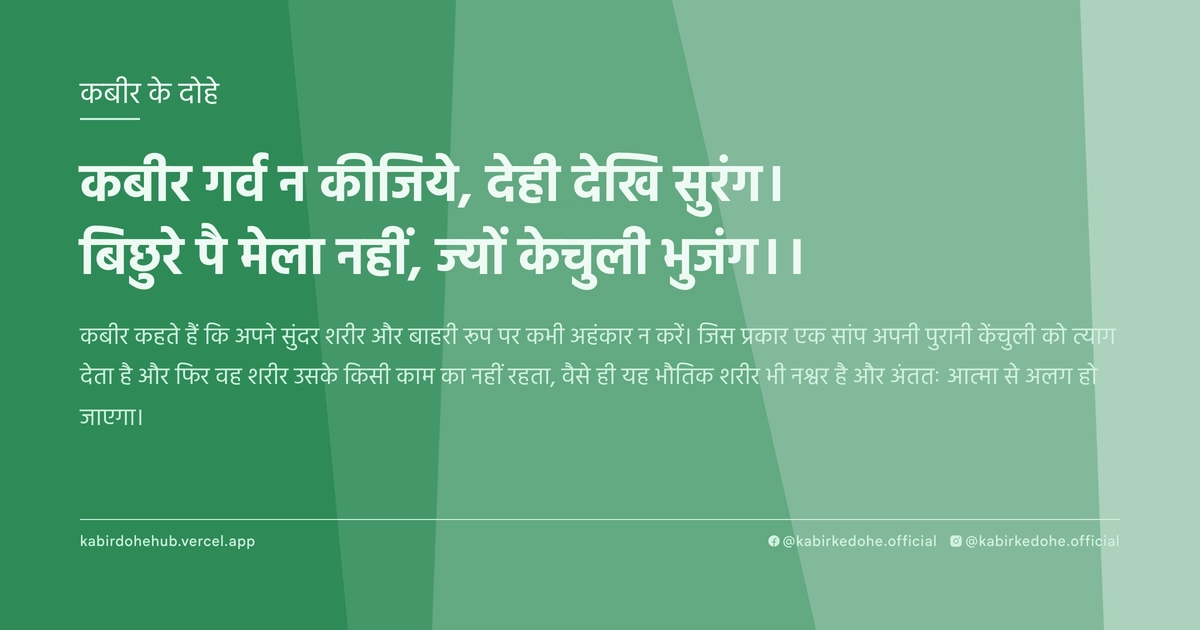
कबीर गर्व न कीजिये, देही देखि सुरंग।
बिछुरे पै मेला नहीं, ज्यों केचुली भुजंग।।
Kabir garv na kariye, dehi dekh surung. Bichure pai mela nahi, jyon kechuli bhujang.
इस पृष्ठ पर इस कबीर दोहे का अर्थ (meaning), हिंदी व्याख्या और अंग्रेज़ी अनुवाद, दार्शनिक विश्लेषण और व्यावहारिक जीवन सीख दी गई है। यह दोहा आत्मा और शरीर (Soul and Body) विषय से जुड़ा है — Kabir doha meaning and explanation in Hindi and English.
अर्थ (Meaning):
कबीर कहते हैं कि अपने सुंदर शरीर और बाहरी रूप पर कभी अहंकार न करें। जिस प्रकार एक सांप अपनी पुरानी केंचुली को त्याग देता है और फिर वह शरीर उसके किसी काम का नहीं रहता, वैसे ही यह भौतिक शरीर भी नश्वर है और अंततः आत्मा से अलग हो जाएगा।
Kabir warns against harboring pride based on physical beauty or a youthful body. He illustrates that just as a snake sheds its skin, which then becomes useless and separated from the creature, the human body is a temporary shell that will eventually be discarded by the soul.
व्याख्या (Interpretation):
इस दोहे का शाब्दिक अर्थ है कि शारीरिक सौंदर्य क्षणभंगुर है। गहरे स्तर पर, कबीर 'माया' के प्रभाव की चर्चा कर रहे हैं, जहाँ मनुष्य बाहरी आवरण को ही अपनी वास्तविक पहचान मान बैठता है। यह 'अहंकार' का मूल है। निर्गुण भक्ति के परिप्रेक्ष्य में, शरीर केवल एक वस्त्र है। जब आत्मा (ब्रह्म) इस शरीर रूपी केंचुली को छोड़ती है, तो भौतिक सुंदरता का कोई मूल्य नहीं रह जाता। यह द्वैतवाद से अद्वैत की ओर ले जाने वाला संकेत है, जहाँ केवल चेतना शाश्वत है, न कि मांस और रक्त का यह ढांचा।
Literally, the verse warns that physical beauty is fleeting. Metaphorically, Kabir addresses the veil of Maya, where humans mistake the external shell for their true identity, fueling the ego. In the context of Nirgun Bhakti, the body is merely a garment. When the Atman (Soul) sheds this bodily 'skin,' physical attractiveness holds zero value. This highlights the central paradox: we spend our lives decorating a vessel that is destined to be discarded. It points toward Advaita Vedanta, urging the seeker to realize that the eternal consciousness is distinct from the perishable biological form.
दार्शनिक विश्लेषण (Philosophical Analysis):
कबीर का यह संदेश उस युग की सामाजिक संरचना पर प्रहार है जहाँ बाहरी दिखावे, जाति और शारीरिक श्रेष्ठता को महत्व दिया जाता था। वे ritualism और बाहरी आडंबरों का खंडन करते हुए आंतरिक शुद्धता पर बल देते हैं। यहाँ अद्वैत वेदांत का प्रभाव स्पष्ट है, जहाँ 'अहं ब्रह्मास्मि' का अर्थ है कि मैं यह शरीर नहीं, बल्कि वह अनंत चेतना हूँ।
सूफीवाद के साथ इसका गहरा संबंध है, जहाँ 'नफ्स' (अहंकार) को मिटाना ईश्वर तक पहुँचने की पहली शर्त है। कबीर यहाँ शरीर को एक 'केंचुली' बताकर यह स्पष्ट करते हैं कि भौतिकता एक भ्रम है। वे समझाते हैं कि जो व्यक्ति अपनी सुंदरता या शक्ति पर गर्व करता है, वह वास्तव में एक ऐसी वस्तु से चिपका है जो समय के साथ नष्ट होनी है।
मनोवैज्ञानिक स्तर पर, यह दोहा 'पहचान के संकट' को संबोधित करता है। मनुष्य अक्सर अपनी सामाजिक और शारीरिक छवि को ही अपना 'स्व' मान लेता है। कबीर इस मिथ्या पहचान को तोड़कर व्यक्ति को उसकी वास्तविक, निराकार प्रकृति से परिचित कराते हैं।
यह विश्लेषण हमें बताता है कि कबीर केवल धर्म की बात नहीं कर रहे, बल्कि वे अस्तित्व की नश्वरता (Impermanence) का पाठ पढ़ा रहे हैं। वे चेतावनी देते हैं कि अहंकार केवल अज्ञानता की उपज है। जब ज्ञान का उदय होता है, तो बाहरी रूप का गर्व स्वतः समाप्त हो जाता है।
अंततः, यह दोहा हमें सिखाता है कि सच्ची सुंदरता आत्मा की पवित्रता और करुणा में है, न कि त्वचा के रंग या शरीर की बनावट में। यह भौतिकवाद के विरुद्ध एक आध्यात्मिक विद्रोह है, जो मनुष्य को उसकी नश्वरता की याद दिलाकर उसे शाश्वत सत्य की खोज के लिए प्रेरित करता है।
Kabir's message strikes at the heart of a social structure that prioritized external appearances, caste, and physical superiority. By rejecting ritualism and outward vanity, he emphasizes internal purity. The influence of Advaita Vedanta is evident here; the realization that 'I am not this body, but the infinite consciousness' is the core of his teaching.
There is a profound connection to Sufism, where the annihilation of the 'Nafs' (ego) is the prerequisite for union with the Divine. By comparing the body to a 'slough' or 'skin,' Kabir clarifies that materiality is a grand illusion (Maya). He argues that pride in beauty is a form of spiritual blindness, as one clings to a vessel destined for decay.
Psychologically, this verse addresses the 'crisis of identity.' Humans often conflate their social and physical image with their true Self. Kabir dismantles this false identity, guiding the individual toward their formless, eternal nature, thereby reducing the suffering caused by the fear of aging and death.
This analysis reveals that Kabir is not merely discussing religion, but the fundamental law of impermanence. He asserts that ego is a byproduct of ignorance. Once spiritual awakening occurs, the pride associated with the physical form evaporates naturally.
Ultimately, the verse teaches that true beauty resides in the purity of the soul and compassion, not in the hue of the skin or the symmetry of the body. It is a spiritual rebellion against materialism, urging the seeker to move from the transient to the eternal.
मूल संदेश (Core Message):
- शारीरिक सौंदर्य एक अस्थायी मुखौटा है।
- अहंकार केवल अज्ञानता का प्रतिबिंब है।
- आत्मा शाश्वत है, शरीर नश्वर केंचुली है।
- सच्ची पहचान चेतना में है, रूप में नहीं।
- विनम्रता ही परमात्मा तक पहुँचने का मार्ग है।
- बाहरी चमक आंतरिक अंधकार को नहीं छुपा सकती।
- Physical beauty is but a temporary mask.
- Ego is merely a reflection of spiritual ignorance.
- The soul is eternal; the body is a perishable shell.
- True identity lies in consciousness, not in form.
- Humility is the only path to the Divine.
- External glow cannot hide internal darkness.
व्यावहारिक उदाहरण (Practical Example):
एक समय की बात है, वाराणसी के घाटों पर माधव नाम का एक अत्यंत सुंदर और युवा मूर्तिकार रहता था। उसकी सुंदरता की चर्चा पूरे शहर में थी और वह अपनी इस छवि पर बहुत गर्व करता था। वह अक्सर अन्य कारीगरों को उनकी साधारण सूरत के लिए नीचा दिखाता था।
माधव का मानना था कि उसकी सुंदरता उसे समाज में एक विशेष स्थान दिलाती है, और वह अपनी कला से अधिक अपने चेहरे की देखभाल में समय बिताता था। वह सोचता था कि उसकी यह चमक कभी कम नहीं होगी।
एक दिन, शहर में एक महामारी फैली जिसने कई लोगों को अपनी चपेट में ले लिया। माधव भी उस बीमारी की चपेट में आ गया। धीरे-धीरे उसका चेहरा पीला पड़ गया, उसकी त्वचा झुर्रीदार हो गई और वह अपनी उस सुंदरता को खोने लगा जिस पर उसे नाज़ था।
जब वह पूरी तरह से कमजोर हो गया, तो उसने देखा कि जिन लोगों को वह 'बदसूरत' कहकर उपहास करता था, वे ही उसकी सेवा कर रहे थे। एक वृद्ध, साधारण सा दिखने वाला व्यक्ति उसके पास बैठा उसकी देखभाल कर रहा था।
माधव ने रोते हुए पूछा, 'मैं तो इतना सुंदर था, फिर भी आज मैं इस हाल में हूँ, और तुम, जिसे मैंने कभी सम्मान नहीं दिया, तुम मेरी मदद क्यों कर रहे हो?'
उस वृद्ध व्यक्ति ने शांति से उत्तर दिया, 'बेटा, सुंदरता तो उस केंचुली की तरह थी जिसे तुमने ओढ़ा था। वह तो चली गई, लेकिन जो करुणा और प्रेम तुम्हारे भीतर छिपा था, वह अब जाग रहा है। असली सुंदरता शरीर में नहीं, सेवा में है।'
माधव को कबीर के शब्दों की याद आई कि शरीर तो केवल एक केंचुली है। उसे एहसास हुआ कि उसने अपना पूरा जीवन एक भ्रम को सजाने में बिता दिया और वास्तविक मानवीय संबंधों को अनदेखा किया।
उस दिन के बाद, माधव ने अपनी सुंदरता का अहंकार त्याग दिया। उसने अपनी कला का उपयोग केवल धन कमाने के लिए नहीं, बल्कि गरीबों की सेवा और आध्यात्मिक मूर्तियों के निर्माण के लिए किया।
उसका व्यवहार पूरी तरह बदल गया। अब वह लोगों को उनके रूप से नहीं, बल्कि उनके हृदय की गहराई से पहचानने लगा। उसकी आंतरिक शांति अब उसकी बाहरी सुंदरता से कहीं अधिक प्रभावशाली थी।
उसने सीखा कि जब शरीर की केंचुली उतरती है, तो केवल हमारे द्वारा किए गए अच्छे कर्म और प्रेम ही शेष रह जाते हैं।
Once, on the ghats of Varanasi, lived a young sculptor named Madhav. He was exceptionally handsome, and his beauty was the talk of the town. Madhav grew arrogant, often belittling other artisans for their plain or weathered appearances.
He believed his beauty granted him a superior social status, spending more time grooming his face than refining his art. He lived under the delusion that his radiance was permanent and unchanging.
One day, a severe plague swept through the city. Madhav fell ill, and as the disease progressed, his once-glowing skin became sallow, wrinkled, and scarred. The beauty he prized so much vanished rapidly.
In his state of extreme weakness, he noticed that the very people he had mocked for being 'ugly' were the ones nursing him back to health. An elderly, plain-looking man sat by his side, tending to his needs with utmost care.
Tearfully, Madhav asked, 'I was so beautiful, yet I am reduced to this. Why are you helping me, someone who never gave you respect?'
The old man replied calmly, 'Son, that beauty was merely a skin, a slough that you wore. It has departed, but the compassion and love hidden within you are now awakening. True beauty is not in the body, but in service.'
Madhav recalled the essence of Kabir's wisdom—that the body is but a shell. He realized he had spent his entire life decorating a mirage while ignoring the depth of human connection.
After recovering, Madhav discarded his vanity. He stopped using his art for fame and began sculpting figures that inspired spirituality and helping the poor without expectation.
His behavior transformed completely. He no longer judged people by their appearance but sought the purity of their hearts. His inner peace became far more magnetic than his former physical beauty.
He finally understood that when the 'skin' of the body is shed, only the seeds of love and good deeds remain to define a human being.
अभ्यास मार्गदर्शन (Practice Guidance):
- प्रतिदिन 15 मिनट मौन ध्यान करें और विचार करें कि आपका शरीर समय के साथ कैसे बदल रहा है, जिससे मोह कम हो।
- एक 'अहंकार डायरी' लिखें: उन क्षणों को दर्ज करें जब आपने किसी को उसके रूप या स्थिति के आधार पर आंका, और फिर उसे सुधारने का प्रयास करें।
- सेवा का अभ्यास: सप्ताह में एक बार किसी ऐसे व्यक्ति की निस्वार्थ मदद करें जिसे समाज 'अदृश्य' या 'असुंदर' मानता है।
- निदान चेकलिस्ट: क्या मैं दर्पण में अधिक समय बिताता हूँ या आत्म-चिंतन में? क्या मेरी खुशी दूसरों की प्रशंसा पर टिकी है? यदि हाँ, तो आप अभी भी 'केंचुली' के मोह में हैं।
- Practice 15 minutes of silent meditation daily, contemplating the inevitable changes in your physical body to reduce attachment.
- Maintain an 'Ego Journal': Record moments when you judged someone based on appearance and consciously rewrite those perceptions with empathy.
- Service Practice: Once a week, selflessly help someone whom society deems 'invisible' or 'unattractive' to break the bias of beauty.
- Diagnostic Checklist: Do I spend more time in front of the mirror than in self-reflection? Is my happiness dependent on external praise? If yes, you are still clinging to the 'slough'.
चिंतन प्रश्न (Reflection Questions):
- यदि आज आपका भौतिक रूप पूरी तरह बदल जाए, तो आपकी पहचान का क्या बचेगा?
- आप अपनी डिजिटल छवि (Social Media) को संवारने में कितनी ऊर्जा लगाते हैं, और वह आपकी वास्तविक आत्मा से कितनी अलग है?
- क्या आप उन लोगों को कम महत्व देते हैं जो शारीरिक रूप से कमजोर या वृद्ध हैं? यह आपके किस आंतरिक डर को दर्शाता है?
- वह कौन सा 'मुखौटा' है जिसे आप दुनिया के सामने पहनते हैं ताकि आप श्रेष्ठ दिख सकें?
- मृत्यु के क्षण में, आपकी कौन सी उपलब्धि आपको सुकून देगी—आपका रूप या आपका चरित्र?
- If your physical form were to change completely today, what would remain of your identity?
- How much energy do you invest in curating your digital image, and how far is it from your authentic soul?
- Do you subconsciously undervalue those who are physically frail or aged? What internal fear does this reveal?
- What is the specific 'mask' you wear in public to appear superior or acceptable?
- At the moment of death, which achievement will bring you peace—your appearance or your character?