
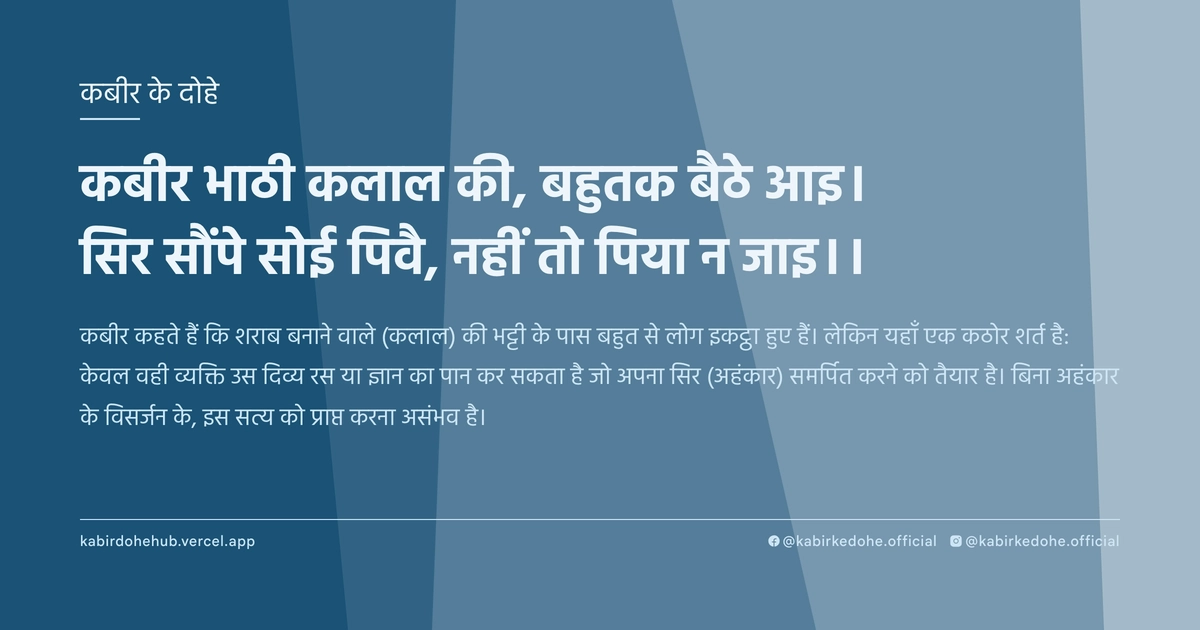
कबीर भाठी कलाल की, बहुतक बैठे आइ।
सिर सौंपे सोई पिवै, नहीं तो पिया न जाइ।।
Kabir bhaathi kalaal ki, bahutak baithe aai. Sir saumpe soi pivai, nahi to piya na jaai.
इस पृष्ठ पर इस कबीर दोहे का अर्थ (meaning), हिंदी व्याख्या और अंग्रेज़ी अनुवाद, दार्शनिक विश्लेषण और व्यावहारिक जीवन सीख दी गई है। यह दोहा प्रपत्ति (Surrender) विषय से जुड़ा है — Kabir doha meaning and explanation in Hindi and English.
अर्थ (Meaning):
कबीर कहते हैं कि शराब बनाने वाले (कलाल) की भट्टी के पास बहुत से लोग इकट्ठा हुए हैं। लेकिन यहाँ एक कठोर शर्त है: केवल वही व्यक्ति उस दिव्य रस या ज्ञान का पान कर सकता है जो अपना सिर (अहंकार) समर्पित करने को तैयार है। बिना अहंकार के विसर्जन के, इस सत्य को प्राप्त करना असंभव है।
Kabir describes a crowd gathered around the vintner's vat, longing for the intoxicating brew. However, he reveals a spiritual paradox: only those willing to surrender their 'head'—a metaphor for the ego and intellectual pride—are permitted to drink. Without the total annihilation of the self, the divine nectar remains unattainable.
व्याख्या (Interpretation):
यहाँ 'भाठी' और 'कलाल' प्रतीकात्मक हैं, जो गुरु या परमात्मा के ज्ञान के स्रोत को दर्शाते हैं। 'सिर सौंपना' का अर्थ शारीरिक मृत्यु नहीं, बल्कि 'अहंकार की मृत्यु' है। यह निर्गुण भक्ति का सार है जहाँ साधक को अपनी पहचान, पद और प्रतिष्ठा का त्याग करना पड़ता है। जब तक 'मैं' जीवित है, तब तक 'वह' (परमात्मा) प्रकट नहीं हो सकता। यह अद्वैत वेदांत के उस सिद्धांत से जुड़ा है जहाँ जीव और ब्रह्म के बीच का एकमात्र पर्दा अहंकार है। माया हमें यह विश्वास दिलाती है कि हम अलग हैं, लेकिन समर्पण ही वह कुंजी है जो इस भ्रम को तोड़ती है। इस प्रकार, यह दोहा आत्म-साक्षात्कार के लिए पूर्ण समर्पण की अनिवार्यता को रेखांकित करता है।
The 'vat' and the 'vintner' serve as metaphors for the source of divine wisdom or the Satguru. 'Surrendering the head' does not imply physical decapitation but the 'death of the ego'. This is the essence of Nirgun Bhakti, where the seeker must shed their identity, status, and intellectual pride. As long as the 'I' exists, the 'Thou' (Divine) cannot be realized. This aligns with Advaita Vedanta, suggesting that the only veil between the Atman and Brahman is the ego. Maya fosters the illusion of separation, and total surrender is the only key to dissolve this boundary. Thus, the Doha emphasizes that spiritual intoxication—the bliss of union—requires the absolute annihilation of the individual self.
दार्शनिक विश्लेषण (Philosophical Analysis):
कबीर का यह दोहा उनके युग के धार्मिक पाखंड और कर्मकांडीय श्रेष्ठता पर एक गहरा प्रहार है। उस समय समाज जाति और शास्त्र ज्ञान के आधार पर विभाजित था। कबीर ने 'कलाल' (शराब बेचने वाला), जिसे समाज में नीचा माना जाता था, को ज्ञान के स्रोत के रूप में प्रस्तुत कर यह बताया कि सत्य किसी विशेष जाति या मंदिर-मस्जिद का मोहताज नहीं है।
दार्शनिक स्तर पर, यह सूफीवाद के 'फना' (Fana) के सिद्धांत से मेल खाता है, जिसका अर्थ है ईश्वर में विलीन हो जाना। जब तक मनुष्य अपनी बौद्धिक क्षमताओं और सामाजिक पहचान को पकड़ कर रखता है, वह केवल बाहरी आवरण को देखता है। वास्तविक ज्ञान 'पीने' के लिए, यानी आत्मसात करने के लिए, पात्रता केवल विनम्रता में है।
अद्वैत वेदांत के अनुसार, अहंकार (Ahamkara) ही वह अविद्या है जो हमें सत्य से दूर रखती है। कबीर यहाँ चेतावनी देते हैं कि आधा-अधूरा समर्पण काम नहीं करता। आप अपनी शर्तों पर सत्य को प्राप्त नहीं कर सकते; सत्य की अपनी शर्त है—पूर्ण समर्पण।
यह विश्लेषण यह भी स्पष्ट करता है कि कबीर 'ज्ञान' को सूचना के रूप में नहीं, बल्कि एक अनुभव के रूप में देखते हैं। सूचना दिमाग से आती है, लेकिन अनुभव के लिए दिमाग (अहंकार) को शांत करना पड़ता है।
अंततः, यह दोहा मनुष्य को उसकी मनोवैज्ञानिक जड़ता से मुक्त करने का प्रयास है। यह बताता है कि आध्यात्मिक प्रगति का मार्ग संचय (accumulation) से नहीं, बल्कि विसर्जन (elimination) से होकर गुजरता है।
This Doha is a profound critique of the religious hypocrisy and ritualistic superiority prevalent during Kabir's era. Society was rigidly divided by caste and scriptural knowledge. By casting the 'Kalal' (a liquor-seller, often marginalized) as the provider of the divine brew, Kabir asserts that Truth is not the monopoly of any specific caste, temple, or mosque.
Philosophically, this mirrors the Sufi concept of 'Fana'—the annihilation of the self in the Divine. As long as a human clings to their intellectual prowess or social identity, they perceive only the external shell. The eligibility to 'drink' or internalize the Truth lies solely in absolute humility.
According to Advaita Vedanta, the ego (Ahamkara) is the primary 'Avidya' or ignorance that separates the individual from the Absolute. Kabir warns that partial surrender is futile. One cannot negotiate terms with Truth; the Truth's only term is total surrender.
This analysis clarifies that Kabir views 'knowledge' not as information, but as an experiential realization. Information is processed by the mind, but experience requires the silencing of the mind's egoic noise.
Ultimately, the Doha seeks to liberate the human from psychological rigidity. It posits that spiritual evolution occurs not through accumulation of merits, but through the systematic elimination of the false self.
मूल संदेश (Core Message):
- अहंकार वह दीवार है जो सत्य के अनुभव को रोकती है।
- पूर्ण समर्पण ही आध्यात्मिक प्यास बुझाने का एकमात्र मार्ग है।
- बौद्धिक ज्ञान अक्सर आत्म-साक्षात्कार के मार्ग में बाधा बनता है।
- जब 'मैं' मिटता है, तभी 'परम' का अनुभव होता है।
- विनम्रता केवल एक गुण नहीं, बल्कि सत्य की अनिवार्य शर्त है।
- बाहरी अनुष्ठानों से अधिक महत्वपूर्ण आंतरिक अहंकार का विसर्जन है।
- The ego is the primary wall blocking the experience of Truth.
- Absolute surrender is the only path to quench spiritual thirst.
- Intellectual pride often becomes an obstacle to self-realization.
- Only when the 'I' vanishes does the 'Absolute' manifest.
- Humility is not just a virtue, but a prerequisite for Truth.
- Internal dissolution of ego outweighs all external rituals.
व्यावहारिक उदाहरण (Practical Example):
एक समय की बात है, वाराणसी के घाटों पर माधव नाम का एक अत्यंत विद्वान पंडित रहता था। उसने चारों वेदों का अध्ययन किया था और शहर के सबसे बड़े विद्वानों में गिना जाता था। उसकी बुद्धि इतनी प्रखर थी कि वह किसी भी तर्क को काट सकता था, लेकिन उसके मन में एक गहरा असंतोष था। उसे लगता था कि उसने सब कुछ जान लिया है, फिर भी वह आंतरिक शांति से वंचित था।
एक दिन उसकी मुलाकात एक साधारण से बुनकर से हुई, जो कबीर के विचारों में लीन रहता था। माधव ने गर्व से कहा, "मैंने शास्त्रों का सार पढ़ लिया है, मुझे बताओ कि वह परम सत्य क्या है?"
बुनकर ने मुस्कुराते हुए कहा, "पंडित जी, सत्य एक ऐसी शराब है जिसे पीने के लिए प्याला नहीं, बल्कि अपना सिर चढ़ाना पड़ता है। क्या आप अपनी विद्वत्ता का अहंकार छोड़ने को तैयार हैं?"
माधव को यह बात अपमानजनक लगी। उसने सोचा कि उसकी वर्षों की तपस्या और पढ़ाई को एक साधारण बुनकर नकार रहा है। वह गुस्से में वहां से चला गया, लेकिन बुनकर की बात उसके कानों में गूंजती रही—"सिर सौंपे सोई पिवै।"
कई दिनों तक माधव सो नहीं पाया। उसने महसूस किया कि उसकी विद्वत्ता वास्तव में एक दीवार बन गई थी। वह सत्य को खोज नहीं रहा था, बल्कि अपनी श्रेष्ठता को सिद्ध करने का प्रयास कर रहा था। उसका 'सिर' (अहंकार) इतना भारी हो गया था कि वह सत्य के द्वार से अंदर नहीं जा पा रहा था।
एक रात, गहरे संकट और मानसिक द्वंद्व के बीच, माधव टूट गया। उसने महसूस किया कि उसकी सारी डिग्रियां और शास्त्र उसके अकेलेपन को नहीं भर सकते। उसने पहली बार अपनी आँखों में आँसू महसूस किए और मन ही मन उस अज्ञात शक्ति के सामने अपना अहंकार समर्पित कर दिया।
उसने स्वीकार किया, "मैं कुछ नहीं जानता। मैं शून्य हूँ।"
जैसे ही उसने यह स्वीकार किया, उसके भीतर एक अद्भुत हल्कापन महसूस हुआ। वह भारीपन, जो वर्षों से उसके सीने पर था, गायब हो गया। उसे अब किसी शास्त्र की आवश्यकता नहीं थी; वह स्वयं उस शांति का अनुभव करने लगा जिसे वह किताबों में खोज रहा था।
माधव अब भी पंडित था, लेकिन अब वह दूसरों को नीचा दिखाने के लिए नहीं, बल्कि दूसरों के दुख को समझने के लिए अपनी बुद्धि का प्रयोग करता था। उसने जान लिया था कि ज्ञान का असली स्वाद तभी मिलता है जब 'जानने वाला' मिट जाता है।
Once in the ghats of Varanasi, there lived a scholar named Madhav. He had mastered the four Vedas and was regarded as one of the city's most learned men. His intellect was so sharp that he could dismantle any argument, yet he harbored a deep, gnawing dissatisfaction. He felt he had learned everything, yet inner peace remained elusive.
One day, he encountered a simple weaver immersed in the teachings of Kabir. Madhav proudly declared, "I have read the essence of all scriptures; tell me, what is the ultimate Truth?"
The weaver smiled and replied, "Pandit ji, Truth is a liquor that requires no cup, but the offering of one's head. Are you prepared to surrender the pride of your scholarship?"
Madhav found this insulting. He felt his years of penance and study were being dismissed by a mere weaver. He stormed away, but the words echoed in his mind: "Only he who surrenders the head may drink."
For days, Madhav could not sleep. He realized that his erudition had actually become a wall. He wasn't searching for Truth; he was attempting to validate his own superiority. His 'head' (ego) had become so heavy that he could not pass through the narrow gate of realization.
One night, amidst a crisis of spirit and mental turmoil, Madhav broke. He felt that his degrees and scriptures could not fill his profound loneliness. For the first time, tears welled in his eyes, and he silently surrendered his ego to the Unknown Power.
He admitted, "I know nothing. I am zero."
The moment he acknowledged this, an extraordinary lightness washed over him. The burden he had carried for years vanished. He no longer needed scriptures; he began to experience the very peace he had been hunting for in books.
Madhav remained a scholar, but he no longer used his intellect to belittle others. Instead, he used it to empathize with their suffering. He had learned that the true taste of knowledge is only available when the 'knower' disappears.
अभ्यास मार्गदर्शन (Practice Guidance):
- प्रतिदिन 20 मिनट मौन अभ्यास करें, जहाँ आप अपने विचारों को केवल देखें, उन्हें सही या गलत ठहराने वाले 'निर्णायक' (अहंकार) को हटा दें।
- एक 'अहंकार डायरी' लिखें: दिन भर में जब भी आपको महसूस हो कि आप किसी से श्रेष्ठ हैं या किसी को नीचा दिखा रहे हैं, उसे लिखें और विश्लेषण करें कि वह कौन सा 'सिर' है जिसे आप सौंपने से डर रहे हैं।
- सेवा का अभ्यास: किसी ऐसे व्यक्ति की मदद करें जिससे आप सामान्यतः नफरत करते हैं या जिसे आप अपने से छोटा समझते हैं, बिना यह सोचे कि आप 'दान' कर रहे हैं।
- निदान चेकलिस्ट: क्या आप अभी भी अपनी उपलब्धियों की चर्चा कर रहे हैं? क्या आप दूसरों की आलोचना करते समय संतुष्टि महसूस करते हैं? यदि हाँ, तो आपका 'सिर' अभी भी आपके पास है, आपने उसे सौंपा नहीं है।
- Practice 20 minutes of daily silence, observing your thoughts without letting the 'judge' (the ego) label them as right or wrong.
- Maintain an 'Ego Journal': Record moments throughout the day when you feel superior to others or judge them, and analyze which part of your identity you are afraid to surrender.
- Practice selfless service: Help someone you typically dislike or perceive as 'lower' than you, without the internal narrative that you are performing an act of charity.
- Diagnostic Checklist: Do you still find yourself boasting about achievements? Do you feel a secret satisfaction while criticizing others? If yes, your 'head' is still with you; it has not been surrendered.
चिंतन प्रश्न (Reflection Questions):
- मेरी कौन सी उपलब्धि मेरी सबसे बड़ी पहचान बन गई है, और यदि वह छीन ली जाए, तो क्या मैं खुद को स्वीकार कर पाऊँगा?
- मैं अपनी बौद्धिक श्रेष्ठता का उपयोग दूसरों को समझने के लिए करता हूँ या उन्हें नियंत्रित करने के लिए?
- मेरे जीवन में वह कौन सा क्षेत्र है जहाँ मैं अभी भी 'सही' होने की जिद पकड़ कर बैठा हूँ, भले ही वह मेरे रिश्तों को नष्ट कर रहा हो?
- क्या मेरा आध्यात्मिक अभ्यास मुझे वास्तव में विनम्र बना रहा है, या यह मेरे 'आध्यात्मिक अहंकार' (Spiritual Ego) को बढ़ा रहा है?
- यदि मुझे समाज में पूरी तरह गुमनाम कर दिया जाए, तो क्या मेरी आंतरिक शांति बनी रहेगी?
- Which achievement has become my primary identity, and if it were stripped away, would I still be able to accept myself?
- Do I use my intellectual superiority to understand others or to control them?
- In which area of my life am I still clinging to the need to be 'right', even if it is destroying my relationships?
- Is my spiritual practice making me genuinely humble, or is it merely inflating my 'spiritual ego'?
- If I were to become completely anonymous in society, would my inner peace remain intact?