
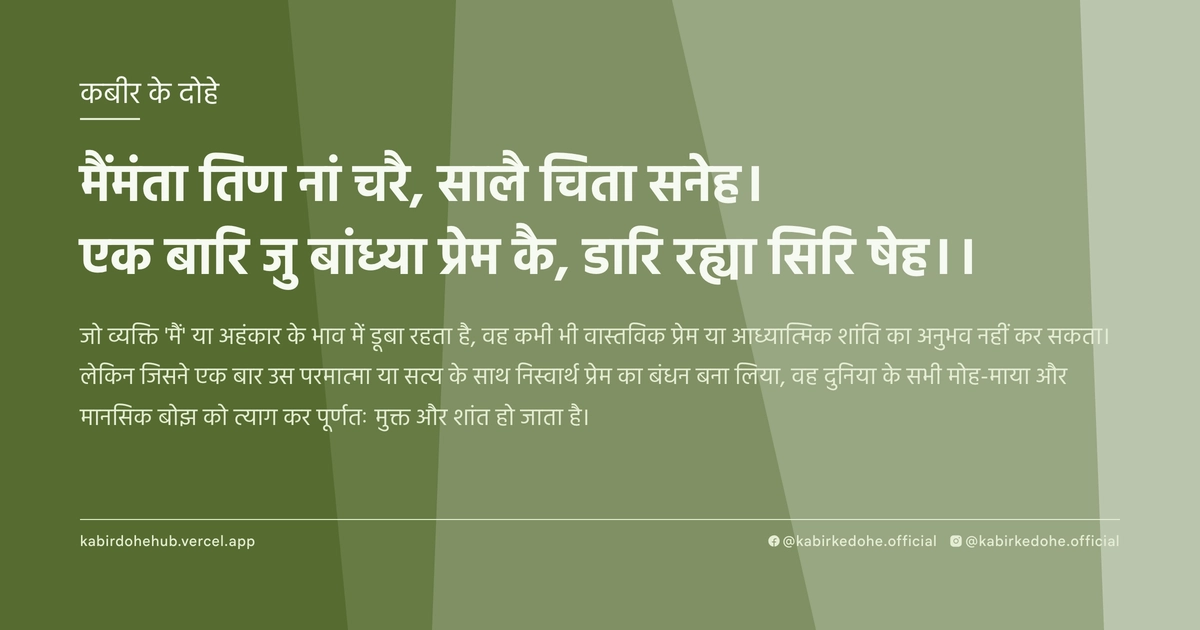
मैंमंता तिण नां चरै, सालै चिता सनेह।
एक बारि जु बांध्या प्रेम कै, डारि रह्या सिरि षेह।।
Mainmanta tin naan charai, saalai chita saneh. Ek baari ju baandhya prem kai, daari rahya siri sheh.
इस पृष्ठ पर इस कबीर दोहे का अर्थ (meaning), हिंदी व्याख्या और अंग्रेज़ी अनुवाद, दार्शनिक विश्लेषण और व्यावहारिक जीवन सीख दी गई है। यह दोहा भक्ति (Bhakti) विषय से जुड़ा है — Kabir doha meaning and explanation in Hindi and English.
अर्थ (Meaning):
जो व्यक्ति 'मैं' या अहंकार के भाव में डूबा रहता है, वह कभी भी वास्तविक प्रेम या आध्यात्मिक शांति का अनुभव नहीं कर सकता। लेकिन जिसने एक बार उस परमात्मा या सत्य के साथ निस्वार्थ प्रेम का बंधन बना लिया, वह दुनिया के सभी मोह-माया और मानसिक बोझ को त्याग कर पूर्णतः मुक्त और शांत हो जाता है।
He who is consumed by the 'I'—the ego—cannot graze in the pastures of divine love or find lasting peace. However, once a soul binds itself in the selfless bond of love with the Eternal Truth, it casts aside all worldly burdens and anxieties, attaining a state of absolute surrender and liberation.
व्याख्या (Interpretation):
यहाँ 'मैंमंता' शब्द अहंकार की उस सूक्ष्म परत को दर्शाता है जो आत्मा और परमात्मा के बीच पर्दा बनी रहती है। कबीर कहते हैं कि जब तक व्यक्ति स्वयं को कर्ता मानता है, वह संसार के द्वंद्वों में फँसा रहता है। 'तिण नां चरै' का अर्थ है कि ऐसा व्यक्ति आध्यात्मिक पोषण प्राप्त नहीं कर पाता। जब प्रेम का बंधन बनता है, तो यह कोई सांसारिक बंधन नहीं, बल्कि 'अद्वैत' की स्थिति है जहाँ प्रेमी और प्रिय एक हो जाते हैं। 'सिरि षेह' का त्याग करना मानसिक तनाव और अहंकार के बोझ को उतार फेंकने का प्रतीक है। यह निर्गुण भक्ति का सार है, जहाँ ईश्वर किसी मूर्ति में नहीं, बल्कि हृदय के निस्वार्थ प्रेम में निवास करता है।
The term 'Mainmanta' refers to the subtle layer of ego that acts as a veil between the Atman and Brahman. Kabir suggests that as long as one perceives themselves as the 'doer,' they remain trapped in the duality of existence. 'Tin naan charai' implies that such a person cannot nourish their soul with divine wisdom. The 'bond of love' mentioned here is not a worldly attachment but the realization of Non-duality (Advaita), where the seeker and the Sought merge into one. Casting off the 'siri sheh' symbolizes the shedding of psychological burdens and the collapse of the false identity. In Nirgun Bhakti, this love is the only vehicle capable of transporting the soul from the illusion of Maya to the reality of Truth.
दार्शनिक विश्लेषण (Philosophical Analysis):
कबीर का यह दोहा मध्यकालीन भारत के सामाजिक और धार्मिक परिवेश की प्रतिक्रिया है, जहाँ कर्मकांड और बाहरी आडंबरों का बोलबाला था। कबीर ने स्पष्ट किया कि मोक्ष किसी मंदिर, मस्जिद या जातिगत श्रेष्ठता से नहीं, बल्कि अहंकार के विसर्जन से मिलता है। यह विचार सीधे तौर पर अद्वैत वेदांत से जुड़ा है, जहाँ 'अहं ब्रह्मास्मि' का अनुभव तब होता है जब 'अहं' (अहंकार) समाप्त हो जाता है।
सूफी मत के 'फना' (स्वयं को मिटा देना) की अवधारणा यहाँ स्पष्ट झलकती है। सूफीवाद में माना जाता है कि जब तक 'मैं' जीवित है, तब तक 'वह' (ईश्वर) प्रकट नहीं हो सकता। कबीर इसी विलीनीकरण की बात कर रहे हैं। उनके लिए प्रेम कोई भावना नहीं, बल्कि एक आध्यात्मिक अनुशासन है जो मनुष्य को उसके सीमित अस्तित्व से निकालकर असीमित चेतना में ले जाता है।
यहाँ 'प्रेम' का अर्थ कामुकता या मोह नहीं, बल्कि 'ईश्वरीय अनुराग' है। यह वह अग्नि है जो अहंकार की लकड़ी को जलाकर राख कर देती है। कबीर ritualism (कर्मकांड) का विरोध इसलिए करते हैं क्योंकि कर्मकांड अक्सर अहंकार को पुष्ट करते हैं ('मैंने यह पूजा की', 'मैं इस कुल का हूँ'), जबकि प्रेम अहंकार को मिटाता है।
मनोवैज्ञानिक स्तर पर, यह दोहा 'कॉग्निटिव डिसोनेंस' को समाप्त करने की प्रक्रिया है। जब व्यक्ति अपनी पहचान को अपनी उपलब्धियों, संपत्ति या पद से जोड़ता है, तो वह तनाव (sheh) में रहता है। जैसे ही वह इस पहचान को सार्वभौमिक प्रेम में विलीन करता है, वह मानसिक बोझ उतर जाता है।
अंततः, कबीर यह संदेश देते हैं कि आध्यात्मिक यात्रा का एकमात्र मार्ग 'समर्पण' है। जब तक हम नियंत्रण (control) की इच्छा रखते हैं, हम बंधन में हैं। जिस क्षण हम प्रेम में स्वयं को समर्पित कर देते हैं, वही समर्पण हमारी वास्तविक स्वतंत्रता बन जाता है। यह विरोधाभास ही कबीर की mysticism की विशेषता है।
This couplet is a profound response to the socio-religious climate of medieval India, characterized by rigid ritualism and caste hierarchies. Kabir asserts that liberation is not attained through temple visits, mosque prayers, or ancestral superiority, but through the annihilation of the ego. This aligns seamlessly with Advaita Vedanta, where the realization of 'Aham Brahmasmi' (I am Brahman) occurs only when the 'Aham' (the egoic I) is dissolved.
The Sufi concept of 'Fana'—the annihilation of the self in the Divine—is vividly present here. In Sufism, it is believed that as long as the 'I' exists, the 'He' (the Divine) cannot be manifested. Kabir speaks of this very merging. For him, love is not a mere emotion but a rigorous spiritual discipline that transitions the human from a limited existence to a universal consciousness.
It is crucial to distinguish this 'Love' from worldly attachment or lust. This is 'Ishq-e-Haqiqi' (Divine Love), a fire that consumes the fuel of ego. Kabir rejects ritualism because rituals often reinforce the ego ('I have performed this sacrifice,' 'I belong to this high caste'), whereas love systematically dismantles it.
Psychologically, this Doha addresses the cessation of the struggle between the perceived self and the actual self. When an individual anchors their identity in achievements, possessions, or status, they carry a heavy burden of anxiety and defense. By shifting the identity to universal love, this psychological weight (sheh) is discarded.
Ultimately, Kabir posits that the only path to spiritual maturity is 'Surrender.' As long as we cling to the desire for control, we remain enslaved. The moment we surrender to the Divine Love, that very surrender becomes our ultimate freedom. This paradox—freedom through surrender—is the cornerstone of Kabir's mystical philosophy.
मूल संदेश (Core Message):
- अहंकार वह दीवार है जो हमें सत्य के अनुभव से रोकती है।
- जब 'मैं' मिटता है, तभी 'वह' (परमात्मा) प्रकट होता है।
- सच्चा प्रेम वह है जो बंधन नहीं, बल्कि मुक्ति प्रदान करे।
- मानसिक बोझ का कारण बाहरी परिस्थितियाँ नहीं, बल्कि आंतरिक अहंकार है।
- समर्पण ही वह एकमात्र द्वार है जिससे अनंत शांति प्राप्त होती है।
- The ego is the wall that obstructs the experience of Truth.
- Only when the 'I' vanishes does the 'Divine' manifest.
- True love is not a shackle, but the key to ultimate liberation.
- Mental burdens stem not from external circumstances, but from internal ego.
- Surrender is the only gateway to attaining infinite peace.
व्यावहारिक उदाहरण (Practical Example):
एक समय की बात है, वाराणसी के घाटों पर माधव नाम का एक वृद्ध बुनकर रहता था। माधव अपने काम में निपुण था, लेकिन उसका स्वभाव अत्यंत क्रोधी और अहंकारी था। वह मानता था कि उसके द्वारा बुने गए वस्त्र शहर में सबसे श्रेष्ठ हैं और वह अन्य बुनकरों को तुच्छ समझता था। उसका मन हमेशा इस चिंता में रहता था कि कोई उसकी तकनीक चुरा न ले या कोई उससे बेहतर कारीगर न बन जाए। यह मानसिक बोझ उसके चेहरे की झुर्रियों और उसकी कड़वाहट में साफ दिखता था।
एक दिन माधव की मुलाकात एक घुमक्कड़ फकीर से हुई, जो घाट की सीढ़ियों पर बैठा मुस्कुरा रहा था। माधव ने अहंकार में आकर फकीर से कहा, "देखो मेरी कला, क्या तुमने कभी ऐसा महीन कपड़ा देखा है?" फकीर ने शांति से उत्तर दिया, "कपड़ा तो सुंदर है, लेकिन इसे बनाने वाला बोझ तले दबा हुआ है। तुम धागों को तो सुलझा रहे हो, पर अपने मन की उलझनें नहीं।"
माधव को पहले तो गुस्सा आया, लेकिन फकीर की आँखों में एक ऐसी शांति थी जिसने माधव को सोचने पर मजबूर कर दिया। फकीर ने उसे समझाया कि जब तक वह 'मैं' और 'मेरा' के जाल में फँसा रहेगा, वह कभी चैन की नींद नहीं सो पाएगा। उसने कहा, "जिस दिन तू अपनी कला को अपना नहीं, बल्कि उस परमात्मा का उपहार मानकर सबको समर्पित कर देगा, तेरा यह बोझ उतर जाएगा।"
माधव ने कई दिनों तक इस बात पर विचार किया। उसने महसूस किया कि उसकी श्रेष्ठता का गर्व ही वास्तव में उसकी सबसे बड़ी बेड़ी थी। उसने धीरे-धीरे अपनी श्रेष्ठता की भावना को त्यागना शुरू किया। उसने गरीब बुनकरों को अपनी तकनीक सिखानी शुरू कर दी, जिसे वह पहले गुप्त रखता था।
जैसे-जैसे उसने 'मैं' का त्याग किया, उसके भीतर एक अजीब सी हल्कापन महसूस होने लगा। अब वह केवल कपड़ा नहीं बुन रहा था, बल्कि वह हर धागे में उस निराकार ईश्वर के प्रति प्रेम पिरो रहा था। वह अब यह नहीं देखता था कि कौन उसे श्रेष्ठ कह रहा है, बल्कि वह इस बात में आनंद लेने लगा कि वह किसी के काम आ रहा है।
एक शाम, जब वह घाट पर बैठा था, उसने महसूस किया कि जिस मानसिक तनाव और ईर्ष्या ने उसे वर्षों तक जकड़ा था, वह अब पूरी तरह गायब हो चुका था। वह अब वास्तव में स्वतंत्र था।
उसका व्यवहार बदल गया; वह अब दूसरों की आलोचना करने के बजाय उनकी सराहना करने लगा। उसके घर में अब शांति थी और उसके चेहरे पर वही मुस्कान थी जो उसने उस फकीर के चेहरे पर देखी थी।
माधव ने जान लिया था कि प्रेम का बंधन ही एकमात्र ऐसा बंधन है जो हमें अन्य सभी बंधनों से मुक्त कर देता है। उसने अपने अहंकार की आहुति दे दी थी और अब वह केवल उस अनंत प्रेम का हिस्सा था।
Once, on the ghats of Varanasi, lived an elderly weaver named Madhav. Madhav was a master of his craft, but his nature was consumed by anger and arrogance. He believed the textiles he wove were the finest in the city and looked down upon other weavers. His mind was perpetually plagued by the fear that someone might steal his techniques or that a superior artisan might emerge. This mental burden was etched into the wrinkles of his face and the bitterness of his speech.
One day, Madhav encountered a wandering fakir sitting on the stone steps of the ghat, wearing a serene smile. Driven by ego, Madhav boasted, "Look at my art! Have you ever seen fabric so fine?" The fakir replied calmly, "The fabric is indeed beautiful, but the maker is crushed under a heavy burden. You are untangling the threads, but you have failed to untangle the knots of your own mind."
Initially, Madhav was offended, but the profound peace in the fakir's eyes forced him to reflect. The fakir explained that as long as he remained trapped in the web of 'I' and 'Mine,' he would never know true tranquility. He told him, "The day you stop viewing your art as your own achievement and instead see it as a gift from the Divine to be shared, your burden will vanish."
Madhav contemplated these words for many days. He realized that his pride in being 'the best' was actually his heaviest shackle. He began to consciously dismantle his ego. He started teaching his secret techniques to poor weavers, whom he had previously despised.
As he let go of the 'I,' a strange lightness descended upon him. He was no longer just weaving fabric; he was weaving love for the Formless Divine into every thread. He stopped seeking validation for his superiority and found joy in being useful to others.
One evening, sitting by the river, he realized that the anxiety and jealousy that had gripped him for decades had completely evaporated. He was, for the first time in his life, truly free.
His behavior transformed; instead of criticizing others, he began to appreciate them. Peace filled his home, and his face mirrored the same smile he had once seen on the fakir.
Madhav had learned that the bond of Divine Love is the only bond that liberates us from all other attachments. He had sacrificed his ego at the altar of love and had become a part of the infinite flow.
अभ्यास मार्गदर्शन (Practice Guidance):
- प्रतिदिन 20 मिनट मौन ध्यान करें, जहाँ आप अपने भीतर उठने वाले 'मैं' (अहंकार) के विचारों को केवल एक साक्षी की तरह देखें, बिना उनसे जुड़े।
- स्व-अन्वेषण जर्नल: प्रतिदिन एक ऐसी घटना लिखें जहाँ आपने अपनी श्रेष्ठता सिद्ध करने की कोशिश की, और फिर विश्लेषण करें कि उस समय आपके भीतर कौन सा डर या असुरक्षा काम कर रही थी।
- निस्वार्थ सेवा का अभ्यास: सप्ताह में एक बार ऐसा कार्य करें जिसका श्रेय आप किसी और को दे दें या जिसे गुप्त रखें, ताकि 'कर्ता' होने का अहंकार मिट सके।
- निदान चेकलिस्ट: क्या मैं दूसरों की सफलता से जलता हूँ? क्या मैं अपनी पहचान अपने पद या संपत्ति से जोड़ता हूँ? क्या मैं दूसरों को सुधारने की तीव्र इच्छा रखता हूँ? यदि हाँ, तो अहंकार अभी सक्रिय है।
- Practice 20 minutes of silent meditation daily, observing the thoughts of 'I' (ego) as a detached witness without identifying with them.
- Self-Inquiry Journaling: Record one instance daily where you felt the need to prove your superiority, then analyze the underlying fear or insecurity that triggered that impulse.
- Practice Anonymous Service: Once a week, perform an act of kindness and either attribute the credit to someone else or keep it secret to dissolve the 'doer' complex.
- Diagnostic Checklist: Do I feel resentment toward others' success? Do I tie my identity to my status or possessions? Do I have an obsessive need to correct others? If yes, the ego is still dominant.
चिंतन प्रश्न (Reflection Questions):
- मेरी वह कौन सी 'पहचान' है जिसे खोने के डर से मैं सबसे ज्यादा तनाव में रहता हूँ?
- क्या मेरा धर्म या मेरी नैतिकता वास्तव में प्रेम पर आधारित है, या यह केवल मेरी श्रेष्ठता दिखाने का एक साधन है?
- यदि कल मेरी सारी उपलब्धियाँ और पद छीन लिए जाएँ, तो मेरे भीतर क्या बचेगा?
- मैं दूसरों की मदद करते समय वास्तव में उनकी मदद करता हूँ, या अपनी 'मददगार' होने की छवि को पुष्ट करता हूँ?
- मेरे जीवन का वह कौन सा 'बोझ' है जिसे मैं केवल इसलिए नहीं छोड़ पा रहा क्योंकि वह मेरे अहंकार का हिस्सा है?
- Which specific 'identity' do I cling to so fiercely that the fear of losing it causes me the most stress?
- Is my adherence to religion or morality based on genuine love, or is it merely a tool to project superiority?
- If all my achievements and titles were stripped away tomorrow, what would remain of me?
- When I help others, am I truly serving them, or am I reinforcing my own image as a 'benefactor'?
- What is the 'burden' in my life that I refuse to let go of simply because it has become part of my egoic identity?